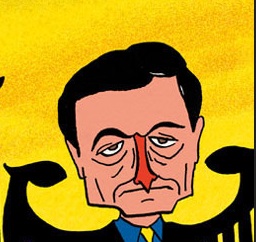
Euro Chaos?

Martin Wolfe writes:  These are exciting times in European central banking. Last Thursday the Swiss National Bank suddenly terminated its successful peg to the euro. This week the European Central Bank is expected to announce its programme of quantitative easing. The SNB has embraced the risk of deflation from which the ECB wishes to escape.

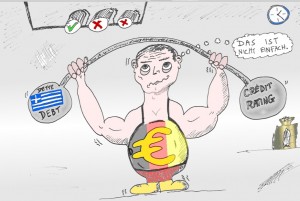
The SNB’s decision was motivated, at least in part, by aversion to being caught up in the ECB’s QE programme. For Mario Draghi, the ECB president, the SNB’s decision is even helpful, since it weakens the euro. For many in northern Europe, however, the Swiss decision will be painful. It will remind them that they no longer enjoy the pleasures (and pains) of a strong currency. The Swiss can readily stop shadowing the euro; the Germans have been imprisoned in it.

The surprise decision created turmoil. Why end a policy that had delivered such enviable stability? The obvious answer is that the SNB feared huge inflation if it remained pegged to the euro, particularly after QE began.

The Swiss could have curbed inflationary dangers without abandoning the peg, for instance by increasing reserve requirements on banks. A sovereign wealth fund could have been set up to manage huge holdings of foreign assets.

Even if a peg to the euro was no longer thought to be desirable, it could have been given up without going cold turkey. Alternatively, it could have allowed the franc to move within a predetermined range, denying speculators a one-way bet on the value of the currency.

More interesting would have been a decision to go further in the direction of negative interest rates than the minus 0.75 per cent now imposed.

To make such a move stick, the authorities would have had to place limits on withdrawals from bank accounts or move entirely to electronic money, to prevent people from protecting their purchasing power by moving into cash. Needless to say, such radical ideas would horrify the prudent burghers of Switzerland.

QE is going to horrify the burghers of Germany, too. But it must now happen since it is the only way still available for the ECB to meet its definition of price stability.

The eurozone is in a slump, afflicted by the “chronic demand deficiency syndrome” that is the world economy’s biggest current weakness.

The question about the forthcoming QE programme is not whether it is needed but whether it will work. The political problem is more serious. It seems QE will be implemented in the teeth of opposition — not just from German members of the ECB governing council, who are entitled to their objections, but also from the German political establishment.

The difficulty is not that, to avoid the bogey of debt mutualisation, purchased bonds will end up on the balance sheets of national central banks. That fudge might even be an advantage to the more indebted countries.

The difficulty is rather that German opposition may fatally undermine the credibility of Mr Draghi’s insistence that the ECB will keep inflation on target.

It is all up to the ECB. It may well fail, not because it is too independent but because it is not independent enough. Similarly, the eurozone may fail, not because of irresponsible profligacy but rather because of pathological frugality. In the end, the ECB must try to do its job. If Germany cannot stand that, it may need to consider its own Swiss exit.
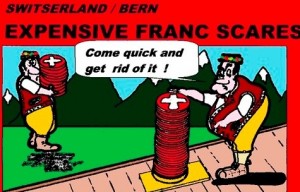
Unpegging the Swiss Franc


La La Rules for Banking

Nicollas Hirst writes:  MEPs will revisit the causes of the 2008 financial crisis on Wednesday (21 January) as they debate new rules that could lead to some of Europe’s largest banks being broken up.

Centre-left and Green members will accuse the centre-right of being unwilling to take on banks that they describe as “too big to fail, too big to save and too big to resolve”.

Many MEPs believe that the revision of the law advanced by Gunnar Hökmark, who is the European Parliament’s lead rapporteur on the matter, ignores the lessons of the financial crisis, namely that risk-taking universal banks – like Royal Bank of Scotland was in the UK, or Bankia in Spain – pose a systemic risk to European economies.

By contrast, Hökmark, a Swedish centre-right MEP, argues that universal banks ought to be cherished rather than broken up. Would this levae us with “ineffective shell regulation”?

Perhaps the MEPs’ first priority should be to ensure investment and growth for the real economy.  But the landscape of the banking sector has changed considerably since Erkki Liikanen, Finland’s central bank governor, recommended that all banks over a certain size be broken up in a 2012 report for the European Commission.

Michel Barnier, the European commissioner for internal market and services 2010-12, rowed back from this, proposing a year ago that the European Central Bank should have the power but not the obligation to break up banks over a certain threshold.

Hökmark , who was also the rapporteur for the proposal that set out last year how member states should restructure failing banks, in the wake of several costly bank failures, is adamant that the EU should concentrate on reviving investment in the economy and not making it more difficult for big banks to provide it.

He warns against attempting to imitate the banking model of the United States when the European system has developed over hundreds of years.

Christophe Nijdam, secretary general of Finance Watch, disagrees. “‘Too-big-to-fail’ banking […] distorts incentives so that Europe’s megabanks are more focused on financial trading than on financing commercial investments,” he said in a statement.

Hökmark’s EPP does not have a majority on the committee for economic and monetary affairs, with 18 MEPs out of 61. The S&D has 16 MEPs on the committee, the Liberals have five, the Greens have four and the European Conservatives and Reformists have five. Hökmark expects a committee vote on the proposal at the end of March or in April.

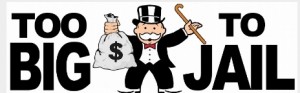
Too Big to Jail  EU Banks

Merkel/Marshall Plan for EU?

Bill Emmott writes:  Ever since Europe’s economic crisis erupted more than four years ago, politicians and pundits have clamored for a grand solution, often invoking the example of America’s postwar Marshall Plan, which, starting in 1948, helped to rebuild Western Europe’s shattered, debt-ridden economies. But the political moment has never been ripe. That could be about to change.

Europe’s situation today bears some similarities to the 1940s. Parochial suspicion has been the main obstacle to a grand solution. No country’s taxpayers have wanted to feel that they are paying for others’ excesses: the single currency did not impose shared responsibility.

The two sides disagree about the nature of the European sickness, and when there is no agreement on the diagnosis, it is hard to agree on a cure.

Greeks look poised to elect on January 25 a government dominated by the far-left Syriza party, which once stood for repudiation of the euro but now pledges to negotiate a restructuring of Greece’s debts. Spain’s most popular party ahead of the general election due at the end of this year is Podemos, which was founded only in January 2014 and has views similar to Syriza’s. And the United Kingdom’s election in May will rock the European boat by focusing on the question of when Britain should hold a referendum on whether to leave the EU.

These political rumbles worry creditor countries, which is reflected in the frequency of warnings from Germany that any new Greek government must adhere to existing agreements.

The passage of time ought to help with this bargaining. Germany’s formula for the euro crisis has been to insist on fiscal belt-tightening and structural reforms to reduce future public spending on pensions and wages, make labor markets more flexible, and boost productivity, all in return for emergency loans. Since the crisis began, the main recipients – Greece, Ireland, Spain, and Portugal – have been following that formula.

As a result, it is becoming possible, in political terms, to say that the debtors have taken their punishment and have made their economies more competitive. Economic growth has rebounded strongly in Ireland, mildly in Spain and Portugal, and meagerly in Greece.

That is why a modern version of the Marshall Plan is needed. Politically, it would be smart if German Chancellor Angela Merkel were to take the initiative in proposing such a grand solution, rather than being forced into piecemeal, reluctant concessions by new governments in Greece, Spain, or elsewhere.

A modern Marshall Plan should have three main components. First, sovereign debt in the eurozone would be restructured to ease the pain suffered by Greece and Spain. Second, a collectively financed public-investment program would focus on energy and other infrastructure. Third, a timetable for the completion of single-market liberalizing reforms – notably for service industries and the digital economy – would be established.

In Germany, debt restructuring would be the most controversial component. But Germans should be reminded that, along with Marshall Plan funds for Western Europe, the other big boost to Germany’s postwar economic recovery came from debt restructuring. The London Agreement of 1953 canceled 50% of Germany’s public debt and restructured the other half to give the country much longer to repay.

By including the other components of public investment and single-market completion, the Merkel Plan (or, better, the Merkel-Hollande-Cameron Plan) would be able to restart economic growth while opening countries to more trade and greater competition.

Of course, a modern Marshall Plan would face a wall of skepticism and obstruction by national interest groups. But, by standing together, European officials could win that battle. And if it is not tried, tomorrow’s Europeans may never forgive today’s leaders.

Debt Re-Structuring

Impact of Macroeconomic Populism?

Making the reduction of income inequalities the sole focus of public policy — dubbed macreconomic populism — has been a recurring presence in Latin American economic history. At certain times over the past 40 years, it has been costly and traumatic, which is true today for Venezuela and Argentina.

This policy approach often overlooks internal restrictions such as the simultaneous need for sustainable fiscal balance, price stability and wage alignment based on productivity. There are also external limitations such as balancing trade and improving the country’s international credit rating, all hopefully within a framework of growth. And populism today has acquired an additional association with bad institutions that aggravate the problem of concentrated markets.

The populist cycle, which lives through three phases of varying duration, is often attributed to irrational voting motivated by an overwhelming faith in electoral promises that ignores potential long-term consequences. Others see the durability in populism in the unfortunate combination of unsatisfied social and political demands, as well as the absence of institutions that equitably distribute the benefits and burdens of society.

From 1990 to 2003, Argentina had a growth rate of just 2.1% of GDP, an unemployment rate of 14.6% and average inflation rate of 197%. Venezuela grew about 2.5% a year up until 1999, with unemployment at 10.1% and average inflation of about 46%. There was public dissatisfaction with economic performance in both countries. There were calls to redistribute incomes as part of reactivating and restructuring the economy, as successor regimes took power.

In the first part of that period between early 2000 and 2011, attending to the social clamor of both countries was the recurring theme that justified a relentless rise in public spending and “raids” into market territority by imposing price controls of various types. The public welcomed measures such as fossil fuel subsidies as high as 80%, taxes and restrictions on dollar trading,  import/export quotas, and certain tax incentives and industry nationalization.

External conditions were favorable. Increasing Chinese demand from 2002 boosted energy and commodities prices during that period — soya 25%, cereals 49.5% and oil 103.5%. This gave the confused impression of impressive growth, with rates of 4.8% and 7.1% of GDP for Venezuela and Argentina, respectively.

But the bill for these policies inevitably arrives. A more than 40% fall in crude oil prices and about 20% for other raw materials has decimated the revenues of both countries. Growing unemployment, the end of protected jobs, food and consumer shortages, power cuts and ballooning debt are all symptoms announcing the coming, third phase of the populist cycle: crisis and collapse. The International Monetary Fund expects both economies to shrink about 2% in 2015, and the mid-term panorama is somber.

Evidence shows that macroeconomic populism is unstable  macroeconomic despite advances in the “good years,” perhaps because of its exclusively short-term focus. Both these countries need institutions that will create credible and stable expectations that encourage investment, rather than promises that destroy what was built before them.

Populism Works?

1% to Own 50% by 2016?

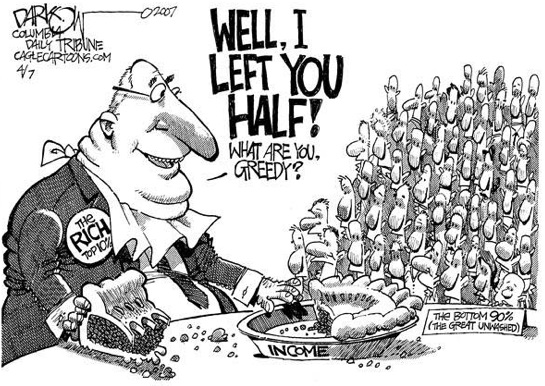
Oxfam reports: Wealth accumulated by the richest one percent will exceed that of the other 99 percent in 2016, the Oxfam charity said Monday, ahead of the annual meeting of the world’s most powerful at Davos, Switzerland.

“The scale of global inequality is quite simply staggering and despite the issues shooting up the global agenda, the gap between the richest and the rest is widening fast,” Oxfam executive director Winnie Byanyima said.

The richest one percent’s share of global wealth increased from 44 percent in 2009 to 48 percent in 2014, the British charity said in a report, adding that it will be more that 50 percent in 2016.

The average wealth per adult in this group is $2.7 million (2.3 million euros), Oxfam said.

Of the remaining 52 percent, almost all — 46 percent — is owned by the rest of the richest fifth of the world’s population, leaving the other 80 percent to share just 5.5 percent with an average wealth of $3,851 (3,330 euros) per adult, the report says.

Byanyima, who is to co-chair at the Davos World Economic Forum taking place Wednesday through Friday, urged leaders to take on “vested interests that stand in the way of a fairer and more prosperous world.”

Oxfam called upon states to tackle tax evasion, improve public services, tax capital rather than labour, and introduce living minimum wages, among other measures, in a bid to ensure a more equitable distribution of wealth.

The 45th World Economic Forum that runs from Wednesday to Saturday will draw a record number of participants this year with more than 300 heads of state and government attending.

Rising inequality will be competing with other global crises including terrorist threats in Europe, the worst post-Cold War stand-off between Russia and the West and renewed fears of financial turmoil.

France’s Francois Hollande, Germany’s Angela Merkel and China’s Li Keqiang will be among world leaders seeking to chart a path away from fundamentalism towards solidarity.

Italian Prime Minister Matteo Renzi and US Secretary of State John Kerry are also expected.

Beyond geopolitical crises, hot-button issues like the Ebola epidemic, the challenges posed by plunging oil prices and the future of technology will also be addressed at the posh Swiss ski resort.

Oxfam Reports

Take RIsk out of Executive Pay?

Executive compensation is set by managers themselves to maximise their own pay, rather than by boards on behalf of shareholders. Indeed, many commentators argue that executives’ pay schemes were major contributors to the financial crisis, encouraging them to take on too much risk and manage their company for short-term profit. In response, President Obama has proposed new executive compensation rules for firms seeking government aid. However, several critics have argued that the recent changes are politically motivated and focus on the level of pay, rather than the incentive structures (e.g. the relative amount of cash versus shares), which have the greatest economic impact.

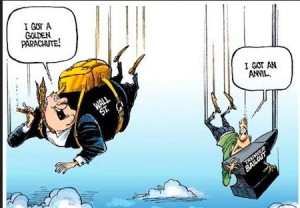
Existing schemes have two main problems. First, stock and options typically have short vesting periods, allowing executives to “cash out” early. For example, Angelo Mozilo, the former CEO of Countrywide Financial, made $129 million from stock sales in the twelve months prior to the start of the subprime crisis. This encourages managers to pump up the short-term stock price at the expense of long-run value – for instance by originating risky loans, scrapping investment projects, or manipulating earnings – because they can liquidate their holdings before the long-run damage appears. Long-term incentives must be provided for the manager to maximise long-term value, which we call the “long-horizon principle.”

Second, current schemes fail to keep pace with a firm’s changing conditions. If a company’s stock price plummets, stock options are close to worthless and have little incentive effect – precisely at the time when managerial effort is particularly critical. This problem may still exist even if the executive has only shares and no options. Consider a CEO who is paid $4 million in cash and $6 million in stock. If the share price halves, his stock is now worth $3 million. Exerting effort to improve firm value by 1% now increases his pay by only $30,000 rather than $60,000 and may provide insufficient motivation. To maintain incentives, the CEO must be forced to hold more shares after firm value declines. Our research has shown that, to motivate a manager, a given percentage increase in firm value (say 10%) must generate a sufficiently high percentage increase in pay (say 6%). In the above example, this is achieved by ensuring that, at all times, 60% of the manager’s pay is stock. We call this the “constant percentage principle.” The appropriate proportion will vary across firms depending on their industry and life cycle, but we estimate 60% as a ballpark number for the average firm.

Alex Edmans and Xavier Cabaix write that two principles should govern executive pay:  Rebalancing to address the constant percentage principle and gradual vesting to satisfy the long-horizon principle.  Executive Compensation

Executive Pay

Pushing for Public Banks

Alexis Goldsmotih writes:  A group of Americans with a different agenda for the future of banking-people are pushing hard for policy change. They’re advocates of public banking, and they want to see new banks created that would be owned and operated by the government, usually at the state or city level. (This would greatly increase the amount of investment capital available for small business development, local infrastructure, and affordable public transportation, none of which are much favored by private banks seeking a high return on investment.).

Gwendolyn Hallsmith is one of those advocates. She’s currently the executive director of the Public Banking Institute, but she worked previously as a public servant in Montpelier, Vermont, where she resides and ran for mayor in 2014. Hallsmith also spent some time in divinity school, and you can hear it in her voice-which is soft but strong and deliberately paced.

To Hallsmith, the main advantage of a public bank is lower-cost financing, which can enable the state to pay for things like building affordable housing, repairing infrastructure, and expanding educational opportunities. And each of these projects creates jobs.

Hallsmith said: Public banks “allow cities, counties, and states to finance important public priorities without needing to rely on Wall Street and pay the hidden interest tax that Wall Street imposes on all our money.”

The quest to achieve public banking at the state and local level has been a long slog. Until quite recently, you had to go back almost 100 years to find the last major victory: the founding of the bank of North Dakota, the only state-run public bank in the United States, which was established in 1919.

But interest has been picking up around the country. Santa Fe, New Mexico, voted in October to conduct a study on the feasibility of a city-run public bank. And in December, the Seattle City Council’s finance committee hosted experts in public banking to explore the topic.

But nowhere have the steps toward public banking been more successful than in the state of Vermont. There, Hallsmith and other advocates won a small victory against Wall Street through an effort so relentless and strategic that it would have made any banking lobbyist proud. They combined savvy organizing with data-driven reports and policy briefs to prove the benefits of a public bank-like avoiding fat interest payments to Wall Street banks-for the state’s economy.   A Fight for Public Banks

 Public Banks in Vermon?

Short Deflation Good? Longterm?

Liam Damm comments from New Zealand:  The Swiss currency bombshell – coming out of the blue on Friday morning – rattled currency markets and sent shockwaves through the banking system. The Swiss, stereotypically at least, are renowned for a love of order. Friday’s move was anything but.

We’re still struggling to digest the oil shock. Then there’s the effect of the US recovery, the Chinese slowdown, Russia’s currency crisis, the Greek debt standoff, and Europe’s plans to print money.  As disparate as these issues are, there is a common theme.

At the core is the spectre of deflation – a phenomenon that the Western world has not seen on a grand scale since the Great Depression.  Switzerland, already dealing with its own deflation issues, has been spooked into unpegging its franc from the euro by Europe’s deflation woes.

Maintaining the peg – which was introduced in 2011 as a response to the GFC – required the Swiss central bank to buy foreign currency.

Even Switzerland’s large reserves would have been stretched by further falls in the euro.   The Swiss official cash rate was also slashed – it is now minus 0.75 per cent (yes, you have to pay the bank to take your money). The oil slump which has greatly heightened the world deflation risk also played its part in the Swiss currency move.

The oil-related meltdown of the Russian ruble sent wealth from the region looking for a safe haven – the Swiss franc. That put further pressure on the Swiss central bank, increasing the cost of maintaining the artificial peg.

The Reserve Bank in New Zealand, like all central banks around the world, will add this to models that must remain constantly under review. Our bank is unlikely to move rates – in any direction – for some time.

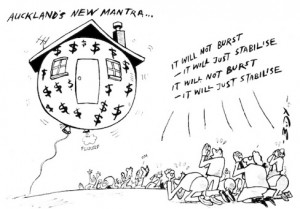
Inflation is very low and likely to fall outside the Reserve Banks target 1-3 per ce  But New Zealand  has the Christchurch re-build, population growth and a housing boom in Auckland to maintain inflationary pressure.

Our recovery began early and that buys us some time. Continued GDP growth in a low inflation environment is a pretty sweet spot.

New Zealand – as it was in the GFC ultimately – could well be buffered from the worst of this. But we won’t avoid the chill if Europe stagnates, if the US recovery is delayed again and if China keeps slowing.

The pressure on our Reserve Bank to maintain a stimulatory cash rate and ensure the economy doesn’t lose momentum is growing.

One final question lingers in all of this. Why is deflation so bad? As prices fall, consumers have more spending power. What is not to like?

The trouble is that without new wealth creation the upside is unsustainable.

As prices fall margins are squeezed, production falls, businesses contract. Jobs are lost and new jobs not created. Wages fall and a negative spiral takes hold.

It is not a wild freefall like the market meltdown of the GFC. Economies will not collapse overnight.

We can look to Japan for a plausible example of what the world might face – stagnation, low growth and regular dips into recession.

Without growth and momentum, opportunity is removed from the economy. And opportunity is one of capitalism’s most powerful drivers.

New Zealand Housing Boom


Russia Cuts Oil Deliveries to the Ukraine

Ken Hanly writes:  Russian president Vladimir Putin has ordered Gazprom to cut supplies to and through the Ukraine by 60 percent. He accuses the Ukraine of siphoning off supplies for Europe and stealing Russian gas.

Russia  claims that due to “transit risks for European consumers in the territory of the Ukraine” the supply cuts had to be made. As a result of the move Gazprom gas supplies to Europe plunged by 60 percent. Ukraine reportedthat Russia had shut off the gas supply. A total of six countries reported a complete shut off of Russian supplied gas.

Bulgaria, Greece, Macedonia, Romania, and Turkey  there had been a stop to gas shipments from Russia coming through the Ukraine. Croatia said that it had to reduce supplies to industrial customers. Bulgaria claimed that it was in a crisis situation and had gas for only a few days. The EUimmediately issued a statement condemning the cut off: ‘Without prior warning and in clear contradiction with the reassurances given by the highest Russian and Ukrainian authorities to the European Union, gas supplies to some EU member states have been substantially cut.’ The statement went on to demand that the gas supplies be restored immediately and that Russia and the Ukraine negotiate an end to their commercial dispute, which is the root cause of the situation.

The head of Gazprom  said that Russia plans to shift all natural gas flows now crossing the Ukraine to an alternative route through Turkey. About 40 percent of present Russian gas shipments to Europe pass through the Soviet area link via the Ukraine. Originally Russia planned a link through Bulgaria but dropped the plan after EU opposition. Bulgaria is now being made to suffer as no supplies at all from Russia enter the country. Russia supplies about 30 percent of EU natural gas.

Gazprom’s viewpoint appears to be that the EU will be the one to deal with that problem as it will simply deliver gas to the border of Greece and it will be up to the EU how gas is delivered from that point.
Russia may be using its plans as a bargaining chip but the EU is itself planning an energy union to reduce dependence on Russian gas and hence it may make sense for Russia to itself reduce reliance on the Ukrainian transit system, especially given the political conflict with the Ukraine.
Turn off the Spigot?

Draghi Next President of Italy

Andrea Markuzzo writes: As the 89 year old President of Italy resigns,  the party leaders are all likely to find it difficult to impose their preference on the parliamentary groups.

Giorgio Napolitano, Italy’s 89-year-old president, has resigned from the office he has held for nearly a decade. His departure will prompt a secret ballot among parliamentarians to replace him. But this is not likely to be an easy job, since the Italian parliament is currently rife with disagreement and dissatisfaction.

Originally elected in 2006, Napolitano reluctantly accepted re-election in 2013 because a highly polarised parliament could not guarantee the required absolute majority to any successor.

Some believe the Italian presidency is little more than a ceremonial role, but the chief of state is actually assigned substantial powers in the Italian Constitution.

What’s more, Italian governments are traditionally unstable and the political scene notoriously fragmented. There have been 63 governments since 1946, and since the political crisis of the early 1990s, majorities have been more and more fragile, composed of up to 20 different parliamentary groups. Against this backdrop, the president represents a rare centre of institutional continuity.

Napolitano, in particular, has pushed the limits of his authority. He used the highest degree of power on offer to him when trying to bring in effective governance before the debt crisis of 2011-12 and during the hung parliament deadlock that emerged after the 2013 elections.

The prestige of the presidential office naturally attracts some top names to the job and several potentials have been identified in the run up to Napolitano’s departure.

Mario Draghi, president of the European Central Bank, is thought to be a strong candidate,

Romano Prodi, Italy’s prime minister between 1996-1998 and 2006-2008, as well as president of the European Commission from 1999 to 2004  could find support. It will be difficult to find a president with support from a broad range of sources. In fact, the major leaders won’t even been voting in this election. Both Renzi and Beppe Grillo, founder of the radically populist Movimento 5 Stelle, have decided not to run for a parliamentary seat in 2013 general elections, so won’t be eligible to vote. Berlusconi, for his part, lost his seat after being onvicted of tax fraud.

President Renzi has been widely criticised by the traditional left for his attempts to give the Democratic Party a business-friendly image, and Grillo is facing growing criticism for the lack of internal democracy in the Movimento 5 Stelle. In Forza Italia, some accuse Berlusconi of taking care of his own interests above those of the party he founded.

The eventual winner will work with Renzi and his ministers on the final parliamentary passage of two crucial political reforms. A new electoral law should introduce a second round between the two largest parties to make sure one has a super-majority of 55% of the seats.