Plunging Oil Prices Long Term?

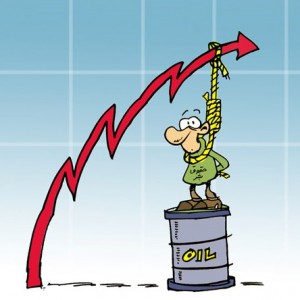
Andy Rowell writes:  How low can the price of oil go? What was unthinkable even a few months ago is now becoming distinctly probable, even likely.

As analysts dissect the ramifications for the oil industry of $40 a barrel, oil traders are now thinking that the price of crude will halve that to a staggering $20 a barrel. Prices have not been that low for 20 years.

Just a few weeks ago, traders believed that the oil price would bottom out at around $40 a barrel, but two weeks into January and we have reached that level already.

If the price of oil drops to $20 per barrel there will be carnage in the upstream unconventional oil industry in North America.

As Australian Business Review reports this morning “the number of contracts or options to sell U.S. crude at $US20 in June has jumped from close to zero at the beginning of the year to 13 million barrels of oil.”

The next few months could be some of the most defining ones in the whole of the hydrocarbon era. If that sounds like hyperbole, think again. The Telegraph reports that the Arab states of OPEC are preparing to “crush U.S. shale,” in their strategy to counter the shale gas revolution headon.

“The strategy will not change,” the Energy Minister of the United Arab Emirates said this week “We are telling the market and other producers that they need to be rational.” He predicted that it could be years before prices stablise, adding: “We are passing through very interesting times.” He finished by saying that he felt it was unlikley that will see a sudden rise in oil prices.”

The price drop threatens to re-write the energy landscape in the U.S. The oil price plunge is already hurting, with 35 horizontal fracking rigs idle last week in North Dakota and Texas fracking hotspots, the biggest single-week drop since the drilling boom started six years ago.

And now the business community are warning of the dangers of this new reality. The basic economics of fracking—that it now costs much more to drill than what oil is selling for. Cnventional drilling can withstand the oil price dip, the short-life span of fracking wells—where there is a breakeven price of $65—will not be able to.

It could be that  the Bakken region straddling Montana and North Dakota, a well that starts out pumping 1,000 barrels a day will decline to just 280 barrels by the start of year two, a shrinkage of 72%. By the beginning of year three, more than half the reserves of that well will be depleted and annual production will fall to a trickle.

 Oil Prices

Solar Power

Kirsten Korosec writes:  SolarCity, the largest installer of residential solar systems in the U.S., nearly doubled its workforce last year, hiring 4,000 people to do everything from system design and site surveys to installation and engineering.

The hiring spree at SolarCity isn’t slowing; it’s picking up speed as the company attempts to install twice as many rooftop solar systems than last year and readies its 1.2 million-square foot factory in New York, which is scheduled to reach full production in 2017.

Installers, panel makers, and even traditional fossil fuel energy companies helped U.S. solar employment grow nearly 22 percent in 2014.

The company’s expansion is indicative of what’s happening within the broader solar industry. More than 31,000 new solar jobs were created in the U.S. in 2014 bringing the total to 173,807—a 21.8 percent increase in employment since November 2013, according to a report released Thursday by The Solar Foundation. This is the second consecutive year that solar jobs have increased by at least 20 percent.

The solar industry is still dwarfed by the 9.8 million workers that the American Petroleum Industry says are employed the oil and gas industry.

Solar already employs more people than coal mining, which has 93,185 workers, and has added 50 percent more jobs in 2014 than the oil and gas pipeline construction industry (10,529) and the crude petroleum and natural gas extraction industry (8,688) did combined, according to the Solar Foundation.

One out of every 78 new jobs created in the U.S. over the past 12 months were created by the solar industry, representing nearly 1.3 percent of all jobs created in the country. Solar companies surveyed for the fifth annual census plan to add another 36,000 employees this year.

Third-party financing that allows homeowners to lease solar systems, a stabilizing manufacturing sector and utility-scale solar developers scrambling to finish projects before the federal investment tax credit drops from 30 percent to 10 percent on Jan. 1, 2017 has helped drive growth, says Andrea Luecke, president and executive director of The Solar Foundation.

The solar job-growth trend has spilled beyond the confines of companies solely dedicated to the renewable energy source.

NRG Energy, one of the largest U.S. independent power producers and owner of 88 fossil fuel and nuclear plants, is expanding its solar business rapidly. NRG’s Home Solar group, the residential solar division of NRG Home, hired 500 people in the past 12 months and now has 1,200 workers.

“We’re growing explosively in several markets,” NRG Home Solar president Kelcy Pegler Jr. said in an interview with Fortune on Thursday following the company’s investor day presentation.

As a result, Pegler’s residential home solar group plans to add “hundreds of jobs” this quarter and will double its current headcount in the next two years.

NRG Energy, which employs 10,000 people, reorganized last year into three business lines: NRG Business, NRG Home and NRG Renew. The company NRG -1.02% has a number of other solar-related jobs within NRG Renew and NRG Home, including its power on the go division which was expanded after the 2014 acquisition of portable solar power company Goal Zero.

These aren’t just part-time jobs either, these are careers.

Solar Power

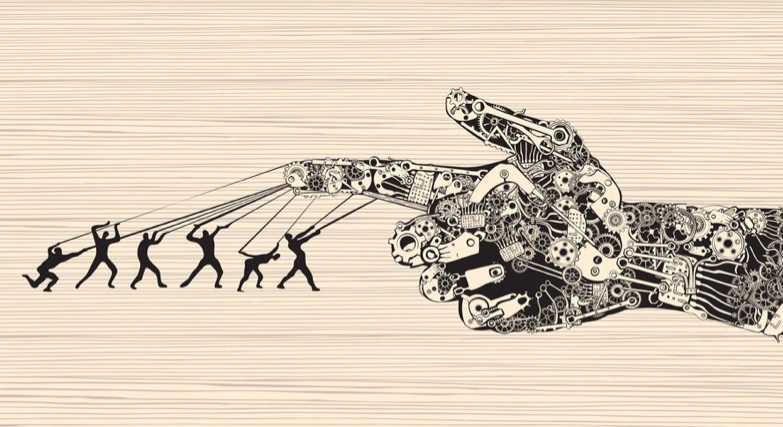
What To Do If AI Goes Too Far…

Orion Jonews writes: Concerned that extreme advances in artificial intelligence could endanger humanity, Elon Musk—founder of PayPal, Tesla Motors, and SpaceX—donated ten million dollars this week to safeguard humans from an “intelligence explosion.”

The term refers to a rapid expanse of machine intelligence that could overcome our attempt to control it. In recent years, machine intelligence, also known as deep learning, has advanced substantially:

“Deep learning has boosted Android’s speech recognition, and given Skype Star Trek-like instant translation capabilities. Google is building self-driving cars, and computer systems that can teach themselves to identify cat videos.”

In the first week of 2015, AI researchers gathered at a closed-door conference in Puerto Rico to draft an open letter pledging to do research only for good ends while “avoiding potential pitfalls.”

A softer side of potential damages that artificial intelligence could do relate to human labor. As Google fervently pursues self-driving vehicles, what will become of those who drive trucks and buses for a living?

Physicist Michio Kaku sees a potentially simpler solution. Even if computer technology continues to double every 18 months—which is doubtful—we could put a chip in robots’ brains to shut them off if they start to get murderous.

AI Too Much?


Work Politics

KShutterstock_136706186Kathleen Kelley Reardon asks:  Can you manage at work without politics?  The answer to that question is, probably not.  Wherever people come together seeking goals – whether the same or different ones – and especially where there is competition for scarce resources, politics is there.  Political arenas run along a continuum from minimally to highly and even pathologically political.  The character of the arena in which you work dictates the extent to which political acumen becomes a necessity.The political landscape where most of us work shifts over time.  While it may be possible to remain a political purist (at least for a while) in some jobs in certain organizations, it is risky to wait around until politics reaches a point beyond your expertise.The more effective route is to prepare for politics. Keep in mind that not all forms of politics are devious or underhanded.  Some political skills are actually no more than good people skills, like interpersonal sensitivity: knowing when to bring up which topics, when to push for something you believe is important, managing conflict to avoid unnecessary flare-ups, and causing others to feel good about working with you.Additional, relatively basic and constructive forms of political know-how include:

–       Creating a positive impression – assuring that key people find you and your ideas interesting.

–       Positioning – being in the right place at the right time.

–       Cultivating mentors – locating experienced advisors.

–       Lining up your ducks – making sure any idea you advance has support from the right people.

–       Developing a favor bank – doing for others, not only because you want to, but so that someday when you need to call in a chit, you will have the “currency” to do so.

Why, you might ask yourself, should I spend my valuable time managing politics instead of doing my job?  The truth is that understanding politics is required to do your job in most of today’s organizations.

Why not start by assessing how things get done — by whom and in what ways — where you work?  Seek guidance if it’s available from people who are adept at managing politics.  Become a student of politics.  Learn, for example, to detect disconnects between what is said and what is done, between what is requested and what is rewarded.  In most organizations, there’s a lot more going on than meets the eye.  It never pays to be the last one to know.


Prey to Gambler’s Fallacy?

Stephen Maxie writes:  Last August, my wife and I welcomed our third daughter into the world. It’s wonderful to be the parent of three girls. There is one significant drawback, however: having to field the question, over and over again, from (mostly) well-meaning people: “So are you going to try for a boy now?” There are several solid reasons we are calling it a day in the reproduction department. But if we were interested in having a fourth child, “trying for a boy” would not be the motivation. The idea is preposterous. Having a string of children of one sex does not presage the arrival of a baby of the opposite sex. Each pregnancy brings the same odds of having a boy or a girl, regardless of how previous pregnancies turned out: about 1 in 2.

The inkling that eventually odds come to favor having a baby of the other sex is an application of the “gambler’s fallacy.” This mistake is often explained with the example of coin tosses. Let’s say you flip a fair coin 5 times and it ends up “heads” each time. Many people watching this unbroken string of unlikely flips would bet good money that the sixth flip will bring “tails.” Heads can’t go on forever! What are the chances that there would be six heads in a row? Answer: on the sixth flip, there are even odds of getting heads or tails, just as there were for the first five flips. You’d be a fool to place a big bet on tails—or on heads, for that matter—for any individual coin toss.

In the long run, with millions or billions of flips, a fair coin will produce increasingly even numbers of heads and tails. The numbers will show something very close to a 50/50 split.  But when you’re dealing with only a few handfuls of flips, the law of small numbers applies: seemingly unlikely strings of coin flips are not that improbable after all. In our example, there is a probability of 1/64 that six flips of a fair coin will result in heads each time (that’s 1 over 2 to the sixth power). Those odds aren’t great; they come out to about a 1.6% chance. The gambler’s fallacy is to look at those meager odds and conclude there is a 98.4% chance the sixth flip will be tails. But here’s the fundamental problem: the probability of the first five flips coming up heads is now 100 percent. They have already happened! The only question is what will happen with the next flip, and those odds are, again, 50/50. Here is another way to look at it: any permutation of six coin flips—all heads or all tails or three heads and three tails or one tails and five heads, e.g.—has a probability of 1/64. So it’s just as likely—and just as unlikely—that six flips of a coin will produce six heads, or three tails and three heads—or any of the other 62 possible permutations.

When we zoom in on a string of one or two dozen flips, then, we are likely to find some series of flips that don’t look so random. Such non-random-seeming strings are to be expected from time to time. And this principle holds outside the realm of coin flips; it applies to purportedly amazing coincidences you might experience in your life.

It’s clear how a gambler can suffer from this fallacy: he can lose big money. If you throw all your chips on black in a game of Roulette after the ball has landed on red 10 times in a row because it couldn’t possibly wind up there an eleventh time—well, you have a good chance of walking home empty-pocketed. On August 18, 1913, scores of French gamblers left the Monte Carlo casino bereft after falling victim to this mistake: the Roulette ball landed on black 26 times in a row that day; during the run, everybody was betting that the wheel would even itself out and turn to red. But of course the wheel had no memory of its previous spins. Only the irrational bettors thought that previous spins had anything to do with how the next spin would turn out.

A new piece of research shows there are weighty implications of this cognitive bias well beyond the casino floor. In next Friday’s Praxis, I will discuss evidence that judges, loan officers and baseball umpires tend to succumb to the gambler’s fallacy in their decision making—dramatically expanding the damage the fallacy can cause to innocent bystanders.

Gambler's Fallacy

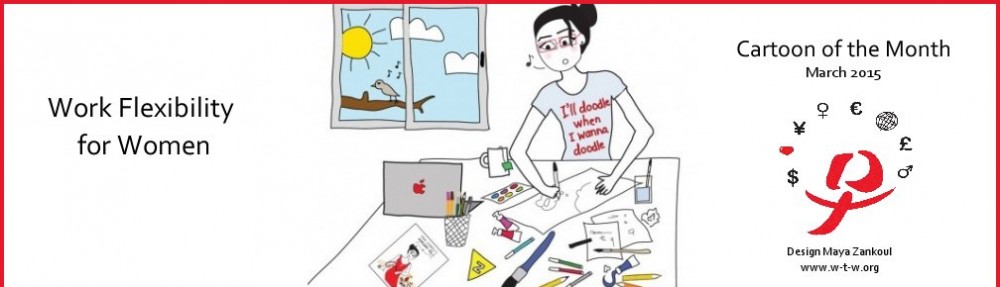
Women and Leadership

A new Pew Study reports: According to the majority of Americans, women are every bit as capable of being good political leaders as men. The same can be said of their ability to dominate the corporate boardroom. And according to a new Pew Research Center survey on women and leadership, most Americans find women indistinguishable from men on key leadership traits such as intelligence and capacity for innovation, with many saying they’re stronger than men in terms of being compassionate and organized leaders.

So why, then, are women in short supply at the top of government and business in the United States? According to the public, at least, it’s not that they lack toughness, management chops or proper skill sets.

It’s also not all about work-life balance. While economic research and previous survey findings have shown that career interruptions related to motherhood may make it harder for women to advance in their careers and compete for top executive jobs, relatively few adults in the new Pew Research survey point to this as a key barrier for women seeking leadership roles.1 Only about one-in-five say women’s family responsibilities are a major reason there aren’t more females in top leadership positions in business and politics.

Americans Have Doubts About Women  Achieving Equality in Corporate LeadershipInstead, topping the list of reasons, about four and ten Americans point to a double standards for women seeking the highest levels of either politics or business. Similar shares say the electorate and corporate America are just not ready to put more women in top leadership positions.

A Woman Who Wants to Reach a Top Position in Business Is Better Off …As a result, the public is divided about whether, even in the face of the major advances women have made in the workplace, the imbalance in corporate America will change in the foreseeable future. About half (53%) believe men will continue to hold more top executive positions in business in the future; 44% say it is only a matter of time before as many women are in top executive positions as men. Americans are less doubtful when it comes to politics: 73% expect to see a female president in their lifetime.

These findings are based on a new Pew Research Center survey of 1,835 randomly selected adults conducted online Nov. 12-21, 2014. The survey also finds that the public is divided over whether a woman with leadership aspirations is better off having children early on in her career (36%) or waiting until she is well established (40%). About one-in-five (22%) say the best option would be to not have children at all.  Women-and Leadership

Money Laundering Post 9/11

Munich-based economic journalist Markus Schulze Wehninck writes:  Money laundering has been an international issue since the end of the 1980s but its career on the global agenda did not start until September 11, when it was connected to the fight against terrorist financing. After the attack on the World Trade Center, a global Counter Terrorist Financing (CFT) regime was built up by the United Nations and pre-existing anti-money laundering (AML) measures were expanded. It was believed that the expertise of AML professionals could be used for the fight against terrorist financial flows. The main task of the Financial Action Task Force (FATF) – an OECD-based international body established by the G7 in 1989 – was extended to the combined ‘label’ of anti-money laundering and counter terrorist financing (AML/CFT).

The connection of these two phenomena has had significant consequences. The ‘dirty money’ to fight is no longer only affiliated with crimes already committed, as money laundering only concerns funds from illicit activities, but as well with future terrorist activities. This boosted the international efforts to fight dirty money flows and new obligations for the private sector.

With its ’40 recommendations’, the FATF had already published an extensive blueprint for financial institution regulation to fight money laundering in 1990. The recommendations, which are implemented – at least in part – by most states, commit banks and other institutions to analyse their customers and financial flows, keep records and report suspicious activities to the authorities.

In 2003, the FATF published nine special recommendations for counter terrorist financing and included “designated non-financial businesses and professions” like (internet-)casinos, real estate agents, dealers in precious metals and stones, and lawyers or notaries. Furthermore, alternative remittance systems, like the informal value transfer system ‘hawala’, and non-profit organisations have been taken into the regulatory focus of the international expert body.

At the same time, other standard setters like the Basel Committee on Banking Supervision or the private sector initiative Wolfsberg Group have expanded and further specified the duties of banks in analysing customers and their financial behaviour. A global system of financial surveillance has emerged which obliges the everyday customer’s local bank to act as a financial watchdog. This surveillance system has merits, as it makes tracking dirty money flows more easy and efficient. But, nevertheless, it creates problems which did not exist before 9/11.

Firstly, the global financial surveillance system clearly violates the banking secrecy provision. The FATF recommendations point out, the secrecy laws of financial institutions are to be constrained where they may “inhibit the implementation” of the recommendations. States get what they wanted for a long time – access to private sector financial data. This data is not only supposed to be shared among domestic state agencies, but in cooperation with their foreign counterparts on a global scale..

The financial surveillance system has its weak points and carries the risk of customers beinging suspected by mistake, a ‘false positive’. Private sector institutions use IT-tools to trace suspicious money flows within the huge amount of financial data. A whole industry sector has evolved to commercially exploit the needs of financial institutions, that is, to find the ‘needles in the haystack’. Data management software develops ‘patterns of normality’ in order to identify abnormalities in financial transactions – an error-prone system.

The best strategy of blame avoidance is thus: reporting, reporting, reporting. How many transactions, banking accounts or credit cards are audited by this surveillance system is not known. However, a 2004 evaluation of the private sector reporting behaviour in Germany notes that 6400 suspicions had been reported the year before, from which about 900 had been false alerts, or just a little over 1 in 7 reports.

Another negative effect is that the fight against dirty money threatens to exclude poor people from financial services. Before 9/11, AML measures were merely associated with rather high sums and certain transaction thresholds, while the relatively small amounts of money used for 9/11 have refocused the dirty money chase on daily retail banking.

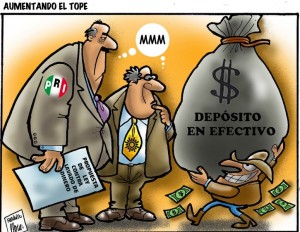
Their obligations force banks to prove identity and residence of their customers, which might be a minor problem in developed countries, but is of extreme significance in the developing world. As evaluations of the impact of the FATF-recommendations on the access to financial services show, ‘know your customer’-rules pose problems in countries where many households do not have formal addresses. This adverse impact has been shown in South Africa, Indonesia, Kenia, Pakistan and Mexico.  Cash Limits by Fernando Llera

Will Corruption Hold Latin America Back?

From the Wharton Business School’s online comments: Buoyed by high prices for the commodities they export, the major nations of Latin America have enjoyed strong growth in recent years, but that slowed down in 2014. Last year, the aggregate growth rate for gross domestic products (GDP) in the region was just 1.1%, the slowest rate since 2009.

For 2015, the UN Economic Commission for Latin America (ECLAC) expects regional growth to recover to 2.2%. This year, Brazil, the world’s seventh-largest economy, is forecast by ECLAC to grow by 1.3%.

Though ECLAC may look at the region’s nations en masse, it would be a mistake to think of it as one homogeneous economic zone.  Mexico and Central America export chiefly to hte US.  Now that the US economy is recovering, they are doing better.

The sub-region which covers much of South American including Brazil is where most of the countries are essentially exporters of commodities and energy, largely agricultural commodities and minerals such as iron ore. These countries have been beaten up by the slowdown in demand for their commodity exports from China.  Chile is also having trouble because of dropping commodity prices, especially of copper.

Bolivia, Venezuela and Argentina are “places where the problems are essentially self-inflicted because of their populist policies which have discouraged foreign investment and trade.

A fourth sub-region to is the Caribbean which is the subject of increased attention now thanks to the recent economic and diplomatic overtures to Cuba.

Given its vast area, huge population and immense natural resources, Brazil is the key problem in South America.  The country’s challenges aren’t limited to a weakening demand for commodity exports.  Stifing regulations, lack of a trained workforce and a corrupt political system are throttling economic development.

Mexico’s economic expansion will be buoyed by the continued rapid growth of its automotive sector. In 2014 alone, Honda began production at a new $800 million plant in Guanajuato state; Mazda opened its first plant in North America, a $770 million facility also in Guanajuato, and Kia announced plans for a new $1 billion plant in Nuevo Leon. Other major firms preparing to open new plants in Mexico include Audi and BMW. Guillen notes that these investors “are not going to go anywhere” else, because their plants are “becoming increasingly more competitive” with auto factories elsewhere in the world. He adds that Mexican plants “also have another advantage; they have cheap energy coming from North America.”

Like Brazil, however, Mexico faces political challenges that could cloud its prospects for faster growth.  Can promise overcome corruption?   Latin America’s Future

Corruption in Latin America

Making Entrepreneurs Central

Dani Rodrik writes:  A specter of job-killing technology is haunting the world.  How this challenge is met will determine the fate of the world’s market economies and democratic polities.

When the new industrial working class began to organize, governments defused the threat of revolution from below by expanding political and social rights, regulating markets, erecting a welfare state that provided extensive transfers and social insurance, and smoothing the ups and downs of the macroeconomy. In effect, they reinvented capitalism to make it more inclusive and to give workers a stake in the system.

Today’s technological revolutions call for a similarly comprehensive reinvention. The potential benefits of discoveries and new applications in robotics, biotechnology, digital technologies and other areas are all around us and easy to see. Indeed, many believe that the world economy may be on the cusp of another explosion in new technologies.

The  bulk of these new technologies are labor-saving. They entail the replacement of low- and medium-skilled workers with machines operated by a much smaller number of highly skilled workers.

A world in which robots and machines do the work of humans need not be a world of high unemployment. But it is certainly a world in which the lion’s share of productivity gains accrues to the owners of the new technologies and the machines that embody them. The bulk of the workforce is condemned either to joblessness or low wages.

Indeed, something like this has been happening in the developed countries for at least four decades. Skill and capital-intensive technologies are the leading culprit behind the rise in inequality since the late 1970s. By all indications, this trend is likely to continue, producing historically unprecedented levels of inequality and the threat of widespread social and political conflict.

The key is to recognize that disruptive new technologies produce large social gains and private losses simultaneously. These gains and losses can be reconfigured in a manner that benefits everyone. Just as with the earlier reinvention of capitalism, the state must play a large role.

Consider how new technologies develop. Each potential innovator faces a large upside, but also a high degree of risk.

These risks are especially high at the dawn of a new innovation age. Achieving the socially desirable level of innovative effort then requires either foolhardy entrepreneurs – who are willing to take high risks – or a sufficient supply of risk capital.

Imagine that a government established a number of professionally managed public venture funds, which would take equity stakes in a large cross-section of new technologies, raising the necessary funds by issuing bonds in financial markets. These funds would operate on market principles and have to provide periodic accounting to political authorities (especially when their overall rate of return falls below a specified threshold), but would be otherwise autonomous.

Designing the right institutions for public venture capital can be difficult. But central banks offer a model of how such funds might operate independently of day-to-day political pressure. Society, through its agent – the government – would then end up as co-owner of the new generation of technologies and machines.

The public venture funds’ share of profits from the commercialization of new technologies would be returned to ordinary citizens in the form of a “social innovation” dividend – an income stream that would supplement workers’ earnings from the labor market. It would also allow working hours to be reduced.

. An innovation state, established along the lines sketched above, would reconcile equity with the incentives that such investment requires.

The Innovation State?

Unpegging the Swiss Franc

Markus Brunnermeier and Harold James write:  Since the European sovereign-debt crisis erupted in 2009, everyone has wondered what would happen if a country left the eurozone. At first, the debate focused on crisis countries – Greece, or maybe Portugal, Spain, or Italy. Then there was a rather hypothetical discussion of what would happen if strong surplus countries – say, Finland or Germany – left.
Through it all, a consensus emerged that an exit by one country could – like the collapse of Lehman Brothers in 2008 – trigger a wider meltdown. Now, in Switzerland, we have a demonstration of just some of the risks that might emerge were a surplus country to leave the eurozone.

In September 2011, Switzerland pegged its currency to the euro to set a ceiling to the Swiss franc’s rapid appreciation in the wake of the global financial crisis that erupted in 2008. The country thus became a temporary adjunct member of the European monetary union. But, on January 15, the Swiss National Bank (SNB) suddenly and surprisingly abandoned the peg.
Obviously, exiting a real currency union is far more complex and legally fraught than ending a temporary exchange-rate arrangement; the effects of such a move would be greatly magnified. Nonetheless, the Swiss move reveals at least some of the uncertainties that a full-fledged exit could create.
The SNB was not forced to act by a speculative run. No financial crisis forced its hand, and, in theory, the SNB’s directorate could have held the exchange rate and bought foreign assets indefinitely. But domestic criticism of the SNB’s large buildup of exchange-rate reserves (euro assets) was mounting.
In particular, Swiss conservatives disliked the risk to which the SNB was exposed. Fearing that eurozone government bonds were unsafe, they agitated to require the SNB to acquire gold reserves instead, even forcing a referendum on the matter. Though the initiative to require a fixed share of gold reserves failed, the prospect of large-scale quantitative easing by the European Central Bank, together with the euro’s recent slide against the dollar, intensified the political pressure to abandon the peg.
Whereas economists have modeled financial attacks well, there has been little study of just when political pressure becomes unbearable and a central bank gives in. The SNB, for example, had proclaimed loyalty to the peg just days before ending it. As a result, markets will now hesitate to believe central banks’ statements about future policy, and forward guidance (a major post-crisis instrument) will be much more difficult.

Today, the global ramifications of a major central bank’s actions are much more pronounced than in 1971. When the Bundesbank acted unilaterally, German banks were not very international. But now finance is global, implying large balance-sheet exposures to currency swings.
Big Swiss banks fund themselves in Swiss francs, because so many people everywhere want the security of franc assets. They then acquire assets worldwide, in other currencies. When the exchange rate changes abruptly, the banks face large losses – a large-scale version of naive Hungarian homeowners’ strategy of borrowing in Swiss francs to finance their mortgages.
Though the SNB had given many warnings that the euro peg was not permanent, and though it had imposed a higher capital ratio on banks, the uncoupling from the euro came as a huge shock. Swiss bank shares fell faster than the general Swiss index.
The risks created by the SNB’s decision – as transmitted through the financial system – have a fat tail. The negative effects for the Swiss economy – through the decreased competiveness of its export industries (including tourism and medicine) – may already be showing that abandoning the euro peg was not a good idea.
But the consequences will not be limited to Switzerland. After years of wondering whether the exit of a small, fiscally weak country like Greece could undermine the euro, policymakers will have to deal with an even bigger shock stemming from the exit of a small, fiscally strong country that is not even a member of the European Union.

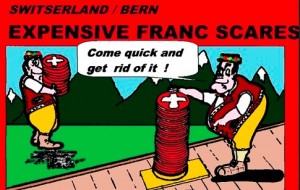
Swiss Franc