How Rice Gets to the Table in Japan

As Japan began reconstruction after the end of World War II, the paramount issue was to feed a nation of hungry people. Infrastructure was ruined and farmland abandoned. Agricultural reforms compelled landlords to sell off their large land holdings to the tenant farmers who worked those lands. Newly-incentivized farmers quickly brought the agricultural sector back into production.

Japan has been doing all right for itself. In terms of total volume of food produced, it is number five in the world. It’s a nation obsessed with food self-sufficiency and food security.

With the distorting forces of the global economy, a graying of the population who till the land, a huge agricultural cooperative that may not be representing the true needs of its constituents, and a ruling government party that actively opposes the cooperative, Japan is going through some huge changes.

JA Zenchu (Central Union of Agricultural Co-operatives) is a mammoth organization that not only represents the interests of 47 prefectural agricultural co-ops and controls a huge insurance company and one of Japan’s largest banks. JA Zenchu has been steadfast in supporting tariffs on foreign rice (up to nearly 800 percent) and has been opposed to Japan joining the Trans Pacific Partnership (TPP).

In the other corner of the struggle over food, there’s the current government, controlled by Shinzo Abe and his Liberal Democratic Party (LDP). Abe and his allies would love to break JA Zenchu.

In the current battle between JA Zenchu and the LDP, the LDP seems to be winning. And it’s not just on the political front. Market concerns are changing the roles of middlemen, unions and wholesalers. A huge grocery store chain, Aeon, is beginning to buy rice directly from producers.

The farmers average age around 66 – and they’ve long depended on the advocacy of the JA Zenchu and protectionist policies of the government. Even parties like the LDP still depend on rural turnout during elections.  They’re pushing for an end to production controls by 2018, but still subsidizing farmers who switch to other crops or produce rice for livestock.

On one hand, a system is in place that supports small farmers and crop diversity. But the co-op that protects these farmers seems more concerned with insurance and banking.  The current government is focused on pushing Japan out of its decades-long economic slump through monetary policy and a rush to corporatize farming.   What direction Japan takes remains the big question.  Rice will remain on the Japanese table. How it gets there is up for grabs.

Growing Rice in Japan

Price of Oil Anyone’s Guess?

Oil prices are carrying on the trend from the second half of 2014 and continuing to drop to lows not seen since 2009.  Energy stocks overall on Wall Street were the worst performing of 2014.

The U.S. Dollar has continued its strong performance at the end of 2014, and this week has hit its highest level since March 2006.  Problems for competitor economies in Asia and Europe have resulted in the dollar index, which measures dollar strength against several other major currencies, reporting 9 year highs of 90.90 as of this morning.

Against the Euro, the dollar has reached a four and a half year high and against the Yen, a seven and a half year high.  All of this points to the U.S. being the global market leader early in 2015, in spite of the so-called oil price war with Saudi Arabia and job losses as the oil and gas industries respond to a lower price climate.  Regardless of the worrying particulars of the U.S. energy scenario on its own, it is important to assess it in context:  China’s economy is slowing as it moves from investment to consumption; Japan has fallen into recession and Russia faces a similar threat in the near future; and growth in Europe is crawling.

Surprising news has come from Russia as we begin the New Year, with oil output for 2014 reaching a record high average of 10.58 million barrells per day.   The Russian Energy Ministry data also highlighted new records for oil and gas condensate production in December of 10.67 million bpd.  Russian energy exports to China also reached new highs of over 22.6 million tons (452,000 bpd) with this forming an integral part to Russia’s post-sanctions strategy of diversifying its international energy clients with a specific focus on the Asian markets.  The Energy ministry is forecasting a decline to 525 million tons in 2015 in light of falling oil prices and an impending recession, while the IEA is predicting a 1% drop in oil output overall for 2015.  Gazprom released figures indicating an output drop of 9%, an all-time low, citing the war with Ukraine as the main reason.

Still it seems that anything can happen in 2015.

From Cars to Camels

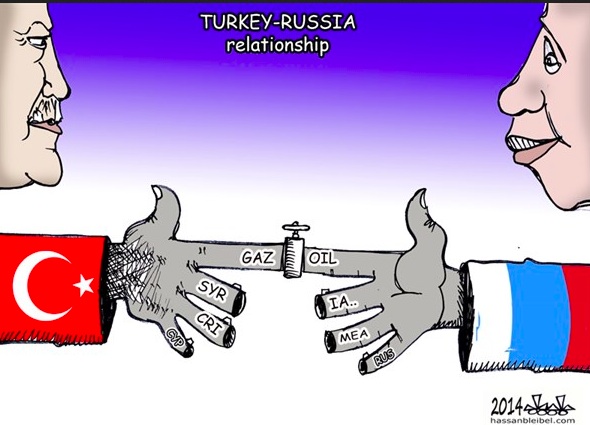
Russia and Turkey: Hanging on for Dear Life

Semih Idz writes:  The friendship between Recep Tayyip Erdogan and Vladimir Putin clearly bolsters the positive atmosphere between the two countries. It is, however, no secret that mutual economic interests provide the driving force for Turkish-Russian ties today.

Dark clouds have nevertheless started gathering over economic relations because of Russia’s economic woes.  These are worrying the Turkish business community.

The downturn in Russia comes at a time when the two countries pledged, during Putin’s Dec. 1 visit to Turkey, to increase the volume of bilateral trade to $100 billion by 2020.

Putin also said Moscow was scrapping the new pipeline to carry Russian gas to Europe over Bulgaria, and would build an alternative pipeline to Turkey.

For good measure, Putin also threw in a 6% discount in the price of gas sold to Turkey, leaving Ankara with smiles all around.

Western sanctions on Russia had also whetted the appetite of Turkish exporters after Ankara — to the annoyance of its NATO allies — made it clear it would not support the sanctions.

The shopkeepers of Istanbul’s Laleli, Osmanbey and Merter districts joined those with raised hopes, expecting an increase in the traditional and semi-official “suitcase trade” in textiles, leatherwear and cosmetics with small Russian buyers who come to Turkey for this purpose. Meanwhile, Turkish industrialists hoped to reap the advantages of the drop in the price of Russian oil.

Prospects for the lucrative tourism sector appear glum, as the number of Russians visiting Turkey is expected to fall. Russian tourists, who generally prefer Antalya on Turkey’s Mediterranean coast and resort towns close to it, leave an estimated $4 billion to $5 billion annually. .

Enver Erkn, an expert with the ALB Menkul brokerage firm, points out that Russia is Turkey’s No. 1 import market (mostly buying oil and gas) and fourth export market. Erkan says that while the drop in the price of Russian oil is a positive development for Turkey, Russia’s deepening economic crisis is not.

Agriculture, which is vitally important for the Antalya region, was suffering from the crisis in Russia. Russia is the main market for Turkey’s fruit and vegetables. Because of the drop in buying power and the devaluation there our agricultural exports have also affected.Warning Turkish contractors not to leave Russia now because their places would be filled by Chinese companies,  Karlov, a Russian minister said that if Turkish operators were concerned about the fall in Russian tourists, the solution was in their hands.

Turkey and Russia

Goldman Sachs Teams with US Government?

Stan Gilani writes: The truth about crony capitalism, at the highest level, is being laid bare.

The public is finally getting a look inside the black box where the titans of Wall Street and their inside-jobbers in Congress and at the highest levels of the U.S. government make decisions.  Star International is suing the US for ripping off American International Group, AIG and its shareholders.   Starr is an insurance company controlled by Maurice “Hank” Greenberg, the former CEO of AIG, not long ago the largest insurance company in the world.

Apparently, this closely watched 37-day trial that was supposed to have ended in November is far from over.  Greenberg’s lawyers just got more than 30,000 new documents they were denied before.  What was covered up when the U.S. government and the Federal Reserve Bank of New York bailed out AIG (as the Fed and the government called it) washow Goldman Sachs inserted one of its directors, Edward Liddy, into the top position at AIG when the government saved it from itself.

Only no one knew how deep the Goldman connection went. No one knew how Liddy, the former CEO of Alllstate Corp. helped push through the bailout with the AIG board – without giving shareholders a chance to vote on it.

The problem for the New York Fed, the U.S. government, and Goldman Sachs was that Greenberg’s stock position was enough to kill the bailout if he had a chance to vote his shares.

He never got the chance…

It wasn’t enough that Goldman’s former CEO was Hank Paulson, the then-Secretary of the U.S. Treasury, and that Goldman got bailed out itself when the Fed and the U.S. government gave it a windfall of profits right out of AIG’s pocketbook for some credit-default swaps that weren’t even worth anywhere near what the government paid Goldman for them. That was theft, plain and simple.

it’s not theft if it’s government-sanctioned.  So, we’re finding out now how deep the rabbit hole is in this trial.

Rabbit Hole?

Russia Déjà Vu Soviet Union?

In the late 1980s, the Soviet Union was forced into an embarrassing scramble for money. It tried to make deals with numerous banks, but the funding offered was far smaller than what the country required. Food shortages worsened, and Moscow needed the help of governments in the West, for which the USSR effectively had to allow Eastern European countries to assert independence.

Writing in 2007, some warned against the consensus that oil prices would stay high:

What lessons can we learn from the Soviet collapse and apply to the current situation in Russia? First, we must remember that Russia today is an oil-dependent economy. No one can accurately predict the fluctuations of oil prices. The collapse of the Soviet Union should serve as a lesson to those who construct policy based on the assumption that oil prices will remain perpetually high. It would seem that in our country, which has lived through the collapse of the late 1980s and early 1990s, this fact would be evident. But as soon as the prices went up again at the beginning of 2000 and in 2004 became comparable in real terms to those at the beginning of the 1980s, the idea that “high oil revenues are forever” has gained an even wider acceptance.

Russia today isn’t the same top-down, command-and-control economy that it was in the 1980s, but the dynamic hasn’t changed entirely. The country is still hugely dependent on oil, particularly in terms of tax revenues and exports.

And Yego Gaida, the Russian economist, r thinks the collapse of the Soviet Union is still relevant for modern Russia:

One more lesson that is relevant for Russian politics today is that authoritarian regimes, although displaying a façade of strength, are fragile in crisis. In conditions of relative stability, society is prepared to tolerate the lack of real elections. People are prepared to come to terms with this situation as an inevitable and habitual evil. But they will do so only until the country encounters a serious challenge, requiring decisive and tough measures in order to adapt to unfavourable conditions.

Oil Prices and  Russia

When Robots Replace Jobs

Nouriel Roubini writes:  Technology innovators and CEOs seem positively giddy nowadays about what the future will bring. New manufacturing technologies have generated feverish excitement about what some see as a Third Industrial Revolution. In the years ahead, technological improvements in robotics and automation will boost productivity and efficiency, implying significant economic gains for companies. But, unless the proper policies to nurture job growth are put in place, it remains uncertain whether demand for labor will continue to grow as technology marches forward.

Recent technological advances have three biases: They tend to be capital-intensive (thus favoring those who already have financial resources); skill-intensive (thus favoring those who already have a high level of technical proficiency); and labor-saving (thus reducing the total number of unskilled and semi-skilled jobs in the economy). The risk is that robotics and automation will displace workers in blue-collar manufacturing jobs before the dust of the Third Industrial Revolution settles.

The rapid development of smart software over the last few decades has been perhaps the most important force shaping the coming manufacturing revolution. Software innovation, together with 3D printing technologies, will open the door to those workers who are educated enough to participate; for everyone else, however, it may feel as though the revolution is happening elsewhere.

For the developed countries, this may seem like old news. After all, for the last 30 years, the manufacturing base in Asia’s emerging economies has been displacing that of the old industrial powers of Western Europe and North America. But there is no guarantee that gains in service-sector employment will continue to offset the resulting job losses in industry.

Technology is making even many service jobs tradable.  Eventually echnology will replace manufacturing and service jobs in emerging markets as well.

Today, for example, a patient in New York may have his MRI sent digitally to, say, Bangalore, where a highly skilled radiologist reads it for one-quarter of what a New York-based radiologist would cost. But how long will it be before a computer software can read those images faster, better, and cheaper than the radiologist in Bangalore can?

Job-reducing technological innovations will affect education, health care, government, and even transportation.  Education and governments are shedding labor.  Even transportation is being revolutionized by technology. In a matter of years, driverless cars – courtesy of Google and others – may render millions of jobs obsolete.

And, of course technological innovation that is capital-intensive and labor-saving is one of the factors – together with the related winner-take-all effects – driving the rise in income and wealth inequality. Rising inequality then becomes a drag on demand and growth (as well as a source of social and political instability), because it distributes income from those who spend more (lower- and middle-income households) to those who save more (high-net-worth individuals and corporate firms).

Obviously, this is not the first time the world has faced such problems, and the past can help to serve as a model for resolving them. Late nineteenth- and early twentieth-century leaders sought to minimize the worst features of industrialization.

As we begin to seek enlightened solutions to the challenges that the Third Industrial Revolution presents, one overall theme looms large: The gains from technology must be channeled to a broader base of the population than has benefited so far. That requires a major educational component. In order to create broad-based prosperity, workers need the skills to participate in the brave new world implied by a digital economy.

Robots March Forward


Experiment with Policies?

J. Bradford de Long writes:  When it became clear in late 2008 that the global economy was headed toward a crash at least as dangerous as the one that had initiated the Great Depression, I was alarmed, but also hopeful. We had, after all, seen this before. And we also had a model for how to mitigate the damage; unfortunately, policymakers left it on the shelf.

Roosevelt’s New Deal policies sometimes conflicted with one another, and quite a few of them were counterproductive. But, by trying everything, and then scaling up the most successful policies, Roosevelt was ultimately able to turn the economy around.

And so, in late 2008, the way forward seemed obvious: recapitalize the banks, guarantee loans, use the government-backed housing lenders Fannie Mae and Freddie Mac to resolve underwater mortgages, drop short-term interest rates to zero and use quantitative easing to prevent deflation or dangerously low inflation, and embrace deficit spending. Then, as events evolved, we would reinforce those policies that seemed to be working and gradually drop those that seemed to be ineffective or counterproductive.

But that was not what we did. Instead, each proposal faced its own opposition. Some worried that recapitalizing the banks would reward the very institutions that had caused the problem. Others fretted that resolving underwater mortgages would reward feckless borrowers. Still others raised concerns about expansionary fiscal and monetary policy. And some favored one set of polices (say, resolving underwater mortgages and recapitalizing the banks), while opposing all the others (for example, deficit spending and raising inflation expectations).

Six years on, the economy has yet to fully recover and the problem persists. The usually wise economist Martin Feldstein makes the case for a set of policies designed to stimulate demand, including increasing investment tax credits and shifting the corporate-tax burden to firms that do not spend very much.

Feldstein’s ideas are promising; and, in line with the lessons of the Great Depression, they are definitely worth trying. The trouble is the rhetoric surrounding his proposals. The article’s headline, “The Fed’s Needless Flirtation With Danger,” is followed by warnings that quantitative easing could “increase the risk of financial instability.” Instead of simply promoting his policies, Feldstein presents them as a “safe and effective alternative” to other approaches. His proposals, he argues, are not an additional arrow in the quiver, but replacements for traditional Keynesian policies.

Pushing your ffavorite recipe at the expense of other is not productive. As policymakers continue to seek a path out of the ongoing malaise, it would be wise to remember Roosevelt’s words before he led the US out of a very similar crisis. “The country needs and…demands bold, persistent experimentation,” he said in 1932. “Take a method and try it. If it fails, admit it frankly, and try another. But above all, try something.”

Try Everything and the Kitchen Sink

Can Individual EU Nations Coordinate to Support the European Central Bank?

Jean Pisani Ferry writes: Eurozone monetary officials are expected to make history when they gather for the European Central Bank’s next policy-setting meeting on January 22.

The ECB has many reasons to launch QE.  Low inflation is already a serious obstacle to economic recovery and rebalancing within the eurozone. Outright deflation would be an even more dangerous threat.

Financial markets consider QE so likely that the largest part of its bond-rate and exchange-rate consequences have already been priced in. Should the ECB not launch QE,  markets would confront an abrupt and damaging unwinding of positions: long-term interest rates would rise, stock markets would sink, and the exchange rate would appreciate. That is not what Europe needs as it struggles.

Jens Weidmann, the president of the German Bundesbank argues that the consequences of recent price data may be less serious than believed, while those of full-fledged QE could be more serious than assumed.  At a time when the US data seem to validate the Federal Reserve’s strategy, why is the ECB hesitating?

The Bundesbank fiercely opposed the ECB’s conditional support of debt-distressed eurozone members, but German officials do not dispute the legitimacy of wholesale bond purchases for monetary-policy purposes.

In principle, QE has nothing to do with sovereign solvency. It is a monetary instrument that the central bank must rely on when its policy interest rate has hit the zero lower bound and thus cannot be pushed lower.

But, by lowering long-term interest rates, central-bank purchases of government debt can help contain government debt service. In this way, QE can keep solvent a government that otherwise would be insolvent.

Japan is a case in point. The Bank of Japan already holds government securities worth 40% of GDP, and it is committed to annual purchases worth 16% of GDP.   With annual purchases amounting to twice the deficit, it has become hard to speak of a “market” for government debt. In fact, the BOJ sets the price.

Such a situation can make the central bank hostage to the government’s behavior. The BOJ’s action is predicated on Abe’s commitment to restoring the sustainability of public finances once deflation has been defeated and the economy has returned to growth. Should Abe fail to deliver, the BOJ would be trapped. If it stopped buying government debt, it could trigger a sovereign crisis and reduce the value of its own portfolio.  But continuing its purchases would tighten the government’s grip.

Trust in the government is therefore vital for any central bank that embarks on QE. The EU fiscal framework lacks credibility and does not give the ECB confidence that governments will continue to pursue sustainability after its bond purchases shelter them from market pressure even further.

Moreover, unlike its counterparts, the ECB does not face a single interlocutor. This explains why the ECB, once obsessed with the risk that governments would coalesce to assail its independence, has turned into the staunchest advocate of fiscal-policy coordination.

These concerns do not diminish the need for bold unconventional action against deflation, and it should not prevent the ECB from launching QE. The parallel with Japan highlights the need for governments to behave responsibly, individually and collectively. Europe’s elected national leaders have a large role to play, and they must not eschew their duties. The more confidence they give to the ECB, the more effective QE will be.

To QE or Not?


Should the USFed Allow Interest Rates to Normalize?

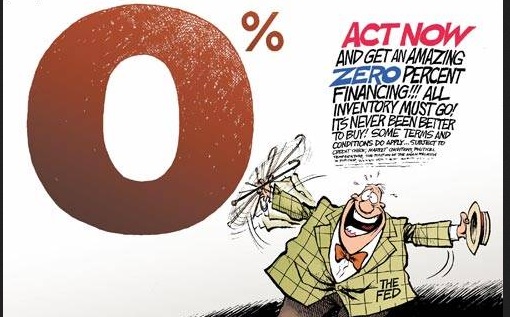
Jared Meyer writes:  Even though the Federal Reserve has ended its massive bond purchases, interest rates remain near zero, where they have been held since late 2008. Low interest rates remain even though the economy has improved.

The Fed believes that if it can keep long-term interest rates low, business investment and consumer spending will increase and the economy will grow. However, the Federal Reserve is unable to singlehandedly create economic growth. Its role is instead to execute sound, consistent monetary policy, which provides the backdrop for a strong economy.

Historical evidence shows that interest rate increases during the early-to-middle stages of economic expansions do not endanger economic growth. As Boston College economics professor and Shadow Open Market Committee Member Peter Ireland argues,“These higher rates are nothing to be feared. To the contrary, they are a necessary component of a broader policy strategy designed to keep the economy growing along a stable path while maintaining the environment of slow-but-steady inflation that has served the country so well, going back more than a quarter century to the days of Paul Volcker’s Fed chairmanship.”

The Federal Reserve’s continued accommodative monetary policy is unlikely to increase GDP or employment growth. Instead, suppressing interest rates in times of increased and sustained economic growth increases the risk of inflation. It is time for the Federal Reserve to let interest rates rise with the improved economy.

Interest Rates

Entrepreneurial Opportunities in Cuba?

A.. J.  Corchado writes:  When the news of the biggest political thaw in more than half a century between the U.S. and Cuba finally came, Cynthia Thomas discovered an unusual longing.  For more than 14 years, Thomas faced an uphill battle in helping lay the foundation for Texas companies to do business in Cuba. President Barack Obama’s Dec. 17 executive order to normalize relations with Cuba provides Texans with a new opportunity.

While normalization won’t be complete until Congress ends its economic embargo, Thomas and others believe the move is a milestone for the United States, particularly Texas. Over the years, Texas leaders have touted possible deals for beans, cotton, rice, grain, packaged desserts, organic soaps, livestock, even airlines and ports. Success has come slowly, with overall sales of Texas agriculture products topping $89 million in 2009 before falling. Some agricultural products are exempt from the embargo.

The fact that Texas doesn’t carry the political baggage of the swing state of Florida bodes well for the Lone Star State.

Texas and Cuba — the Western Hemisphere’s last communist nation — may seem like an odd match, but they share intriguing bits of history. Both have had revolutions. Both have a passion for gritty cowboys, fine cattle and baseball. And both have unwavering pride in their independent spirit, underscored by their flags, each emblazoned with a single star.  On Fidel Castro’s first and only trip to the United States in 1959, he stopped in Houston, met with a Texas cattlemen’s group and donned a cowboy hat for the cameras.

Texas lore fascinates Cubans. Near Cuba’s heartland town of Camaguey, where Texas’ King Ranch once owned thousands of acres and raised the most prized cattle herd around, locals readily embrace norteño music, known in Texas as Tex-Mex. The properties were expropriated by the Cuban Revolution and are now known as Rancho King, said to be one of Fidel Castro’s favorite places for quiet reflection.

Cuba will require patience for investors and tourists. The island is packed with well-educated residents hungry for technology, new fashion styles, restaurants, etc. Yet much of the population of more than 11 million people is mired in poverty. With a per capita gross domestic product of about $3,900, most Cubans cannot afford pricey foreign products.  The key, he added, will be the development of the Cuban tourism industry, which boasts of its stunning beaches.

 Cuba Opens Up