Entrepreneurs: Sell 1, Give 1 Away?


US Money Toms
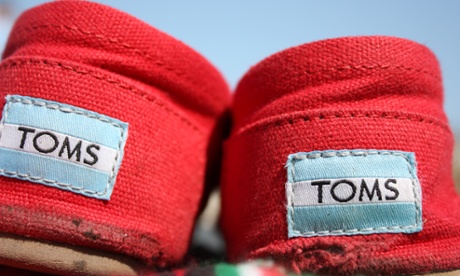
Blake Mycoskie founded Tom’s in 2006.  It was the first one for one company. 

Five years after he lost his shot at winning $1m in the first season of The Amazing Race, Mycoskie returned to Argentina to explore the country – and Malbec. Few days into his trip, he found himself joining in on a shoe drive, collecting shoes in a better-off areas and then driving them to places outside the city to be distributed to the poor.  “When we started pulling out the shoes, you’d have thought it was Christmas day. These kids were so excited to get these shoes and they weren’t even new. They weren’t even in the package.”

Mycoskie was excited, too. Until he realized that come next year, the 250 children they had outfitted with shoes would need a new pair again. Taking few extra weeks in Argentina, he came up with a plan: he had a local shoe maker make about 250 pairs of shoes, he would sell them back in California and then use the money to get another 250 pairs to give the kids.

Simple, right?

That’s until the Toms shoes, as he called them, actually took off. After being rejected by a couple of places, a store agreed to sell about 80 pairs of Toms shoes. Mycoskie had sold another 30 to friends and relatives, through a website he had created, with one or two orders coming in each week. The day after an article appeared in the LA Times, Toms received orders for 2,200 pairs of shoes by 2 o’clock that afternoon.

“But I only had 140 pairs in my apartment. This was the first of my many supply chain problems to come,” says Mycoskie. “I did what I think a lot of entrepreneurs do in a time of dire need – I started posting as many ads for interns on craigslist as possible. And that strategy worked.”

Within a week, he had three interns contacting all the people who placed their and whose cards were already charged, to let them know that they were working on filling their orders. At the same time, Mycoskie was on a plane to Argentina to figure out how to make more shoes.

The new supply chain, consisting of six to seven guys making about 800 to 900 shoes a week, worked– that is, until Anna Wintour’s office called.  Vogue Magazine [made] it look like I know exactly what I am doing,” Mycoskie says of the article. “This does not look like a guy who is selling shoes out of his apartment with interns and they are making them in garages all throughout Buenos Aires and because it was Vogue magazine – all of a sudden everyone through we were a real company.”

That year Toms ended up selling 10,000 shoes out of Mycoskie’s apartment. Since then Toms’ ‘One for One’ has grown beyond shoes to eyewear and coffee.

Says Mycoskie in interview:  II am a very curious person and I need to be stimulate, to stay engaged. If I was just doing shoes all the time and working on just giving shoes, I think I’d get bored. Part of the reason we do these other products is, one, so we can help people in more ways and that’s very gratifying.

I think companies are starting to realize that there is real opportunity to address needs and build sustainable, profitable businesses at the same time.

Did you anticipate that consumers would be so enthusiastic about your social mission?

No, of course not. We figured out early on that people were interested in what we were doing but never did we anticipate the demand that we’ve had.

What are some of the more interesting things you are hearing from your customers? Do they want to do more?

The most interesting thing is that customers really want to be connected, not just at a time of the purchase, but through the life cycle of the purchase.

Is there anything you would have done differently?

I wish that I had more experience on the retail side.

Hiring:

As the company grows there is this pressure to hire all these people that have the right things on their resume and have done the job before and all that stuff. But the truth is there is not so much about doing the job before, it’s about being the right mentality and attitude so that you can learn the job and you can do it with the right spirit.


Jamie Dimon Got What He Wanted in the US Budget

The sudden dramatic collapse in the price of oil could cost trillions of dollars in oil derivative losses; and the FDIC could be liable, following repeal of key portions of the Dodd-Frank Act last weekend.  That means taxpapers will pay for mistakes the banks made — yet again.

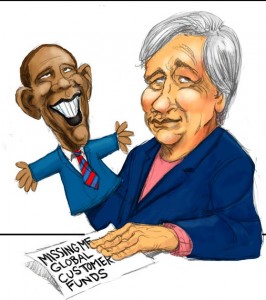
Some have argued that the small section of Dodd-Frank that was repealed when the budget was passed came to not very much.  But why then did Jamie Dimon of JP Morgan Chase and President Obama lobby lawmakers to vote for the bill.

Ellen Brown writes:  Quibbling over a mere 5% of the derivatives business sounds like much ado about nothing, but Jamie Dimon and the president evidently didn’t think so. Why?

Under Dodd Frank, FDIC-insured banks were not allowed to put depositor funds at risk for their bets on derivatives, with certain broad exceptions.  At FDIC insured banks, interest rate, currency, gold/silver, credit derivatives referencing investment-grade securities, and hedges werepermissible activities within an insured depositary institution. Those not permitted included “equity, some credit and most commodity derivatives.”

A fraction, but a critical fraction, as it included the banks’ bets on commodities. Five percent of $280 trillion is $14 trillion in derivatives exposure – close to the size of the existing federal debt.  $3.9 trillion of this speculation is on the price of commodities.

Among the banks’ most important commodities bets are oil derivatives. An oil derivative typically involves an oil producer who wants to lock in the price at a future date, and a counterparty – typically a bank – willing to pay that price in exchange for the opportunity to earn additional profits if the price goes above the contract rate. The downside is that the bank has to make up the loss if the price drops.

The drop in the price of oil by over $50 a barrel was completely unanticipated and outside the predictions covered by the banks’ computer models. The drop could cost the big banks trillions of dollars in losses. And with the repeal of the Lincoln Amendment, taxpayers could be picking up the bill.

It may well be that the head of JPMorgan Chase, the President’s personal banker, wanted his losses covered and that’s what he got when the budget was passed.  Jamie Dimon got the public to pay again.

The Budget Passed


Japanese Draw Down Savings

Keith Ujikane and Tru Fujioka write:  Japanese drew down savings for the first time on record while wages adjusted for inflation dropped the most in almost five years, highlighting challenges for Prime Minister Shinzo Abe as he tries to revive the world’s third-largest economy.

Real earnings fel 4.3 percent in November from a year earlier, a 17th straight decline and the steepest tumble since December 2009, the labor ministry said today.

A higher sales tax combined with the central bank’s record easing are driving up living costs, squeezing household budgets and damping consumption. Abe’s task is to convince companies to agree to higher wages in next spring’s labor talks to sustain a recovery.

Abe is trying to generate a virtuous cycle in the economy, where higher incomes fuel consumer spending, which in turn prompts companies to boost investment and wages. Last week he secured a pledge from business leaders to do their best to boost pay next year.  The government will aim for wages to increase faster than inflation.

The savings rate, which the Cabinet Office calculates by dividing savings by the sum of disposable income and pension payments, peaked at 23.1 percent in fiscal 1975.

As Japan’s population ages, its growing ranks of elderly are tapping their savings, according to the Cabinet Office. Consumers also ran down savings to make purchases ahead of a sales tax-increase in April, the first since 1997.

Japanese officials for years rebutted American pressure on their commerce policies by attributing much of the trade gap between the two nations to Japan’s higher savings rates. The central bank chief said in 1993 that Japan’s trade surplus would remain because of its high savings rate. The country’s top trade negotiator was cited in 1994 saying “Americans should save more, and Japanese should spend more” to balance trade.

Japan’s shrinking workforce is intensifying a labor shortage that Kuroda has said will prompt an increasing number of companies to boost pay to secure workers. So the Bank of Japan and Abe hope.

Savings in Japan


Role of the US Fed in Crises?

DIrk Ehnts asks: Can the private sector — firms ahd households, borrow from the central bank?  The answer is “no, but…”   The definition of a financial crisis should be “things are so bad that rules are broken, procedure ignored”. Let’s look at one of the instances of financial crisis: the Federal Reserve Bank in the last financial crisis.

The Fed has “emergency powers”, which have been granted by Congress in 1932 and expanded in 1991.  The Emergency Banking Act of 1933 contains this clause.

Subject to such limitations, restrictions, and regulations as the Board of Governors of the Federal Reserve System may prescribe, any Federal reserve bank may make advances to any individual, partnership, or corporation on the promissory notes of such individual, partnership, or corporation secured by direct obligations of the United States or by any obligation which is a direct obligation of, or fully guaranteed as to principal and interest by any agency of the United States. Such advances shall be made for periods not exceeding 90 days and shall bear interest at rates fixed from time to time by the Federal reserve bank, subject to the review and determination of the Board of Governors of the Federal Reserve System.

The Fed has this question in its FAQ section:

What types of investment funds are eligible borrowers?
Investment funds that are organized in the United States and managed by an investment manager that has its principal place of business located in the United States are eligible borrowers for purposes of the TALF. However, any investment fund which is not a U.S. company in accordance with the last sentence of the first FAQ in the “Borrower Eligibility” section is not an eligible borrower for purposes of the TALF.

The Fed also extended credit to rescue Bear Stearns and American Insurance Group (AIG), which was highly controversial when it happened.  The Fed was forced to reveal some information about the balance sheet operations.  There were also swap programs with five central banks. The Fed writes:

In November 2011, the Federal Reserve announced that it had authorized temporary foreign-currency liquidity swap lines with the Bank of Canada, the Bank of England, the Bank of Japan, the European Central Bank, and the Swiss National Bank. These arrangements were established to provide the Federal Reserve with the capacity to offer liquidity to U.S. institutions in currencies of the counterparty central banks (that is, in Canadian dollars, sterling, yen, euros, and Swiss francs). The Federal Reserve lines constitute a part of a network of bilateral swap lines among the six central banks, which allow for the provision of liquidity in each jurisdiction in any of the six currencies should central banks judge that market conditions warrant. In October 2013, the Federal Reserve and these central banks announced that their liquidity swap arrangements would be converted to standing arrangements that will remain in place until further notice. Since their initial establishment in 2009, the Federal Reserve has not drawn on any of the foreign-currency liquidity swap lines.

In the longer term and as its authorities permit, the Treasury will seek to remove from the Federal Reserve’s balance sheet, or to liquidate, the so-called Maiden Lane facilities made by the Federal Reserve as part of efforts to stabilize systemically critical financial institutions.

By now, all the Maiden Lane facilities have been resolved.  What has not been resolved is the role of Central Banks in financial crises.  In the US, the Fed has come out smelling quite good.  Whether or not recorvery will trickle down to the middle and low class remains to be seen.

Federal Reserve Swaps Currency?

Does Gender Diversity Work?


Should you opt for diversity, picking an equal number of men and women to comprise your team, or should you instead create a single-gender office?

Well, it all depends on whether you’re aiming for a happy staff—or a productive one.

A new study, Gender Diversity in the Workplace conducted by researchers at the Massachusetts Institute of Technology and George Washington University, found that people are happier working with employees of the same gender—yet, surprisingly, gender-diverse teams tend to be more productive.

The researchers looked at anonymous employee surveys administered at a Boston-based professional services company between 1995 and 2002 that measured cooperation, trust and work enjoyment; they also analyzed the teams’ revenue over that same time period.

The managers of firms face the challenge of assembling a workforce and a culture that
will succeed in the task at hand. The results of this paper shed light on how actual and
perceived diversity is associated with indicators of firm social capital and measures of
ultimate office performance, revenues.
We find that the perception that a firm is supportive of diversity in an office is posi-
tively associated with indications of the level of cooperation in that office. Other proxies
for social capital or corporate culture, such as employee morale and satisfaction, were
also higher in offices in which this perception was higher. Nevertheless, the presence of
actual gender diversity was a significant factor in
reducing
these same measures of social
capital. At the same time, tenure diversity had little measurable association with proxies
for social capital.
Inoursecondsetofresults,weinvestigatethedeterminantsofoffice-levelrevenues.
We find that the perception that the firm accepts diversity has no estimated payoff in this
dimension. Interestingly, gender diversity is associated with a positive contribution to
revenues, although this effect is diminished once office-level fixed effects are included.
In contrast, tenure diversity is associated with lower revenues.
We note an interesting contrast between our results on tenure diversity and gender
diversity. Tenure diversity had little association with our measure of social capital but
a strong negative association with performance. Gender diversity seems to affect the
functioning of the firm in quite a different way. Our first set of results suggests that
gender diversity could have detrimental impacts on the formation of firm social capital,
but the revenue results suggest that whatever impacts it had were outweighed or at least
canceled by the direct contribution of gender diversity in the office

Do Fines Deter Banks?

Howard Davies writes:  In November, the United Kingdom’s Financial Conduct Authority (FCA) announced a settlement in which six banks would be fined a total of $4.3 billion for manipulating the foreign-exchange market. And yet share prices barely reacted. Why?

The nefarious practices and management failings uncovered during the yearlong investigation that led to the fines were shocking. Semi-literate email and chat-room exchanges among venal traders revealed brazen conspiracies to rig the afternoon exchange-rate “fix” for profit and personal gain. Using nicknames like “the three musketeers” and “the A-team,” they did whatever they liked, at an enormous cost to their institutions.

But, despite the huge FCA fine, no top executive was forced to leave and investors did little more than shrug.  Even $4.3 billion is small change when compared to the total fines and litigation costs incurred by the major banks over the last five years. Morgan Stanley analysts estimate that the top 22 banks in the United States and Europe have been forced to pay $230 billion since 2009 – more than 50 times the cost of the FCA settlement. This is over and above the heavy losses that banks incurred from bad lending and overambitious financial engineering.

American banks have incurred more than half of these massive penalties. The European bill amounts to just over $100 billion – roughly half of which was paid by the top seven British banks.

In the US, the penalties have been dominated by fines for sales of misleadingly marketed mortgage-backed securities, often to the two government supported entities Fannie Mae and Freddie Mac.

In the UK, by contrast, the biggest penalties have come in the form of compensation payments made to individual mortgage borrowers who were sold Payment Protection Insurance.

The Morgan Stanley analysis suggests that we can expect another $70 billion in fines and litigation costs over the next two years from already identified errors and omissions.

The irony here – not lost on the major banks’ finance directors – is that as fast as banks add capital from rights issues and retained earnings to meet the demands of prudential regulators, the funds are drained away by conduct regulators.

Some of the money, especially in the UK, has gone back to individual customers. Today, the payments have become so large that the government has seized them and channeled revenues exceeding the regulator’s enforcement costs to veterans’ charities.

In the US, the end recipients are less clear; indeed, they are undisclosed. Charles Calomiris of Columbia University has challenged what he calls “a real subversion of the fiscal process” as funds are raised and spent in non-transparent ways.

Do fines on this scale serve as useful deterrents?  Clearly, the post-crisis period has revealed unacceptable behavior in many institutions. It will be some time before we know whether large fines on corporations, paid principally by their shareholders, contribute to keeping the system honest.

Whether the current approach serves as an effective deterrent is a question that should be widely debated. Senior bank managers and regulators have a common interest in developing a more effective system – one that punishes the guilty and creates the right incentives for the future.

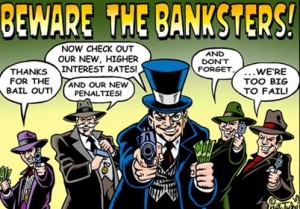
Bank Fines

Campaign 2016: Breakup Banks?

Simon Johnson writes:  Citigroup took advantage of the budget approval process in te US Congress to tuck into thousands of pages of law the repeal of some of the 2010 Dodd-Frank financial reforms. The passages were drafted by Citigroup lobbyists and inserted in legislation at the last moment.

At a stroke, Citi executives demonstrated both their continued political clout in Washington and their continued desire to take on excessive amounts of financial risk.  This is exactly what Citi did during the 1990s and 2000s under Presidents Bill Clinton and George W. Bush – with catastrophic consequences for the broader economy in 2007-09.

Breaking up Citigroup is under serious consideration as a potential campaign theme. For example, in a powerful speech – watched online more than a half-million times – Senator Elizabeth Warren responded uncompromisingly to the megabanks’ latest display of muscle: “Let’s pass something – anything – that would help break up these giant banks.”
Warren is attracting a great deal of support from the center and the right.

Senator David Vitter of Louisiana is the most prominent Republican member of Congress in favor of limiting the size and power of the biggest banks, but there are others who lean in a similar direction. The vice chair of the Federal Deposit Insurance Corporatio consistently warns about the dangers associated with megabanks. Former FDIC Chair Sheila Bair, a Republican from Kansas, argues strongly for additional measures to rein in the biggest banks.

From the perspective of anyone seeking the nomination of either of America’s political parties, here is an issue that cuts across partisan lines. “Break up Citigroup” is a concrete and powerful idea that would move the financial system in the right direction. It is not a panacea, but the coalition that can break up Citi can also put in place other measures to make the financial system safer.

Megabanks are accused of abuse of power and the great rip-off of the middle class. Crony capitalism is implicit in the massive implicit government subsidies that these banks receive. Both left and right agree on the fundamental asymmetry that the recent “Citigroup Amendment” implies: Bankers get rich whether they win or lose, because the US taxpayer foots the bill when their risky bets fail.

Potential Republican presidential candidates have hesitated to take up this issue in public – perhaps feeling that it will inhibit their ability to raise money from Wall Street. Among the Democrats, however, the opportunity seems to be much more compelling; indeed, avoiding a confrontation with Wall Street might actually create problems for a candidate like Hillary Clinton who is close to Wall Street.

This idea would attract support from centrists. “Break up Citigroup, end dangerous government subsidies, and bring back the market.” The US presidential candidate who says this in 2016 – and says it most convincingly – has a good chance of winning it all.

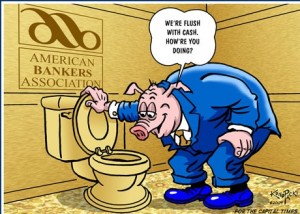
Break up the Banks

Should Greece’s Sovereign Debt Be Cancelled?

Ashoka Mody writes:  The European Commissioner for Economic and Financial Affairs, Pierre Moscovici’s unnecessary—and unseemly—visit to Athens served to spotlight Europe’s corrosive politics.

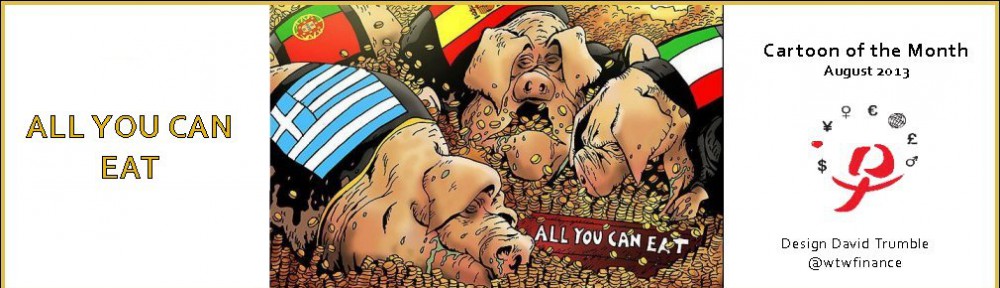
Greece should not have been a member of the eurozone. But after the German Chancellor Helmut Kohl ensured Italy’s inclusion in May 1998, Spain and Portugal were waived in. So, the inevitable Greek entry came in 2002.

From October 2009, when Greek authorities acknowledged that they had lied about their fiscal accounts, to May 2010, the claim was that the problem would go away without external help. When eventually the troika—the European Commission, the European Central Bank, and the International Monetary Fund—put together a large bailout fund, the manifestly untenable claim was that Greece would repay its private creditors in full. In July 2011, the repayment terms on the troika’s debt were eased, but it was too little too late. Large losses were eventually imposed on private Greek creditors but not before harsh austerity caused an extraordinary slump in growth and lasting misery.

Today, the only right way forward is for the troika to allow Greece to repay its official creditors in, say, 100 years. This will effectively mean debt forgiveness but the cosmetics may help German leaders tell their citizens that they will be repaid.

But, of course, the system fights back all rational thinking. Ireland and Portugal will yelp that they also deserve more relief on their troika borrowings. More fundamentally, the forgiveness will directly contravene the Lisbon Treaty’s no-bailout provision, which prevents one member state from paying another’s debts. That would call into question the constitutionality of the European Stability Mechanism, which was approved by the European Court of Justice on the basis that the loans from the facility would be repaid with an “appropriate margin.”

At some point, a new fork in the road has to be taken. Today, Greece offers an opportunity to modestly test the eurozone’s pressure points. The stakes are high not just for the resolution of the crisis but for the future shape of Europe.

The same debates are being played out in Spain and will inevitably appear in Italy, which is being sucked into a debt-deflationary cycle. The discordant politics will make the resolution of economic challenges ever harder.

With Greece, the mistakes were legion. But a fresh start is now possible. Forgive the troika’s Greek debt. With a primary surplus—fiscal revenues above expenditures—and with now a very low public debt burden, Greece can start afresh with private creditors. The task of monitoring Greek fiscal accounts must shift from Mr. Moscovici’s office in Brussels—and from German officials—to private creditors.

Private creditors who will own newly-issued Greek debt will also unambiguously bear the burden of future defaults, ideally automatically and incrementally through sovereign “cocos”.  A one-time violation of the no-bailout provision would be accompanied by a credible new no-bailout regime. And Greece will remain under pressure to reform and manage its public finances, but under a less politically-charged regime.

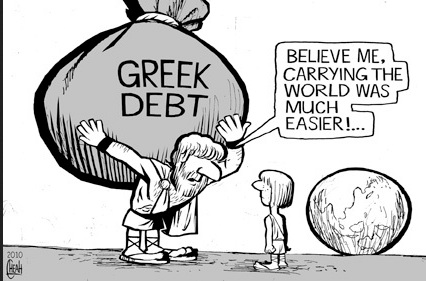
Greek Debt

Does Inequality Impact Growth?

Rising income inequality has cost European economies up to 10 percent in lost economic output over the past twenty years, according to a new report by the bloc’s leading economic thinktank.

The richest 10 percent across the OECD’s 34 member countries earn 9.5 times as much as the poorest 10 percent.

The report, published by the OECD, refutes the concept of ‘trickle-down economics’ which the political establishment in most western countries have signed up to for the past generation.

While a raft of recently published research has demonstrated that countries with high levels of income inequality suffer from higher levels of crime and health and social costs, there has hitherto been little evidence that it acts as an active drag on economic performance.

The richest 10 percent across the OECD’s 34 member countries, most of whom are EU members, now earn 9.5 times as much as the poorest 10 percent, up from a 7:1 ratio in the 1980s.

However, France, Ireland and Spain bucked the trend, where lower gaps between rich and poor actually gave a marginal boost to economic growth prior to the economic crisis, while inequality has had a more detrimental effect in the UK and Finland – where it shaved off nine percent from growth – than in Italy and Sweden which lost an estimated six percent of output between 1990 and 2010 because of rising inequality.

“Income inequality has a sizeable and statistically significant negative impact on growth,” the report says, adding that “redistributive policies achieving greater equality in disposable income has no adverse growth consequences.”

The research indicates that income inequality gradually lowers the educational achievement of students with poor parents, lowering social mobility in the process.

“Addressing high and growing inequality is critical to promote strong and sustained growth,” said Angel Gurria, the OECD’s Secretary General, at the the launch of the report.

“Countries that promote equal opportunity for all from an early age are those that will grow and prosper,” he added.

In response, the OECD urges governments to hike property taxes on property and wealth and scrap tax breaks that disproportionately benefit higher earners, alongside greater support for the bottom 40 percent of earners to make sure that they are not left further behind.

“As top earners now have a greater capacity to pay taxes than ever before, governments may consider re jigging their tax systems,” argues the report, adding that governments should also increase access to education, healthcare and training.

“Anti poverty programmes will not be enough,” it states.

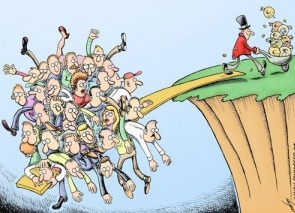
Inequality

Investors Shun Turkey

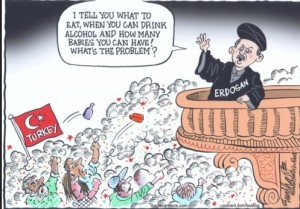
Mehmet Cetingulec writes:  Turkey is in urgent need of investment to stem rising unemployment. It is all but obvious now that the construction sector alone cannot sustain economic growth and reduce unemployment. Investment is needed from both foreign and local sources to build plants and create jobs. Yet, economic data for the first nine months of the year shows that foreign direct investment (FDI) in Turkey is on the decline, while Turkey’s own investors are increasingly fleeing abroad.

Optimism was high earlier in the year. FDI stood at $5.1 billion in the first four months, and was estimated to reach $16 billion at year end.  What happened in the second half of the year that made investors lose their appetite?

While the impact of the conflicts in Iraq, Syria and Ukraine on Turkey grew, expectations rose that emerging economies would have trouble following the US decision to stop monetary expansion. Domestically, unrest in the mainly Kurdish southeast and escalating political tensions have also discouraged foreign and local investors.

Even the revised growth target lowered from 4% to 3.3%, has become unattainable amid a downturn in investment and industrial output.

The official jobless rate, 10.1% in August, climbed to 10.5% in September. No fewer than 3,064,000 Turks are looking for work.

According to the latest data on investment, the key factor affecting unemployment, FDI inflows amounted only to $750 million in September. FDI in the first nine months of the year stood at $9.12 billion. This figure, however, includes $3.1 billion invested in real estate, which means that foreigners put only about $6 billion in business.

CHP lawmaker Umut Oran, who has conducted a comprehensive study on domestic and foreign investments, told Al-Monitor, “For years, the government managed the system with hot money. Now it is about to face the bitter reality.”

Oran argued that the Justice and Development Party (AKP) government wasted time with economic models that failed to create jobs. Turkish capital invested abroad hit an all-time high of $4.2 billion in the first nine months of the year, up 113% from the same period last year.

“Turkey is no longer able to lure foreign capital, as it keeps drifting away from democracy and the rule of law to being a country whose judiciary is paralyzed and public auditing mechanisms are used as a weapon by the government, and which is increasingly becoming a third-world country where one-man rule is taking root amid rampant corruption,” Oran said. “Local capital is looking for countries to flee [to]. Its new destinations are the Netherlands, Germany, Azerbaijan and the United States.”

Faik Oztrak, CHP deputy chairman for relations with the business community and a former Treasury undersecretary, told Al-Monitor he had obtained more recent figures, which indicate that FDI in the first 10 months of the year amounted to $10 billion, while Turkish investment abroad reached $4.7 billion in the same period.

“Our businesspeople seem to believe that the investment climate in Turkey has deteriorated. And they have good reasons for that. To expect them to make investments in a country where the rule of law takes blows each and every day, where the concept of justice is eroding and political interference in the economy is increasing, would be over-optimistic,” Oztak said.

Oztrak’s point is of critical importance. The Turkish economy faces an uphill track, even though it benefits from falling oil prices. Before anything else, Turkey has to guarantee law and justice, stamp out nepotism and make sure to address people’s fears.

Turkey's Economy