Four EU Countries in Top Ten

Benjamin Fox writes:  Four EU countries in the world’s top ten economies.

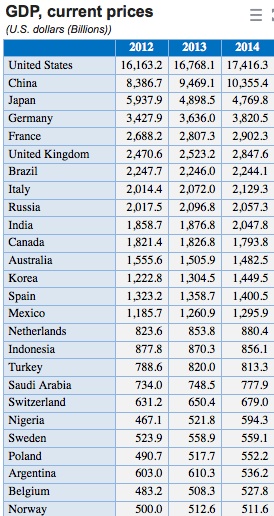
– Four European countries are in the world’s 10 largest economies, according to research by the Centre for Economic and Business Research.

The annual World Economic League Table 2015 published on Friday (26 December) by the London-based think tank puts the US as the world’s main economic powerhouse, followed by China and Japan.

Germany, the UK and France take the fourth, fifth and sixth spots, respectively, with Italy, in the eighth place, the only other EU country in the top 10.

The UK has edged ahead of France into fifth place in this year’s rankings, although the Cebr comments that the $1 billion (€850 million) gap in output between the two countries is “well within the margin of error” and would likely be extinguished if France’s markets in drugs and prostitution, which “may prove to be ‘larger than their British counterparts”, were included.

In June, the UK economy received a statistical boost of £65 billion (€80 billion) following the introduction of new EU accounting rules allowing the so-called ‘grey economy’, which includes proceeds from drug trafficking and prostitution, to be recorded.

Meanwhile, Russia is the main loser in the new list, dropping from eighth place to tenth in the rankings, with Cebr chief executive Douglas McWilliams suggesting that Moscow’s role in the ongoing Ukraine conflict was a factor in the country’s economic decline.

“The fun of the world economic league table is that it brings things back to hard figures,” said McWilliams.

He added that “countries like Russia and Argentina, who have invaded neighbouring countries and whose leaders spout aggressively nationalistic rhetoric, are brought down to earth by their falls in the league table as their economies collapse”.

The Russian economy is poised to endure a 4.5 percent recession in 2015 as a result of falling oil prices and the effects of western sanctions.

Last week the country’s central bank was forced to spent around €3 billion of its foreign currency reserves to prevent a run on the rouble currency.

But the next 15 years are likely to be about the continuing rise of some of the ‘Bric’ countries – Brazil, Russia, India, and China.

China is projected to overtake the US by 2025 as the world’s largest economy, the Cebr forecasts, while the “unstoppable” rise of India will see it become the world’s third-largest economy by 2024.

In Europe, meanwhile, Cebr predicts that Germany’s ageing and declining population, coupled with the weakness of the euro, will allow the UK to overtake it by 2030.

IMF GDP October 2014

The Social and Economic Cost of Incarceration

Robert Rubin, Secretary of the Treasury and Nicholas Turner, head of a criminal ustie institute write on the problem of high incarceration rates in the US.  They cite a comprehensive report  published this year.

This is not only a serious humanitarian and social issue, but one with profound economic and fiscal consequences. In an increasingly competitive global economy, equipping Americans for the modern workforce is an economic imperative. Excessive incarceration harms productivity. People in prison are people who aren’t working. And without effective rehabilitation, many are ill-equipped to work after release.

Interestingly one person exploring a possible Presidential candidacy in 2016, former Senator Jim Webb of Virginia, has been trying to address this problem for a very long time. He first became interested in inarceration rates when he visited prisons in Japan, a country half our size with incarceration rates about 1/20th of ours.

He then tried to develop ths issue as he was campagining.  When asked whether this was foolish for a US politician, whose popularity is usually determined by ‘tough on crime’ caveats, he said he felt a politican should lead on issues, not follow.

Clearly in the US our punishment of victimless crimes is out of control.  Clearly also, the majority of people incarcerated are of African American descent.

In addressing on a deeper level the cause of racial division in the US, we would do well to listen to Jim Webb.

Robert Rubin seldom bills as one his crednetials his position as a partner of Robert Freeman on the arbitrage desk of Goldman Sachs.  Freeman was led out of Goldman in handcuffs for insider trading, although he ended up only pleaing to a mail fraud charge. He did spend 4 months in jail, a rare event for people of Freeman and Rubin’s ilk.   Is Rubin’s recent interest a mea culpa or a way of lobbing an issue up in the air that is more apporpriately Jim Webb’s than Rubin’s good friend Mrs. Clinton’s.

Let’s hope that if this is poitics as usual that the issue sticks and begins to be addressed in the US.

Behind Bars


Flowering Entrepreneurs in Haiti

An average Haitian flower producer using traditional methods makes $170 per year on a surface of 1,000 square meters; a farmer who owns a greenhouse can generate between $1,500 and $2,500 annually, depending on the crop, on only a 70-square meter area—a staggering difference.

Farmers like Michel Dorlean, a flower producer, struggled financially. The horticulturalist grew up learning the family business of planting flowers on traditional hillside plots in his mountainous village of Furcy. The hillside locations leave flowers vulnerable to excessive heat, wind, humidity and rain. Dorlean used to lose a portion of his yields to weather.

But last year, his battered flower plots flourished into a profitable business thanks to greenhouse activities spurred by Feed the Future West, a USAID-supported project under Feed the Future. “You may not believe this, but my father has been working in the flower business for 40 years and, without exaggeration, I can say that within five years I will earn more than he made in all those years,” Dorlean said.  Flowering Entrepreneurs

Terracing Gardens

Counterfeits on Canal

Popular fashion designs have been copied throughout history—and a new exhibition reveals the blurred line between stealing an idea and celebratory homage.
Today, counterfeit fashion evokes heaving piles of fake designer bags on Canal Street. Or fast-fashion chains like Zara and H&M churning out runway imitations.But the phenomenon of counterfeiting is as old as couture itself. In the early 1900s, fashion forgers often sketched designs they saw in Paris shows and sold reproductions in France and overseas. By 1914, more than two million fake couture labels had been sewn into garments, several of which are currently on view in New York City at the Museum at FIT’s exhibition.
The superb economic writer for the New Yorker magazine pointed out that counterfeits are really a win-win business.

The only people who can afford the real thing buy it six months before counterfeits are on the market.  By the time they have competition on the street, they have moved on to the next luxury item.  Rich people are flattered as the peons pick up their Vuitton bags and Chanel suits.  Designers are inspired to move on more quickly to catch the next wave.

If we don’t solve the inequality problem this way, at least we make everyone happy for a moment.  Wiin. Win.

Counterfeits

Do the Russians Like Putin?

Alex Berezow writes:   Comedian Norm Macdonald was fond of pointing out that Germans love David Hasselhoff.  Germany’s infatuation with “The Hoff” pales in comparison to Russia’s admiration of Vladmimir Putin that archaeology-loving, race-car-driving, tiger-tranquilizing, bare-chested survivalist known affectionately to some former world leaders as Pooty Poot.

Despite a deeply troubled economy, international notoriety, and a ruble that has collapsed in value, Russians are standing by their man with a stunning 81% approval rating.

Mr. Putin has maintained an approval rating of 61% or higher since he has assumed high public office. (The only exceptions were his first two months in office when many Russians still didn’t know who he was.)

What can we conclude from this?  Mr. Putin’s popularity went soaring within months of his taking office.  His approval rating has remained high for 15 years. The more tyranical he behaves, the more popular he becomes.

Putin’s popularity, therefore, is likely to due something else: Russians don’t think highly of Western-style democracy.  .Forty-five percent of Russians believed a Western-style democracy would be destructive to the country.

The unsettling conclusion is that an anti-democratic, tyrannical bully who is willing to invade his neighbors for the sake of Russian glory is exactly the sort of leader Russians want. Mr. Putin is not acting in defiance of the will of the people; rather, he is the embodiment of the Russian mindset. This is deeply troubling.

Russians want Putin as their leader, and thus, they deserve whatever economic catastrophe likely awaits them in the not-too-distant future.

Putin, A Successful Leader

Tobacco Bonds, Wall Street and the Raters

Cezary Polkul writes:  When the economy nosedived in 2008, it didn’t take long to find the crucial trigger. Wall Street banks had peddled billions of dollars in toxic securities after packing them with subprime mortgages that were sure to default.
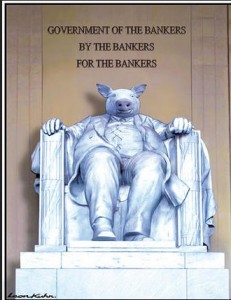
Behind the bankers’ actions, however, stood a less-visible part of the finance industry that also came under fire. The big credit-rating firms – S&P, Moody’s and Fitch – routinely blessed the securities as safe investments. Two U.S. investigations found that raters compromised their independence under pressure from banks and the lure of profits.

Now there is evidence the raters also may have succumbed to pressure from the bankers in another area: The sale of billions of dollars in bonds by states and municipalities looking to quickly cash in on the massive 1998 legal settlement with Big Tobacco.

Credit-rating agencies are supposed to make independent judgments about the risks of a deal. But in their pitches for state business in tobacco bonds, bankers bragged they could manipulate the raters to get favorable treatment for their transactions.

A review by ProPublica of documents from 22 tobacco bond offerings sold by 15 state and local governments shows that bankers routinely bragged about having their way with the agencies that rated their products. The claims were brazen, the documents show, with bankers saying they routinely played one firm against its competitors to win changes to rating methods, jack up a rating or agree to rate longer-term, riskier bonds.

“Fitch reached out to UBS for input so that they would fall in line with the other ratings agencies,” UBS said after it and other financial services firms dropped Fitch from deals because of its “constraining” stress tests. Following the conversation, “Fitch amended their stress criteria,” UBS told officials in Michigan as it readied a 2006 deal.

In 2007, JPMorgan promised to negotiate Fitch to their knees if Ohio hired the bank for a $5.5 billion deal that was the largest sale, or “securitization” of tobacco settlement payments.

The 140 documents, unearthed through public records requests, show that bankers from six Wall Street firms – UBS, Bear Stearns, Citigroup, Merrill Lynch, JPMorgan and Goldman Sachs – claimed they could persuade the rating agencies to make favorable changes to their criteria.

Garnering better grades for the tobacco bonds meant the bankers could sell more of them, get a leg up on their competition and win millions of dollars in fees from the governments issuing the debt. The state and local governments were trading their annual tobacco payments for up-front cash by making the bond deals. As ProPublica has reported in a series of stories, the bonds have proved much riskier than advertised, leading to fiscal headaches for the issuers and losses for investors.

While there are no indications that the bankers did anything illegal, their claims further undermine the argument by the raters that their opinions are only the result of independent analysis.

Since the economy tumbled in 2008, the estimated $36 billion of bonds issued in the tobacco sector – like so many other corners of Wall Street – have proven to be founded on shaky assumptions.

The future may be even bleaker for a $3 billion sliver of the debt. Those securities, known as capital appreciation bonds, promised balloon payoffs so large – $64 billion, all told – that they are almost certain to default. The documents show bankers pressed rating agencies to ease criteria for evaluating those bonds as well.

ProPublica shared the tobacco bond documents with S&P, Moody’s and Fitch. All denied changing their methodologies, also known as rating criteria, in response to demands from bankers.

In an interview, Nicolas Weill, who oversees Moody’s rating methodologies for tobacco bonds and similar securities, said, “We don’t negotiate criteria.” Those criteria – such as stress tests that gauge how much cash is available to repay the bonds under various scenarios – are “never, ever’’ open to deal-by-deal changes. He said the firm may evaluate different deal structures but only if they meet those criteria.

Fitch said: “With respect to every one of the examples provided to us by ProPublica, we can affirm that no banker or other outside party unduly influenced any of these ratings decisions … We determine our ratings – they are not open to negotiation with issuers and bankers.”

S&P said “On the whole, the assertion that S&P’s cash-flow stress assumptions for tobacco settlement bonds were relaxed is false … credit ratings change because factors that affect credit risk change.”

ProPublica shared the documents with each of the banks. All declined to comment except UBS, which said the bankers involved no longer work for the firm, which exited the municipal bond business amid the 2008 market turmoil.

ProPublica also shared the materials with the Securities and Exchange Commission, which regulates rating agencies and has been working to reform the rating process since the abuses in mortgage-backed securities.

The SEC also has been investigating whether S&P bent its criteria to win ratings of commercial mortgage bonds. The regulator is now seeking to suspend S&P from that part of the business in what would be its toughest action yet against one of the big three raters.

The SEC declined to comment on the documents provided by ProPublica.

The documents give the bankers’ version of what happened, and some degree of exaggeration can be expected in any sales pitch. Nevertheless, former rating analysts, lawyers and regulatory experts who reviewed the documents said the consistency of the bankers’ claims across multiple years, deals and states, compared with known criteria changes and ratings, suggests the banks’ influence was real.

“Banks have a right to advocate for their clients – that’s normal,” said Mayra Rodriguez-Valladares, a financial regulatory consultant who reviewed the documents at ProPublica’s request. “What’s going on here is very different … this is the banks trying to convince rating analysts to make changes to their methodology, and that’s really crossing the line.”  Same Old Ratings
Ukraine One Step Closer to NATO?

Ukraine’s parliament has voted to scrap the war-torn country’s “nonaligned” status, taking it a step closer to a bid for Nato membership and angering Moscow.

Dmitry Medvedev, Russia’s prime minister, said the move by Kiev legislators to renounce military and political neutrality would have “extremely negative consequences”, while Sergei Lavrov, foreign minister, said it was “counterproductive”.

Wary of farther eastward Nato expansion, Moscow has staunchly opposed Kiev’s membership of the Atlantic alliance as well as political and economic integration with the EU.

The conflict in eastern Ukraine has claimed more than 4,700 lives, with 1,000 of them dying in fighting between government and pro-Russian separatist forces in violation of a September ceasefire.

“It will only escalate the confrontation and creates the illusion that it is possible to resolve Ukraine’s deep internal crisis by passing such laws,” Russia’s TASS news agency quoted Mr Lavrov as saying.

Representatives of Kiev, Moscow, the pro-Russian rebels and the Organisation for Security and Co-operation in Europe were due to start a fresh round of peace talks in Minsk on Wednesday.

The talks are expected to focus on attaining a complete ceasefire and the formation of a 30km buffer zone. Officials will also discuss measures to address a mounting humanitarian crisis in eastern Ukraine, where passage of some aid convoys to Donetsk has been blocked.

Two-thirds of MPs backed the legislation to end nonaligned status. But the process for applying to join Nato is expected to last many years and may involve holding a national referendum.

Nato membership for Ukraine is also likely to meet resistance from some alliance members worried about further riling Moscow, though a Nato spokesperson in Brussels on Monday insisted “our door is open and Ukraine will become a member of Nato if it so requests and fulfils the standards and adheres to the necessary principles”.

Public support for joining Nato was low for must of Ukraine’s 23 years of independence but surged this year after Russia occupied the Crimean peninsula and backed a separatist insurgency in the country’s Russian-speaking industrial eastern heartland.

Moscow steadfastly denies sending troops or arms to rebel forces.

Justifying the shift towards Nato, the Ukrainian legislation adopts “aggression against Ukraine from the side of the Russian Federation, its illegal annexation of the autonomous republic of Crimea, waging of a so-called ‘hybrid war,’ military interventions in eastern regions of Ukraine, and constant military, political, economic and informational pressure”.

Such Russian behaviour, according to the legislation, “necessitates better functioning guarantees of independence, sovereignty, security and territorial integrity.”

To Join NATO or Not?

A Present for MF Global Holdings, Jon Corzine’s Company

Federal Court in New York Orders MF Global Holdings Ltd. to Pay $1.212 Billion in Restitution for Unlawful Use of Customer Funds and Imposes a $100 Million Penalty

The U.S. Commodity Futures Trading Commission (CFTC) has obtained a federal court consent Order against Defendant MF Global Holdings Ltd. (MFGH) requiring it to pay $1.212 billion in restitution or such amount as necessary to ensure that claims of customers of its subsidiary, MF Global Inc. (MFGI), are paid in full. The CFTC previously filed and settled charges against MFGI for misuse of customer funds and related supervisory failures in violation of the Commodity Exchange Act and CFTC Regulations (see CFTC Press Release 6776-13). MFGI was required to pay $1.212 billion in restitution to its customers, as well as a $100 million penalty. MFGH’s restitution obligation is joint and several with MFGI’s restitution obligation, pursuant to which a substantial portion of the restitution obligation has already been paid (see CFTC Press Prelease 6904-14). The consent Order, entered on December 23, 2014, by Judge Victor Marrero of the U.S. District Court for the Southern District of New York, also imposes a $100 million civil monetary penalty on MFGH, to be paid after claims of customers and certain other creditors entitled to priority under bankruptcy law have been fully paid.

The consent Order arises out of the CFTC’s amended Complaint, filed on December 6, 2013, charging MFGH and the other Defendants with unlawful use of customer funds. In the consent Order, MFGH admits to the allegations pertaining to its liability based on the acts and omissions of its agents as set forth in the consent Order and the amended Complaint.

The CFTC’s amended Complaint charged that MFGH controlled MFGI’s operations and was responsible for MFGI’s unlawful use of customer segregated funds during the last week of October 2011. In addition to the misuse of customer funds, the amended Complaint alleged that MFGH is responsible for MFGI’s (i) failure to notify the CFTC immediately when it knew or should have known of the deficiencies in its customer accounts, (ii) filing of false statements in reports with the CFTC that failed to show the deficits in the customer accounts, and (iii) use of customer funds for impermissible investments in securities that were not considered readily marketable or highly liquid, in violation of CFTC regulations.

The CFTC’s litigation continues against the remaining Defendants, Jon S. Corzine and Edith O’Brien.

Fines Levied on MF Global Holdings

Can the EU Learn from Turkey?

Mustafah Sunmez writes:  The U.S. will increase interest rates after abandoning the loose monetary policies it adopted against the Great Recession crisis  The EU is not at the same place.   How will re-growth in the U.S. affect other regions?  The changing of the financial climate, especially in the U.S., has brought about the slowing of the economy in emerging countries, including Turkey.  They provide a test case of what may happen in Europe.

Foreign capital invested in Turkey until the US turnaround.  When it returned to the US, the Turkish economy turned south.  As economic growth decreased as production and investments fall, unemployment chas climbed.

The number of unemployed became 3,064,000 in September 2014. The Turkish Statistical Office (TÜİK) declared the official unemployment rate was 10.5 percent. The unemployment rate has been declared to be 9.1 percent for men and 13.6 percent for women. Non-agricultural unemployment is estimated to be 12.7 percent in the same period. Youth unemployment between the ages of 15 and 24 is 19.1 percent.

When economic growth fell below 3 percent, tax income also was reduced.  Budget expenditures increased 11 percent, which are 2 points above inflation. As a result, the budget, which had a deficit of 7 billion Turkish Liras in the first 10 months of last year, in the same period this year had a deficit of 15 billion liras, with an increase of 95 percent.

Interest expenditures within budget expenditures, which reached 45 billion liras, were close to each other in the first 10 months of this year and last year. Interest expenditures are 12.3 percent of the total.

Personnel expenses increased nearly 15 percent to become 94 billion liras, which were 6 points above inflation. The increase in the number of public employees has been the biggest factor in this rise.

A striking increase was experienced in budget expenditures in the premiums of the Social Security Institution (SGK) and its deficit financing items. The SGK took the biggest share of the central budget’s current transfers. From the 363 billion liras of expenditures of the budget in the first 10 months, 22 percent was allocated to its social security deficits and financing.  Fluctuations in emerging markets, first and foremost in Russia, and the expectation of an increase of interest rates from the FED hit the markets big time.

If circumstances force a new raise of the interest rate, this would mean that 2015 will be a new stagnation and shrinking year for Turkey. It should not be too difficult to predict that such an economic climate in a year when general elections will be held will upset voters.

UnemploymentUnemployment among young people is 24.4%; one in four is unemployed.
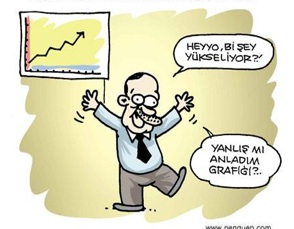
Erdogan: “Hey, something is rising [in this country]?!” “Did I get the chart wrong?…”

Russia Bailing Out Banks

Peter Spence writes: Russia is facing a “full-blown economic crisis”, a former finance minister has warned, as the country is forced to take emergency financial measures.
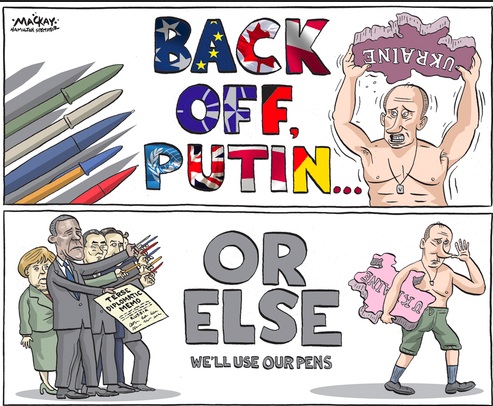
The economy has been battered by a wave of sanctions as a result of tensions over Ukraine, geopolitical uncertainty, and falling oil prices.

Analysts have warned that the Russian economy will not improve in the long-term unless either the oil price or relations over Ukraine improve.

The Central Bank of Russia (CBR) said that a plan to loan Trust bank an amount of up to 30bn roubles (£343m) had been approved, while analysts warned that Russia’s banking sector had become particularly vulnerable.  Anna Stupnytska, an economist at Fidelity Solutions, said that “the risk of a sovereign default is low, it’s the corporate sector where the main vulnerabilities lie, and banking in particular.  Due to sanctions, companies cannot refinance their debt as access to international markets has been essentially cut off.”
A government agency which provides deposit insurance will hold a complex assessment of the bank’s financial standing in order to determine further financial resolution measures.
Russian authorities also moved to reintroduce grain industry protections, stating that the government would develop proposals to control exports within 24 hours.
As the rouble has crumbled over the year, the price of imported goods has risen, putting pressure on Russian budgets.  The CBR now expects that the resultant inflation will reach double digits by the end of the year.  Controls on grain may in turn help to keep a lid on increases in bread prices, although economists warned that shortages may follow.

Meanwhile, US regulators denied clearance to an acquisition by Rosneft, a majority state-owned oil company, putting brakes on its hopes for global expansion.  The decision prevented the purchase of a Morgan Stanley owned oil trading business by the Russian corporation.

When I Need Money I Take ItWHEN I NEED MONEY I TAKE IT!