Pink Tide Rises in Latin America

Across Latin America the pink tide continues to rise.  As opposed to red, pinks relfect more moderate socialist ideas.  Leaders eschew pro-market, free-trade-policies such as privitization and deregulaion.  Anti-poverty policies are the cornerstone of the movement.

When Hugo Chavez died last year, some said pink tide would fade. Since then, Dilma Rousseff fended off a strong challenge in Brazil and in Bolivia Ewa Morales easily won a third time of office.

Leftist politicians have been so popular that more conservative politicians have to move to the center to stay in contention.  Efforts to overturn social security programs have been abandoned.

Extension of term limits in some countries has caused democrats to cry foul.  Some left leaders are accused of not leaning left enough.  Mr. Morales is critisized for supporting a market economy.

Tabare Vasquez victory in Uruguay shows that after 16 years the Pink Tide is still rising.

Humiliate Putin? Lift Sanctions?

Leonid Bershidsk writes:  As Russia’s economic crisis deepens, hurting trading partners from Germany to Tajikistan, many will say Westerns sanctions have succeeded.

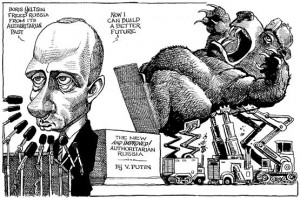
Unconditionally lifting sanctions now would probably be the best way to humiliate Russian President Vladimir Putin and undermine his standing at home.

The sanctions were first introduced in March, after Russia annexed Crimea, but they only got serious in July, after someone — apparently Russia-backed rebels — accidentally shot down a passenger airliner over eastern Ukraine. Their effect was to cut off Russia’s state-owned companies from Western debt markets. By extension, all Russian borrowers became toxic to Western lenders. Even this, however, did not cause any major turmoil in Russia: It is a commodities-based economy, and with oil fetching more than $100 per barrel, the state companies and the financial authorities could attend to any and all refinancing needs without outside help.

Then, in mid-September, Brent oil fell below $100. That was the main ingredient in the soup: The Putin regime has forgotten how to live with low oil prices. Money got short, and the ruble tanked. One could argue that there would have been no meal without the stone, i.e. without the sanctions, but in reality it would probably just be slightly thinner gruel: Russia would still have suffered an economic decline because of its structural problems, oppressive business climate and disinvestment following the Crimea invasion, which convinced many business people, Russian and foreign alike, of Putin’s aggressive unpredictability. Russia’s record capital flight this year started right after Crimea, well before effective sanctions were introduced.

Politically, however, the sanctions helped Putin enormously: They made it possible for him to argue that the West is out to get Russia and that, to survive as a country, it needs to fight back. According to Pew Research, from July 2013 to July 2014, the percentage of Russians with a positive attitude toward the U.S. fell to 23 percent from 51 percent, the steepest such drop in at least 15 years. According to Russian pollsters at Levada Center, in November 2014, 50 percent of Russians didn’t care what the West thought of their country, compared with 40 percent in 2007. And, of course, Putin’s approval soared above 80 percent: He embodied the conviction of 77 percent of Russians that the country needs to follow a non-Western path to succeed.

Now, the security of Putin’s regime rests solely on Russians’ patience with economic hardship. Anti-Putin and pro-government intellectuals are split in their predictions: The former argued the anti-Western, ultra-patriotic mood is just a thin patina that inflation would scrape off within months, while the latter cited Russians’ passive willingness, during previous crises, to go without salaries for months on end. They all agreed, however, that Western sanctions have worked to build, not destroy, that all-important patience, creating a siege mentality and a kind of Stockholm syndrome even in those who have had no love for Putin.

Sanctions on Russia?

Bubble, Bubble, Toil and …..

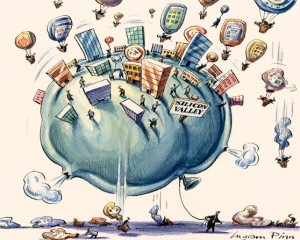
In December 15 years ago the dotcom crash was a few weeks away. Veterans of that fiasco may notice some familiar warning signs this festive season. Bankers and lawyers are being priced out of office space in downtown San Francisco; all of the space in eight tower blocks being built has been taken by technology firms. In 2013 around a fifth of graduates from America’s leading MBA schools joined tech firms, almost double the share that struck Faustian pacts with investment banks. Janet Yellen, the head of the Federal Reserve, has warned that social-media firms are overvalued—and has been largely ignored, just as her predecessor Alan Greenspan was when he urged caution in 1999.

Good corporate governance is, once again, for wimps. Shares in Alibaba, a Chinese internet giant that listed in New York in September using a Byzantine legal structure, have risen by 58%. Executives at startups, such as Uber, a taxi-hailing service, exhibit a mighty hubris.

Yet judged by the financial yardsticks of the dotcom era there is as yet no bubble. The NASDAQ index of mainly technology stocks is valued at 23 times expected earnings versus over 100 times in 2000.

Instead, today’s financial excess is hidden partly out of sight in two areas: inside big tech firms such as Amazon and Google, which are spending epic sums on warehouses, offices, people, machinery and buying other firms; and on the booming private markets where venture capital (VC) outfits and others trade stakes in young technology firms.

Take the spending boom by the big, listed tech firms first. It is exemplified by Facebook, which said in October that its operating costs would rise in 2015 by 55-75%, far ahead of its expected sales growth. Forget lean outfits run by skinny entrepreneurs: Silicon Valley’s icons are now among the world’s biggest, flabbiest investors. Together, Apple, Amazon, Facebook, Google and Twitter invested $66 billion in the past 12 months. This figure includes capital spending, research and development, fixed assets acquired with leases and cash used for acquisitions (see chart 1).

That is eight times what they invested in 2009. It is double the amount invested by the VC industry. If you exclude Apple, investments ate up most of the cashflow the firms generated. Together these five tech firms now invest more than any single company in the world: more than such energy Leviathans as Gazprom, PetroChina and Exxon, which each invest about $40 billion-50 billion a year. The five firms together own $60 billion of property and equipment, almost as much as General Electric. They employ just over 300,000 people. Google says it is determined to keep “investing ahead of the curve”.

What are the odds of all this money being spent sensibly? Apple is still tremendously profitable. The other firms have patchier records.

When previous champions, such as Nokia, Yahoo and Microsoft, made big acquisitions in adjacent areas they often fared badly.

The second area of technology froth is in private markets. Their exuberance was demonstrated on December 4th when Uber closed a $1.2 billion private funding round that valued the five-year old firm at $40 billion. Baidu, China’s biggest search engine, is set to buy a stake.

Part of what is happening is a shift away from stockmarkets. Entrepreneurs are keen to avoid the bureaucracy involved in initial public offerings. They now have alternative ways to raise cash and to award tradable shares to staff.

But with many investors chasing a few firms, VC gurus are worried about frothy valuations. The best-known of these, Marc Andreessen, has said valuations are getting “a little warm”, and called for discipline.

The sins of big, listed tech firms and younger, private ones will be forgiven if their growth continues at a blistering pace for several years: so far there is no clear sign of deceleration. But if these firms do slow down before then, the present investment boom will look like a horrible mistake for the firms and investors that financed it.
Tech Bubble?

.

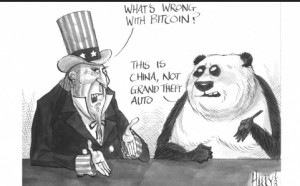
Bitcoin Regulation?

Wences Casares, founder and CEO of Bitcoin vault Xapo, calls Bitcoin “maybe the most important social experiment going on right now” and heralds the cryptocurrency as a potential replacement for the gold standard.  “Technologically it’s not an experiment, it is robust and it works. But because at the social level it’s an experiment there’s still a chance that it fails. And therefore it’s risky and nobody should invest in Bitcoin in an amount of money that they cannot afford to lose because of that risk. But there’s also a chance that it works out well and if it works out well it may be the first thing in 5,000 years that finally replaces the gold standard which has been the standard for quite a very long time. And it becomes a new meta currency that sits atop all currencies.”

Casares explains that he doesn’t believe any sort of cryptocurrency should ever supplant national and local currencies. People need to draw their salaries in dollars, euros, pounds, etc. National and regional monetary policies require state currencies. But the world’s consumers should have a choice, particularly when buying on the internet or internationally. That’s where Bitcoin comes in.

As far as regulation goes, Casares compares Bitcoin to gold. Gold is decentralized. Its supply is determined by nature, not by a government or corporation. Bitcoin can be the same way:

“I think that we need to regulate Bitcoin to have basic consumer protections, to prevent criminal activity on it, to prevent money laundering. But I think doing so is not hard and I think doing so is doable with the regulations that we already have in place to account for cash. Cash is very anonymous and we have regulations in place to manage the anonymity of cash.”

At the same time, regulators shouldn’t operate from a position of fear when they decide how to oversee cryptocurrencies:

“What we are seeing right now is because a lot of the regulators are still getting their arms around bitcoin, the first reaction is a scared reaction that tends to overregulating which that wouldn’t be good for the regulators, wouldn’t be good for the industry but I think we will get there and it’s not so complicated.”


Bitcoins

Warren Puts Banks on Notice

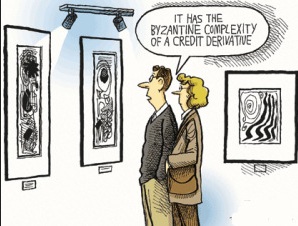
Who cares about relaxing Dodd Frank?  …the swaps push-out rule — section 716 of Dodd-Frank, which would require banks to book their derivatives in subsidiaries that are not their insured depository institutions was killed as part of the new deal to fund the government.

Why put financial regulation in an unrelated spending bill? Why rewrite financial regulation based on a draft by Citigroup lobbyists? – but let’s spend a minute on why it’s not worth caring about.
First: The rule doesn’t apply to most derivatives. Federal Deposit Insurance Corporation Vice Chairman Tom Hoenig:  “In fact, under 716, most derivatives — almost 95% — would not be pushed out of the bank. That is because interest rate swaps, foreign exchange and cleared credit derivatives can remain within the bank. In addition, derivatives that are used for hedging can remain in the bank. The main items that must be pushed out under 716 are uncleared credit default swaps (CDS), equity derivatives and commodities derivatives. These are, in relative terms, much smaller and where the greater risks and capital subsidy is most useful to these banking firms.”

Can equity derivatives bring down a bank?  Uncleared CDS has a rough track record, though the market is slowly moving away from it in general. But the big derivatives risks were going to be allowed to remain in the depository banks anyway.

Pushing out derivatives into non-insured subsidiaries doesn’t make them go away. Defenders of the rule cite the example of AIG, which foundered on uncleared CDS and brought down the financial system. AIG: not an insured bank! Neither was Lehman! The people arguing for the swaps push-out rules are not people who, in other contexts, would say that only insured depository banks get any government support. They’d say that “too big to fail” banks (you know: derivatives dealers) pose risks to the financial system even in their non-bank subsidiaries, risks that lead to an implicit expectation of government support beyond the explicit FDIC insurance. Here, they are right. If JPMorgan blows itself up trading CDS, that will be a problem for everyone, whether it happens in the insured bank or some uninsured subsidiary. The rule won’t stop that. The rule is (was?) fine, but it’s not worth getting upset about. This is all theater.

Credit Default Swaps

Rial Hit by Nukes or Oil Prices?

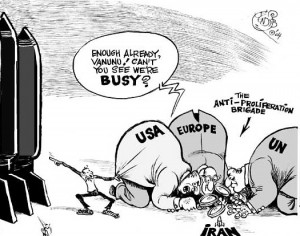
Three weeks after nuclear talks in Vienna failed to put an end to the 12-year nuclear standoff between Iran and the West, forex and the stock and gold markets in Tehran are still nosediving, with Iran’s monetary officials struggling to control the negative sentiment.

The rial has lost over 3,200 against the dollar.  TEDPIX, the Tehran Stock Exchange’s main index has also drpped.. So far, the Tehran Stock Exchange has plunged over the last three weeks by 1.5% to 3%.

Rouhani hailed the extension of talks as a victory.  Administration officials later echoed his remarks, as the rial was continuing to depreciate against all major foreign currencies. Surprisingly, this time the moderates obtained a staunch conservative supporter. Supreme Leader Ayatollah Al Khamenei said in a speech a couple of days after Iran and the P5+1 agreed to extend talks that he was “not in opposition to the extension of the talks.” His backing comes as conservatives, of course not the ayatollah himself, have been criticizing the administration in the last year for taking a “soft” stance in talks with the West, namely the United States.

However, Ayatollah Khamenei said that the government does have an economic response to the crippling sanctions. The government does not want to announce publicly that the continuation of sanctions has negatively affected the market sentiment.

On the other hand, a new group of economists, mainly loyal to the moderate government, has insistently backed the idea through news media that it was the OPEC’s decision that pushed markets into the red.

Coincidentally, at the same time as the nuclear talks, OPEC was meeting in Vienna where the member countries decided to maintain their output, despite Iran’s opposition.

A number of economists in Tehran now argue that with OPEC refusing to cut the production of 30 million barrels a day, the oil price will probably plunge even further in the coming months.

Among those blaming the recent oil price decline for the free fall of Iranian markets is Mohammed Tabban,  a Tehran-based economist, who believes the OPEC’s decision has made the public think that oil revenues will plunge next year.

People fear that government revenue from oil exports will drop further and therefore foreign currencies might be in short supply in the Iranian market.

It appears that professional dealers and traders are more concerned about sanctions and the future of the nuclear talks than the OPEC’s decision, whose immediate impact on markets is hardly believed to be a major issue.

Given the fact that ordinary people are so sensitive about the value of the dollar, monetary officials have come with ideas to help avoid rapid depreciation of the rial against the dollar in the future.  Three researchers with the Monetary and Banking Research Institute wrote in that the Central Bank of Iran needs “to control the rial’s flux, and not its rate.”

Nuclear Talks or Oil Prices?

Instability in Sovereign Bonds

Mohamed El-Erian writes: Sovereign bonds have been full of surprises this year: From the U.S. to Spain, yields are declining further after confounding investors’ expectations by staying low for most of 2014. It’s a trend that could be setting markets up for greater volatility in 2015.

The level of interest rates is truly remarkable. Who would have predicted that toward the end of the year, U.S. 10-year Treasury bonds would yield only 2.12 percent, German bunds only 0.62 percent or Japanese 10-year bonds only 0.37 percent? Even more financially challenged governments, such as Italy, Portugal and Spain, have seen yields fall to record lows.

The trend has three main drivers. First, with the exception of the U.S., almost all the systemically important economies have seen their growth projections deteriorate.

Second, inflation projections have come down, and will probably fall further given the sharp drop in oil prices.

Third, many investors have stayed away from U.S., German and Japanese government bonds or even bet against them, on the expectation that yields would rise and prices would fall.

The trend toward lower yields has been oddly pervasive, ignoring important differences in individual countries’ economic outlooks and government finances. There are just three significant exceptions:

  1. The yield difference between U.S. Treasuries and German bunds has increased to nearly 1.50 percentage point, from about 1.05 at the beginning of the year — recognizing the diverging outlooks for growth, inflation and central bank policy in the U.S. and Europe.
  2. The yields on Greek and Russian debt have risen sharply compared to German bunds and U.S. Treasuries, reflecting perceptions of increased credit and default risk.
  3. In some emerging economies such as Brazil, increasing yields reflect growing concerns about excessive dependence on tighter monetary policy to compensate for inadequate fiscal policy.

One big question for 2015: Will such exceptions remain small and isolated, or will yields diverge more broadly along with different countries’ growth, inflation and policy prospects?

If yields fail to reflect growing divergences in economic and financial fundamentals, they will place more pressure on currency markets to serve as global shock absorbers. The more this happens, the greater the risk that large currency moves will end up breaking something else in the system. On the other hand, sharp moves in yields that better reflect credit and default risks can also cause problems — for example, by making it harder for governments with shaky finances to borrow the money they need to pay off maturing debt.

Sovereign Bonds

Will Russia Introduce Capital Controls?

Leonid Bershidsky writes:  The failure of an emergency rate hike to stop the ruble’s decline against the dollar increases the probability that Russia will introduce capital controls. President Vladimir Putin, who sees Russia’s economic woes as the consequence of a Western plot, must be increasingly amenable to the recipes that worked in another country ruled by an anti-Western authoritarian leader: Malaysia in 1998.

The Russian central banks’ surprise key rate hike to 17 percent, from 10.5 percent, announced at 1 a.m. Moscow time, seemed at first to have its desired effect: Short sellers paused at the increased expense. Other players, stunned by the boldness of the increase, were forced to consider whether it might not be a good idea now to hold Russian assets. And the ruble bounced back 10 percent against the dollar.

The Russian state oil company Rosneft, run by Putin’s friend Igor Sechin, raised 625 billion rubles ($10.8 billion) recently: Rosneft borrowed at 11.9 percent. The Central Bank did nothing yesterday, potentially allowing Rosneft to pump some of the money into the foreign exchange market. Then early today it raised the rate, causing Russian bond yields to rocket. The current 10-year sovereign bond yields more than 14 percent, compared with 13 percent 24 hours ago.

This is not a situation in which even a 17 percent interest rate makes holding ruble assets appealing: The ruble’s downside potential is too high.

That’s also what happened in Malaysia in 1997. Four years later, Harvard University’s Ethan Kaplan and Dani Rodrik told the story.  Malaysia controls

When the Asian financial crisis hit, Malaysia’s position looked a lot like Russia’s today: It had big foreign reserves and a low short-term debt level, but relatively high general indebtedness if households and corporations were factored in. At first, to bolster the ringgit, Deputy Prime Minister Anwar Ibrahim pushed through a market-based policy with a flexible exchange rate, rising interest rates and cuts in government spending. It didn’t work: Consumption and investment went down, and pessimism prevailed, exerting downward pressure on the exchange rate..

That old economic debate is suddenly relevant again. In 1998, following the Asian crisis, Russia’s economy collapsed. The country lived through debt default, devaluation, a failed IMF bailout and capital controls all at the same time. Now, Putin must be tempted to control the damage while it’s still possible.

His anti-Western advisers are evidently holding up the Malaysian example. “What can [Central Bank Governor Elvira] Nabiullina do within the market model if she is forbidden to sell too much foreign currency and some of the world’s biggest financial players have been ordered to play against her?”

Naturally, the specter of capital controls now hangs over the foreign exchange market, pushing investors to get as much money as possible out of Russia. If Putin is worried about public discontent following the ruble’s decline, he may follow the advice within days. If he’s betting on Russians’ patience, Nabiullina’s orthodox policies — rate hikes and other measures to squeeze ruble liquidity — will be allowed to continue, with breaks for emergency aid to Putin’s friends.

Putin Contemplates Capital Controls

Oil Prices Stable for 2015?

George Perry writes:  The sharp decline in world oil prices during the last half of this year has become the defining economic event of 2014. It has been hailed as a timely stimulus to global demand because it adds to the purchasing power of consumers. Lower gas prices have already strengthened the U.S. expansion and supported the still-fragile recoveries in much of Europe, Japan and the emerging economies. These demand side effects are still growing, but they are only the most immediate impacts. Depending on how the tumultuous events in the oil market play out, they will have important effects through many other channels, and not all these will be so desirable.

No simple generalization explains the history of oil prices. They have responded sharply to some political and economic changes and have also remained in a fairly narrow range for extended periods. In the first postwar decades, vast new oil supplies from the Middle East kept oil prices low.  Then in 1973, Saudi Arabia and other oil producing states of the region nationalized their oil industries and formed the OPEC cartel which constrained output enough to quadruple the world oil price to $12 a barrel. In the years since, the ability or willingness of OPEC to stabilize prices has been uneven. Prices soared after the takeover of Iran by the clerics in 1979, and then slid back during the 1980s in the face of new oil discoveries in the North Sea, Mexico and Alaska, and the drive to oil conservation in the advanced economies that slowed demand growth. The next big move came in the 2000s, as surging demand for oil from China and other developing nations drove the price from around $20 at the end of the 1990s to around $120 a barrel in the summer of 2008. Prices crashed during the Great Recession and then promptly started back up as recovery began and China’s growth continued.

And then the new era for oil began. The introduction in 2009 of fracking for recovering oil from shale deposits reversed a long decline in North American oil production. Production grew slowly at first, and the renewed global economic expansion brought oil prices back to near $100 a barrel by 2011. Prices then stayed in a narrow range for three years as growing shale production kept global supplies rising in step with global demand. But by mid-2014, what had seemed a sustainable balance was upset as shale production accelerated and Libyan oil output rose sharply from depressed levels. As Saudi Arabia appeared reluctant to reduce output to support the market, the price decline steepened. Are the recent prices around $60 a barrel likely to be the new normal?

In the race between global demand and supply, today’s lower prices will both raise consumption and restrain the growth of supply. Both will move up the short run equilibrium price, suggesting a price in the $60s could be sustainable. But uncertainty and turbulence rather than equilibrium may characterize the oil market for some time. As Libya’s experience shows, supplies from the Middle East, including those affected by sanctions on Iran, are hard to predict.

As the range of outcomes and responses suggests, there could be pressure for market prices to move above or below present levels. But it seems reasonable to project oil prices settle in a range in the $60s in assessing 2015 economic prospects.

While the economic stimulus from lower oil prices starts immediately, some of the effects through other channels take more time. The creation and expansion of the fracking industry has been an important source of high paying blue collar jobs in the US and has contributed meaningfully to the economic recovery. With today’s much lower prices, the industry’s future plans are being scaled back sharply which will cut into the economy’s job growth in 2015. This consolidation will also lead to a rash of bankruptcies among the small firms that have spearheaded the fracking revolution. But those are the risks of a speculative industry. In the aggregate, oil production is not a dominant part of the U.S. economy and the positive stimulus from lower gas prices for consumers will outweigh the negative effects on employment and GDP in 2015.

For countries such as Russia, where oil sales are a major source of budget revenues and foreign exchange reserves, the drop in oil prices creates a huge financial problem.

Price of Oil


Interest Rates to 17% in Russia

Olga Tanas and Anna Adrianova wirite: The Russian central bank said it would raise its key interest rate to 17 percent from 10.5 percent, effective today. The move was the largest single increase since 1998, when Russian rates soared past 100 percent and the government defaulted on debt.

The ruble lost 2.5 percent to 66.0985 against the dollar as of 12:53 p.m., reversing an early gain prompted by the news.

The announcement, as well as its timing, underscored the financial straits in which Russia now finds itself. If sustained, the new higher rates would squeeze an economy that is already being hurt by sanctions led by the U.S. and European Union, and by a collapse in oil pirces.. Some analysts said they doubted the economy could withstand such high rates for long.

The ruble, which has depreciated 50 percent this year against the dollar, is the worst performer among more than 170 currencies tracked by Bloomberg. It gained almost 11 percent today, before weakening to a record.

“In order to limit the negative effects of such depreciation of the national currency on the Russian economy, we decided to increase the key rate,” Russian central bank Governor Elvira Nabiullina said on state TV channel Rossiya 24. “We really must learn to live in the ruble zone, rely to a large extent on our own sources of financing.”

So far this year, Russia has spent $80 billion of its foreign-exchange reserves in an unsuccessful attempt to prop up the ruble. Brent, the grade of oil traders look at for pricing Russia’s main export blend, lost as much as 3.3 percent to $59.02 on the London-based ICE Futures Europe exchange, trading below $60 a barrel for the first time since July 2009.

The economy may shrink 4.5 percent to 4.7 percent next year, the most since 2009, if oil averages $60 a barrel under a “stress scenario,” the central bank said yesterday. Net capital outflow may reach $134 billion this year, more than double last year’s total.

Others were more optimistic, saying the action was big enough to arrest the ruble’s record decline. “The central bank is trying to stop the avalanche, and such a massive hike may be sufficient,” said Slava Breusov, an analyst at Alliance Bernstein in New York.   “No one seems to be thinking what it will do to the economy, as the priority is to stop the ruble plunge.”

Russian Economy