OPEC’s decision to stand pat last week and maintain current crude production levels sent oil prices down to nearly five-year lows on Monday. It also prompted a couple of big related questions: Is OPEC deliberately trying to smother the U.S. oil boom, and will it be able to?

The heavy hitters inside the oil-exporting cartel certainly give that impression. By leaving the taps open and pushing prices down, the idea is to make it less economical to produce oil from fracking, which is more expensive than pumping oil in big, traditional Middle Eastern fields. OPEC’s secretary-general, Abdalla El-Badri, said after last week’s Nov. 27 meeting that the decision was OPEC’s way of answering the glut of light, tight oil unleashed by the U.S. energy revolution. And Iranian officials said that, in backroom meetings, Saudi officials were especially worried by the threat posed by rising U.S. oil production.

Granted, the Organization of the Petroleum Exporting Countries is hardly monolithic. Its decision to keep oil production unchanged is probably less a concerted strategy to dent U.S. output than a reflection that the disparate group historically takes time to reach consensus. OPEC’s big producers, led by Saudi Arabia, also want to convince smaller producers to share any pain from output cuts — something that will be easier after a few more months of relatively low oil prices.

Regardless of whether it was OPEC’s intention or not, with U.S. oil prices trading in the high $60s per barrel for the first time since the summer of 2009, the economic climate for U.S. oil production is, on paper at least, more challenging than it has been in years.

But that doesn’t mean that sub-$70 oil will kneecap the U.S. boom anytime soon. For starters, prices will have to remain depressed before U.S. oil producers pack up their rigs for good. If oil prices stay steady through all of 2015 — a big if — energy analysts expect U.S. production growth to drop by 500,000 or 600,000 barrels. That wouldn’t be enough to cure the crude overhang that is weighing on markets today.

But most importantly, thanks to technological advances, it has gotten steadily cheaper to produce tight oil from blasting apart shale seams deep underground. That means that the “break-even” oil price for U.S. producers is getting lower all the time, making the industry more resilient to price dips.  If the United States needed $80 barrels a few years ago, it can comfortably manage today with prices close to $70, data from different shale plays show. Daniel Yergin, head of energy consultancy IHS, says that 80 percent of U.S. tight-oil production can survive with oil below $70 a barrel.

Norway’s Statoil, which has become a big player in North America, makes clear what’s driving the change: technological advances that lower the cost of drilling each well. Costs have fallen 50 percent in two years, the company said, and could keep falling another 15 percent by 2016. At the same time, producers are now squeezing out more oil than they used to. The upshot, Statoil says, is fewer wells, at lower cost, with greater overall production.

That isn’t to say that the industry can completely shrug off lower oil prices. Even if the wells themselves are still profitable, oil companies need a constant influx of cash to keep operating. Brown Brothers Harriman, the investment bank, said that lower oil prices could crimp the easy credit that many operators need to keep prospecting, which could curtail the expansion of U.S. oil output. That most shale plays can survive with lower prices underscores that some can’t; those more expensive projects will likely get curtailed if oil prices stay depressed through the first half of next year.

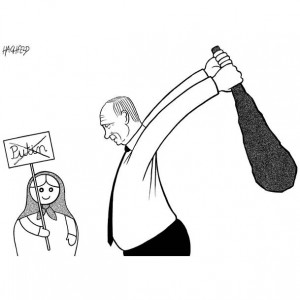
Could it also be that the US has induced its long term partner Saudi Arabia to cooperate in starving Putin?
Oil Prices in Russia

Currency Wars

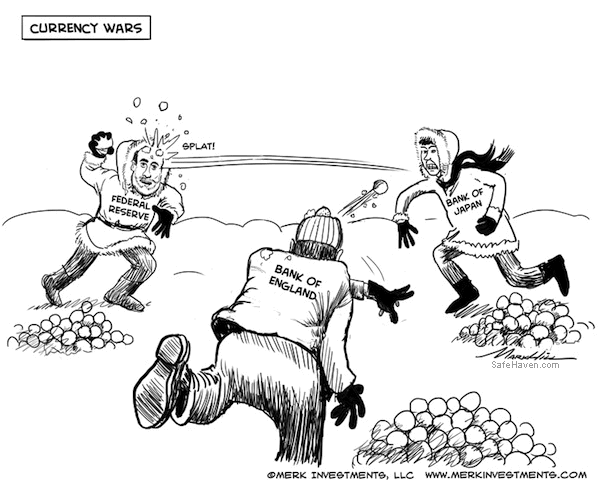
Is the Bank of Japan’s quantitative easing to weaken the yen a ‘beggar-thy-neighbor’  approach?  Central banks in China, South Korea, Taiwan, Singapore and Thailand are easing their policies.  The European Central Bank and the banks of Norway, Switzerland and Sweden may soon follow suit.

The dollar continues to grow strong, but if it grows too strong against other currencies the US Fed may well decide to hold off on raising interest rates.  This appears to arise from the fact that monetary policy is the only instrument left to effect economies.  This may be the time for slower fiscal consolidation and infrastructure spending.

Austerity programs have not worked.  Less austerity in the short run, infrastructure investment and less reliance on monetary easing make sense. Can these ideas fly internationally?

Currency Wars


Turkey To and Fro on EU

Recent developments  show that Turkey is poised to continue regressing in terms of EU standards. New security legislation, for example, that the government is preparing to introduce is considered to be draconian and highly restrictive in terms of individual rights.

Prime Minister Ahmet Davutoglu claims that the proposed legislation complies with EU standards, but critics in Turkey and Europe reject this and say it will not only set Turkey’s reform process back, but will also harm Ankara’s ties with the EU.

Another potential problem is Erdogan’s desire to turn Turkey into a presidential system. General elections planned for June are critical in this respect. The Justice and Development Party (AKP) wants results that will enable the party to alter the constitution on its own and enable Erdogan to become an executive president who is unencumbered by checks and balances.

Erdogan’s commitment to the political criteria necessary for EU membership is already under question.  Many recall his asking Russian Presiden Pitin in November 2013 to admit Turkey to the Shanghai Cooperation Organization to save it from the slow and painful EU accession process.

On the European side of the equation, key EU members, most notably France and Germany, have been less than welcoming as far as Ankara’s membership bid is concerned, arguing that Turkey is not a European country and should therefore not be given full membership.

France has even blocked chapters of Ankara’s membership negotiations that pertain to full membership. Meanwhile, Cyprus, as a veto-wielding EU member, continues to block key chapters in Turkey’s membership talks in an effort to try and solve the Cyprus problem according to its national interests.

Turkish opponents of EU membership use these developments to argue that Ankara should ditch the EU and look elsewhere for strategic partners. Erdogan’s remarks about the Shanghai Cooperation Organization also emboldened them in this regard. Looked at superficially, such views appear justified.

Some influential Turkish voices, however, starting with former President Abdullah Gul, sense a red herring here. Gul has always supported the view that the EU perspective is important, as it is a positive force for reforms in Turkey.

Influential voices in Europe underline Turkey’s vital importance for Europe and continue to canvas for Ankara’s membership bid.

The EU Commission’s 2014 Progress Report also stressed Turkey’s vital strategic location in terms of developments in the Black Sea region and the Middle East, and recommended deepening the cooperation between Ankara and the EU in a host of areas of concern to both sides.

Historically speaking, Turkey’s bid for EU membership has been looked on with suspicion and derision in the Middle East, the prevalent belief being that this is the clearest indication that Ankara has turned its back on its Islamic heritage.

But, with the Arab Spring having gone seriously wrong, the example of a secular and democratic Turkey with an EU perspective is expected by many analysts to gain importance in the region again. This will, however, require a Turkey that returns to the path of reforms, rather than giving the appearance of drifting away from the EU.

Put another way, Ankara will have to overcome the impression in Europe that it is part of the mess in the Middle East, as Italy’s Deputy Foreign Minister said during the conference organized by TUSIAD and the Brookings Institution.

Turkey and the EU

Original Al-Monitor Translations

Türkçe okuyun

Translate with Google

Powered by Translate

More From Turkey Pulse

Expensive Ghost Soldiers in Iraq

The Iraqi army has been paying salaries to at least 50,000 soldiers who don’t exist, Iraqi Prime Minister Haider al-Abadi said Sunday, an indication of the level of corruption that permeates an institution that the United States has spent billions equipping and arming.

A preliminary investigation into “ghost soldiers” — whose salaries are being drawn but who are not in military service — revealed the tens of thousands of false names on Defense Ministry rolls, Abadi told parliament Sunday. Follow-up investigations are expected to uncover “more and more,” he added.

Abadi, who took power in September, is under pressure to stamp out the graft that flourished in the armed forces under his predecessor, Nouri al-Maliki. Widespread corruption has been blamed for contributing to the collapse of four of the army’s 14 divisions in June in the face of an offensive by Islamic State extremists.

With entry-level soldiers in Iraq drawing salaries of about $600 a month, the practice of “ghost soldiers” is likely to be costing Iraq at least $380 million a year — though officials say that’s probably only a fraction of the true expense.

The corrupt practice is often perpetrated by officers who pretend to have more soldiers on their books in order to pocket their salaries, experts say.

Abadi’s announcement was met with applause in parliament. He said that the perpetrators would be tracked down eventually but that his priority is to end the practice as soon as possible.

“The problems are wide, and it’s an extremely difficult task which is going to involve some strong will,” said Iraqi security analyst Saeed al-Jayashi. “Training is weak and unprofessional.”

The United States is focusing its efforts on three divisions in order to begin effective counteroffensive operations against the Islamic State, which controls around a third of the country’s territory.

Ghost Soldiers

Tanzanian Prime Minister Implicated in Fraud

Tanzanian politicians are calling for the resignation of the prime minister, Mizengo Pinda, after a government report implicated him in an energy scandal that resulted in the plunder of more than $120m (£76.5m) from the country’s central bank.

In a dramatic parliamentary session on Wednesday that was disrupted by power outages, Tanzania’s public accounts committee (PAC) revealed that senior officials authorised fraudulent payments to offshore bank accounts under the guise of energy contracts. The state-owned energy provider Tanesco, along with five senior politicians – including the minister for energy and the attorney general – are implicated in the scandal, the PAC said.

Investigators said that Tanesco formed a joint escrow (holding) account in 2006, known as the Tegeta account, with Independent Power Tanzania Limited (IPTL), which is owned by Pan Africa Power (PAP). Funds from this account were transferred to offshore bank accounts held by private businessmen and government officials, the committee said.

Tanzania’s Revenue Authority (TRA) has called for Interpol to investigate the role of Harbinder Singh Sethi, a businessman suspected of organising fraudulent payments, as well as James Rugemalira, who is suspected of siphoning off funds through his stake in IPTL.

Tanzania Energy Scandal

Impact of the Economy on Race Relations in America

Young African American men are not employed.  What is particularly sad in the US is that our President, who identifies as African American and looks African American has not stepped forward in the six years in office to take the bully pulpit on this issue.  Many who voted for him hoped that we could turn a corner on this most intractable issue.

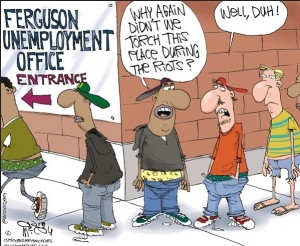
Jude Wanniski boiled down the major problem of our time as balancing the tension between income growth and redistribution. During the 1992 riots, he identified a scarcity of capital relative to labor as a major problem for the black inner city and a major source of tension in race relations. He noted, “When there is no capital available, the price of labor must drop to uncivilized lows to clear competitive levels.” Certainly, until the scarcity of capital relative to labor is addressed, the American empire will remain vulnerable to the violent eruptions that have befallen Ferguson.

During the early 1990s, Jack Kemp’s pursuit of enterprise zones in the inner city was a clear attempt to bridge the gap between growth and redistribution. The promise of enterprise zones was that their tax exemption on capital gains could attract the investment capital necessary so surplus labor (largely African American) could be pulled out of the streets and into increasingly productive, legal uses.

Today, it is Senator Rand Paul, who has visited Ferguson, who sounds like Kemp with his outreach initiatives to the black community. Similar to Kemp, he champions enterprise zones in the inner city. But he has taken the script further.

As veteran political columnist Ronald Brownstein noted this summer, Paul “has moved beyond the economic arguments that anchored previous outreach efforts to embrace criminal-justice reform with a passion unprecedented in modern Republican politics. Few Democrats, in fact, have matched the fervor of Paul’s case against drug laws that have disproportionately incarcerated minority men.”

Jim Webb, a one-term Senator from VIrginia and Reagan’s Secretary of the Navy, also addresses this issue.  He is putting out feelers for the democrats’nomination in the early part of 2015.

Race Relations in the US

Wall Street Takes Physical Possession of Commodities

Wall Street firms driving up commodity prices.  Machinations by financial firms that have bought up huge swaths of coal mines, aluminum warehouses, or natural gas reserves could be leading to higher prices for consumers and companies that rely on those natural products REPORT-Wall Street Bank Involvement With Physical Commodities alleges.

Furthermore, Wall Street titans may be exposing themselves to huge risks and reaping unfair trading advantages by investing heavily in physical commodities, according to the Senate Permanent Subcommittee on Investigations.

The report’s main author also criticized regulators for allowing financial firms to take increasing stakes in physical commodities, while those institutions also made hefty trades in the financial markets on those products, and called for an overhaul to limits on such activity.

“We simply cannot allow a large, powerful Wall Street bank the power to influence the price of a commodity essential to our economy, especially when that bank is trading in financial products related to that commodity,” said Sen. Carl Levin (D-Mich.).

The two-year investigation focused on three major financial firms that have made significant investments in commodities: Goldman Sachs, JPMorgan, and Morgan Stanley.

For example, in 2012 Goldman owned 1.5 million metric tons of aluminum, equal to roughly one-quarter of the nation’s annual usage of the metal. And Levin focused on Goldman, accusing the firm of orchestrating a “merry-go-round” system aimed at lengthening the lines for providing aluminum, which in turn lead to higher premiums for the metal — costs that could eventually be passed on to consumers.

The report claims that after purchasing aluminum warehouses in Detroit, Goldman approved contracts with warehouse clients where they paid them to load and move metal from one warehouse to another. Those repeated movements slowed down clients attempting to remove their aluminum, slowing its delivery and ultimately driving up the premium for the metal, the report claimed.

In a response to the report, Goldman said that most of the aluminum stored in the facility was not blocked by lengthened lines, and argued that metal movements were independent decisions of clients.

The 396-page report also delves into a host of other investments by financial firms, such as Goldman’s acquisition of a Colombian coalmine that was briefly shuttered due to protests, Morgan Stanley’s investments in jet fuel, and JPMorgan’s buying spree of power plants.  “Imagine if BP had been a bank, the liability resulting from the oil spill could have led to its failure and another round of taxpayer bailouts,” said Sen. John McCain (Ariz.), the top Republican on the panel.

In 2012, a team of Federal Reserve officials looking into commodities activity found that large institutions had a shortfall ranging from $1 billion to $15 billion each in capital and insurance to cover potential catastrophic losses from commodities investments.

The report also said that allowing banks to invest heavily in physical commodities could give them an unfair edge on trading in financial markets tied to those commodities. Firms could receive inside information about what is happening in those markets thanks to those investments, or even be able to sway how markets move by changing conditions at those physical facilities.

The report noted that after Goldman acquired the uranium company Nufcor, it increased trading activity in the company tenfold. Goldman said Wednesday it was in the process of whittling down the company’s operations to minimal levels.

Levin stopped short of specifically saying how regulators should curb physical commodity investments, but said regulators or future Congresses should seriously consider placing stricter limits on the activity.

Banks do face limits on the amount of physical commodities they can invest in, but the report claimed the Fed was relying on an “uncoordinated, incoherent patchwork” of limits on that activity, allowing banks to expand their investments, and also lacked data key to monitoring and policing that type of activity.Wall Street Owns Physical Commodities

Women Twice as Likely As Men to Suffer from Poverty in Asia

Women make up two-thirds of Asia’s poor, according to the UNDP, which means that women are twice as likely as men to suffer from poverty. And poverty is continuing to rise among Asia’s women, not only because they have lower incomes, but because of discriminatory attitudes which result in lower capabilities and opportunities. Asia has one of the world’s worst gender gaps, with Africa being the only continent behind it, based on a combination of indicators covering economic participation, educational attainment, health and survival, and political empowerment. Asia is the worst region in the world for women’s health and survival relative to that of men.

In short, the benefits of Asia’s very rapid growth are not being shared in the region. And naturally the adverse situation of Asia’s women trickles down to many children, except for a family’s eldest son who is usually spoiled rotten. Child poverty is a particularly important issue in countries like Laos, Mongolia, the Philippines and Vietnam where one-third or more of the population are children.

It may seem surprising that the state of poverty is not so rosy in Asia. Many Western tourists are dazzled by the bright lights of Shanghai, Singapore, Hong Kong and Bangalore. But poverty is substantially a rural phenomenon in Asia, with more than half of Asia’s population living in the countryside.

The rural poor represent over three-quarters of Asia’s total poor population. Many of the rural poor are subsistence producers, family farmers or landless agricultural producers. And the poverty of urban slums is usually hidden away from tourists, despite the new fad of “slum tourism” in cities like Mumbai and Jakarta. To reduce rural poverty requires improving agricultural productivity, rural infrastructure, and access to social services. Poverty in Asia

Poverty in Asia


Turkey Dances with Russia on Gas

Nerdun Hacıoğlu writes from Moscow:  Turkey wants to renew the bilateral gas agreement with Russia rather than requesting a discount in the existing deals.  Gazprom and Turkey’s BOTAŞ have been discussing the deals.  Turkey wants to renew the existing gas deal with Russia on a new principle of price setting, rather than asking for a gas discount.  Gazprom will decide to accept or reject this idea.

Turkey has acted in the opposite direction of the western countries about Russia. And Turkey does not create any problems with the South Stream gas pipeline, noted Russian Energy Minister Alexander Novak.

“The Akkuyu nuclear power plant project constitutes one of the building stones of the economic relations between the two countries. A new industrial sector has been born in Turkey. The project will be completed in line with the pre-defined plans. Loans can be secured to finance the project from other countries than the western countries,” he said.  Novak also noted the bilateral trade is in favor of Russia.  “Some $18 billion of goods and services were exported from Russia to Turkey in the last nine months of this year. This figure is quite high, as the total of the trade volume was $23.7 billion. This is mainly caused by Turkey’s huge energy imports,” he noted.

Is Turkey in Danger?


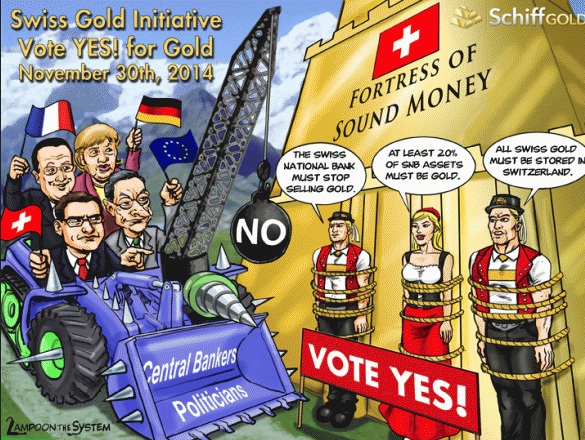
78% Vote Against Protecting the Country’s Wealth with Gold

Whether as a result of an unprecedented scare campaign by the Swiss National Bank (most recently reinforced by Citigroup), or due to confidence that Swiss gold is as safe abroad as it is at home, or simply due to good old-fashioned “hanging chads”,  the Swiss population overwhelmingly rejected a referendum to force the Swiss National Bank to hold some 20% of its reserves in gold in a landslide vote, with about 78% voting against what AP politely termed “protecting the country’s wealth by investing in gold.”

The proposal stipulating the Swiss National Bank hold at least 20 percent of its 520-billion-franc ($540 billion) balance sheet in gold was voted down by 78 percent to 22 percent. The initiative “Save Our Swiss Gold” also would have prohibited the SNB from ever selling any of its bullion and required the 30 percent currently stored in Canada and the U.K. to be repatriated.

Gold Referendum Fails