The business climate is improving for both large and small firms in India. New foreign direct investment rules have boosted the real estate sector. The government has launched a program to get 75 million bank accounts set up by next year. This is designed to help the 1.2 Indians who do not have access to afforable credit.
Aqua Fair in the US
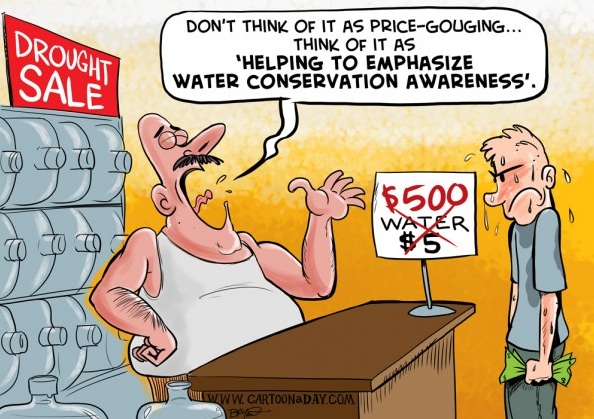
The US turned to water in the latest eelctions. By an average of 65 percent of the vote, measures to protect the water supply in America were passed by citizens. Nineteen states approved water conservation funding. Twenty-seven state and local ballot measures will dedicate more than $20 billion to open space, water protection, parks, and trails.
At the same time, despite a 4 percent increase in population, public water supply withdrawals declined. Power-plant conversions to more efficient systems and environmental protection are among the reasons cited. Persistent drought has an impact on domestic use.
FIFA DeTox?
Futbal is weighed down by corruption. Australians were warned to walk away from any future World Cup hosting bids until FIFA, the global governing body, came clean about the corrupted process that delivered the 2022 games to Qatar.
Australia has been criticized in FIFA summary report. Australia has been part f the rotten game of cash for hositng rights. The nation’s reputation has suffered. Australian taxpayers were billed $46 milion for the bid.
Mexico: China’s Hub in the Americas?
Mexico works to become China’s hub in Latin America. President Enrique Pena Nieto traveld to China for the Asia-Pacfic Economic Cooperation summit. He explained the benefits Mexico offers for investment. He wants investors to turn the country into a logistics platform for the Mexican market and other countries in North and South America.
Mexico’s industry is wary of Chinese imports that compete with low prices. Pena Nieto pointed out that Mexico is looking for a partner not an importer of low quality and inexpensive products.
Mexico would like to sign agreements to help create jobs and resources to help overcome inequality and poverty in the country.
Kazakhstan & Belarus: Good Guys
Kazakhstan is not in the strugglle of sanctions and counter sactions. New opportunities are opening. It has full access tto the Russian market asa member of the European Economic Community and Customs Union. It has good relationships with everyone.
Kazakhstan maintains its previous goal of becoming one of the 20 most econmically devleoped countries by 2015. It has the same per capita GDP as RUssia. Low unemployment. Very litle foreign debt, a baanced budget and significant foreign currency reserves. Kazakhstan and Belarus are the good guys of the post-Soviety space.
Contrarian Bond Kitty Purrs
Michael Hasenstab manages $190 billion of government debt for Franklin Templeton. Soft-spoken, measured and publicity-shy, Mr Hasenstab is the antithesis of “bond king” Bill Gross, but with an equally impressive record. The main fund he manages has returned 8% a year for the past decade, double the average for funds that invest in sovereign bonds.
Big, contrarian bets have become Mr Hasenstab’s trademark. Since 2010, he has been investing enthusiastically in Ukrainian government debt, and now owns $8.8 billion of the country’s $16 billion of international bonds. In April, as eastern Ukraine descended into war, Mr Hasenstab appeared in a promotional video from Kiev, touting the great potential of Ukraine’s economy. His funds are also the largest single investor in Ghanaian, Hungarian, Iraqi, Irish, Philippine, Sri Lankan and Uruguayan government debt, according to Ipreo, a market intelligence firm. Even the “safer” elements of his portfolio—big holdings of Malaysian, Mexican and South Korean debt—are relatively exotic.
Such bets can be lucrative. Over the course of 2011 Mr Hasenstab spent over $11 billion on Irish government bonds. The country had been downgraded to junk status amid fears of default; panicked investors were dumping their bonds, allowing Mr Hasenstab to buy at yields as high as 14%. Ireland’s skilled workers and lack of Greek-style civil unrest, he thought, would stand the country in good stead in the long run. And so they did: within 18 months he had earned well over a 50% return.
Mr Hasenstab argues that, with interest rates likely to start rising after a 30-year bull run in government debt, the only way to make money in bond markets will be to find other countries that the market is mispricing. So his international research team of 20, many of them with doctorates in economics, searches constantly for out-of-favour countries with hidden promise. They mostly ignore indices, benchmarks, ratings agencies and newspapers, focusing instead on data and first-hand research. Mr Hasenstab himself has visited 25 countries this year. Taking a long view is an essential part of the strategy: he asks investors to judge his performance over a minimum of three years.
Yet whereas Mr Hasenstab attributes his success to independent-mindedness, thoroughness and patience, others see it as moral hazard on a grand scale. His Irish investment, for instance, only did so well thanks to the country’s bail-out by the European Union and the IMF. In the same vein, he added to his holdings of Ghanaian bonds last year, despite a budget deficit of 10% of GDP, a weakening currency and a warning from the IMF that the country’s borrowing was unsustainable. The investment lost value until August, when the IMF announced that Ghana had requested a bail-out and prices jumped.
Ukraine is another spot where Templeton’s business and that of the IMF may be intertwined. Mr Hasenstab says he was initially attracted by Ukraine’s relatively low debt (below 40% of GDP when he started buying, in 2010), its vast agricultural potential and double-digit yields. He saw the turmoil that surrounded the ousting of Viktor Yanukovych earlier this year as an opportunity to buy on the cheap. “The universal consensus was that it was not going to work,” he says in his cheerleading video. Yet that is still the consensus, even after a rescue package from the IMF. The hryvnia has lost half its value against the dollar this year, Ukraine’s reserves are dwindling and the economy is contracting. Most observers assume another bail-out is only a matter of time.
Meanwhile, Templeton’s huge holdings of Ukrainian debt give it enormous influence. Some accuse it of delaying needed reforms by sparing the government a sobering debt strike. It could certainly precipitate a crisis by selling. It could also block any voluntary restructuring of Ukraine’s debts.
Mr Hasenstab says of the IMF: “Their presence or lack of presence does not solely direct our investments.” His funds’ success does not hinge on a Ukrainian bail-out: his investments there make up only 4.5% of their holdings. He points out that he has done well in lots of places where the IMF was not involved at the time, including Hungary, Indonesia, Lithuania, Mexico and South Korea, and that he has avoided places where bail-outs seemed inevitable, such as Greece. He would certainly have no interest in precipitating a crisis, in that it would hurt his returns. And his funds always keep a big cushion of cash, to avoid forced sales if there are unexpected redemptions.
Mr Hasenstab says his critics are mainly vulture funds, jealous of his success. They are certainly inconsistent: another complaint is that his success derives in large part from propping up nasty regimes by buying their debt, which is hard to square with the notion that he is merely chasing bail-outs. But it is also hard to accept the idea that his returns are due solely to macroeconomic insight.

The Mystique of Sanctions
Christopher R. Hill writes about the effectiveness of sanctions and also their real consequences. He asks whether US policy in the Mid-east has not been weakened by sanctions.
Sanctions regimes have attracted almost a cult following, defined by a tendency to exaggerate their success and potential. Many academic studies have shown that the success rate of sanctions is limited. Even the sanctions against South Africa’s apartheid regime may have impeded the transition to majority rule. Because divestment by multinational companies often resulted in fire sales of industrial facilities to regime allies, sanctions may have done more to empower and enrich reactionary elements than to catalyze social change. Many US officials believe that the election of a new Iranian government with a mandate to get out from under Western sanctions is evidence that the sanctions are working. (Never mind that a lack of such evidence would have elicited calls for more sanctions.)
In fact, the dynamics of sanctions are more nuanced. As the Balkan wars of the 1990s showed, sanctions often result in a shift from legal to illegal trade. In the Balkans, this empowered mafia elements, and sometimes fused them to political parties and institutions. In Iran, a similar pattern has emerged: Western sanctions have cast the Revolutionary Guard, with all of its seedy economic activities, in the role of organized crime.
The Iranians who most want an end to the sanctions tend to be those who suffer from them, not those enriched by them. But those who suffer from sanctions suffer not just from economic hardship; the isolation that sanctions impose favors the country’s least enlightened elements. The Revolutionary Guard is not worried about whether it is in the international community’s good graces.
Iran has also fueled sectarianism in the region. By supporting Shia forces beyond its borders – particularly Hezbollah in Lebanon and Syrian President Bashar al-Assad’s minority Alawite regime, as well as some of the worst of the Shia militias in Iraq – Iran has aroused the Arab world against it and empowered Sunni Arab extremists. There is no question that the Iranians have both Sunni and American blood on their hands. Just as recklessly, Iran has competed with the Sunni Arab states in the anti-Israel sweepstakes.
The US has recognized the centrality of these issues and has sought to manage them through other sets of negotiations. But a strategy of compartmentalization requires focus and fortitude on the part of policymakers. Their task will not be easy. Perhaps Obama’s successful swing through East Asia will be a source of inspiration.
Tax Spending in the UK
Muslim Interest in Banking
The Federal Reserve Bank of Richmond comments: Most Americans don’t have to think about whether basic banking services are available. If anything, it feels like the choices in savings accounts, auto loans, mortgages, and investment vehicles are overwhelming. Not so for a certain segment of the U.S. population. There were roughly 2.8 million Muslims in the United States as of 2010, according to the Pew Research Center’s Religion and Public Life Project, though estimates vary (see map). The most recent study published by the Association of Statisticians of American Religious Bodies estimates that Islam was the fastest-growing religion in the United States between 2000 and 2010. Muslim Banking in the US
Islamic finance is rooted in the principle that investments should create social value and not merely wealth. The Quran, the 1,400-year-old text that governs followers of Islam, prohibits riba, the charging or receiving of monetary benefit from lending money, interpreted in modern terms as a prohibition against interest. Islamic finance also prohibits excess risk or uncertainty (gharar), gambling (maysir), and sinful activities (haram). Transactions generally must be tied to real, tangible assets.
Dense Cities Plus Highly-Educated People = Economic Growth?
Philadelphia Federal Reserve repors: Most countries make sustained economic growth a principal policy objective. While many factors contribute to growth, economists believe that educating workers plays a critical role. Individuals invest in education because of the expected benefits to themselves or their children, such as higher earnings. But suchprivate investment can increase the productivity of others as well. For example, the collaborative effort of many educated workers in a common enterprise may lead to invention and innovation that sustains the growth of the enterprise. Some economists believe there is an important link between national economic growth and the concentration of more highly educated people in cities. Economic Impact of Educated People in Cities
,