What do Putin and Rouseff Have in Common?

Russia and Brazil are struggling.  Trouble has been brewing for a while. High inflation and big currrent account deficits meant exports were too cosrtly; their currencies topped the list of those likely to tumble. The Russian rouble, has fallen far.  The central bank scaled back its expensive and futile efforts to prop the currency up, leaving it floating almost freely.

Brazil and Russia are in really bad shape. The largest emerging economies after China, together they have the heft of Germany. In both countries the currency is sliding. The real hit new lows in November after data revealed the budget deficit reached a record in September. The rouble is dropping faster, down 27% in a year and 10% in the past month. Both face stagflation: bubbly prices coupled with growth rates likely to be below 1% this year.

Some of their pain comes from abroad. Brazil’s main trading partners are slowing (China), stagnant (the euro area) or tanking (Argentina). Not only are export volumes down; the prices of things Brazil sells—iron ore, petroleum, sugar and soyabeans—are dropping as global demand falters. Russia is feeling the slowdown too, as energy prices fall. It is one of the world’s biggest producers of oil and natural gas. Its big five energy firms employ close to 1m workers. Exports worth $350 billion flowed through pipelines to Europe and Asia in 2013. As prices drop, Turkey’s gain is Russia’s loss.

But Brazil and Russia’s problems have domestic roots too. Since the 1990s Brazil has tended to aim for a primary surplus (before interest payments) of close to 3% of GDP—enough to begin reducing its debts. But Dilma Rousseff, the newly re-elected president, has played havoc with Brazil’s public finances.

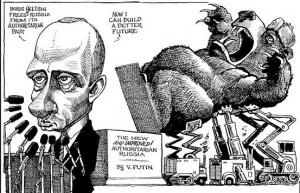
Russia’s self-inflicted wounds are even more severe. Vladimir Putin’s invasion of Ukraine led to American and European sanctions that have been gradually tightened since they were imposed in July. The rules limit Russian firms’ access to American debt markets. They also ban American firms from selling kit or advice to Russia’s energy giants. This prevents western oil firms from helping Russian ones develop oil- and gasfields. Mr Putin’s retaliation—import tariffs on Western goods—has pushed up domestic prices further.

There could be worse to come. The drop in commodity prices looks set to last. Meanwhile, in order to crimp inflation and stem the slide in their currencies the central banks in both countries raised their rates last month: they stand at 11.25% in Brazil and 9.5% in Russia. At the same time, worried finance ministries are keen to bolster their books. In Brazil, fuel-tax hikes are being mooted, and tax breaks on car purchases may be scrapped. In Russia a rule that caps the budget deficit at 1% of GDP may require austere fiscal policy.

Banks could prove vulnerable as public-sector spending cuts hit incomes and high interest rates make loans hard to service. In Russia things are particularly bad: non-performing loans are rising, and savers are draining the banks of roubles.

Bond markets could be another flashpoint. Both have big foreign-exchange reserves: despite losing around $100 billion in the past year, Russia has close to $370 billion. But they also have big dollar debts that become harder to serve as their currencies fall. Pessimists see tumbling currencies, bond-market routs and even bank runs.
Russia's Problems

How Goes the Business of Cannabis?

Put politely, the cannabis business in the US is finding its footing.

Drug dealers aren’t what they used to be. In Colorado, which in January became the first place in the world fully to legalise cannabis, buying a joint feels more like visiting a trendy craft-brewery than a drug den. Dispensaries along Denver’s “green mile” are packed with young, bearded men earnestly discussing the merits of strains with names like “Bio-Jesus” and “Death Star”. Some varieties claim to be inspirational, while others say they promote relaxation, or “couch-lock”, as the tokers call it.

Colorado’s pot industry expects to rack up sales of $1 billion this year. Across America the market is reckoned to be worth about 40 times that much. Most of it is still illegal, of course. But slowly, entrepreneurs are prising it out of the hands of crime gangs. Nearly half the 50 states permit the sale of marijuana to medical patients, which in practice may include anyone willing to fake a back problem. This week Oregon and Alaska joined Colorado and Washington in legalising it for recreational purposes, too. If other countries legalise, as Uruguay already has, it could open up a global cannabis market worth perhaps $100 billion a year (by the best guesses, which are stabs in the dark).

Who will corner that market? In Colorado a gold rush of excitement has seen hundreds of tiny firms sprout up. Just as everyone in San Francisco seems to be designing an app, everyone in Denver has an idea for a canna-business. Pot-friendly ski-chalets, taxi services and wedding planners are taking orders. Non-smokers can sign up for cannabis cookery courses. For the truly lazy, there is the option of lying back and being rubbed down with weed-infused massage oil.

Despite the boom, no big force has yet emerged. Even Colorado’s biggest retail chains, such as LivWell, Strainwise and The Clinic, have fewer than ten branches each. No firm has much more than about 7% of the cultivation or retail market, reckons Mike Elliott of Colorado’s Marijuana Industry Group. At first sight this fragmentation is odd. Cannabis-farming benefits from economies of scale just as any other form of agriculture does. And you might think that when taking a mind-altering and potentially harmful substance people would prefer a trusted brand over a small upstart, as they overwhelmingly do with cigarettes.

What would it take to build a Marlboro of marijuana, then? Most of the obstacles are regulatory. Until recently Colorado’s dispensaries were obliged to grow at least 70% of the cannabis they sold, and cultivators had to retail at least 70% of what they grew. The idea was to make it easier to keep track of the drugs—“from seed to sale”, as the state government puts it—and avoid creating excess supply, which could feed the black market. But one consequence is that firms have been unable to specialise. Some companies are good at farming but not at selling; others have nice storefronts but lower-quality products. No company has grown as fast as it might have, were it able to focus on one thing.

Cannabis businesses have been financially hamstrung, too. Getting a bank account is difficult, since even local banks must obey regulations laid down at the federal level, at which cannabis is still outlawed. About one-third of the industry is completely unbanked, according to Mr Elliott.

The federal ban also makes it hard to do business in more than one state.

It may not be long before these obstacles fall. Even without inspiration from a drag of Bio-Jesus, it is not hard to imagine a future in which the federal ban is eased, now that voters in so many states have backed liberalisation. The innovative pot entrepreneurs in places like Denver would welcome that.  But should they?  Alcohol after the end of Prohibition, and also tobacco came to be dominated by a few giant corporations.

Would household names really consider selling cannabis? They already have. In 1969 a Philip Morris executive wrote to the Justice Department, requesting a sample of marijuana for testing. In 1970 British American Tobacco put together a blueprint for a “cannabis-loaded cigarette”. Cannabis is certainly controversial. But then so is lung cancer. It may well be that the executives best placed to make a mint from marijuana, once it is fully legal across America, are the Marlboro men themselves.

Cannabis

Swiss Gold Referendum Approaches

Save Our Gold Movement in Switzerland is getting about 40% of the Swiss vote in opinion polls.  Although some people have concluded that Switzerland is a business, not a country. the gold initiative represents an income switch inside Swtizerland:

Income to Swiss exporters and banks who profit on the relatively weak franc would go to the Swiss households, wage earners and low income families.  Purchasing power increases when the CHF increases.

Low income groups are rather in favor of the initiative, while high income earners are against it. In particular, the income groups under 5000 francs are in favor. Switzerland imports a big part of its food and basic necessities from its neighbors. the German discounters Aldi and Lidi have a strong presence in Switzerland.  A 10% stronger franc would imply far lower living costs for the low income groups.  On the other side, entrepreneurs and high wage earners would have losses on Swiss stocks, when the SNB can no longer manipulate the FX rate. Logically the latter group is against the gold initiative.

Swiss Gold

US Probes Putin Allies for Money Laundering

Prosecutors in the Eastern District of NY are investigating members of Putin’s inner circle for  money-laundering.   Did billionaire Russian gas trader and Putin associate Gennady Timchenko transfer funds related to allegedly corrupt deals in Russia through the U.S. financial system? The Justice Department is helping the investigation.

The prosecutors are investigating transactions in which Gunvor Group, a commodities firm founded by Timchenko, bought oil from Russia’s Rosneft and sold it to third parties.

The report said the transactions predated U.S. sanctions against Russia introduced in March on Timchenko and others over the Ukraine crisis. Timchenko is also co-owner of Russia’s No. 2 gas producer Novatek.

Transfers of funds related to the transactions could constitute illegal money laundering if the funds were found to have originated from illicit activity such as, for example, irregular sales of state assets such as oil, the newspaper said.

The newspaper cited one source as saying the probe was also examining whether any of Putin’s personal wealth was connected to allegedly illicit funds.

The U.S. Treasury has said Putin has investments in Gunvor and may have access to Gunvor’s funds. Both the company and the Kremlin have strenuously denied those allegations.

“When it comes to President Putin, he does not and never has had any ownership, beneficial or otherwise in Gunvor. He is not a beneficiary of Gunvor or its activities, directly or indirectly,” Gunvor said.

money laundering

Is the US Government’s Investigation of Foreign Banks a Diversionary Tactic?

US regulators are re-upping their case against Standard Chartered, a British bank.  They are doing this under US domestic laws which forbid trading with Iran.   These laws do not apply to foreign banks, so the case is a false one.  Nonetheless, shares in the bank fell precipitously when the US announced its new investigation.

British politica leaders have refused to get involved.  Some think that the bank has no choice but to move back to Shanghai where it began in 1858.

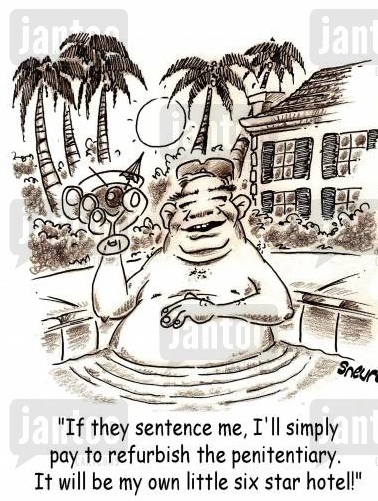
US regulators will not touch a US banker like Jamie Dimon, who until recently was the President’s personal banker among his many roles.  They are trying to defend themselves to US citizens cangry at banks by attacking foreign banks like Credit Suisse and Deutsche Bank.  Meanwhile Bank of America, JP Morgan Chase and Citibank are sailing through with no criminal charges lodged against them.  Fines which seem huge to ordinary citizens are just the cost of doing business for big banks.

Fining Big Banks

War on Women?

Heather Wilhelm writes: If you follow the antics of modern “feminism”—or even if you desperately try to ignore them—you’ve probably witnessed the following sad and wacky spectacle: Every week or so, certain clusters of cloistered, college-educated, first-world women will dredge the darker realms of the Internet for some new form of oppression to call their own.

It was refreshing, then, to see many of America’s much-touted, reproduction-obsessed, faux “War on Women” candidates—most notably Colorado’s Mark Udall and Texas’s Wendy Davis—lose handily in Tuesday’s elections. Equally refreshing was recent news out of Australia, in which the country’s foreign minister, Julie Bishop, told an audience that “feminist” is “not a term that I find particularly useful these days.”  Bishop sees herself, apparently, as a person, not a walking “lady part” grievance machine.“I’m a female politician, I’m a female foreign minister,” Bishop said. “Get over it.”

The bulk of modern feminists probably won’t approve.  Monsters, apparently, are everywhere. “Sexism is not just something that occasionally rears its ugly head,” as feminist writer Jessica Valenti recently warned in the Guardian. “It exists every day in every space.”

Yikes! As a woman who occupies various and sundry spaces on this madcap, whirling sphere, I was certainly surprised to learn this.

“What part of feminism,” asked Clementine Ford, a Melbourne-based feminist and writer, did foreign minister Bishop “find so unappealing?”  The nagging suspicion that most hard-core feminists would happily karate-kick you from behind in a dark alley if you disagree with them. It also could be the repeated public “rage spirals.”

There’s a more serious problem, however: For modern feminists, facts don’t seem to matter, and manufactured crises are all part of a day’s work. As some very real oppression of women unfolds around the globe, today’s Western feminists are busy constructing entire narratives out of false “epidemics”—widespread, sinister “street harassment” is the latest of many—that crumble upon closer examination.

I guess this makes sense, when you think about it: If the “oppression” of American women were to entirely disappear, a whole host of laptop scribblers would face the daunting task of selling “think pieces” about something else, and the only other thing they tend to know about is fusty, boring old Marxist economics. Who, aside from the people who pretended to get beyond Page 2 of Thomas Piketty’s book attacking capitalism, wants to read about that? There’s a delicate economy in the balance here, people—and, no doubt, large piles of unpaid student loans.

So the show must go on. Dilemmas must be concocted, and hackles must be raised. However, judging by the peculiar, stringent waft of its latest narratives, modern feminism might face an interesting test in the coming years—and it could fail that test by seriously misunderstanding what women really want.

Many women, in short, want husbands. A stable marriage is usually the best economic arrangement for all parties involved. The Democrats aren’t alone in getting this.  Desperate to appeal to left-leaning single ladies, the College Republican National Committee recently ran a cringe-worthy ad that compared choosing a candidate to buying a wedding dress.

While this week’s election results suggest that the left’s “War on Women” narrative is sputtering, the progressive dedication to curating the single, female demographic will continue to grow. With that comes a subtle vested interest in keeping more single ladies, well, single. Who needs a husband, after all, when you’ve got Uncle Sam?\

War on Women?

Luxembourg, a Tax Haven

Center for Public Integrity reports on the magical land of Luxembourg which has become a tax haven for large corporations.

  • Pepsi, IKEA, AIG, Coach, Deutsche Bank, Abbott Laboratories and nearly 340 other companies have secured secret deals from Luxembourg that allowed many of them to slash their global tax bills.
  • Advisors have helped multinational companies obtain at least 548 tax rulings in Luxembourg from 2002 to 2010. These legal secret deals feature complex financial structures designed to create drastic tax reductions. The rulings provide written assurance that companies’ tax-saving plans will be viewed favorably by Luxembourg authorities.
  • Companies have channeled hundreds of billions of dollars through Luxembourg and saved billions of dollars in taxes. Some firms have enjoyed effective tax rates of less than 1 percent on the profits they’ve shuffled into Luxembourg.
  • Many of the tax deals exploited international tax mismatches that allowed companies to avoid taxes both in Luxembourg and elsewhere through the use of so-called hybrid loans.
  • In many cases Luxembourg subsidiaries handling hundreds of millions of dollars in business maintain little presence and conduct little economic activity in Luxembourg. One popular address – 5, rue Guillaume Kroll – is home to more than 1,600 companies.

Magical Kingdom of Luxembourg

The “Living Will” Provision of Dodd Frank

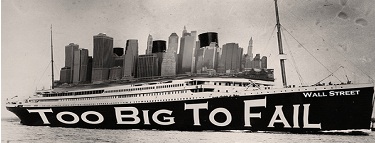
Is this a solution to ‘too big to fail?”

Jeffrey M. Lacker, had of the Federal Reserve of Richmond, spoke on ‘too big to fail’

Here are his main points:

  • “Too big to fail” results from two mutually reinforcing conditions: Investors feel protected by an implicit commitment of government support, and policymakers feel compelled to provide that support to avoid a disruptive adjustment of expectations.
  • The origins of too big to fail can be traced back to the introduction of federal deposit insurance in 1933. The problem was exacerbated by a series of rescues by the Federal Reserve and the FDIC that began in the 1970s, and by policymakers’ actions during the financial crisis of 2007–08.
  • The Orderly Liquidation Authority created by the Dodd-Frank Act retains many of the flaws of ad-hoc pre-crisis practices and does little to improve creditors’ incentives to monitor risk-taking.
  • A better strategy for ending too big to fail is the provision in the Dodd-Frank Act requiring large financial firms to prepare “living wills” detailing how they could be resolved under the Bankruptcy Code.
  • Resolution planning is difficult work, but living wills must be credible in order for policymakers to commit to using them rather than relying on government backstops.

Living Wills?

Israel Arrests 14 for Tax Evasion

Steven Scheer writes:   Israel arrested 14 people, including a senior UBS investment adviser, as part of an investigation into Israelis allegedly holding undisclosed bank accounts with UBS worth hundreds of millions of euros, the Tax Authority said on Wednesday.  All 14 had been released on bail soon after their arrests.
In addition to the unnamed senior investment adviser at UBS who was arrested in June in Tel Aviv, 12 Israelis with accounts at UBS had also been arrested, including two suspects who own a chain of health clinics abroad, said the tax authority. An accountant for the clinics was also arrested.  An Israeli court allowed publication of the arrests and allegations following a petition by an Israeli newspaper. The court is considering whether to release the names of those arrested.
Israel is starting to crack down on foreign bank accounts held by its citizens after a similar move by the United States to track accounts held by Americans abroad.  The tax authority said it had carried out a long investigation into accounts held by Israelis in Swiss banks and received information that thousands of Israelis maintain accounts in Switzerland, worth hundreds of millions of euros.

The authority said that the UBS adviser had arrived in Israel the day before he was arrested. He had met Israeli clients at a luxury hotel in Tel Aviv the following day.
“The meetings were held under secret surveillance of tax authority investigators,” it said. “At the end of the meeting …all the participants were arrested.”
Searches were subsequently made in the hotel room of the UBS adviser, UBS’s office in Israel and in other locations.  Among the adviser’s possessions, investigators found lists of hundreds of Israelis with unreported bank accounts in Switzerland, the authority said, adding that he is accused of helping clients intentionally and deliberately avoid reporting and paying taxes.
It said the adviser — directly responsible for dealing with the accounts — would visit Israel for secret meetings with clients who did not want to send instructions and documents to the bank by phone, mail or fax to avoid revealing that they held Swiss bank accounts.
Leumi, Israel’s second largest bank, last week said a settlement with U.S. authorities over possible tax evasion by the bank’s American clients could be far higher than previously estimated.
The total penalty could reach as much as $600 million, based on Leumi’s previous estimate as well as a settlement offer from New York State’s financial regulator.

Arrests

Can Germany Help Italy?

Jim O’Neill writes:  I’ve spent a good deal of my 35 years as an economic and financial analyst puzzling over Italy. Studying its economy was my first assignment in this business — as a matter of fact, Italy was the first foreign country I ever flew to. I’m just back from a vacation in Puglia and Basilicata. Over the decades, the question has never really changed: How can such a wonderful country find it such a perpetual struggle to succeed.

All the while, Italy has pitted weak government against a remarkably adaptable private sector and a particular prowess in small-scale manufacturing.

The rest of Europe had mixed feelings about this readiness to restore competitiveness through devaluation — meaning at their expense. When discussions began about locking Europe’s exchange rates and moving to a single currency, opinions divided among the other partners, notably Germany and France, on what would be in their own best interests. Many German conservatives, including some at the Bundesbank, doubted Italy’s commitment to low inflation.

In the end, of course, the decision was made to bring Italy in. The results haven’t been good. It’s ironic that between 2007 and 2014 Italy has done better than most in keeping its cyclically adjusted budget under control.  The reason is persistent lack of growth in nominal GDP, itself partly due to an overvalued currency and tight budgetary restraint.

Italy is the euro area’s third-largest economy and its third-most populous country. Given this, the scale of its debts and everything we’ve learned about Europe’s priorities during the creation of the euro and since, I’ve always presumed that, in the end, Germany would do whatever was necessary to protect Italy from the kind of financial blow-up that hit Greece in 2010.

Italy needs growth in nominal GDP to stop its debt burden from rising any further.

This means it needs Germany’s help — not just through greater fiscal flexibility, which is essential, but also through a rise in euro-area inflation back to the European Central Bank’s target of “below, but close to, 2 percent

Perhaps German citizens should pay an extra tax each year the country experiences inflation that is below but not close to 2 percent — with the penalty increasing in proportion to the shortfall? The proceeds could be distributed to countries with a cyclically adjusted fiscal deficit of less than 3 percent and less-than-trend GDP growth.  Perhaps Italy could impose a punitive tax on German tourists?

Crazy?  I know.  Not any crazier than insisting on an arbitrary fiscal-deficit rule, unadjusted for the economic cycle — or letting demand fall so low that Europe misses its inflation target by a mile, and in a way that condemns Italy and others to endless recession?

Italian Economics?