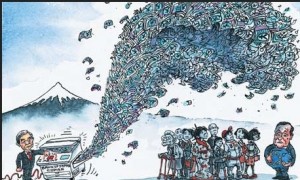
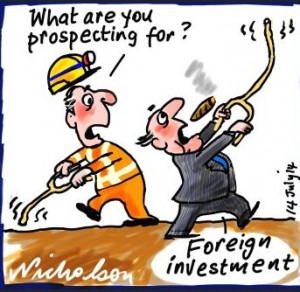
The Kremlin’s Cleanest Hands?

Michael weiss writes;  Igor Schualov, Moscow’s first deputy prime minister, is worth 250 million dollars.   Called Mr. Clean, where di he get his money?

Shuvalov used offshore companies to purchase close to $2 million in building materials from a Belgian contractor in order to outfit a lavish greenhouse for his 18.5-acre estate just outside Moscow. The company, Glas & Metaal Engineering, which filed for bankruptcy in June 2011 and no longer exists, was based in the municipality of Menen, Belgium. It was contracted in February 2006 to sell “glass-panels and the support-structures in stainless steel, and aluminium outside cleaning-gantry” for the glazed dome and walls for the “Wintergarden” on Shuvalov’s sprawling estate in Zarechye village in the Odintsovo district of Moscow, the buildings of which were designed by Italian architect Giuliano Moretti.

The land of Zarechye-4, Shuvalov’s property, formerly belonged to members of the Soviet Politburo, including hard-line communist ideologist Mikhail Suslov, for the purpose of hosting VIPs. Shuvalov’s neighbors include billionaire oligarchs Roman Abramovich and Suleyman Kerimov, with whom Shuvalov has profited enormously in financial dealings uncovered in 2011 and 2012.

Shuvalov was meant to be different. A reputed liberal in the Kremlin, once considered Russia’s business-friendly “sherpa” to the G-8, Davos, and the World Trade Organization, Shuvalov has long been thought of as an agreeable counterpoint to the hard-line siloviki, or strongmen, a faction that now seems dominant in the Kremlin. In congratulating the formation of the new Russian government after Putin’s return to the presidency in May 2012, the influential U.S.-Russia Business Council named Shuvalov first as an “[advocate] for improving the business climate and strengthening the U.S.-Russia bilateral commercial relationship.”

Shuvalov’s role has been to put a more respectable face on international Russian commerce, a face never more urgently needed than it is now.  Corruption in Control in Russia

Shuvalov

Irish Water: Public or Private?

Irish Minister for the Environment Alan Keely might hold a referendum to make sure that Irish water stays in public ownership.  The Irish government is mired in conroversy over the furute ownership of Irish water.

Water is plentiful in Ireland, but the Irish use about as much water as Americans do. A lot.  102 gallons per person each year.  Pipes have to be repaired.  Someone has to pay.  The people are baulking.  In difficult economic times in the country, free water has become a campaign cry.  The International Monetary Fund is insisting that the problem be taken care of iif Ireland is to receive funds.

Primary responsibility for that transformation falls to Irish Water, a new enterprise that consolidates the water services provided by 34 local authorities. Headquartered in Dublin, but with eight regional offices, Irish Water will work to fill a backlog of investment needs – including leak repair – that has resulted from more than a century of underinvestment in water services.

The House voted to accept a Fianna Fáil motion which stated: “That Seanad Éireann requests the Government to initiate legislation to provide for a constitutional referendum to enshrine the ownership of Irish Water to the Irish people in perpetuity.”  The Seanad was ladjourned for 15 minutes after Opposition Senators protested that they did not have enough time to debate water charges.

When Cathaoirleach Paddy Burke called on Mr Kelly to respond to the debate, Independent Senator Fidelma Healy-Eames complained that she did not get an opportunity to speak.  Fianna Fáil Seantor Brian Ó Domhnaill said the Government did not want to hear what the people were saying.

Meanwhile in the Dáil Mr Kenny said he agreed with Tánaiste Joan Burton that water charges should be affordable and fair.

Free Irish Water

Republicans May Make Positive Impact on Global Economy in the Legislature

The Repulicans will control both houses of Congress in the US.  This may be good news for the global economy.

Daniel Altman writes:  Both houses of Congress will fall into Republican hands for the first time since 2005. The global economy will be watching to see if the two parties can finally work together — and perhaps, in some ways, they can.

With Republicans at the helm in both houses, simply boasting of stopping President Barack Obama’s agenda probably won’t impress voters too much in 2016, either. And no one wants to go down in history as the party bigwig who merely watched while nothing got done (right, Mitch McConnell?). So Republicans may want to advance some legislation that the president would sign.

This is where the global economy comes in. The United States has been the lead horse pulling the wagon for several years now, and that doesn’t look like changing in the next two. The European Union is still hamstrung by austerity, unemployment, and weak monetary policy.   China is in the midst of a slowdown.  And Japan, though showing some hopeful signs, is operating far from capacity.

In other words, the ball is in Washington’s court. And there are three important areas where Republicans can set an agenda that might even bring Obama along, offering him a chance to strengthen his as-yet-shaky legacy, and give Congress something to crow about.

The first is taxes, and the corporate income tax is front and center. The United States has one of the highest rates in the world, which has resulted in vast pools of cash owned by American corporations sitting unused overseas.   Cutting the rate would make federal tax revenue less volatile, but it would also give Americans who pay taxes as companies a chance to shelter vast amounts of income. To preserve the reduction in volatility while maintaining the tax base, legislation might also get rid of some of the dozens of loopholes. 

If American companies took advantage of a friendlier tax rate to bring their earnings back stateside and invested them in their businesses, global growth could get an enormous boost. U.S. companies may hold on the order of $5 trillion in cash abroad; investing even $1 trillion at return of 5 percent would raise annual output in the United States by $50 billion, or about 0.3 percent per year, with likely spillovers abroad. Of course, the rest of the world might also suffer a dent in its liquidity, but the net effect of putting those dollars to work would almost certainly be positi

Another area ripe for reform is immigration. The United States has an immigration policy that’s largely motivated by politics and cultural considerations rather than economics.

Even against the backdrop of an immigration policy that lacks economic underpinnings, research suggests that migration to and from the United States responds to supply and demand.  Taking the brakes off immigration would allow more businesses to operate efficiently, bringing in workers as they would raw materials or physical capital. And when immigrants work in the United States, they frequently earn much more than they would have at home — and they send a portion of their incomes back to spur growth there as well. It’s hard to believe that Obama would reject a pro-business immigration reform that also allowed Republicans — not to mention the president — to accentuate their toughness on border security.

The last area where Republicans and the president might find common ground is trade. Obama is more in favor of free trade than the Democratic caucus, which has put a damper on his administration’s efforts to sign historic pacts with the EU and neighbors across the Pacific.  There’s a chance that immigration and trade deals could be pushed through

That’s the economics. But from a political perspective, do any of these three areas show actual potential for progress?

Establishment Republicans, as opposed to the insurgent Tea Partiers and their ilk, have always boasted of a pro-business agenda. And John Boehner, the speaker of the House of Representatives, and Mitch McConnell, the presumptive Senate majority leader-in-waiting, are about as establishment as they come. By a stroke of luck, it’s also fashionable for Democrats to be pro-business these days.  For Obama, especially as a lame duck, there’d be little benefit to vetoing economically driven proposals on any of the issues above; instead, he could use pro-business credentials to become an asset on the campaign trail again. 

No, the big question is whether the pragmatism of establishment Republicans can win over the more ideological wings of their party. Immigration, trade, and even taxes are all emotional issues, especially for Americans fed up with job searches and stagnating incomes. But as long as payrolls in the United States keep growing, there may just be room under the covers for some rather unusual bedfellows. If they can finally get it together, the global economy may be in for a blissful couple of years.
China: Should We Look at Productivity Instead of Growth?

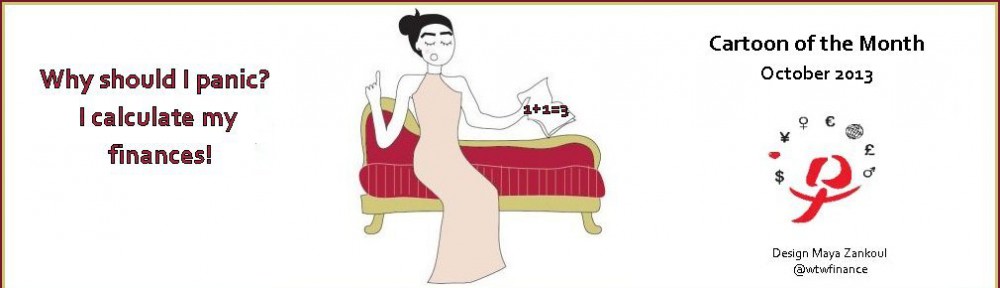
Look at productivity in China, not growth. to see where China is really headed.

With iron ore prices already sitting at five year lows, a further slowdown in Chinese growth is not the sort of news that Australian policy-makers need. What is of greater concern is whether we are seeing the beginning of something more permanent. Will China have a similar trajectory to Japan since the early 1990s? This would impact the rise of China’s middle class.

In the long run economic growth is delivered when productivity climbs. That means finding better ways of doing things. The only other way to produce more output is to use more inputs. However, the problem is diminishing returns. Building a rail link that connects an inland city with a port brings enormous benefits but once built, there is little need for another..

Productivity struggles to attract the attention of commentators because it is hard to calculate. Professor Chris O’Donnell and James Laurenceson found evidence of rapid productivity growth across most provinces. This is good news but also no surprise – China had access to easy sources of productivity gains such as borrowing technology from overseas.

The key question is whether productivity can continue to improve as the economy matures?  The government has spent much on human capital and the results are significant. China’s universities are now second only to the US in terms of their total research output.

But for truly rich productivity gains to be unlocked, reforms are needed that shift the economy away from its dependence upon investment. For consumers to take the lead they need more income. Getting state-owned banks to pay the household sector market rates of return on their savings deposits is one example of the type of policy that is sorely needed.

Facing a downturn in economic activity, the first instinct of China’s leaders is to pull policy levers that pump up aggregate demand. But temporary measures to boost growth such as expanding the supply of credit have largely run their course and are no longer sustainable.

When pushed they have also shown themselves to be nothing if not pragmatic. President Xi Jinping’s aggressive tackling of official corruption in response to public anger is a case in point. If stalled living standards are to be avoided, committing to a productivity-enhancing reform agenda is really the only option that China has left.

Focus  on what the data says about the trajectory of productivity. Through the first half of 2014 consumption contributed 54% of GDP growth, while investment chimed in with 49% (net exports were responsible for -3%).

The overall growth rate may be disappointing but if there is a widening of the gap in favour of consumption then this is exactly the sort of news that China and Australia needs.The Conversation

Productivity in China

SEC Fines Bio-Red Laboratories for Bribery

An SEC investigation found that Bio-Rad Laboratories lacked sufficient internal controls to prevent or detect approximately $7.5 million in bribes that were paid during a five-year period and improperly recorded in books and records as legitimate expenses like commissions, advertising, and training fees. The improper payments enabled Bio-Rad to earn $35 million in illicit profits.Bio-Rad, which self-reported its misconduct and extensively cooperated during the investigation, agreed to pay $55 million to settle the SEC’s charges and a parallel action announced today by the U.S. Department of Justice. Said Andrew J. Ceresney, Director of the SEC’s Division of Enforcement:

Bio-Rad Laboratories failed to detect a bribery scheme and did not properly address red flags that such a scheme was underway. This enforcement action, which reflects credit for Bio-Rad’s cooperation in our investigation, reiterates the importance of all companies ensuring they have the proper internal controls to prevent FCPA violations.

According to the SEC’s order instituting settled administrative proceedings, Bio-Rad made excessive payments disguised as commissions to foreign agents with phony Moscow addresses and off-shore bank accounts. The agents had no employees and no capacity to perform the purported services for Bio-Rad, and were retained primarily to influence Russia’s Ministry of Health and help the company win bids for government contracts. Bio-Rad managers repeatedly ignored various red flags indicating that the Russian agents were likely bribing government officials, and they condoned an atmosphere of secrecy. Country managers were allowed to communicate through at least 10 different personal e-mail addresses with aliases, and referred to the commissions with code words such as “bad debts.”

According to the SEC’s order, Bio-Rad employees used local intermediaries in Vietnam and Thailand to funnel bribes through to foreign officials in exchange for business. Bio-Rad’s Singapore subsidiary sold products at a deep discount to Vietnamese distributors, who passed through a portion of it as bribes. Bio-Rad acquired a company in Thailand and failed to uncover a pre-existing bribery scheme in which Thai agents received inflated commissions that were partially used for improper payments.

The SEC’s order finds that Bio-Rad, headquartered in Hercules, Calif., violated the anti-bribery, internal controls, and books and records provisions of the Securities Exchange Act of 1934. The company agreed to pay $40.7 million in disgorgement and prejudgment interest to the SEC, and a $14.35 million criminal fine to the Department of Justice. The company also must report its FCPA compliance efforts to the SEC for a period of two years.

The SEC’s investigation was conducted by FCPA Unit members Catherine W. Brilliant and Alka N. Patel in the Los Angeles office. The SEC appreciates the assistance of the Fraud Section of the Criminal Division at the Department of Justice as well as the Federal Bureau of Investigation, Bank of Lithuania, Financial and Capital Market Commission of Latvia, and British Virgin Islands Financial Services Commission.

When governments put their mind to it, coruption can be stopped.

Bribes


Venezuela Raises Minimum Wage…Again

President Maduro has raised the minimum wage for the third time this year.  The raise comes amid an annual inflation rate of 63.4%.

Mr Maduro said the measure and other benefits meant workers would be better off despite the inflation, which he blamed on an “economic war” the opposition were waging against him.

The new wage will be 4,889 bolivars per month ($776; £485 at official exchange rates, $49 in the black market).

Under Venezuela’s strict currency controls, people and businesses can receive US dollars at the official rate only by applying to a government currency agency, and then only for specific purposes such as importing goods or paying for foreign travel.

The amount of dollars available at the official rate is restricted, but the demand remains high. This has caused the black market to flourish.

To applause from party members and workers gathered at an official event, President Maduro said he had “decided to accept the proposal from the workers to decree a 15% rise in the minimum salary from 1 December”.

Last week, the president announced that he would raise the salaries of the members of the Venezuelan armed forces by 45%, a move which was heavily criticised by the opposition.

Mr Maduro said the increase was “just” and “well deserved”.

Mr Maduro says Venezuela’s economic problems are created by a greedy elite which lives off the profits of smuggling and selling goods at inflated prices.  The opposition accuse the socialist government of Mr Maduro and that of his predecessor in office, Hugo Chavez, of mismanaging the economy for the past 15 years they have been in office.

Maduro

Press Suppressed in Egypt

Louisa Loveluck writes about cartooning in Egypt.  Egypt’s cartoonists have traditionally been among society’s most searing political critics. Straddling the line between journalism and satire, they can express what others can’t. “The cartoon is a weapon,” says Anwar, the pen behind last week’s cartoon. “All artists have the gun – they just need to know when, where and whom to shoot.”

Yet his trenchant image stood out for its rarity. After three years of revolutionary tumult, and the fall of two presidents, Egypt’s subversive cartoonists are mostly taking another tack. Gone are the irreverent depictions of the leader of the day. And dissenting media outlets have been forcibly closed, or have ceased publication of their own accord, wary of voicing criticism of Egypt’s popular new leader.

“There are periods in history that are not suitable for serious criticism,” says Doaa El Adl,  another cartoonist at Al-Masry Al-Youm. “You can criticize, but you must not bring down the system – these people who chant against the military regime don’t understand that the only option is the Muslim Brotherhood.” 

Most media are firmly on board. On Oct. 26, leading newspaper editors convened to issue to a statement supporting “all measures taken by the state in combating terrorists and protecting national security.” A week earlier, Sisi had called on Egyptians to rally in the face of terrorism following two militant attacks on soldiers in the restive North Sinai region left 33 dead. It was the deadliest day for the Egyptian army in decades.

Egypt’s new leadership, which came to power after a military coup, casts itself as the bulwark against a political trend that indulged Islamic fundamentalism and dreamed of turning the country into a theocracy. That tilt, and the popularity of the July 2013 coup, makes cartooning a perilous profession for those who like to poke fun at those in power.

Amr Selim, an elder statesman of Cairo’s cartooning scene, says the space for dissent has shrunk. And like Ms. Adel, he sees his work as a patriotic duty: “Not everything is perfect, but Egypt must move forward,” he says.

Things changed under the interim junta that followed. Amid a febrile atmosphere, cartoonists and journalists pushed the envelope, learning by trial and error what the authorities of the day deemed acceptable. The results were popular, often spreading across social media like wildfire. Some received threats for their criticism of the army.

Pressure comes from Egypt’s feared security forces. Last month, the editor-in-chief and a reporter from Al-Masry Al-Youm’ were hauled before state security prosecutors and interrogated for fourteen hours after the paper declared it would publish investigation records into alleged fraud in the 2012 presidential election. A print run of the paper was also recently pulled over an interview it featured with an Egyptian spy.”

But just days later, the newspaper published his image of the shuttered office on the inside page. And on Thursday, it was Adel’s turn to send another shot across the bows. In her cartoon, a journalist edges along a tightrope labeled “the margin of freedom.” Below, waits the hand of authority, its fingers poised to flick and send him spinning.

Press Freedom in Egypt

EC Downgrades EU Economy

The European Commission cut its growth forecasts for the eurozone and the wider European Union.  The Commission predicts that the eurozone will grow by 0.8% in 2014 and 1.1% in 2015. In the spring, which is when the Commission last published such estimates, it revised up its growth forecasts for 2014 to 1.2% and to 1.7% for 2015.

Today’s downgrade confirms that the economic recovery that began to emerge earlier this year in Europe is losing momentum. Weak growth over the coming years is expected to make only a small dent in unemployment in both the eurozone and across the EU.

Growth in 2014 and 2015 will be stronger outside the eurozone in 2014. The EU economy as a whole will grow by 1.3% in 2014 and 1.5% in 2015.  By comparison, the Commission estimates that the United States economy will grow by 2.2% in 2014 and 3.1% in 2015.

The Commission presented its autumn economic forecasts, based in part on draft national budgets and forecasts submitted to the Commission by eurozone governments in mid-October.

The Commission will use its latest forecasts to assess to what extent the draft national budgets comply with eurozone budget rules that set limits on public spending and debt. It is expected to publish the opinions by mid-November.

Pierre Moscovici, the European commissioner for economic and financial affairs, presented the forecasts together with Jyrki Katainen.  Katainen admitted that the “economic and employment situation is not advancing fast enough”. Both he and Moscovici stressed the need for greater investment, without letting up on fiscal consolidation and structural reforms.

Some eurozone economies will enjoy strong growth in 2014. Luxembourg and Malta are predicted to register growth of 3%, while Ireland is expected to grow by 4.6%

Austerity the Answer?

QE in Japan

The Bank of Japan (BoJ) stunned the financial markets by unexpectedly expanding its programme of quantitative easing. The bank’s existing measures, a “different dimension” of easing from past efforts, were already daringly bold. Now it will swell Japan’s monetary base at an even faster pace, by around ¥80 trillion ($712 billion) each year, up from ¥60 trillion-70 trillion currently. To do so, it will hoover up still larger quantities of Japanese government bonds (JGBs).

The bank’s action is also an admission of partial failure thus far. Its bond-buying has succeeded in sparking some inflation, yet its goal of achieving price rises of 2% a year by around April 2015 remains a distant possibility. Along with the government, it badly underestimated the dampening effect of a hike in the consumption tax in April this year, which caused the economy to shrink by 1.7% in the second quarter.

Economists had started to question Mr Kuroda’s oft-stated commitment to banishing Japan’s entrenched deflationary psychology. Mr Kuroda admitted that matters had reached a “critical point”, as the bank’s efforts were losing momentum.

Now a fresh round of no-holds-barred QE will immediately boost Mr Abe’s economic plan. The Nikkei stock index—a vital gauge of success for the government—rose to its highest level in seven years on the news. The yen lurched further downwards, which will help import inflation.

As well as buying an additional ¥30 trillion of JGBs a year, the BoJ will also purchase more risky assets in the form of exchange-traded funds and investment trusts in Japanese property.

A motivation for Mr Kuroda—in addition to visibly slowing inflation and weak growth—may have been an intensifying political debate over whether or not Mr Abe should again raise the unpopular consumption tax from 8% to 10% in 2015.

But this latest round of QE is not without its detractors. In April 2013 the BoJ’s nine-strong policy board voted unanimously in favour of its radical new monetary drive, this time it revealed a rare split.

QE in Japan

Norway’s Investors Look Hard at China

Yngve Slyngstad runs the world’s biggest sovereign wealth fund and travels around China for a week once a year.

Understanding what’s poised to become the world’s largest economy is crucial for Slyngstad as he manages a fund that Norway predicts will reach $1 trillion in less than three years. He’ll be in China this month, visiting Beijing and other cities.

Growth in China is slowing and the lack of transparency is making it hard for investors to understand exactly why.

Slyngstad, who last year visited Shenzhen, Hangzhou and the Shandong province, is looking for investments to channel billions of dollars in Norway’s oil cash. He has been lobbying the Chinese government to allow the fund a bigger quota than the $1.5 billion it’s permitted to place in Chinese A shares.

Norges Bank Investment Management, which runs the fund as part the central bank, owned 1.3 percent of global stocks at the end of last year.

Figuring out how to invest in China is just one of many hurdles. Slyngstad said one of the main worries now is how monetary policy will affect his investment decisions. Continued turmoil in the EU and distortions in credit markets also cause concern.

Slyngstad said the fund is now “less invested in” credit markets after excess liquidity distorted prices. He’s adjusting the portfolio even after corporate bonds were the fund’s best performing asset class in the third quarter.

The financial crisis — during which the fund has bought up cheap securities everyone else was selling — has challenged truths about investment, monetary policy, the economy and the financial markets, he said. It has showed that the financial industry has the capacity to heal itself, with or without the help of regulators, according to Slyngstad.

The power of the crisis could be called “Schumpeterian creative destruction,” said Slyngstad, who has studied German philosophy.  “Crisis within the financial sector also serves a purpose,” he said. “You have to be careful about something that without a crisis looks stable, but may also turn stagnant.”.

A discussion on broadening the asset mix of the fund is coming “no matter” what, and a tipping point could be when it has reached 4 percent in real estate, Slyngstad said. The fund has so far snapped up properties on Times Square in New York,  the Avenue des Champs-Elysees in Paris, Regent Street in London as well as San Francisco, Washington and Zurich among other cities.

“That will be a natural touch point,” he said. “Both for the real estate question, and for the real assets question.”

Norway's Investments