Oil Prices and Governance

As oil prices plummet, consumers are delighted. Oil producers retrench.

OPEC is scrambling to gain control of the market again and meets at the end of November.  Countries desperate to boost prices, like Venezuela and Russia, are also the least democratic. Oil revenue is used to pay off a powerful elite or pay expensive subsidies to the poor. Neither tactic works well over time.

Norway’s example is of a society that decided to secure its own power and position vis  a vis the big oil companies.  Norway is the world’s fifth largest exporter,  They have tried to distribute money fairly and leave an economy for the future which is not oil-based.  Fighting a tendency to have personal favoritism in government is particularly important for oil rich countries.  High levels of trust and transparency are essential.  These stand out in a country like Norway when oil prices fall.

Falling Oil Prices

The Lagarde List in Greece

During the worst of the economic crisis in Greece, Christine Lagarde, former French Finance Minister, gave a list of 2,000 Greek tax evaders who had Swiss bank accounts.  Government officials in Greece claim to have lost the CD the list came on, and then lost the USB drive they copied it on to.  They dragged their heels for months.

In the fall of 2012, a Greek journalist got hold of the list and published it.  Fifty police officers were sent out to arrest the journalist and not the tax evaders.

Corruption has plagued Greece and helped precipitate the economic crisis.  A handful of super-rich, well-connected people own practically all the country’s TV, radio and newspapers.  They also control major banks, as well as oil, shipping and construction businesses.  Tough for the press and independent citizens to go up against.

Lagarde's List

Abe’s Efforts at Gender Equality Faltering

Two women ministers, Industry and Justice, both women, have left Abe’s cabinet in Japan.  The two resigned amid allegations they violated political funding and election laws.

Yoko Kamikawa will move from her post as gender equality minister to Justice.  She will be replaced by a man.

The embattled former ministers were among record-equaling five women appointed to Japan’s cabinet in September.  The industry minister became embroiled in controversy surrounding the start up of several nuclear reactors after the Fukushima Daichi meltdown.

Abe’s support has fallen since September.  Many are opposed to the sales tax hike he proposes to reform the economy. A majority oppose the restart of nuclear reactors.

Japanese Cabinet

Security Issue with Erection of Cell Towers?

Mysterious interceptor phone towers are being erected in the US.  The towers do not appear to belong to the National Security Agency.

In the US today, selling information is big business.  How can Twitter, Skype, Google and Facebook offer their services free to customers?  Just try opting out of information sharing.  It’s almost impossible.

These towers tell your phone that none of your usual conections are available and trick you into using theirs.

NSA does’t need a fake tower to tap your phone.  They just go to your supplier.  The FCC announced that it was investigated the use of towers by criminals and foreign intelligence.

Cell Towers

I


Is Tesla the Next Apple?

Is Tesla the new Apple?

This is the state of the smartphone/tablet market: Investors were overjoyed when Apple delivered 4.6 revenue growth  in the spring quarter. And the hottest product of the year in the mobile device industry is going to be iPhone 6 because it finally is an iPhone with a screen size larger than 4 inches.

The car industry,is now in the same spot the phone sector was in 2007.

The original iPhone changed what a phone was. The role of the display morphed from vehicle of passive viewing to actual control mechanism, far more intuitive than a keypad could ever be. That sort of fundamental shift of how a product can be used can only happen once in a decade or two. Now Tesla is changing the car in an equally fundamental manner: this new vehicle is totally silent, free refueling stations enable you to drive from California to New York without paying a cent in fuel costs, etc. The phone sector will be playing with  thinness, display size and camera quality for at least five years.

Tesla is getting ready to gut GM and Ford with its car range that is about to expand radically. Just as with Apple, the narrow early distribution of a groundbreaking new product is giving the established players a deceptive period of grace. It will take a couple of years for the real impact to become clear.

But we clearly are now entering an interesting period as Tesla prepares to roll out an SUV called Model X in 2015 and a budget car Model 3 in 2017.

An ecstatic new Morgan Stanley research note claims that “we’d be disappointed if the Model X did not sweep every major Car of the Year award on offer by the automotive media.”  A  palpable sense of frenzy is building in the automotive press and financial media. The design of the Model X is unusually bold and exotic for an SUV and a gutsy move.

The Model X is small potatoes compared to Model 3, though. This car is expected to retail at $30,000, less than half of the price of the current Model S. It will represent a direct attack on the smaller German quality cars of BMW, Audi and Mercedes Benz. If Model X production ramps up aggressively and starts making real inroads in the luxury SUV market, the Model 3 could form the second prong of a dangerous pincer movement aimed at the most lucrative parts of the car industry: high-end SUV models and compact luxury sedans.

As Tesla’s charging station network expands and buzz around the structural innovation of the new models builds, rival car vendors seem to be wading through molasses.

Who would have thought in 2007 that all the excitement around the iPhone would migrate to car business so rapidly?

Testosterone and Greed

To keep libidos active after menopause, some women take testossterione.  It turns out that this may make them greedier.

Joe Pinsker wrires:  Results of a study done by researchers at the University of Lausanne ecently published in The Leadership Quarterly suggest that  people with high levels of testosterone were more likely to behave greedily.

There’s already a thorough body of research on how power contorts morality and reason. Power, it’s theorized, turns people selfish because it makes them feel entitled and emotionally detached. It can make them view others as less worthy, which is of course compounded by the finding that power can increase bias. Given also that power makes people feel immune to bad consequences, it makes sense that some of those in power do so many awful things.

Hormones are a less-scrutinized variable in moral decision making. High levels of testosterone have been linked to diminished generosity and empathy, but the connections between testosterone and corruption—defined by Lausanne’s researchers as ignoring social norms for personal gain at others’ expense—hadn’t been sketched until this study.

To trace this relationship, researchers designed two experiments—both variants of what’s called “the dictator game”—that culled subjects from a Swiss university. In the first setup, subjects were randomly assigned to be leaders or followers. Each leader was solely responsible for deciding how to distribute prize money given to the group. For example, leaders at one point chose between “$100 for me; $70 for you,” “$90 for me; $90 for you,” and “$150 for me; $10 for you.” These numbers were selected such that the more the leader chose the receive, the less his or her followers would get. The leaders with more power—that is, with more followers or more distribution choices—behaved more greedily.

The second experiment was more ambitious. Weeks before subjects were assigned leader/follower roles, they filled out a survey about the fairest way to distribute the money. The vast majority of people agreed that the “$100 for me; $70 for you” arrangement was fair—which allowed the researchers to declare that picking “$150 for me; $10 for you” would be violating a norm that everyone agreed on. Subjects also had their mouths swabbed to measure testosterone levels.

During the experiments, once subjects had been named either leaders or followers, they were frequently reminded of the survey results, making them aware of what their peers expected of them. When leaders’ power over a situation was relatively low, roughly half of them stayed true to the social norms they helped develop; this dropped to 19 percent when they were given more power. Also, the greediest behavior was linked to high baseline levels of testosterone.

Susan Case, a professor of organizational behavior at Case Western notes that the average age of the subjects is about 21 years—an age too collegiate to use in generalizing about the corporate world.

From the Lausanne study, it’s not clear whether testosterone levels control corrupt behavior, or whether high levels of it are linked to the presence of some other physiological feature that does.

David Mayer, a management professor at the University of Michigan, points out that this research is similar, in spirit, to fMRI studies indicating which parts of the brain light up when a certain decision is made.

Indeed, what can be done to make business executives more likely to act with the public good in mind?  Iit appears the best way to curb selfish behavior is to turn away from hormones and toward oneself. “Being self-aware … actually reduces people’s tendency to morally disengage from the tasks they are doing and act with greater integrity,” says Fordham University’s Kyle Emich. Specifically, Emich recommends installing mirrors in the offices of the powerful—”so people are forced to look at themselves,” he says.

Testosterone and Greed

Japan Not Moving on Tsunami Repairs

Taiga Uranaka and Antoni Stockowsky write: Japanese government funds budgeted for reconstruction and transferred to local governments are stuck in banks across the tsunami-ravaged northeast.  The central government has paid out more than $50 billion directly to local governments in Miyagi, Iwate and Fukushima prefectures, the areas hardest hit by the disaster. But about 60 percent of that money remains on deposit in the region’s banks.

Ishinomaki, where more than 3,700 people died in the tsunami – the most casualties of any city in the disaster – has been deeply affected by the funding paralysis. The port city, where 56,000 buildings were damaged, has been showered with money for reconstruction – about $4.1 billion in the three years after it was hit.

But almost 60 percent of the money, or $2.3 billion, remains in bank deposits. And fewer than five percent of the planned new homes for the city’s nearly 25,000 evacuees have been completed.

Makoto Kitamura, the deputy director general of the Reconstruction Agency, says local government spending of reconstruction money has been accelerating. “The pace of the construction projects has also been picking up,” he told Reuters, sitting in his office in Tokyo. “So it is not something you should worry about.”

For Prime Minister Shinzo Abe, the reconstruction delays are a potential time bomb. Before he became prime minister in December 2012, Abe campaigned in parliamentary elections on a pledge to speed up reconstruction – a promise he has repeated on both anniversaries of the disaster since he took office.

As prime minister, he vowed in March 2013 that “reconstruction will have made a lot of progress and our lives will be better by March 11 next year.” A year later he repeated the promise: The government would make the year ahead one in which “everyone in disaster-hit areas feels the progress of reconstruction.”

So far, about 2,700 housing units of a planned 29,000 have been completed in the tsunami-hit areas. In its housing plan issued more than a year ago, the government said it aimed to complete 15,000 homes by March next year. It has since scaled back that target to 10,000 units.

A labor shortage exacerbated by the siphoning of workers away from the disaster zone to build commercial facilities for the 2020 Tokyo Olympic Games has slowed reconstruction. So have a spike in the cost of building materials and problems in procuring land in the disaster zone.

Much of the reconstruction cash has ended up on the ledger of 77 Bank in Sendai, some 50 kilometers west of Ishinomaki. Government deposits at 77 Bank, the region’s largest lender, have jumped four-fold to almost $17 billion in the past three years as reconstruction money flooded in, the bank said.  Like 77 Bank, other regional lenders have also ploughed funds into Japanese government bonds, creating a closed loop of financing. By buying government bonds, the banks’ investments are essentially helping to fund the borrowing that the government undertook to make the disaster-related allocations in the first place. The central government issued $130 billion worth of reconstruction bonds in the three years after the disaster.

The unspent funds sitting in bank deposits also come at a cost to Tokyo. The government is under mounting pressure to cut a public debt load that is more than twice as large as annual economic output.

Separate from the money allocated directly to the prefectures, the central government has poured $140 billion into disaster-relief and reconstruction projects, including emergency loans to small- and medium-sized businesses hit by the tsunami.

The government’s five-year reconstruction plan was built on unrealistic assumptions, said Yoshikiyo Shimamine, the chief economist at Dai-ichi Life Research Institute in Tokyo. “Given bottlenecks such as labor shortages and material cost rises and difficulties in getting consensus among residents who are relocated, reconstruction budgets are not something that can be spent within five years,” he said.

Officials in Ishinomaki, home to 150,000 people, say spending the more than $4 billion in reconstruction aid has proven tough. With all of the city-owned land having been designated for temporary housing after the tsunami, the local government had to negotiate the purchase of an additional 9,000 plots to build permanent homes. That inflated the price of a plot of land in Ishinomaki by 15 percent last year, the biggest jump anywhere in Japan.

Before the city could buy land, it had to track down the legal owners. That proved tedious, said Oka. Officials discovered that in many instances, properties had been passed down without proper inheritance procedures.

After the tsunami, about a third of public works projects in Miyagi failed to attract bidders in the first round as construction companies say they held back for fear the projects would be unprofitable.

A strip of Ishinomaki’s shoreline where 6,500 homes once stood has been declared too dangerous to build on. And many local government officials, who would otherwise have played a role in reconstruction, either died in the tsunami or had their homes destroyed and are themselves living in temporary dwellings.
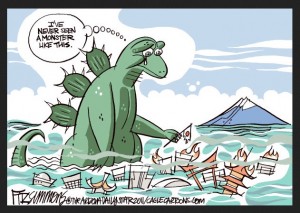

Tsunami Repairs

Getting Brazil Out of Recession?

Marc Sergio Lima writes:  Brazil’s budget deficit unexpectedly widened to a record in September, prompting the government to say it won’t meet its fiscal target as a possible credit downgrade looms. Swap rates rose.

The deficit widened to 69.4 billion reais ($28.4 billion), more than twice the 31.1 billion reais.  The gap is the biggest since December 2001, and for the first time ever, Brazil posted a primary deficit for the first nine months of the year, totaling 15.3 billion reais.

Fresh off the closest election win since the return of democracy,  President Dilma Rousseff  faces the challenge of pulling Brazil out of recession, slowing above target inflation and preventing a further deterioration of fiscal accounts that threatens the country’s investment grade status. This week the central bank surprised analysts with a interest rate increase, marking the first measure in an effort to regain investor confidence. Now the government has to cut spending.

“The credit rating firms have made it clear that the fiscal dynamics are very bad and a downgrade will happen if there isn’t a clear, very strong and credible signal the government will reverse spending increases,” Santos said in a phone interview from Sao Paulo. “It remains to be seen if the government will be able to do so.”

In March Standard & Poor’s downgraded Brazil’s credit rating to one level above junk, citing a slowdown in economic growth and a deterioration in fiscal accounts. Moody’s Investors Service signaled it could cut Brazil’s credit rating to one level above junk when it lowered the outlook to negative last month.

The primary surplus, which excludes interest payments, narrowed to 0.61 percent of gross domestic product in the 12 months through September, compared with a 1.9 percent target for 2014.

The cost to protect the nation’s debt securities against non-payment for five years dropped yesterday as investors interpreted the central bank move as a sign Rousseff is willing to unwind policies that fanned inflation and boosted the budget deficit.

Brazil’s economy entered recession after gross domestic product shrank 0.6 percent in the second quarter in the biggest quarterly contraction since 2009. That followed a revised 0.2 percent drop in the first three months of the year.

Dilma Rousseff

Hezbollah Sanctions?

Juan Pecquet writes:  European officials, not the Lebanese, are the ones raising sharp questions about Hezballlah sanctions legislation that unanimously passed the House in July.  European officials are worried about crippling Lebanon’s economy even as Beirut’s bankers say they’re OK with the House-passed Hezbollah sanctions bill.  The legislation has stalled in the Senate partly as a result, but the bill’s backers are confident they can address any concerns.

Lebanese bank officials in  contrast have said they can live with the new restrictions, especially after a lengthy “findings” section that could have cast the country’s financial sector in a negative light was cut from the bill.

Concern is not as much with the American financial institutions as it is with some of the European financial institutions — and the pushback is coming primarily from that entity.

The EU has been reluctant to break ties with the Shiite militia — it labeled Hezbollah’s so-called military wing a terrorist organization only last year under rising US pressure — and has not blacklisted the group’s bank accounts and assets. Countries such as France insist on maintaining open channels with the most powerful political force in Lebanon.

“We are in contact with working-level staffers of Congress on a very regular basis to exchange on many foreign policy issues,” a French diplomatic source said. “Lebanon is one of the issues discussed, as are Africa, Ukraine, Syria, Iraq or Ebola to name just a few over the last few months.”

The British government did not respond to a request for comment.

Joseph Gebeily, president of the Lebanese Information Center in Washington, said Hezbollah relies on the European financial sector in part because it actively avoids Lebanese banks.  “Hezbollah’s image is important to Hezbollah. They don’t want to be seen as doing damage [to the Lebanese banking sector],  Even Hezbollah parliamentarians can’t open an account.”

Quotas for Women in Japan

Abe’s plan to require businesses with 300-plus employees to establish targets for hiring women and getting them into management positions is a good start. But the policy is rife with escape clauses. Formal and binding quotas akin to Norway’s would have more teeth. Tokyo should at least start mandating leadership roles at the public-sector level and expand from there.

Abe is looking to Norway for guidance:  Norway introduced a 40% quota for female directors of listed companies in 2006, to come into force in 2008.  Non-complying firms could theoretically be forcibly dissolved, though none has in fact suffered such a fate. Since then gender quotas for boards have been imposed in Belgium, Iceland, Italy, the Netherlands and Spain (though with less severe sanctions: non-complying firms must generally explain in their annual reports why they fell short and what they plan to do about it). The European Commission is considering imposing quotas across the EU. Malaysia has imposed a 30% quota for new appointments to boards, and Brazil a 40% target, though only for state-controlled firms. The governments of several other countries, including Australia, Britain and Sweden, have threatened to impose quotas if firms do not appoint more female directors voluntarily. So why are gender quotas becoming more common?

One reason is a growing impatience with the glacial pace of voluntary change: women are the majority of all graduates almost everywhere in the developed world, but make up a smaller share of the workforce the further up the corporate ladder they go. Another is that Norway’s quota law has not been the disaster some predicted. “As a principle, I don’t like quotas,” Ider Kreutzer, the former chief executive of Storebrand, an insurance group, told the Financial Times the year after the law came into force. “But I have not been able to find any big problems with the legislation in practice.” Some had worried that they would actually decrease diversity by forcing companies to dive for the same small pool of eligible women, nicknamed the “golden skirts”. In fact, Norway still has more “golden trousers”—male directors are twice as likely to sit on more than one board. Nor did it obviously lead to less qualified boards: female Norwegian board members are more likely to have a degree than male ones.

Whether you think robust measures to increase the share of women in senior management are a good thing in the first place depends partly on how convinced you are that diversity in management is important. It might improve performance by mirroring the diversity of customers—or, as our Schumpeter columnist recently argued (though about cultural rather than gender diversity), it might increase conflict, worsen communication and reduce workplace trust. Easier to dismiss is the still-common objection that quotas are anti-meritocratic: that is more true of the status quo. Oodles of research demonstrates that women are evaluated less positively than identically qualified men when applying for stereotypically male jobs, such as leadership roles. One study found that a commitment by hiring committees to shortlists with at least 25% women helped to remove anti-woman bias.

Over time, advocates of quotas hope that a sudden large increase in the number of women in leadership will change attitudes.

Gender Equality for Japan?