Senator Cory Bernardi has pushed to ban burkas in the Australian Parliament. President Tony Abbott waffled on the issue. Most Austrailians feel that the issue is one of personal liberty. The wearing of a nurka has nothing to do with terrorism or national secuirty. It is not a poke at western society. Successful and strong nations are built on differences. A piece of clothing is meaningless.
Does Poland’s PM Want to be Merkel?
Ewa Kopacz has portrayed her government as nurturing and thoughtful, one that would not make rash deicsions. Families will come first, much like Mrs. Merkel who is known as “Mummy.”
In trying to pacify disgruntled coal workers, Ms. Kopacz invited their wives to tea in Warsaw. Kopacz is the second woman to serve as Poland’s Prime Minister. Twenty percent of Parliament are women.
She has been ridiculled in the press for emphasizing gender over policy. Some think she can’t be mother of all Poles because she is confrontational and can be stubborn. But she has a strong mandate, and her vision of security for Polish families is popular.
Marissa Mayer’s Leadership Qualities?
What kind of leader is Marissa Mayer of Yahoo? Katie Benner writes: At the end of the day, all executives have to be honest with themselves about whether or not they’re good leader
What are their weaknesses? What don’t they understand? Mayer had never run a business before her arrival at Yahoo (and the company declined to comment on her tenure). She was an early member of Google’s leadership team (Employee Number 20) and exercised a lot of influence over the look and feel of the company’s monster search engine as well as other products. But she was eventually demoted at Google when the political winds went against her.
Mayer was a star student throughout her life and her faith in academic prowess is a common trait in Silicon Valley, where companies like Google stock the employee pool with elite grads. Yahoo — a sprawling Web giant that has its hands in many key parts of the Internet — needs a strong, competent manager at the top of the company. It hasn’t had anyone good at the helm in years. And as we’ve seen amid the tenures of Scott Thompson, Carol Bartz and Jerry Yang, there’s no way that Yahoo’s fortunes will improve without strong leadership.
The rookie qualities that have become part of the Mayer story are a reflection of some brew of inexperience, arrogance, insecurity and poor judgment. No company can grow big or move fast if the CEO has to control every widget that leaves the factory. Eventually, top talent will leave for companies where they’re empowered. The place they’re fleeing will, almost always, weaken.
Each achievement was a pointed refutation of one of many criticisms that’s dogged Mayer’s tenure at Yahoo. The turnaround is a nonstarter. She doesn’t have a strategy. Tumblr was a flop. She’s a poor financial steward.
Leadership, and it’s more stolid cousin management, can be fuzzy, malleable terms, but Corporate America adores them nonetheless. Blackstone’s founder, Steve Schwarzman, was known to be a terrible manager who alternately belittled and terrified employees in his early years. So he eventually brought in a very empowered number two, Tony James, to run day-to-day operations and manage employees. Schwarzman’s private equity firm has thrived as a result. Sandy Weil, on the other hand, famously felt threatened by other strong executives at Citigroup, a flaw he never fully addressed. The weaker leaders who took over after he left ran the megabank into the ground.
No matter how many board members and how many management coaches work with Mayer, only she can answer the questions about what she does and doesn’t know. Only she can bring in top executives, deputies and team leaders who can challenge her and offset her weaknesses.
Leapfrogging to Clean Energy
Norway will give Liberia up to 150 million dollars in aid in exchange for which Liberia will try to stop the rapid destruction of trees. Years ago Norway made a similar deal with Brazil to halt deforestation. In 1960 economist Ronold Coase talked about bargaining between parties that could produce a mutual benefit. James Surwieki in the New Yorker points out that trying to get Liberia to stsop cutting down trees without an incentive is high-handed. The deal Norway has made makes sense for both parties.
Noone wants more Chinas. Developing countries suffer most under cimate change regulations. So why not pay them to leap to the future?
Demand for Good Governance in Hong Kong?
Sin Ming Shaw writes: After the failure of three consecutive Chinese-selected leaders to address Hong Kong’s concerns, it is no wonder that Hong Kong’s citizens are increasingly seeking to loosen China’s grip on their government. But, for the Chinese authorities, this movement reflects an unacceptable challenge to China’s sovereignty.
In this sense, Hong Kong is locked in a vicious circle – and it is up to China’s government to break it. The fact is that Hong Kong’s citizens understand that they need China, and they have no interest in subverting the central government – nor do they have the power to do so. Their demands for democracy are simply calls for good governance. They believe that free and fair elections represent their best chance of having a competent leader – someone like Patten, China’s former nemesis, who is remembered fondly in Hong Kong.
China’s government is doing itself a disservice by demanding that Hong Kong’s citizens bow before their sovereign, while blaming “outside hostile forces” for spurring some kind of unconstitutional rebellion. Instead, it should focus on the problems created by the chief executives that it chose for the wrong reasons, and it should resolve the underlying governance problems that the demonstrations reflect.
Getting Girls to Code
Reshma Saujani writes: The idea for Girls Who Code came about when I was running for office in 2010 in New York City. I’ve always been a policy junky, but when you’re actually on the campaign trail you get to see issues in a much more immediate way. I was visiting schools and talking to teachers and parents across the district and I saw that our kids weren’t learning computer science, and that the gender and socioeconomic divide in tech access was just enormous. With 1.4 million jobs in the computing fields by 2020, I knew we had to do something to close that gap.
At Girls Who Code, we’ve gone from one program teaching 20 girls to reaching 3,000 by the end of 2014 through Summer Immersion Programs and Girls Who Code Clubs. This summer alone we are in NYC, Boston, Miami, Seattle, and all over the Bay Area with programs at Adobe, Amazon, AppNexus, AT&T, eBay, Facebook, GE, Goldman Sachs, Google, IAC, Intel, Intuit, Microsoft, Square, Twitter, and Verizon.
The most interesting (and inspiring!) part of championing young women in tech is that they really become our ambassadors in the movement. When they graduate from our summer immersion program, they know they’ve learned something special and they go on and teach other girls and start clubs at their schools and libraries.
As far as challenges, I think people just don’t realize how bad the problem is. Jaws drop when I tell people that in 1984, 37% of CS majors were women, and now that number is 12%.
Decline in Venture Capital Confidence in US
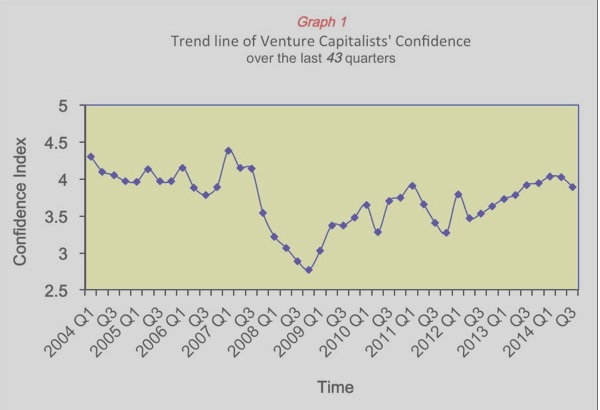
Mark v. Cannice writes: The Silicon Valley Venture Capitalist Confidence Index® (Bloomberg ticker symbol: SVVCCI) is basedon a recurring quarterly survey of San Francisco Bay Area/Silicon Valley venture capitalists. The Indexmeasures and reports the opinions of professional venture capitalists on their estimations of the highgrowthventure entrepreneurial environment in the San Francisco Bay Area over the next 6 – 18 months.1The Silicon Valley Venture Capitalist Confidence Index® for the third quarter of 2014, based on aSeptember 2014 survey of 33 San Francisco Bay Area venture capitalists, registered 3.89 on a 5 pointscale (with 5 indicating high confidence and 1 indicating low confidence). This quarter’s indexmeasurement fell from the previous quarter’s index reading of 4.02.
In summary, confidence declined in the third quarter of 2014, ending an upward trend in sentiment over the previous two years. Worries over inflated valuations and their eventual impact on the venture business model, along with concern on the macro environment, drove the decline in confidence. However, a still strong if moderating exit market for venture-backed businesses, healthy levels of investment and fundraising, rampant disruptive innovation, and the ever present belief in the determination of Silicon Valley entrepreneurs kept sentiment at a relatively high level. Recent public market volatility, though, may slow the exit environment in the near term, with a resulting drag on other aspects of the venture business model. Whether the deceleration in public and private markets acts as a moderating force against over exuberance or is a signal of a longer-term slowdown in the entrepreneurial and broader economic environment remains to be seen. Venture Capital Confidence
Bankers and Financiers Commit Crimes, Pay Peanuts for Them and Keep on Trucking
Rengan Rajaratnam settles insider trading charges. The Securities and Exchange Commission announced that former hedge fund manager Rajaratnam has agreed to pay more than $840,000 and accept securities industry bars in order to settle the agency’s insider trading case against him.
The SEC had filed charges against Rajaratnam for his role in the widespread insider trading scheme conducted by his brother Raj Rajaratnam and hedge fund advisory firm Galleon Management. The insider trading occurred in securities of more than 15 companies for illicit gains totaling nearly $100 million. The SEC has now obtained court judgments or settlements in Galleon-related enforcement actions against 35 defendants, resulting in approximately $165 million in monetary sanctions.
Rengan Rajaratnam, who became a portfolio manager at Galleon after co-founding hedge fund advisory firm Sedna Capital Management, neither admitted nor denied the SEC’s allegations in agreeing to the settlement that is subject to court approval. The proposed final judgment would permanently enjoin Rengan Rajaratnam from violating Section 10(b) of the Securities Exchange Act of 1934 and Rule 10b-5, and require him to pay $372,264.42 in disgorgement, $96,714.27 in prejudgment interest, and a $372,264.42 penalty. Under the settlement, he also would be barred from association with any investment adviser, broker, dealer, municipal securities dealer, or transfer agent with the right to apply for reentry after five years. No jail sentences handed down. His brother is one of the few bankers to get time — eleven years.
Climate Change and Jobs in the EU
Cimate and jobs. Unions warn that a weak EU cllimate deal risks jobs. PHilips and SHell call for ambitious energy package. Nearly a million potential jobs will be lost if EU leaders fail to agree strong climate and energy targets at a summit starting on Thursday, according to the head of Europe’s trade union movement.
Europe’s heads of state are set to sign a deal which proposes a binding 40% greenhouse gas cut by 2030 and two goals which will not be binding on member states, one for a share of 27% of energy coming from renewable sources and another for a 27% improvement in energy efficiency.
Disagreements with eastern European states on ‘burden sharing’ to meet the targets and energy security issues in the final package are said to be narrowing.
But Bernadette Ségol, the leader of the ETUC which represents around 60 million workers, warned that the proposed targets were too low to reap the benefits of a new clean energy economy.
“Energy efficiency and renewable energy targets create jobs,” she told the Guardian. “The lower the target, the fewer the jobs that are created. Governments opposing ambitious and binding targets are wasting an opportunity to reduce Europe’s shameful levels of unemployment. Politicians risk throwing away up to 823,000 new jobs that could be created by more ambitious targets.”
The 823,000 jobs number is the result of ETUC analysis Ségol called for a “just transition” to a low-carbon economy that treated workers and communities affected by energy intensive job losses fairly, while noting that climate change posed an “existential challenge to humans.”
Germany and Denmark favour most robust renewables and energy efficiency goals as do the European commission’s incoming president, Jean Claude-Juncker, as well as the outgoing climate and energy commissioners.
ETUC would prefer a more robust binding target of 40% for energy efficiency improvements, as opposed to 27% and non-binding, and a binding target to improve renewables by 30%.
But such aspirations have been opposed by the UK. With one eye on the rise of Ukip, David Cameron has let it be known that he prefers a single greenhouse gas target that would prevent Brussels from interfering with plans for the expansion of nuclear energy and shale gas.
“We think that a [single] 40% target for greenhouse gas emissions is very ambitious,” Beyrer said in Brussels. “But the EU cannot afford to do it unilaterally. We see this as a negotiating position for the COP21 [UN climate] summit in Paris.
A spokesman for Knauf described Beyrer’s statement as “rubbish”.
Big Data Not Discriminatory?
Daniel Castro writes: Many individuals have made the claim that big data might lead to more discrimination, An online retailer might offer one price to Asian customers and another price to Latino customers This idea appeared in the White House big data review led by John Podesta, where the final report stated that “An important conclusion of this study is that big data technologies can cause societal harms beyond damages to privacy, such as discrimination against individuals and groups.” This idea was also the subject of a recent Federal Trade Commission (FTC) workshop exploring what FTC Chairwoman Edith Ramirez termed “discrimination by algorithm.” While this type of discrimination is plausible, there are many compelling reasons why it may never come to pass. Moreover, the focus on how big data might be used to harm individuals has overshadowed the bigger opportunity to use data as a new tool in the fight for equality.
One reason concerns about discrimination are likely overblown is because many laws, including the Americans with Disabilities Act (ADA), the Genetic Information Nondiscrimination Act (GINA), the Fair Credit Reporting Act (FCRA) and the Employee Retirement Income Security Act (ERISA), protect consumers from employers, creditors, landlords and others who may take adverse actions against them based on protected classes of information. Big data does not exempt businesses from following these laws. Earlier this year, for example, the FTC brought charges and entered into a settlement with Instant Checkmate for violating the FCRA.
Of course, just because a business might be able to create a racist or sexist algorithm, does not mean that it will do so. After all, most businesses are not actively seeking to discriminate against minorities, and in fact, many companies are actively championing a more inclusive worldview. Moreover, even where there are “bad apples,” companies face significant market pressure to not engage in such behavior, a lesson that most executives have probably learned following the swift departure of sponsors after the disclosure of former Los Angeles Clippers owner Donald Sterling’s racist remarks. Big data has not changed these factors.
But the bigger point is that the focus on preventing discrimination has diverted attention away from the bigger opportunity to use big data to create a more inclusive society. There are at least three ways this can happen. First, automated processes can remove human biases from decision-making. For example, while loan officers or apartment managers may discriminate, perhaps even unintentionally, on the basis of age or race, computers can be programmed to ignore these variables. Second, data creates feedback loops that encourage people to treat others as individuals. While some taxi drivers have notoriously refused to pick up passengers because of the color of their skin, apps like Uber allow drivers to decide whether to give someone a ride based on the passengers’ ratings, which are mostly tied to whether the riders are punctual and tidy. Third, data is a useful way to identify latent racism, such as discriminatory hiring practices or racial profiling by police. For example, data collected about the disparate impact of New York City Policy Department’s controversial stop-and-frisk policy has helped change opinions on the approach.
In short, not only are fears that big data will lead to discrimination in the future likely overblown, but they have clouded the debate. Those working to fight discrimination should look to data as a way to further eliminate unjust biases in society and create a more fair and transparent society.