Uber A New Business Model

Mohamed El_Erian writes:  The more I use Uber, the more I am convinced of the transformational power of recent technology innovations, especially when it is intelligently combined with behavioral science and economic principles. Indeed, it is only a matter of time until this potent mix disrupts an increasing number of industries, including certain segments of finance.

By finding a powerful way to improve the well-being of both passengers and drivers, Uber is transforming a mode of urban transportation that, for a long time, has seen little positive evolution in the provision of service. Passengers get more than a pleasant phone interface to order their rides and monitor their progress. We feel incredibly empowered and enabled. We like that the fare is billed directly to a credit card that the company has on record; and that our feedback is solicited immediately and in a user-friendly manner.

These are just some ways in which Uber has combined technological innovation, mobility and behavioral science to widen and deepen how it acquires and retains clients. And such insights are also being applied to the drivers, who are also empowered and enabled.

Once drivers pass their evaluation, Uber provides them with the needed setup, including the technology for location services, billing and so on.

The number of drivers signing up with Uber is growing markedly, enabling the company to offer its riders an expanding option of vehicles and service levels. Moreover, through the use of the “surge reminder,” which better calibrates fares with demand-supply imbalances, Uber can entice more drivers to come out at busy times. And this is only one way that the company is using basic economic principles to be more responsive in providing services.

In analytical terms, Uber is a growing P2P (peer-to-peer) platform that is dismantling barriers to entry in a comprehensive way — so much so that even the old-style limousine services and taxis are starting to sign up with Uber as a means of supplementing their traditional business.

Elements of this model are slowly being replicated in certain parts of finance, and will probably expand in the years to come — especially in providing more appropriate consumer credit to underserved segments of the population.

By reducing old-style overheads and other outmoded costs, as well as using access to broader sources of loanable funds, P2P models can pass savings on to borrowers through lower interest rates while also providing an attractive return to creditors.

And by using a broader set of data, this new group of financial intermediaries can improve on traditional credit models and better customize the provision of products to borrowers — a process that can be further enhanced with incentives to improve the paydown of debt balances and overcome debt traps.
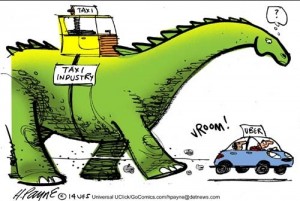
Uber Business Model

European Central Bank May Buy Corporate Debt

Why would the European Central Bank buy corporate bonds? It may be that the market for asset backed securities and covered bonds in simply not large enough for the massive bond buying the ECB may do. They may have to acquire corporate debt as well. 

This does raise the question of how buying debt of large corporations will do much to boost lending to smaller firms, a stated objective. And the corporations are not issuing a lot of bonds anyway.

Equity, Bonds, Loans

When Women Don’t Bump the Glass Ceiling

The Minneapolis Fed  Despite making large inroads, females still constitute a small proportion of the top percentiles: the glass ceiling, albeit a thinner one, remains. We measure the contribution of changes in labor force participation, changes in the persistence of top earnings, and changes in industry and age composition to the change in the gender composition of top earners. A large proportion of the increased share of females among top earners is accounted for by the mending of, what we refer to as, the paper floor – the phenomenon whereby female top earners were much more likely than male top earners to drop out of the top percentiles.  Glass Ceilings and Paper Floors

The Ceiling?

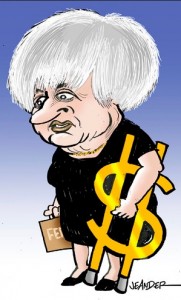
Yellen Addresses Inequality in the US

Janet Yellen, head of the Fed, spoke in Boston about income inequality as a major problem in the US.  Ruminating on the ever-widening gap between America’s rich and poor, Federal Reserve Board Chairwoman Janet Yellen, in a widely reported speech on Friday, said: “I think it is appropriate to ask whether this trend is compatible with values rooted in our nation’s history, among them the high value Americans have traditionally placed on equality of opportunity.”

Could have been said about the Gilded Age and the 1920s, when similar questions were raised and, incidentally, gave rise to a formulation called the “Great Gatsby curve,” the relationship between income inequality and low social mobility that recent economists came up with.

Only this time, it’s more so. “The past several decades have seen the most sustained rise in inequality since the 19th century after more than 40 years of narrowing inequality following the Great Depression,” Yellen said, citing the Federal Reserve’s triennial Survey of Consumer Finances, published last month, and other data.

“By some estimates, income and wealth inequality are near their highest levels in the past hundred years, much higher than the average during that time span and probably higher than for much of American history before then.”

Yellen is not the first to point this out, but the fact that it’s being made by the world’s most powerful central banker, and in such stark language, may hopefully give it some added purchase. “Stagnant or falling living standards for many families” went side-by-side with the wealthiest 5 percent’s share of total wealth reaching 63 percent in 2013, up from 54 percent in 1989.

“To put that in perspective, the average net worth of the lower half of the distribution, representing 62 million households, was $11,000 in 2013. About one-fourth of these families reported zero wealth or negative net worth, This $11,000 average is 50 percent lower than the average wealth of the lower half of families in 1989, adjusted for inflation.”

“Meanwhile, the average real wealth of families in the top 5 percent has nearly doubled, on net — from $3.6 million in 1989 to $6.8 million in 2013.”

And, a brief example of the Great Gatsby curve: “Other research tells us that inequality tends to persist from one generation to the next. … Research also indicates that economic mobility in the United States has not changed much in the last several decades; that mobility is lower in the United States than in most other advanced countries.”

So much for rags-to-riches. What can be done? While some inequality will always be with us, says Yellen, she offers offers “four building blocks of opportunity” to help level the playing field

The first two “cornerstones” focus on improving education and other resources for “children in their most formative years,” and easing the unequal debt burden a college education imposes on the less well-off. Generally speaking this will require more government spending, a stronger social safety net, and reforming how public education is paid for. Hint: Maybe it’s not through property taxes.

Building block No. 3: Start a business. “A significant source of wealth,” notes Yellen, but much harder to get, especially for those in the lower income categories, where business ownership “has fallen to a 25-year low, and equity in those businesses, adjusted for inflation, is at its lowest point since the mid-1990s.”

The editors of W-T-W.org  Women and Finance are recommending a 20 year infrastructure repair and building program in the US which would take care of badly needed improvements and also employ people while we figure out how to match job readiness with available jobs.

Yellen boston fed speech


Investigate NY Fed Supervision of Wall Street?

Whistleblower tapes revealed the weakness of the New York Federal Reserves oversight of Wall Street and big US banks.  Senators Elizabeth Warren and Sherrod Brown call for investigation.

Warren and Brown, both members of the Senate Banking Committee, called for an investigation of the New York Fed after Carmen Segarra, a former examiner at the bank, released secretly recorded tapes that she claims show her superiors telling her to go easy on private banks. Segarra says that she was fired from her job in 2012 for refusing to overlook Goldman’s lack of a conflict of interest policy and other questionable practices that should have brought tougher regulatory scrutiny.

“Congress must hold oversight hearings on the disturbing issues raised by today’s whistleblower report when it returns in November, because it’s our job to make sure our financial regulators are doing their jobs,” Warren said in a statement on Friday. “When regulators care more about protecting big banks from accountability than they do about protecting the American people from risky and illegal behavior on Wall Street, it threatens our whole economy. We learned this the hard way in 2008.”

In an interview with This American Life and ProPublica, Segarra described numerous instances in which she said she alerted her bosses to questionable practices at Goldman. In one instance, she said she alerted a colleague that a senior compliance officer at Goldman had said that the bank’s view was that “once clients became wealthy enough, certain consumer laws didn’t apply to them.” Segarra claims that her New York Fed colleagues asked her to ignore the remark and change meeting minutes she had taken, which contained evidence of what the Goldman executive said.

New York Fed presdient WIlliam Dudley gently demanded a change of culture, but this won’t do the job.  We need muscle behind bank reform.

Bank Reform?


Argentina’s Education System Stalled by Digital Gap

Technology has not entered the school system in Argentina.  Teachers are still more uncomfortable with technology than their students are.  The debate between educators who want to move the country forward to become competitive in areas of science and technology and those that feel that all children must be brought up to digital literacy before a new upgrade is undertaken has not been resolved.  The education system is stallled.

Education?

Mexico Moves Forward

Since 2012, three major politial parties in Mexico have joined forces to pass 11 major reforms.  Most striking are:

1.  Civiiliry in politics.  In August a controversial and difficult bill was paased curbing the power of Pemex, the petroleum monopoly and a pride of the country.  A new generation of leaders sees an advantage in curbing old-style infighting.

2.  Better services.  Meixo is one of the world’s most ope economies. It has 44 trade agreements with other countries.  Reforms will help get loans to small businesses and build more roads, railroads and airports.  This may be a good time for entrepreneurs.  And murders are down 29 per cent.

3. Openess and transparency.  Transparency institutes and corruption commissions will watch over awards for oil and gas development and all other matters.

by Fernando Llera

by Fernando Llera


India Empowers the Poor

Modi has instituted more toilets and bank accounts for the poor.  But his program that directly engages the poor in their progress is the installation of solar panels. Modi wants every home to have one light bulb by 2019.

300 million Indians have no electricity at all.  Millions more have only sporadic power.  For them, solar is a way to leap frog over conventional fossil-fuel energy into clean energy.  If people can put solar panels over their homes or in empty spaces they can participate in their own uplift.

The potential for solar power is huge. Of the world’s twenty top economies it has the most sunlight.  Timing is ripe.  Solar power is nearing the cost of coal.  China, Africa and other parts of the world are rushing to solar, but India has the potential to be champion of solar.

Solar Power

Head of NY Fed Calls on Banks to Improve Culture

The head of the New York Federal Reserve Bank says that banks must improve their culture. Banks must change the way employees are compensated and take other steps to fix a corporate culture that encourages misdeeds or face being broken up, said William C. Dudley.

If bad behavior persists, “the inevitable conclusion will be reached that your firms are too big and complex to manage effectively,” Dudley said.

Dudley’s comments, which follow bank scandals involving Libor and foreign exchange trading, were made at a closed-doors workshop attended by senior bankers at the New York Fed on reforming Wall Street culture and behavior.

Lawmakers have enacted a major overhaul of the rules designed to prevent banks becoming “too big to fail.” Dudley said it was fair to question if the “sheer size, complexity and global scope of large financial firms today have left them ‘too big to manage.’”

Dudley, who has had to defend the New York Fed recently against allegations it was too soft on big Wall Street firms, suggested a number of ways to better align bank employee incentives with the interests of the general public.  These include deferred compensation plans that switch emphasis to debt, rather than equity, and a centralized, industry-wide registry for tracking individual offenses.

Fines levied against banks could be paid out of deferred debt compensation of senior managers, which would play the role of a performance bond, Dudley said.

“This would increase the financial incentive of those individuals who are best placed to identify bad activities at an early stage, or prevent them from occurring in the first place,” he said, noting that since 2008, fines on big U.S. banks have exceeded $100 billion..

Dudley’s remarks followed a speech by Fed Governor Daniel Tarullo delivered at the same conference in which he said banks may face stiffer rules unless they improve their bad behavior.

“If banks do not take more effective steps to control the behavior of those who work for them, there will be both increased pressure and propensity on the part of regulators and law enforcers to impose more requirements, constraints and punishments,” Tarullo said.

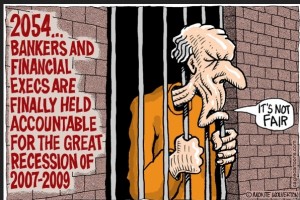
Bankers' Accountability

Turkey Struggles with Inflation

Mehmet Cetingulec writes:  Turkey’s Central Bank, whose resistance to government pressure to lower interest rates proved to be the right decision, has not had the same success in ensuring financial stability by controlling inflation.

The Central Bank’s record against inflation has been dismal not only this year, but for several years.Since Erdem Besci was appointed its governor in 2011, none of the bank’s inflation aims have been achieved.

In 2011, annual inflation was predicted to be 5.5% but ended up at 10.4%. In 2012, the bank’s inflation target was 5%, but it ended up 6.16%. The 2013 target was 5% but the result was 7.4%. The 2014 target was set at 5.3%, then adjusted upward to 6.6%. But it’s now clear that even that target won’t be hit.

Turkey’s Central Bank has two basic duties: keeping inflation under control and ensuring stability in financial markets. In 1997, the bank and the Treasury signed an agreement to cooperate to lower inflation rates.  The idea was to lower inflation by adopting monetary and financial measures in cooperation with relevant public agencies. Though this protocol is valid, inflation still cannot be lowered.

The Central Bank had forecast improvement in inflation after June 2014. Basci, under heavy pressure, had promised lower inflation and interest rates in a June 2 presentation to the council of ministers. On June 3, Prime Minister Recep Tayyip Erdogan, who was unhappy with Basci, said “The Central Bank said it will lower interest rates… I don’t find their approach to interest rates worthwhile.”

What the prime minister had meant to say was explained by pro-government Sabah, which reported that the governor was given a three-month grace period.

But months have passed and the anticipated reduction in inflation and therefore in interest rates did not materialize. When the trend continued unabated, the 5.3% inflation rate was pushed up to 9.5%. By naming this new target in its medium-term program, the government has acknowledged in advance that the inflation rate will double by the end of the year.

Meanwhile, the IMF revised its prediction for Turkey’s inflation upward to 9% from 7.8%. Inflation did not go down and the interest rate was not reduced, but the alternative plan that was to be applied after the three-month grace period was not introduced.

Prime Minister Erdogan, who was targeting Basci, has since been elected president. Prime Minister Ahmet Davutoglu, who formed the new government, does not have the luxury of making controversial decisions by changing the economic management when the regional developments signal increased risks.

Babacan and his economic management team stipulated the lowering of inflation as the primary target of its 2015-17 program, whereas earlier, the primary target was to lower the current deficit. That target has been achieved to some extent. The current deficit, which was above $60 billion at the end of last year, is now below $50 billion. The goal will be now to achieve the same success in lowering inflation. But it is not possible. Neither Babacan nor Basci have enough time to leave behind a legacy of success.

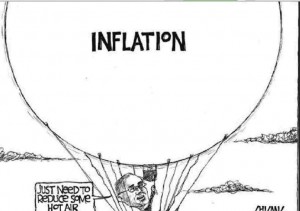
Inflation in Turkey