Gas Tax for Infrastructure Repair in the US?

The Bloomberg editors are recommending an increase in the gas tax to fund infrastructure repairs.  Concern about infrastrucutre repair in the US is commendable, but we must begin to tackle the issue in a broader context.

W-T-W>org Women and FInance is recommending a twenty-year program funded by the federal government and administered by states in which tolls would pay for the repairs and money to be saved by new job creation would be factored into the costs and savings of the project.

The problem with gas taxes, which might be lievied as the cost of gas goes down, is that people who gas up to go to their jobs or trasnport goods may be disproportionately taxed.  The gas tax should also be legally pegged to infrastructure repair.

Gas Tax and Infrastructure


China: The World’s Leading Economic Power?

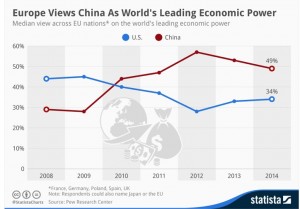
According to a survey by the Pew Research Center China lead the U.S.. Back in 2008, before the financial crisis, a European median of 44 percent considered the United States the leading economic powerhouse worldwide. In that year, 29 percent considered China the world’s leader.

China raced into the lead for the first time in 2010, and today, it’s viewed as the foremost economic power by 49 percent of Europeans compared to 34 percent for the United States. Interestingly, the shift in peception concerns America’s premier European allies – France Germany, Poland, Spain and the United Kingdom.

US investor Philip Anschutz is pulling out of China because it’s hard to him to collect the money he’s earned.  The US sees to it that peope get paid the money they are owed.  A factor to conisder in the concept of “economic power.”

This chart shows the median view across EU nations on the world’s leading economic power.

China- The World's Leading Economic Power?

Turkey’s Economic Forecasts Take a Hit with Kurdish Demonstrators Wrecking Havoc

Mehmet Cetingulec writes:  Rating time has come for the Turkish economy. Fitch Ratings was the first to announce its review. Contrary to the expectation that it would downgrade either the country’s credit rating or outlook, the agency kept both unchanged: the “stable” outlook and the BBB-investment grade.

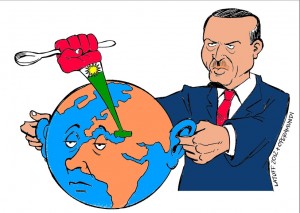
The review, was expected to send the financial markets rallying. But when the markets reopened Oct. 8 after the holiday, the good news from Fitch was overshadowed by Kurdish demonstrators wreaking havoc across the country.  The main index of the Istanbul stock exchange shed 1,400 points in a single day, plunging to a five-month low of 72,943 points. The Turkish lira, which had been expected to gain ground, slid to 2.29 against the dollar, while bond yields reached 9.78%.

Then the Istanbul stock exchange made up for the losses over the Kobani protests, gaining 2,265 points to close the day at 75,208. The dollar slid from 2.29 to 2.25 Turkish lira, but moved back to 2.27 later in the day as the unrest continued. The bond yield fell to 9.48% before closing the day at 9.6%.

While affirming Turkey’s grade, Fitch welcomed “post-presidential election assurances that the current economic team will remain in place … as constructive.” The statement added that structural reforms, a lasting reduction in the current account deficit, a more stable inflation,  higher domestic savings and increased foreign investment could result in positive rating action.

In short, Turkey is walking a tightrope. Fitch’s favorable review prevented the unrest from taking a more serious toll on the markets. Pro-government media hailed Fitch’s decision as a “holiday present,” while the opposition press saw it as the “reward” of parliament’s approval of a government motion for possible Turkish military action in Syria and Iraq and the deployment of foreign forces in Turkey.

Fitch’s decision id not satisfy Economy Minister Nihat Zeybekci, who never misses a chance to slam ratings agencies.  “Turkey’s realities indicate the credit rating should have been much higher,” the minister said.

In sum, the following conclusion can be made: IS has begun to make an impact not only on Turkey’s exports but also on its politics and domestic security. In this climate, the good news from Fitch came as a “remedy” for the markets. But to get a similar good rating from Moody’s in December, Kobani’s shadow over the markets in particular should be removed.

In short, Turkey is walking a tightrope. Fitch’s favorable review prevented the unrest from taking a more serious toll on the markets. Pro-government media hailed Fitch’s decision as a “holiday present,” while the opposition press saw it as the “reward” of parliament’s approval of a government motion for possible Turkish military action in Syria and Iraq and the deployment of foreign forces in Turkey.

Turkey


Renewable Energy for the EU

Michael Grubb writes: EU based on coal as energy is an idea that is dead on arrival.

Poland now has a glowing opportunity to shape the energy transition, but without the economic and social upheaval experienced in the UK. For one thing, the technologies are all more mature. Renewables are becoming far more cost-competitive. Poland does not have to make the same investments that the UK, Germany and other ‘early adopters’ had to make.

Above all, the European Union stands ready to help. Through free allowances under the Emission Trading Scheme and other energy-related support mechanisms, the EU is giving Poland more than €10 billion to spend on energy and climate infrastructure.   European Energy Union

Renewable Energy

The Illusion of Global Regulation

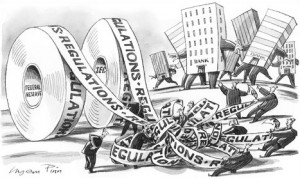
Howard Davies writes: The global system of financial regulation is extraordinarily complex. Partly for that reason, it is little understood.

Many people show some spark of recognition at the mention of the Basel Committee on Banking Supervision, which sets capital standards for banks. They may also have heard of the Bank for International Settlements, the central banks’ central bank, in which the Basel Committee sits. And the International Organization of Securities Commissions (IOSCO), which sets standards for exchanges and securities regulators, has name recognition in some quarters. But when you get to the International Association of Insurance Supervisors, brows furrow.  Financial Regulation

Global Financial Regulation

Domestic Banks Face Different Challenges than Global Banks

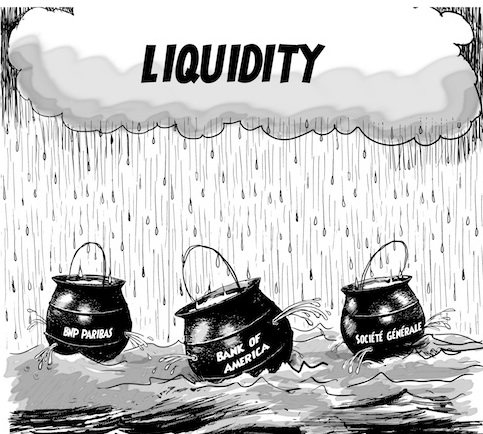
Economists at the New York Federal Reserve write: Large global U.S. banks—that is, those that have offices in foreign countries and are able to move liquidity from affiliates across borders have an advantage over large domestic U.S. banks, which have to rely on financing raised in capital markets and from depositors to extend credit and issue loans..  The internal liquidity management by global banks has, on average, mitigated the effects of aggregate liquidity shocks on domestic lending by these banks.

If a bank has stable deposit funding or maintains more liquid assets on its balance sheet, its lending might be less affected by aggregate liquidity shocks.

There also might be different responses to liquidity risk by U.S. banks that are domestically oriented compared with banks that are global.   Because these two types of banks have very different business models, the channels and magnitude of transmission of liquidity risks into bank lending may differ significantly. Small domestic banks have relatively strong lending responses to liquidity risks.  By contrast, banks with foreign affiliates, particularly large banks, move funds across their organizations to offset such risks, and potentially insulate lending in their home markets.  However, these same banks may decrease lending abroad as they move liquidity into their home country.

For both types of banks, changes in aggregate private liquidity are likely to influence lending differently in crisis than in normal periods, in part because of the availability of and willingness to use official sector liquidity facilities in periods of aggregate liquidity stress. When banks have access to central bank liquidity facilities priced at terms below private market rates, this might relax the constraints imposed by the composition of banks’ balance sheets on their access to external funding, leading to a different relationship between those balance sheet characteristics and the banks’ lending,  Is Liquidity a Measure of Stability

Bank Liquidity


Austerity in the Eurozone?

Germany cuts growth forecast as exports flag and geopoitical concerns loom large.   Other countries in the EU push Germany to start spending.

German Economics Minister Sigmar Gabriel said Berlin expected gross domestic product (GDP) to expand by only 1.2 percent in 2014, down from an earlier estimate of 1.8 percent.  Germany’s leading economists blame stalled recovery in the eurozone for Germany’s troubles.

In addition, the planned introduction of a national minimum wage and higher pensions outlays adopted by the government recently would further throttle growth, they said.

After robust growth of 0.8 percent in the first quarter of this year, the German economy slipped back, contracting by 0.2 percent between April and June. As the government is waiting for third-quarter growth figures, due to be released later this month, Economics Minister Gabriel said he did not expect the economy to contract again.

Pointing to the robust state of the German labor market, with its low unemployment, he said: “This is the foundation on which higher wages and increased household spending will continue to rest.”

As Gabriel banks on rising consumption to prop up the German economy in the remaining months of 2014, some think the government should boost higher speniding for higher growth.  Finance Minister Wolfgang Schauble has resisted such calls.  But ther eurozone member want Germany to open the public purse and allow partners in the currency area higher budget deficits to spur growth..

Schaube

Turkey Revises Economic Targets in Response to Rising Inflation and Weakening Currency

The Turkish government has revised its year-end economic targets amid regional turmoil, rising inflation, a weakening currency and shrinking industrial output. The revisions were announced Oct. 8 as part of Ankara’s new medium-term program, its economic road map for 2015-17. The growth forecast was slashed to 3.3% from 4% for 2014, and to 4% from 5% for 2015.

Efforts to rein in inflation have proven a huge disappointment. Accordingly, the year-end estimate was raised to 9.4% from the earlier 5.3% projection, a level Turkey could now hope to achieve only in 2016, if everything goes as planned.

While Ankara has failed on inflation and growth, it has achieved notable progress in reducing the current account deficit.  The economy management will now shift its priority to battling inflation and move the current account deficit problem to second place, with structural reforms third on the priority list.

Deputy Prime Minister Ali Babacan, who is in charge of the economy, pledged the required structural reforms, a key issue for foreign investors, will be sped up in a bid to prop up growth.  Turkey’s main economic targets are as follows:

Gross domestic product (GDP) per capita: $10,537 at the year-end; $10,936 in 2015; $11,541 in 2016; and $12,229 in 2017. (The original target for 2014 was $11,277, meaning it has been postponed by two years, to 2016.)

GDP growth: 4% in 2015; 5% in 2016 and 2017.

Inflation: 6.3% in 2015; 5% in 2016 and 2017.

Unemployment: 9.6% in 2014; 9.5% in 2015; 9.2% in 2016; and 9.1% in 2017.

Investment: Public investment to reach $85 billion by the end of 2014. A preliminary $88 billion will be allocated for public investment in the 2015 budget.

Budget deficit: 1.4% of GDP at the year-end; 1.1% of GDP in 2015; 0.7% of GDP in 2016; and 0.3% of GDP in 2017.

Foreign trade: Exports are expected to reach $160.5 billion and imports $244 billion in 2014. Projections for the next three years: $173 billion in exports and $258 billion in imports in 2015; $187.4 billion in exports and $276.8 billion in imports in 2016; $203.4 billion in exports and $297.5 billion in imports in 2017.

Tourism: Revenues from tourism are expected to reach $29.5 billion by the year-end, and are projected at $31.5 billion in 2015; $33.5 billion in 2016; and $35.5 billion in 2017.

Privatization: Revenues from privitization are estimated at $8.7 billion in 2015 and $6.7 billion in 2016. Tax revenues and primary expenditures are expected to increase by 19.7% and 5.1%, respectively.

In the previous medium-term program, the current account deficit for 2014 was projected at $55.5 billion. The revised projection has put the figure further down, at about $46 billion. But despite the progress, the decrease is not quite healthy. The rise in exports has had a positive effect in reducing the deficit, but one should keep in mind that slowing growth is another factor that narrows the gap. The economy would have gained more if the decrease in the current account deficit had been accompanied with strong growth, driven by structural reforms.

The current account deficit target was set at 5.4% of GDP for 2015 and 2016, and 5.2% of GDP for 2017. The target rates in the previous program stood at 6.4% for 2014; 5.9% for 2015; and 5.5% for 2016. According to Babacan, the targeted deficits translate to $46 billion in 2014 and 2015; $49.2 billion in 2016; and $50.7 billion in 2017.  The low level of Turkey’s domestic savings is a major reason for its dependence on short-term capital inflows, or the so-called hot money. According to Babacan, domestic savings are expected to reach 14.9% of GDP at the year-end, with the targets set at 15.2% in 2015; 16.2% in 2016; and 17.1% in 2017.

In sum, all of Turkey’s economic targets except for the current account deficit have been revised downward in the new, medium-term program. It remains to be seen whether the lower targets will be achieved.
Turkey's Economy

Is ISIS Oil Well Running Dry?

Michael Phiips writes:  In early August, Islamic State controlled sections of Syria and Iraq that together are about the size of Wyoming. At that point, its territory included seven oil fields and a refinery in northern Iraq, as well as six of the 10 oil fields in eastern Syria. Although the movement was able to produce only about half the potential output under its control, it had no problem tapping the region’s well-established oil smuggling network.

Most of the group’s oil flows through local middlemen and is paid for almost entirely in cash, making transactions extremely difficult to track and shut down. This has insulated Islamic State from traditional methods the West has used to dry up terrorist funds in the past, such as international banking sanctions and anti-money laundering laws.

A straight-up bombing campaign does seem to be doing a lot of that work. According to the IEA report, U.S.-led sorties over northern Iraq and Syria are “frustrating the jihadists’ ability to operate oil fields and refineries.” At its peak, most of the oil smuggled from Iraq was loaded from the Ajeel oil field near Tikrit on tanker trucks and routed toward Kurdistan. The IEA, citing Iraqi oil industry sources, estimates that Islamic State was loading about 120 tanker trucks with about 20,000 barrels a day from Ajeel. Sustained airstrikes, including ones targeting convoys have cut that traffic to about 10 trucks a day, or about 2,000 barrels, according to the IEA’s report.

In Syria, the IEA estimates that Islamic State’s oil output is down to about 10,000 barrels a day. Airstrikes by the U.S., the Saudis, and the UAE have wiped out “dozens of teapot refineries” in Syria, depriving the movement’s war machine of a key source of gasoline. Turkey and the Kurds have also cracked down on its smuggling operation. In late September, the Kurds reportedly seized four militant tanker trucks from the Ajeel field and detained the drivers.

There is still a lot of work to do. The Islamists retain control of Syria’s largest oil field, the Omar field in the Deir Az-Zour region of the country. The squeeze on finances has made Islamic State even more desperate to control oil fields and refineries. Its fighters have turned Iraq’s largest refinery into a battleground, forcing it off-line and sharply reducing output. With most of its refining capacity in Syria destroyed, Islamic State might go after two big refineries, closer to Lebanon in the west of Syria, that are under the Assad government’s control, opening up a much broader two-front war and potentially limiting the movement’s ability to wage war to the east, in Iraq.

Oil Fields of the Middle East