The common methodology better explains cross-sectional differences in lending by internationally active banks than lending by purely domestic banks.
The channels of transmission of liquidity shocks to bank lending differ across banks. Deposit funding matters more for the domestically oriented banks. In contrast, internal liquidity management strategies and official liquidity support matter more for the banks with foreign affiliates.
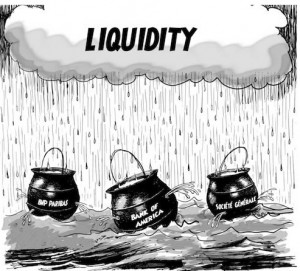
The common empirical model explains more of the cross-sectional and time-series variation in domestic lending than in net-due-to (such as intrabank lending) or foreign lending. This finding suggests higher stability of domestic lending. At the same time, we see cross-border lending growth is more sensitive to liquidity risk in relation to the balance sheet characteristics of the banks. An interpretation is that cross-border lending tends to be subordinated to domestic lending activity as stress conditions change. Liquidity Risk
Frank Li, a Chinese American, writes about hopes for the future. China at 65

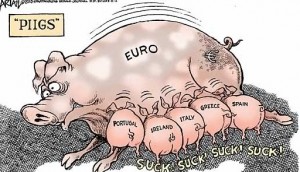
This anti-ECB sentiment in Germany has swelled during 2014, as Draghi’s attempts to increase the eurozone’s low inflation have departed further and further from economic orthodoxy. German conservatives have greeted each new policy with displeasure. The German media has called negative interest rates “penalty rates,” claiming they redistribute billions of euros from German savers to Southern European spenders. On Sept. 25, German Finance Minister Wolfgang Schauble spoke in the Bundestag of his displeasure with Draghi’s program to buy asset-backed securities. Judging from the German hostility to even “quantitative easing-lite” measures, the ECB’s attempts to rope Germany into further stimulus measures could prove troublesome indeed.
All of the measures the ECB has announced so far, however, are mere appetizers. Financial markets have been demanding quantitative easing, a broad-based program of buying sovereign bonds in order to inject a large quantity of money into the market. Up to this stage, three major impediments have existed to such a policy: the German government’s ideological aversion to spending taxpayers’ money on peripheral economies; the political conception that quantitative easing would ease the pressure on peripheral economies to reform; and the court case that has been hanging over OMT (the only existing mechanism available to the ECB for undertaking sovereign bond purchases). Notably, the OMT in its original guise and quantitative easing are not precisely the same thing. In the original conception of OMT, the ECB would offset any purchases in full by taking an equivalent amount of money out of circulation, (i.e., not increasing the money supply itself). Nonetheless, any declaration that OMT is illegal would severely inhibit Draghi’s room for maneuver should he wish to undertake full quantitative easing.
This confluence of events leaves Merkel nervously awaiting the decision of the European Court of Justice. In truth, she is in a no-win situation. If the Luxembourg court holds OMT illegal, Draghi’s promise would be weakened, removing the force that has kept many sovereign bond yields at artificially low levels and permitting the desperate days of 2011-2012 to surge back. If the European Court of Justice takes up the German court’s three suggestions and undercuts OMT to the extent that the market deems it to be of little consequence, the same outcome could occur. And if the European Court of Justice rules that OMT is legal, a sizable inhibitor to quantitative easing will have been removed, and the possibility of a fully fledged bond-buying campaign will loom ever closer, much to the chagrin of the German voter and to the political gain of the Alternative for Germany. Germany’s Fight
Leonid Bershidsky writes: US has to deal with Ireland on taxes. The Senate Subcommittee on Investigations has tried.
in 1991 and 2007, Apple and Ireland agreed that much of the money flowing into the company’s Irish accounts had nothing to do with its operations in the country, and hence shouldn’t be taxed as profit in Ireland. Instead, the two sides negotiated a deal in which Apple paid tax on a certain percentage of its Ireland-related costs. The deal stood for 15 years, much longer than most European countries would allow such tax rulings to remain in force. Even after some amendments, Apple Sales International paid taxes on less than $80 million in 2011, a year in which the Ireland-incorporated entity recorded $22 billion in pretax income, according to the U.S. Senate’s Permanent Subcommittee on Investigations.
In most countries, such revelations would have led to a corruption scandal. Why would a government pass up a chance to levy taxes on billions of dollars in income? In Ireland’s case, the situation is more complicated: It defines a company’s domicile as the location of its central management and control operations, which in the case of Apple’s subsidiaries would be the U.S. By contrast, the U.S. defines domicile as the place of incorporation. So Apple’s Irish subsidiaries don’t really have a home for tax purposes.
Should Ireland care? The Cupertino, California-based company has 4,000 employees at its Cork facility, where it still assembles some computers but mostly handles sales and user support. That’s less than 5 percent of Apple’s total workforce, but a big deal for the depressed city. The taxes calculated on the basis of the small operation’s costs are not a major consideration for the Irish authorities — they are just nice to have.
The EC’s letter says that the deal appears to constitute illegal state aid: Because the tax base is negotiated, rather than calculated according to some predetermined formula, it provides unfair, selective advantages to Apple. Theoretically, the EC could recover billions of dollars in taxes that Ireland has failed to charge since 2003. To do that, the eurocrats would have to prove that Apple had been singled out for tax advantages. The Irish government isconfident it hasn’t violated state-aid rules. If the government in Dublin can show it treats other companies similarly — as Google and other beneficiaries might confirm — it will be difficult for the bureaucrats in Brussels to act.
Ireland is happy to have Apple and the other tech giants invest in its economy. There is no reason why it should pressure a U.S. company to pay more taxes. If the U.S. wants to make its companies pay their fair share, it has the power to do so — either by coercing them or by enticing them with improved corporate tax legislation.
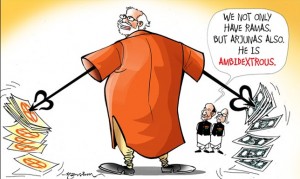
Nisid Hajari writes: As a campaigner, Indian Prime Minister Narendra Modi has drawn comparisons to U.S. President Barack Obama. The U.S. president with whom Modi would seem to have the most in common, though, is not the 44th but the 40th: Ronald Reagan. Like the Gipper, Modi was elected at a time of malaise and drift, with an economy hobbled by high inflation and slowing growth. He came to office promising to lead a national revival, in part by eliminating excessive state intervention in the economy.
In fact, Modi is no more Reagan than he is Obama. The U.S. doesn’t even seem to be Modi’s role model for economic policy. His decisions thus far lean more toward the Chinese and Japanese models of state-led capitalism.
Modi has made it clear that he prefers to give them more managerial autonomy and allow them to reform themselves rather than sell them off outright. His administration’s first budget made no concessions on tax rates. While some attempt was made to trim spending, the budget included no high-profile initiatives to end wasteful subsidies or dole programs.
On monetary policy, Finance Minister Arun Jaitley has repeatedly favored lowering interest rates, despite persistent inflation. His priority is clearly infrastructure — whether roads, power, ports or railways. All these sectors require massive investments and involve considerable risk in terms of returns. These are not areas where private companies traditionally rush to invest.
On the other hand, companies backed by state-funding or cheap finance from state-owned banks and financial institutions can more safely assume these huge risks. This is precisely why Modi returned from a bilateral visit to Japan with commitments worth $35 billion for infrastructure. When Chinese President Xi Jinping visited India a few weeks later, he pledged another $20 billion. Modi will bring home no such promises from the U.S.
The prime minister is more statist in his approach than leaders in Beijing. Where China has largely liberalized foreign direct investment across all sectors, Modi has been reluctant to raise FDI caps above 49 percent in sectors such as defense and insurance.
While this approach worked well for Japan and China, it’s far from guaranteed to achieve similar results in India. The Indian state, which is dysfunctional at several levels, is never likely to be even half as efficient as China’s or Japan’s. India’s largely government-owned defense companies have not produced world-class products in six decades. Government-owed insurance companies have not delivered either.
On the other hand, India’s private-sector companies have already shown that they can be as efficient as U.S. corporations. What they need are technology, investment and expertise.
Nouriel Roudini writes: Global markets have not reacted for several reasons. For starters, central banks in advanced economies (the United States, the eurozone, the United Kingdom, and Japan) are holding policy rates near zero, and long-term interest rates have been kept low. This is boosting the prices of other risky assets such as equities and credit.
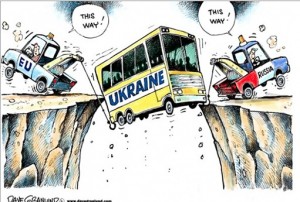
Second, markets have taken the view that the Russia-Ukraine conflict will remain contained, rather than escalating into a full-scale war. So, though sanctions and counter-sanctions between the West and Russia have increased, they are not causing significant economic and financial damage to the European Union or the US. More important, Russia has not cut off natural-gas supplies to Western Europe, which would be a major shock for gas-dependent EU economies.
Third, the turmoil in the Middle East has not triggered a massive shock to oil supplies and prices like those that occurred in 1973, 1979, or 1990. On the contrary, there is excess capacity in global oil markets. Iraq may be in trouble, but about 90% of its oil is produced in the south, near Basra, which is fully under Shia control, or in the north, under the control of the Kurds. Only about 10% is produced near Mosul, now under the control of the Islamic State.
Finally, the one Middle East conflict that could cause oil prices to spike – a war between Israel and Iran – is a risk that, for now, is contained by ongoing international negotiations with Iran to contain its nuclear program.
So there appear to be good reasons why global markets so far have reacted benignly to today’s geopolitical risks. Why the Markets Have not Responded to Geopolitical RIsks
Stephen S. Roach writes: QE may have been a resounding success in some ways – namely, arresting the riskiest phase of the crisis. But it did little to revive household consumption, which accounts for about 70% of the US economy. In fact, since early 2008, annualized growth in real consumer expenditure has averaged a mere 1.3% – the most anemic period of consumption growth on record.
This is corroborated by a glaring shortfall in the “GDP dividend” from Fed liquidity injections. Though $3.6 trillion of incremental liquidity has been added to the Fed’s balance sheet since late 2008, nominal GDP was up by just $2.5 trillion from the third quarter of 2008 to the second quarter of this year. As John Maynard Keynes famously pointed out after the Great Depression, when an economy is locked in a “liquidity trap,” with low interest rates unable to induce investment or consumption, attempting to use monetary policy to spur demand is like pushing on a string.
This approach also has serious financial-market consequences. Having more than doubled since its crisis-induced trough, the US equity market – not to mention its amply rewarded upper-income shareholders – has been the principal beneficiary of the Fed’s unconventional policy gambit. The same is true for a variety of once-risky fixed-income instruments – from high-yield corporate “junk” bonds to sovereign debt in crisis-torn Europe.
The operative view in central-banking circles has been that the so-called “wealth effect” – when asset appreciation spurs real economic activity – would square the circle for a lagging post-crisis recovery. The persistently anemic recovery and its attendant headwinds in the US labor market belie this assumption.
Nonetheless, the Fed remains fixated on financial-market feedback – and thus ensnared in a potentially deadly trap. Fearful of market disruptions, the Fed has embraced a slow-motion exit from QE. By splitting hairs over the meaning of the words “considerable time” in describing the expected timeline for policy normalization, Fed Chair Janet Yellen is falling into the same trap. Such a fruitless debate borrows a page from the Bernanke-Greenspan incremental norm. QE Post Crisis
Much unemployement in the US is a disconnect between jobs available and people trained for the jobs. Wlelcome news from Vice President Biden:
Training America’s workers with the skills they need for a good job can help middle class families and help American businesses grow our economy. While America’s businesses have created 10 million jobs over the past 54 months, the longest streak of uninterrupted job growth in our country’s history, we need to do more to train Americans with the skills they need, and connect them with businesses that are looking for skilled workers. The funding is part of the Trade Adjustment Assistance Community College and Career Training (TAACCCT) competitive grant program, which is co-administered by the Department of Labor and Department of Education.
The grants will provide community colleges and other eligible institutions of higher education with funds to partner with employers to expand and improve their ability to deliver education and career training programs that will help job seekers get the skills they need for in-demand jobs in industries like information technology, health care, energy, and advanced manufacturing.
Building on the strategies advanced in the Workforce Innovation and Opportunity Act, these types of job-driven training partnerships are an important way to successfully prepare and place workers in jobs that pay a middle class wage.

Since Vladimir Putin has held the reins of the Russian leadership, Russia has actively integrated into the global economy, making the era of his rule even more liberal in an economic respect than it was under former President Boris Yeltsin. Russia ranked seventh in the world for stock market capitalization at the time of the 2008 crisis, foreign assets in its banking system reached 26 percent, and foreign trade increased by almost five times from 2000 to 2008.
The number of Russians traveling abroad rose from 9.8 million in 2000 to 32.7 million in 2008, and Russia’s rate of development in modern communications and various segments of the Internet economy was one of the fastest in the world.
But the situation began to change in 2011 when two important circumstances became clear. On one hand, the relative success of the Russian economy gave rise to a call for political change, and many anticipated a “new perestroika” under the more progressive and tech-savvy President Dmitry Medvedev.
On the other hand, it became evident that Russia lacked the mobilization and technological capacity to achieve large-scale modernization and end the country’s reliance on natural resource exports in the near future.
That began Russia’s “reversal of 2012” — the point at which the political elite understood that a gas and oil economy worked best under a nondemocratic “power vertical” and that restructuring the country’s political foundations in hopes of achieving an uncertain result — and at a time when mass public protests were on the rise — was simply too risky.
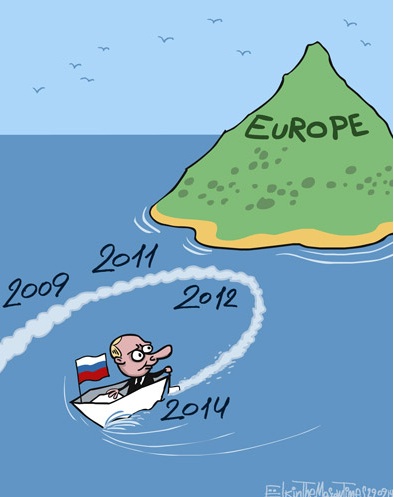
Russia began turning away from Europe, and the West as a whole, not during the Ukrainian revolution in February, but when Putin began his third term as president in 2012. The fact that many Western leaders in recent years had what Polish President Bronislaw Komorowski called “hopes for Russia’s democratic modernization” only proves that they misunderstood the nature and outlook of the Russian elite and people.
By 2014, Russia had once again become a country whose leadership showed no intention of complying with the rules of foreign or domestic policy. In fact, those leaders would probably act even more decisively if economic considerations did not hold them back. But the truth is that Russia depends heavily on the world economy, even if its political elite believe otherwise.
Hardships will hit Russia’s private businesses hardest, even while the government continues pumping budgetary funds into bailouts for state-owned corporations headed by Putin’s close associates. Over the next few years, Russia will also fail to benefit in almost any way from its “turn toward the East.” The failure of that project will grow increasingly evident just as anti-Western sentiment in Russia declines, giving way once again to envy of Western prosperity and a desire for renewed friendship.
Russia cannot survive without the outside world. The external debts of its banks and corporations exceed the size of its foreign exchange reserves. Russia finances more than half of its budget with the export of raw materials and imports 100 percent of its computers, mobile communications devices, telecommunications technology and many types of equipment. Under such conditions, the economy itself will have an impact on the country’s political course.
Many people raise the objection that the process of globalization in the early 20th century did not prevent the outbreak of World War I. That is true, but 100 years ago European powers were constantly fighting either each other or in their colonies, human life meant less, and war seemed like a perfectly appropriate means for solving many problems.
Today nobody is prepared to give their life for the sake of Gazprom or Rosneft, and most citizens and politicians understand that it is no longer possible to solve serious problems through direct confrontation. Russia’s “foreign offensive” will fail not because of a defeat at the front, but for lack of support at the rear. And the more actively Russia isolates itself from the international system, the sooner that mutiny will occur.
No further sanctions are even necessary: Those already in effect are enough to prod Moscow leaders into taking retaliatory measures that will derail Russia’s economy.
And when that happens, Russia will turn once again to the West — as it has turned many times in the past — in search of investment, technology and innovation. At that point, both sides will need to build economic and political ties that are strong enough to resist the machinations and adventurism of a handful of oligarchs with close ties to the Kremlin.