Fed in US to End Taper, Maybe.

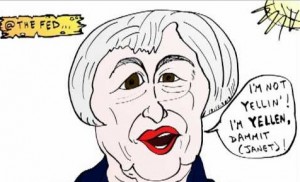
The Federal Open Market Committee (FOMC) – the board of directors of the Federal Reserve decided to continue to “taper” – reduce their rate of monthly purchasing under their quantitative easing policy. The taper in the 18 December 2013 meeting was $10 billion, the 29 January 2014 meeting added $10 of taper, the 19 March meeting tapered $10 million. the 30 April meeting tapered $10 million, the 18 June meeting tapered $10 million, the 30 July meeting tapered $10 million, and this 17 September meeting another $10 million. The most notable words are in this statement:  If incoming information broadly supports the Committee’s expectation of ongoing improvement in labor market conditions and inflation moving back toward its longer-run objective, the Committee will end its current program of asset purchases at its next meeting.

Has Yellen come to realiza that the intractable unemployment problems in the US are nothing the Fed can help?
Yellen Tapers

New Chair of CFTC Talks About Uncleared Swaps

Chairman Timothy G. Massad said:  As we take up any rule required by the Dodd-Frank Wall Street Reform and Consumer Protection Act, we must never forget why the Act was passed and the motivations behind Title VII. The Dodd-Frank Act was a comprehensive response to the worst financial crisis since the Great Depression. While there were many causes of that crisis, one was excessive risk from the over the counter swaps market, a large, global industry essentially unregulated by any jurisdiction at that time. It was six years ago—September 16, 2008—when our government was required to step in and prevent the failure of AIG, which was on the brink of collapse because of excessive swap risk, a collapse that could have thrown our nation into another Great Depression.  Opening Statement of Chairman Timothy G Massad

Money and Washington

Putin’s Oil Grab

Leonard Bershidsky writes:  Evtushenkov, founder of Sistema and Bashnaft, an oil company   rode into big business on the coattails of former Moscow mayor Yuri Luzhkov, a cheerful but ruthless politician whose wife became the city’s biggest real estate developer during his tenure. Evtushenkov headed the city government’s committee for science and technology, moved quickly to privatize Moscow’s fixed telephone network and set up what is now one of Russia’s three national mobile carriers, MTS. His business empire, called Sistema, grew rapidly. Evtushenkov expanded into electronics manufacturing and real estate, then took his companies public. Back then, Russia was a relatively tame dictatorship, so investors weren’t worried about Evtushenkov’s path to riches.

Sistema and MTS shares have crashed since news of Evtushenkov’s confinement to his mansion near Moscow with a monitor bracelet. The Kremlin doesn’t care. “We allow that some insignificant show of emotion in the markets may take place,” Putin’s press secretary, Dmitri Peskov, told the Interfax news agency. “That, however, is no reason for law enforcement agencies not carrying out necessary investigations.”

Sechin and Rosneft, sanctioned in the U.S. and in Europe, no longer have to wear sheep’s clothing and pretend to play by civilized rules. Private Russian businesses, large and small, now face a bigger threat than before the new Cold War: Putin and his entourage, riding a patriotic wave, no longer need a smokescreen for the de-facto nationalization of Russia’s economy so it can be run by their rent-seeking clique.

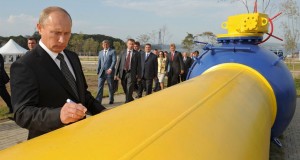
Putin Signs a Pipeline

LEGO Sells Out New Shapes for Real Girls

Harvard Business Review reports:  Why did it take until 2014 for the world’s second-largest toy maker to offer girls (and their toy-buying parents) products they might actually want? (After all, even Barbie has been an astronaut since 1965.)  Perhaps it has something to do with the profile of LEGO’s management team, comprised almost entirely of men. The three-person board of the privately-held company is all men, led by CEO Jørgen Vig Knudstorp. The 21-person corporate management team has 19 men and two women – both in internally-facing staff roles, not connected to the customer base or product development.* When your leadership isn’t gender-balanced, it’s tough to have a balanced customer base. The new ‘Research Institute’ range was proposed by geoscientist Ellen Kooijman on one of the company’s crowd-sourcing sites. But it begs the question, is there really no one inside the company who might have come up with the radical idea of having women scientists feature in a 21st century toy company’s line?   A Woman’s Image

Friends

Scotland: Nationalism or Economics

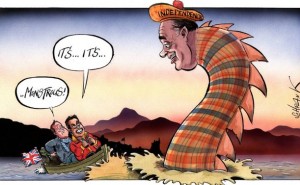
George Friedman writes:  Scotland was buried in Britain for centuries and has resurrected itself. This raises the question of how confident any of us can be that national claims buried for only decades are settled. I have no idea how the Scottish will vote. What strikes me as overwhelmingly important is that the future of Britain is now on the table, and there is a serious possibility that it will cease to be in the way it was. Nationalism has a tendency to move to its logical conclusion, so I put little stock in the moderate assurances of the Scottish nationalists. Nor do I find the arguments against secession based on tax receipts or banks’ movements compelling. For centuries, nationalism has trumped economic issues. The model of economic man may be an ideal to some, but it is empirically false. People are interested in economic well-being, but not at the exclusion of all else. In this case, it does not clearly outweigh the right of the Scottish nation to national-self determination.   Scottish Independence

Scotch Independence

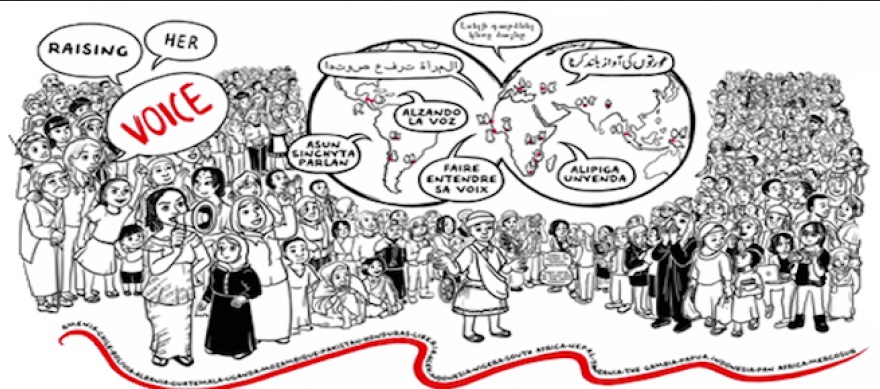
Make Women in Technology Visible

With nearly 16 million programmers in the world, at 10 to 15 percent women, there are more than two million female programmers — but we never see them. Technical women remain largely invisible and behind the scenes despite important and often elite contributions.

In tech, we are standing on the shoulders of giants — men and women who have innovated and collaborated to bring us to where we are today. So many entrepreneurs, computer scientists, heroes, and creators have come before us — and yet we are critically challenged by the lack of visibility innovators of those days.

In the Hollywood film Jobs, all of the men on the core Macintosh team are introduced and have speaking roles, but we don’t meet Joanna Hoffman or Susan Kare, though both were a core part of the original Macintosh product development team.

The Geena Davis Institute on Gender in Media (GDI), through studies done with the USC Annenberg School, found a three to one ratio of male to female characters in children’s TV, with 80 percent of the jobs held by characters in kids TV and films being held by male characters. We need to help Hollywood and other media creation hubs fix this damaging bug. Armed with GDI research and the need to shift, we and many others have begun helping with outreach work to top media partners.

We have a tremendous opportunity to help change the narrative and our actions — all of us, women and men working alongside one another, have an important role to play here.

With nearly 16 million programmers in the world, at 10 to 15 percent women, there are more than two million female programmers — but we never see them. Technical women remain largely invisible and behind the scenes despite important and often elite contributions.

Making Women Visible

Will the Alibaba IPO Drag the Market Down?

Mohamed El-Erian writes:  The Alibaba IPO will be a very big deal, with potentially marketwide impact. At a possible $22 billion to $24 billion, it could well be the largest IPO in history. So it really matters how investors fund their purchase of Alibaba shares.

The broader market would be least affected if the incremental funds came from a healthy and sustainable increase in borrowing, associated with a greater willingness (and ability) on the part of investors to assume risk. The deployment of idle cash would also have minimal effect on the rest of the market. Although both will occur to some extent, they are unlikely to be the main drivers.

This leaves plenty of potential for downward market pressure as investors sell existing holdings in order to make room for their Alibaba purchases. Given that most investors don’t know as yet how many shares they will receive, most of the selling wouldn’t materialize until quite far into the IPO process. The combined effect could be quite significant.

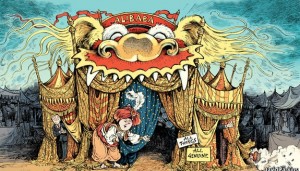
Alibaba IPO

Scotland: Yes and No

Conservative columnists suggest that it is unfair to other citizens of the UK who can’t vote on an issue that impacts them.  Others are arguing that there are benefits to separation for workers.  They talk about civic nationalistm – the idea that all citizens should be engaged in the process of deciding where society is headed, not just getting their hands on the tiller once every four or five years. It utilises the n-word because democracy on a national level offers the best opportunity for fundamental change.

The vote appears to be close, but insiders think there will be no split at this time.

 Scotch Independence

The State of the Irish Economy

John O’Hagan writes:  Some recent commentaries would at times lead one to believe that our public finances problem has almost been resolved. And that with renewed significant growth the severe unemployment and equity problems that followed the crisis have largely been addressed.

Three years ago the economy of the Republic was still reeling from tumultuous years of economic setback.  Output after 2007 had declined on a scale almost never seen in peacetime anywhere, unemployment had trebled, employment had declined by almost 300,000 and large-scale net emigration had resumed for the first time in almost 25 years.

At times it seemed like the political system could not survive intact in the face of widespread anger and with huge numbers facing large-scale financial problems arising from negative equity, lost jobs and a fear that the euro zone might implode.

Three years on, things look a lot brighter. As some populist commentators fuelled the flames of discontent, most of the Irish population, it seems, got on with dealing with a crisis that was largely of our own making. There is only so long one can lament events and attempt to blame others, be it at a personal or societal level, but ultimately we must move on and try to make good the damage and plan for a better future.

Many of those most affected complained least: the involuntary emigrants, the newly unemployed, the people trapped in negative equity and the young who took the brunt of the pain. Very often it was those least affected who complained the most: those in secure, pensionable jobs and many of the elderly who were largely protected from the effects of the recession.

Last year now appears to have seen a major turning point, with further large employment increases likely this year. A remarkable recovery in employment, then, will have occurred in just three years.  There is no reason why the Republic cannot prosper in years to come and remain one of the high-income countries of the world.

The country has a healthy, stable democracy and a well-established rule of law. The skill levels of the labour force are the same as they were prior to 2008. There is a healthy openness to competition and entrepreneurship.

All democracies are flawed to an extent and economic debates are often fraught and misinformed, Ireland over the last six years being no exception. It is worth remembering therefore that economic policy is exercised in the political market place, and will continue to be so in the years ahead.

Economists may have forgotten their history up to recent times but so also do they often forget that economic policy and politics are inseparable. Having a solution to an economic problem is of little benefit if the political system cannot be assured of delivering on it without risking major instability, thereby exasperating the difficulties.

Huge inequities persist despite the recovery. The most important antidote to such inequities is to create employment which is now happening on a large scale in the Republic.  Bringing about major further reductions in unemployment is the great social and economic policy challenge ahead.

A disturbing reflection of this is the exercise electorally of “grey power” in recent years, where as a result payments to over-65s, regardless of their circumstances, have largely been protected while those to other, younger groups have been cut.

Short-term fluctuations

One also should not be deflected from the medium- to long-term focus by the short-term fluctuations of financial markets or predictions of imminent doom or boom.

Ireland  still has a huge accumulated debt and continued large borrowing needs to fund day-to-day expenditures.

Jobs in Ireland