Europe: Structural Reforms in Exchange for Short-Term Fiscal Constraints

Michael Spence writes:  In a post-crisis environment of aggressive and unconventional monetary policy in other advanced countries, the ECB’s less aggressive policies (owing to its more restrictive mandate) have resulted in an exchange rate that has damaged competitiveness and the growth potential of many eurozone economies’ tradable sectors. European Tradae-Off- Structural Reforms for Short Term Loosening of Fiscal Constraints

EU

How is Modi Faring in India

Fareed Zakaria writes:   Narendra Modi, India’s new prime minister, radiates confidence. He has the first outright majority in India’s parliament in 30 years. The public lauds him, world leaders court him and the Bombay Stock Exchange continues to soar. But will this moment of euphoria translate into lasting gains? Can India become the world’s next economic powerhouse?

I had the chance to pose these questions when I met with Modi last weekend at his house in New Delhi, his first interview since becoming prime minister. Modi is extremely intelligent and focused but is different from most leaders I have met. His worldview has been shaped almost entirely from experience rather than formal schooling. Born poor and lower-caste (which in India is a worse fate), he left home when he was 17 and soon got involved in politics, joining the RSS, a hard-line Hindu nationalist group. He later got bachelor’s and master’s degrees, but his real education came from traveling around India.

He recounted the thousands of villages he had visited as the head of the government in the state of Gujarat — a period during which Gujarat grew as fast as China. This feel for how people live animates him. Modi is passionate about hygiene and has launched an ambitious drive to build toilets in homes, schools and elsewhere. In his Independence Day speech last month, atop the ramparts of the Red Fort in New Delhi, Modi spoke plainly about the shame that vast numbers of Indians defecate in public. Any previous prime minister would have considered the topic beneath the office. But Indians love his down-to-earth approach.

During the election campaign, Modi placed a particular twist on the lavatory theme. He explained that India needed toilets first and temples later. Can this approach succeed?

Modi


The Economic Meaning of China’s Infrastructure Investment

Andrew Sheng and Xiao Geng write:   Without large-scale infrastructure investment, especially in transport, the productivity gains that enabled America’s emergence as an industrial power would have been impossible. Though the process included significant creative destruction, rapid economic growth offset losses resulting from excess capacity.
Similarly, when viewed through the long lens of history, China’s ghost towns will prove to be potholes on the path to development. China’s massive infrastructure investment, funded largely through LGFVs, will most likely be remembered for its critical contribution to the country’s economic modernization.  China’s Infrastructure Expenditures

China's March to the Future

The New Economics? Man Motivated by Self-Interest and His Social Relations

Dennis J. Snower writes:  Mainstream economics – and the concept of homo economicus – recognizes only half of what makes us human. We are undoubtedly motivated by self-interest. But we are also fundamentally social creatures.

Snower argues that the world seems to be on the verge of another “great transformation,” with changes far more profound than news-grabbing economic or geopolitical headlines about Asia’s economic rise or the fires in the Middle East. The coming changes will fundamentally redefine the nature of our economic interactions – and the social dynamics that underlie them.  The New Human Being

New Humans


Safra Catz, Co-Head of Oracle as Women Enter High Hi-Tech

Safra Catz, who was co-president and CFO of Oracle until Thursday, has just been promoted to co-CEO — alongside Mark Hurd — after its founder and longtime CEO Larry Ellison announced he’s stepping down to the Executive Chairman position.

Oracle said in a statement that Catz will be responsible for all manufacturing, finance, and legal decisions, while Hurd will be in charge of sales, service, and global business units. Ellison will continue to oversee all software and hardware engineering functions.

The move might come as a bit of a surprise, but Catz’s track record tells she was a natural choice for Oracle’s board.

Catz first joined Oracle in 1999 as senior VP. But she quickly rose through the ranks, becoming executive VP within seven months, and president of Oracle Corporation by 2004, a position she had kept for over a decade. She served as Oracle’s interim CFO from November 2005 to September 2008, only to return to the same role in 2011 as full-time CFO. She’s also been an Oracle board member since 2001.

A former banker at Donaldson, Lufkin & Jenrette, an investment bank that was later acquired by Credit Suisse, Catz has played a major role in Oracle’s M&A department, overseeing nearly 100 M&A deals worth billions of dollars for the company. Some of the biggest deals she’s led include the $10.3 billion acquisition of PeopleSoft and the $7.4 billion deal for Sun Microsystems. She’s a graduate of the Wharton School, but also holds a law degree from UPenn, which made her Ellison’s consigliere as well.

As remarkable as her resume is, Catz is perhaps better-known for regularly being named the highest-paid woman executive in the world. Last year, she made $44.3 million in total compensation, easily becoming the world’s top paid female exec and CFO. In 2013, she became the first female to hold the highest-paid CFO position, when she made approximately $43.6 million. That amount, in fact, was a drop from her 2012 compensation of $51.7 million.

“Safra and Mark are exceptional executives who have repeatedly demonstrated their ability to lead, manage and grow the company. The Directors are thrilled that the best senior executive team in the industry will continue to move the company forward into a bright future,” Oracle Board’s Presiding Director Michael Boskin said in a statement.


Safra Catz, Co-CEO, Oracle

Could You Be A Professional Taster?

Let’s make more job categories available to everyone.  You could be a supertaster, hired by food and drink companies to taste their products.

Alex Russell writes: There are natural variations between humans in our senses. We need different prescriptions to correct our eyesight. Some people say that vinyl sounds better than CDs or MP3s and will pay big money for audio equipment, while others can’t tell the difference.  Strictly speaking, the word “taste” refers to the five primary tastes: sweet, sour, bitter, salty and umami.

There is some evidence for other primary tastes, with fat most likely to be the next to be recognized. Others include calcium and metallic, although the latter is often due to various disorders or conditions.  It’s the bitter taste that started all of this supertaster stuff. Supertasters

Supertasters

Is Classroom Time Related to Good Teaching?

This is an important economic issue because long-range employment issues around the world are related to education.  While in the US we need stop gap measure like a massive infrastructure program to get people back to work, the future depends on education.

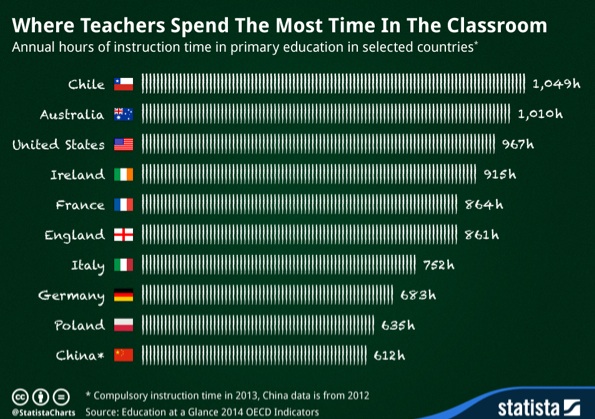
Generally, primary school teachers are required to spend more hours teaching than their counterparts in secondary education – a total average of 782 hours each year.

The OECD reports:  The average day lasts somewhere between 3 and 6 hours in the vast majority of countries across the world but Chile, France and the United States are notable exceptions where teachers spend in excess of 6 hours in the classroom. Those hours certainly add up in Chile where primary school teachers have 1,049 annual hours of instruction time. Australia isn’t too far behind with 1,010 while American teachers also put in a huge number of hours each year – 967.

This chart shows the annual hours of instruction time in primary education in selected countries.

.

Classroom Hours Worldwide


Military Projects for Entrepreneurs?

DARPA (the Defense Advanced Projects Research Agency) and Arizona State University are testing a jetpack for US troops but it has at least one drawback. The device will not allow soldiers to fly instead increasing the ground speed of the wearer allowing them to run a four minute mile.

Think of a jetpack and you may imagine flying over a futuristic city, inspired by scenes in sci-fi films. But the technology could also be used to enable soldiers to run faster in warzones in a matter of years.
US engineers have created a working prototype that attaches to people’s backs and helps them to run a mile in a much shorter space of time – despite carrying the large metal pack.
The project is the military’s latest effort to create exoskeletons for US soldiers to give them super-human strength, speed and other advantages on the battlefield.

imagine flying over a futuristic city, inspired by scenes in sci-fi films. But the technology could also be used to enable soldiers to run faster in warzones in a matter of years.
US engineers have created a working prototype that attaches to people’s backs and helps them to run a mile in a much shorter space of time – despite carrying the large metal pack.
The project is the military’s latest effort to create exoskeletons for US soldiers to give them super-human strength, speed and other advantages on the battlefield.

.

Jetpack for Soldiers

High Speed Trading Firm Nabbed by SEC

An SEC investigation found that Latour Trading LLC operated without maintaining its required minimum net capital on 19 of 24 reporting dates during a two-year period, and the firm missed the mark by large amounts ranging from $2 million to $28 million. During this period, Latour’s trading at times accounted for as much as 9 percent of the trading volume in equity securities for the entire U.S. market.

To settle the SEC’s charges, Latour agreed to pay a $16 million penalty, the largest ever for violations of the net capital rule. The previous high was $400,000 in an enforcement action in 2004. Nicolas Niquet, Latour’s chief operating officer when the series of violations began, agreed to pay a $150,000 penalty to settle the charges against him. Said Andrew J. Ceresney, Director of the SEC’s Division of Enforcement:  This record sanction reflects the seriousness of Latour’s violations of the net capital rule, which is a critical broker-dealer financial responsibility requirement. We also will aggressively pursue executives who cause the violations.

According to the SEC’s order instituting a settled administrative proceeding, a crucial step for a broker-dealer when calculating its net capital is to take percentage deductions referred to as “haircuts” from the firm’s proprietary securities and other positions. The purpose of these haircut deductions as prescribed in the net capital rule is to account for the market risk inherent in a firm’s positions and create a buffer of liquidity to protect against other risks associated with the securities business. A failure to calculate proper haircuts can inflate a broker-dealer’s net capital.
The SEC’s order finds that Latour repeatedly miscalculated its net capital amounts in 2010 and 2011 by failing to make proper haircut deductions from the market value of its proprietary securities positions and other positions.

SEC- "It Must be Cut"