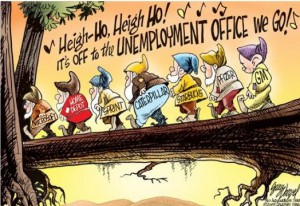
Fischer states that the changes in jobs in the US is greater even than those impacted by the Great Depression of the 1930s. Permanent Structural Change in Employment in the US
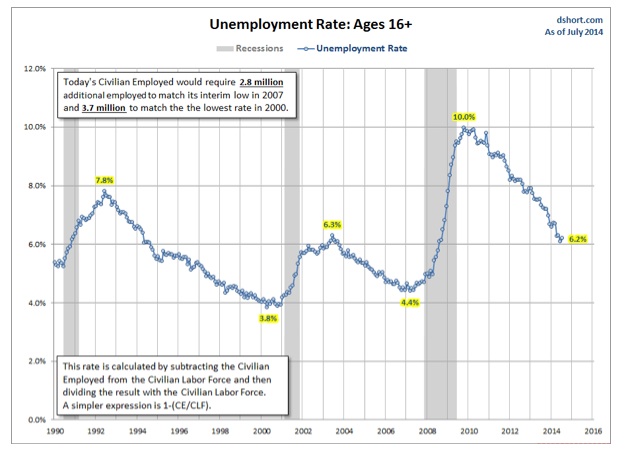
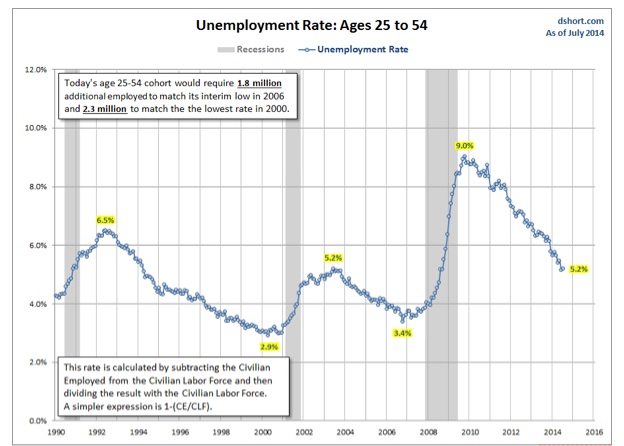

Fischer states that the changes in jobs in the US is greater even than those impacted by the Great Depression of the 1930s. Permanent Structural Change in Employment in the US
The Venice Film Festival, whose roots are layered with political tension and change, is one of the most prestigious film festivals today and one of the most important sources of economic stimulation in Venice.
Long ago one of the founders of W-T-W.org won a gold medal there. Venice Film Festival Stimulates the Economy

A Chinese antitrust regulator said on Tuesday that Microsoft Corp has not been fully transparent with its sales data on the software it distributes in China, including information on sales of its media player and web browser software.
Zhang Mao, head of the State Administration for Industry and Commerce, said in Beijing that Microsoft has expressed willingness to cooperate with ongoing investigations.
“After multiple meetings, including at high levels, they’ve expressed a willingness to respect Chinese law and collaborate with investigating officials,” Zhang said.
The Microsoft investigation comes amid a series of antitrust probes into foreign firms in China, including mobile chipset maker Qualcomm and German carmaker Daimler’s luxury auto unit Mercedes-Benz.
The State Administration for Industry and Commerce said earlier this month that Microsoft is suspected of violating China’s anti-monopoly law.
This is in relation to problems with compatibility, bundling and document authentication for its Windows operating system and Microsoft Office software.
“The investigation is ongoing and we will disclose the results to the public in a timely fashion,” Zhang said, adding that the Microsoft probe is one of nine investigations opened this year that include the software, tobacco, telecommunications, insurance, tourism and utilities sectors.
The companies involved in the nine investigations comprise domestic, foreign, State-owned enterprises and trade associations, according to Zhang.
Microsoft China Chief Executive Ralph Haupter did not respond to Zhang’s comments, saying only that more work needs to be done on Chinese information safety protection.
An industry insider said on Tuesday that despite policy barriers, global tech giants can still enjoy great opportunities in China if they can find the right marketing strategy.
Derek Shen, China head of the United States social networking website LinkedIn, said foreign tech companies should understand Chinese requirements when doing business in the country.
“To survive in China, they have to figure out the strengths that are difficult for local rivals to replicate,” he said. “It is a tough task even for Google, because its technological edge can be quickly overrun by Baidu or Tencent Holdings. Overseas tech giants seem unaccustomed to the Chinese marketing climate.”

Martin Feldman writes: America’s current tax system adversely affects the US economy in several ways. The extra tax that US firms pay if they repatriate profits raises their cost of capital, thus reducing their ability to compete in international markets. Foreign firms can also outbid their US counterparts in acquiring new high-tech firms in other countries. And when a foreign firm acquires a US company, it pays US tax on the profits earned in the US but not on the profits earned by that firm’s other foreign subsidiaries, thus lowering its total tax bill.
A shift to a territorial system of taxation would remove the disadvantages faced by American multinational corporations and encourage them to reinvest their overseas profits at home, increasing US employment and profits. Because only a small share of overseas profits is now repatriated, the US government would lose very little tax revenue by shifting to a territorial system. A few years ago, the US Treasury Department estimated that shifting to a territorial system would reduce corporate tax revenue by only $130 billion over ten years. Keeping US Companies in the US

Jesse Eisinger writes: Admitting a problem, as the cliché has it, is the first step to solving it. But with the Justice Department and the Securities and Exchange Commission, admissions of wrongdoing have been the last step. There’s much work to be done to hold giant corporations accountable for their misdeeds. Do Big Banks’ Apologies Change Behavior

The Chinese media and the Internet are full of speculations on how the top leadership will continue the anti-corruption campaign after putting former security chief Zhou Yongkang under investigation. A former member of the Standing Committee of the Political Bureau of the Communist Party of China Central Committee, Zhou is the highest-ranking official facing investigation for corruption since the launch of reform in the late 1970s. As Chinese often say, Zhou is the “biggest tiger” to be trapped in the anti-corruption net.
Although people have welcomed the probe against Zhou, they are asking what turns will the anti-corruption campaign and the overall political development take now? Will the campaign taper off? And what long-term effects will the anti-corruption campaign leave? The official press is busy trying to answer these questions. Shortly after Zhou was put under investigation, a commentary on gmw.cn went on to say hunting down a “big tiger” cannot be the ultimate goal of the crackdown on corruption. Instead, the goal should be to use the opportunity to deepen government reforms, and to wipe out bad officials’ influence in ways prescribed by the law. After hunting down Zhou, China still has three major battles to fight.
The first battle is to use the Fourth Plenum of the 18th CPC Central Committee, scheduled for October, to expedite the country’s legal development and strengthen the rule of law. In fact, the natural continuation of the anti-corruption campaign is to design effective institutions to prevent the distortion of law in implementation.
The second battle is to redress the inequality in wealth and status in the market, which can be done through reform of State-owned enterprises, which have de facto monopoly over of natural resources, and make them face effective competition.
The market should be strictly regulated to curb what the author of the article in People’s Daily calls “feudal capitalism”, or crony capitalism. Authorities must make serious efforts, even if they are not more serious than the anti-corruption drive, to encourage “true entrepreneurship” while battling “bureaucratic capitalism” and “barbarian capitalists”. The third battle has to be fought on the international relations front to earn China a larger space for its peaceful rise.
It is still too early to claim victory over corruption. People could feel disappointed again if there aren’t more effective methods to deal with the problems mentioned above. Therefore, the leadership has to show more tangible results to the people.
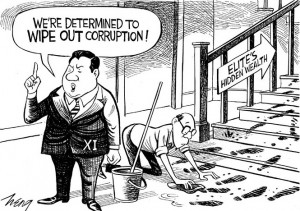
Matt Levine makes brilliantly clear how the US tax system works when companies are international.
The most recent story on the Burger King press page remains “Burger King Restaurants Bring Back Chicken Fries,” but events have overtaken the chicken fries. After many media reports, Burger King and Tim Hortons have put out a press release confirming that they’ve been holding merger talks, and imagine what the catering is like. This announcement has set off a frenzy of condemnation, since any merger would be what is called an “inversion,” turning the combined Burger Tim into a Canadian company and thus freeing it from its harsh but patriotic duty to pay U.S. income taxes.
This condemnation is a bit confused, so I thought it might be helpful to explain very simply (too simply!) how the U.S. corporate income tax system works. There is nothing new here, lots of people know this, but weirdly lots of people don’t, too. It works like this. Matt Levine Explains Inversion
Although employment is one of the Fed’s central missions and the current chair, Janet Yellen has a passionate commitment to employment for all willing workers, the shape that unemployment takes in much of the developed world can not be altered by monetary policy although it can perhaps be changed by tax policy. Writing from Jackson Hole, Daniel Altman looks at some tacts that might help.
The private sector in the United States has been consolidating rather than expanding in the past few decades. The average payroll at an American company is about 50 percent higher now than in 1977, as I have written. In other words, there have been progressively fewer businesses per worker, and those business have gotten much bigger. This hinders innovation too, since bigger organizations tend to have more vertical hierarchies. The more layers in the organization, the tougher it is for new ideas to percolate to the top.
In this environment, low interest rates may not be enough to boost employment. Some firms could find it easier to replace and renew old capital, and new firms may find the cost of raising money more bearable. But stricter lending policies among banks have dulled this effect, stifling the growth of small businesses. Overall, however, the case for hiring in the United States — or, indeed, for any major expansion of their production here — is clearly a difficult one to make for many American companies. The US Fed is Not Going to Solve the Employment Problem
Barclays was one of the last major international banks to still accept accounts held by money-transfer operators (MTOs), whose activities are seen in the West as open to abuse. But a record $1.9 billion fine slapped on HSBC by U.S. authorities for conducting business with banks in Mexico and Saudi Arabia with possible links to drug trafficking and terrorism appears to have tipped the balance for Barclays. The profit margins no longer seem worth the reputational risk. Now, ironically, Barclays finds itself in the role of “bad guy” by dint of its slowness in pulling out of the MTO sector.
“At the end of the day, the money will still come in, but at much higher transaction cost and with less transparency,” says Shire, Somaliland’s minister of planning. “So who do you punish by doing this? Is it the pirate, the terrorist, or the poor man?” Money Transfers in Somaliland

August 26th is celebrated as Women’s Equality Day in the US, The not-so-popular President issued a proclamation
“From classrooms to boardrooms, in cities and towns across America, and in the ranks of our Armed Forces, women are succeeding like never before. Their contributions are growing our economy and advancing our Nation. But despite these gains, the dreams of too many mothers and daughters continue to be deferred and denied. There is still more work to do and more doors of opportunity to open. When women receive unequal pay or are denied family leave and workplace flexibility, it makes life harder for our mothers and daughters, and it hurts the loved ones they support. These outdated policies and old ways of thinking deprive us of our Nation’s full talents and potential. That is why this June we held the first-ever White House Summit on Working Families to develop a comprehensive agenda that ensures hard working Americans do not have to choose between being productive employees and responsible family members. We know that when women and girls are free to pursue their own measure of happiness in all aspects of their lives, they strengthen our families, enrich our communities, and better our country. We know that when women succeed, America succeeds.”
It is the hope of the founders of W-T-W.org, women and finance, that knowledge and interconnected networks across the world makes a small contribution to women as they step out into the world and take their deserved places.