The tasting room is packed at Orpheus Brewing. The heady aroma of hops and barley hangs in the warm evening air as casually dressed 20- and 30-somethings gather around highboy tables and spill out onto the wood-planked patio overlooking Atlanta’s Piedmont Park. Already there’s a gentle buzz, although it’s hard to tell whether the buzz is a side effect of the artisanal brews on tap or simply the excitement surrounding the latest addition to the city’s burgeoning craft beer market. Scenes like this are becoming more common across the Southeast as craft beer takes hold in a region long dominated by national brands and light lagers. The Atlanta Fed report. Atlanta Fed Report on Craft Beer
EU Threatens More Sanctions Against Russia
The leaders of the European Union have instructed the European Commission and the EU’s diplomatic service to prepare further sanctions to be imposed on Russia, in reaction to its military action against Ukraine.
Herman Van Rompuy, the president of the European Council, said the EU was ready to take “significant further steps in light of the evolution of the situation on the ground”. He condemned the movement of Russian troops and weaponry into Ukraine. Angela Merkel, Germany’s chancellor, said that sanctions would be imposed “if the situation in the last days goes on”. Merkel also committed money to help rebuild the damaged infrastructure in Ukraine.
The European Council adopted conclusions that called for a ceasefire and urged Russia to implement a peace plan prepared by Ukrainian president Petro Poroshenko, who attended the Council meeting.
Van Rompuy denounced “the presence of Russian armed forces on Ukrainian soil”. José Manuel Barroso, the president of the European Commission, said: “What is happening in the eastern part of Ukraine is war.”
It is unclear whether the mooted sanctions will be an intensification of existing measures affecting exports in the military, energy and the financial sectors, or will extend into new economic sectors.
The Council specifically instructed the Commission to include in its proposals a measure “on the basis of which every person and institution dealing with the separatists groups in the Donbass [region of eastern Ukraine] will be listed”.
Barroso said that at a meeting with Poroshenko he had said that the EU stood ready to provide “an additional €1 billion in loans to Ukraine”.
The EU leaders also discussed the worrying state of the European economy, in light of a very low level of inflation and extremely high unemployment. They agreed that the situation raises “significant concerns”. “In recent weeks economic data have confirmed that the recovery, particularly in the euro area, is weak,” the conclusions state. The leaders agreed to hold a special summit on jobs and growth in Italy in early October, and a summit of government leaders from eurozone countries following the European Council in late October.
Speaking after the Council, Hollande said the situation was unacceptable. “The diagnosis is unquestionable. It’s a widespread situation, there are some countries in recession, and inflation has reached a historic low everywhere. Therefore there is a European problem, a lack of sufficient demand.”
How to Give Female Farmers A Voice
Jaqui Ashby writes: Imagine a typical scene in agricultural research for development: a group of predominantly male researchers visit a group of male farmers whose views they take to inform their work.
The reality is that a large proportion of smallholder farmers – the majority in some parts of the sector – are female. What can researchers do to make sure female farmers get their fair share of attention in agricultural research? Here are our top tips for implementing a successful gender strategy:
You may need to recruit specialised researchers who will make sure gender issues are addressed in technical fields like plant breeding. For example, to make sure CGIAR have the in-house expertise to tackle gender equality in research, we are forming a community of young gender researchers with a post-doctoral programme.
You could also try designing a programme which focuses explicitly on gender-related changes in farming systems. Our aquatic agricultural systems programme includes research focused on transforming gender roles and social norms that hold back the productivity of female farmers.
To give female farmers a fairer deal, research must look beyond the practical needs of women to tackle underlying constraints. This includes unequal land rights, restricted mobility or limited schooling that prevent fair access for women farmers to extension training, credit or markets. Often institutions and policies have to change before women can benefit from our technologies.
Tackling gender inequalities in farming means you need to think differently about agriculture. Instead of concentrating on crops and livestock, think about food systems that include minor crops and vegetables grown by women, and post-harvest processing, so much of which is done by women. Or about domestic use of farm resources, especially labour, but also water and fuel for cooking.
You’ll definitely need extra resources dedicated to tackling the gender inequalities which affect many aspects of how crops and livestock are raised, consumed, and sold, and who benefits from new research. So dedicated budget for this purpose in research plans, proposals and programmes are a must.
We try to ensure our technologies create opportunities for both women and men through the collection of data and evidence. This data should be disaggregated by sex, that is, analysed separately for males and females. This often involves asking questions such as “who is benefitting from you work?” which gives us a better idea of how women farmers specifically are benefiting from our technologies.
Ending Crony Capitalism in Hong Kong
Nisid Hajari writes: When they meet on Sunday, legislators from China’s rubber-stamp National People’s Congress are expected to disregard even modest proposals to open up Hong Kong’s political system. In all likelihood the decision will provoke street protests, drive moderates into the more radical pro-democracy camp and call into question the former British colony’s standing as a global financial center and bastion of free enterprise. And for what? The good of Hong Kong, of course.
Wang Zhenmin, a Chinese law professor who sat on the committee overseeing Hong Kong’s constitution, laid out the case most blatantly on Thursday: the interests of the city’s powerful tycoons had to be safeguarded from unchecked democracy. “If we just ignore their interest, Hong Kong capitalism will stop,” he said. “Democracy is a political matter and it is also an economic matter.”
On the face of it, Beijing’s intransigence makes little sense. Pro-democracy groups proposed a system of open nominations with a much lower threshold — about 5 percent of the voting population. Even if some anti-Communist radical were able to get on the ballot, the chances of him or her winning would still be negligible. In addition, any victor would be sworn into office with an oath that acknowledges China’s suzerainty over Hong Kong; a leader could be ousted for violating it.
Compromise proposals supported by moderates would have entailed even less risk. For example, China could have expanded the nominating committee, adding more members directly elected by the public, while lowering the nominating threshold. Thus the choices available to voters would have expanded beyond a tight circle of pro-Beijing cronies without threatening China’s hold over Hong Kong.
According to Credit Suisse, a few wealthy businessmen now account for 60 percent of the city’s wealth. Those who have prospered most are engaged in sectors such as banking and real estate, where political connections matter. Hong Kong recently topped the Economist’s “crony capitalism index” just ahead of oligarch-ridden Russia. Frustration over Hong Kong’s yawning wealth gap is rising dangerously. While gross domestic product has grown about 50 percent in the past decade, median household income has only risen 10 percent.
The cost of defending the plutocrats is high. A Chinese government has raised doubts about the continued independence of Hong Kong’s judiciary and the city’s commitment to the rule of law, which have been pillars of its success. Raids this week on high-profile opposition supporter Jimmy Lai were hardly more reassuring. Perhaps leaders in Beijing feel they are defending a principle greater than the pocketbooks of Hong Kong’s elite. They have long feared that showing leniency toward Hong Kong would encourage other disgruntled parts of China, such as Tibet and Xinjiang, to demand greater autonomy.
Sooner or later, Chinese leaders are going to have to get more comfortable with the idea of autonomy in outlying regions. So far Beijing is failing.
Gender Balance on EU Commission
The EU member states are meeting to pick a new President and Foreign Minister. Frederica Mogherini the possible pick to be Foreign MInister, is thought by some to be too close to Russia. If Donald Tusk, President of Poland, is chosen as President, this may assuage fears. Martin Schulz, the president of the European Parliament, made comments about the gender balance of the next Commission: “if there are fewer women elected to Commission than the current nine, there is a risk of receiving not enough support in the European Parliament.” Schulz also said he is a “Mogherini-fan”. “I know her very well and she is experienced enough for the job [of High Representative].” Biography
Update: Tusk and Mogherini Get the EU Jobs:
Donald Tusk is to leave the prime ministership of Poland to become president of the European Council in succession to Herman Van Rompuy. His appointment balances the choice of Federica Mogherini, Italy’s foreign minister, as the European Union’s high representative for foreign policy. The decisions were announced by Van Rompuy, who said that they had “the full support of all” members of the European Council.
“You have the full endorsement of the European Council and this full endorsement was very important to me,” said Van Rompuy, adding that he had spoken several times to each government leader “to make sure we made the right choice”.
The announcement came two and a half hours into an EU summit that was convened specifically to discuss the appointments – after Van Rompuy deemed the matter not ripe for decision at an earlier summit on 16 July. Agreement on Tusk and Mogherini was apparently painless, and the greater work of the summit may prove to be discussion of how to respond to Russia’s incursions into Ukraine.
Tusk, who has been prime minister since 2007, will take up his EU post on 1 December for a two-and-a-half year term. Mogherini will take up her post – which also includes a vice-presidency of the European Commission – when the new Commission to be led by Jean-Claude Juncker takes up office, which is scheduled to be on 1 November for a five-year term.
At a press conference at which Van Rompuy presented the two anointed EU leaders to the television cameras, Tusk addressed directly questions about whether he has the linguistic skills necessary for the Council presidency, announcing (in English) that for the moment he would answer questions in Polish, but in December he would speak in English. “Nothing is good enough for Europe – including my English. I will polish my English. I will be ready in December – 100%.”
Mogherini was questioned about the charges that she lacked experience and that her candidacy had been supported by Vladimir Putin, the Russian president. She rejected the first charge, responding that she was the foreign minister of a G7 country and that she had been involved in European and foreign affairs for 20 years. She stressed her experience of parliamentary institutions and of politics.
On alleged sympathy towards Russia, she said that her first trip abroad after Italy took on the presidency of the EU’s Council of Ministers had been to Kiev. After two days there, she had gone on to Moscow. She had been trying, she said, “to co-ordinate efforts to facilitate a form of dialogue”. Tusk said he was confident that he and Mogherini would work well together. “I am very serene about our co-operation,” he said.
Van Rompuy, in his opening remarks, had identified three challenges that the new leaders of the EU would have to address: the EU’s stagnant economic performance; the Ukraine-Russia crisis; and “Britain’s place in Europe”.
Tusk picked up this reference to the UK, saying that he had discussed with Prime Minister David Cameron his ideas for reform of the EU.
“No reasonable person can imagine the EU without the UK and I cannot imagine it myself,” he said. He also stressed that he did not want divisions to open up between the eurozone and the rest of the EU. As well as being president of the European Council, Tusk will be president of the euro summit – the meetings of government leaders of the eurozone – a post that was given formal recognition by the 2012 fiscal compact treaty. Such eurozone summits are to happen twice a year and some meetings may be attended by all countries that are signatories to the fiscal compact treaty (currently 25 member states). That Tusk comes from a country that does not belong to the eurozone was not a barrier to his taking the euro summit presidency, despite some earlier objections from France.

Is Constraining Debt Leverage Ratios the Answer in China?
Yu Yongding writes: Earlier this year, rumors of China’s impending financial doom – triggered by either a housing-market crash or local-government debt defaults – were rampant. But, in recent months, the economy has stabilized, leaving few doubts about China’s ability to grow by more than 7% this year. Given that the Chinese government had ample scope for policy intervention, this turnaround should come as no surprise. But the moment of financial reckoning has merely been postponed, not averted.
The fundamental problems that triggered alarm bells in the first place – including real-estate bubbles, local-government debt, rapid growth in shadow-banking activity, and rising corporate leverage ratios – remain unresolved. Of these, the most immediate threat to China’s economic and financial stability is the combination of high borrowing costs, low profitability for nonfinancial corporations, and very high corporate leverage ratios. Waiting for market-oriented reform in China
How to Address Income Inequality
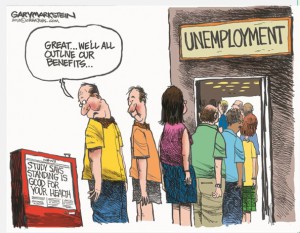
Michael Spence writes: High-priority items are fairly clear. In the short run, the top priority is income support for the poor and the unemployed, who are the immediate victims of crises and the underlying imbalances and structural problems, which take time to remove. Second, especially with rising income inequality, universal access to high-quality public services, particularly education, is crucial.
Inclusion sustains social and political cohesion – and hence the very growth needed to help mitigate the effects of rising inequality. There are many ways for economies to fall short of their growth potential, but underinvestment, especially within the public sector, is one of the most potent and common. Good and Bad Income Inequality
Revving Up Stalled Economies Worldwide
Stephen A. Roach writes: The latest slowdown in developed countries is not so easily dismissed. Lacking cyclical vigor in the aftermath of severe recessions, today’s economies are finding it especially difficult to shrug off the impact of shocks and break out of anemic growth trajectories. Consider the US. Though annual GPD growth is estimated to have rebounded to 4% in the second quarter of 2014, following the 2.1% first-quarter contraction, that still leaves average growth in the first half of the year at a measly 1%.
The problem is even worse in Japan, where consumers brought forward expenditures in anticipation of the sales-tax hike. The 6.1% first-quarter growth surge to which this gave rise was more than offset by a 6.8% second-quarter contraction. The net result in the first half of this year – an average decline of 0.3% – is broadly in line with the 0.2% contraction now estimated for the fourth quarter of 2013. With the trajectory of real (inflation-adjusted) growth having moved into negative territory, on average, for three consecutive quarters, Japan may once again be reverting to recessionary form. Stalled Economies Need Fundamental Repair
Why Banking is Boring in Japan
Dick Ehnts writes: Unprecedented monetary stimulus has cut the spread between lending rates and deposit rates at Mitsubishi UFJ Financial Group Inc. to a record low in the first quarter. Cash and deposits at the nation’s biggest bank and its two closest rivals piled to 82 trillion yen last quarter. Citigroup is considering a retreat from Japan after pulling back from retail banking in markets with low returns, including Spain, Greece and Turkey.
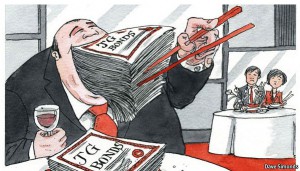
Difficulties making money probably have something to do with the weak demand for loans in Japan. For the last 20 years, the private sector has been reducing its liabilities. To make up for the shortfall in effective demand, government spent hundreds of billions of yen to keep the economy at somewhere close to full employment. Compared with what Spain and Greece are going through it has so far been a resounding policy achievement.
However, government bonds are boring for bankers, especially if the central bank buys them up and clearly fixes the prices (which it does anyway, but it is more obvious now in Japan then ever). There does not seem to be any indication that this will change in the near future, especially not after the unsurprising big dent to GDP growth after the latest tax hike.
George Soros has made almost $1 billion since November from bets that the yen would tumble, according to a person close to the billionaire’s $24 billion family office.
The Japanese wager helped the firm return about 10 percent last year and 5 percent so far this year. The yen has weakened 17 percent versus the dollar since about the start of the fourth quarter, the worst performance over a similar period since 1985.
With no further weakening of the yen in sight, bankers and central bankers in Japan might as well enjoy a vacation or two. Probably it would be their first since ‘the crisis’ which started in 1991. They could try to think about a new concept to describe what has happened to Japan and discuss existing economic theories in order to solve the countries economic woes. One hint: another tax hike is not a good idea. Another hint: it is not a problem of social justice or the budget.
China and Thailand Back on Track
Thailand is seeking more opportunities to collaborate with China, especially in the areas of rail transport, agricultural products and tourism, after months of political turmoil.
Phaichit Viboontanasarn, commercial minister at the Thai embassy in Beijing, said that plans for a high-speed rail line linking Chiangmai and Bangkok have been modified by the new Thai government, led by former army head Prayuth Chan-ocha. The railway will instead be a conventional line connecting Nong Khai in northeast Thailand with the capital. Phaichit said the country will gradually improve its national railway network and work closely with Chinese companies that have mature technology at prices lower than those of many international competitors.
Many parts of Thailand’s rail network are still single-track lines, and the government wants to improve the basic rail system first by building double-track lines and related facilities. Thailand is a large member economy of the Association of Southeast Asian Nations, which has 600 million consumers.
“With stable economic growth driven by tourism, modern manufacturing and agricultural development, Thailand will build its own high-speed railway system when the time is ripe, which will help us further enhance trade. China surely will be a big contributor to our high-speed railway sector,” Phaichit said.
Bilateral trade surged from $26 million in 1975 to $70 billion in 2013, and this growing trade has improved the service sectors including aviation, tourism and hotels. Bangornrat Shinaprayoon, director of the Tourism Authority of Thailand’s Beijing office, said: “Thailand is doing its best to reduce the negative impact of the political chaos and has shifted the government’s top priority to economic development, especially the tourism, agricultural processing, transportation, electronics and vehicle industries.” In the first seven months of this year, 2.22 million Chinese visited Thailand.
Bangornrat said that Thailand expects 4.3 million Chinese tourists this year. “Thailand has waived visa fees for Chinese tourists from August 9 to November 8 and opened eight customs channels for Chinese visitors at airports in Thailand,” Bangornrat said.