Federal Reserve Report on Small Business Loans

Key findings include:

Small firms report rising costs, including financing costs, as key growth challenge in 2013

  • Two in three firms experienced increasing costs of running their business and a quarter said it was their biggest growth challenge
  • Two in five firms reported increasing financing costs
  • The number of firms reporting being priced out of credit markets increased to 5 percent in 2013 from 3 percent in 2012

40 percent of firms applied for credit in 2013 – not a significant change from 2012

  • Lines of credit and business loans continue to be the most sought after credit products with 70 percent and 52 percent of applicants seeking each product respectively
  • While 39 percent of applicants sought credit to cover day-to-day operations, 30 percent sought credit to expand their business or make capital investments – a significant increase from a year ago

Firms continue to report small credit needs and high application costs

  • Most applicants sought relative small loans: 90 percent sought under $1 million and 51 percent under $100,000
  • Applying for credit is time consuming – on average firms spent 33 hours applying for credit, contacted three financial institutions, and submitted three credit applications

Overall approval rates remained constant from a year ago; credit market continues to be favorable for profitable and experienced firms

  • 58 percent of applicants received at least some of the credit they applied for in 2013 – not a significant change from 2012
  • 37 percent of credit applicants were profitable, down from 44 percent in 2012; however, 76 percent had credit experience, up from 69 percent
  • Experienced and profitable firms typically sought larger loan amounts, had higher approval rates, and faced unchanged or decreasing financing costs

Credit demand will remain strong in 2014

  • 37 percent of firms plan to apply for credit in 2014 and 17 percent have not made a decision
  • Applicant pool likely to increase: fewer firms reported having sufficient financing and being debt averse in 2013
  • More than half of unsuccessful applicants and non-applicants report interest in exploring new financing types and contacting new lenders

About the Small Business Credit Survey

The Small Business Credit Survey (SBCS) is a semi-annual survey of establishments conducted by the Federal Reserve Bank of New York’s Outreach Team, reporting information about business performance, financing needs and choices, and borrowing experiences. Responses to the SBCS provide insight into the dynamics behind aggregate lending trends and shed light on noteworthy segments of the small business credit market (as reported by borrowers). The SBCS captures the perspectives of businesses with fewer than 500 employees in New York, New Jersey, Connecticut, and Pennsylvania. Results are weighted to reflect the full population of small businesses in the four states of coverage.
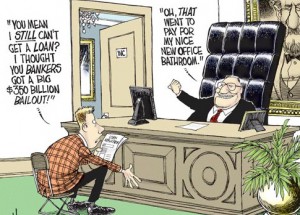

Small Business Loans

Synergy Beijing, Tianjin, Hebei Provinces

A leading team and office to promote the synergetic development of Beijing, Tianjin and Hebei province has been set up by China’s cabinet, with Vice-Premier Zhang Gaoli appointed director, people.cn reported on Aug 8.

Integration of Beijing with its two neighboring provincial areas will be speeded up after the creation of this office, said Hu Cunzhi, vice-minster of the Land and Resources Ministry.

The three regions are new engines that will boost China’s economy growth, said Xu Yaotong, professor of China National Administration School. The integration of these areas will get a substantial boost, he added.

Beijing, Tianjin and Hebei

China Stimulating Startups

The State Council, China’s cabinet, has decided to exempt 45 more items from central government approval to reduce intervention in the economy.
In a statement released Tuesday, the cabinet noted most of these items, either removed or devolved to lower levels, concern investment, employment and innovation. They include the verification of small companies for tax relief, approval of PhD research funds in higher education institutes and the approval of Web domain registration service providers.

Fewer approvals by the central government will give more power to local governments and freedom to enterprises, which is believed to stimulate vitality and creativity in the market and society.
The central government has cut or delegated to lower governments nearly 400 administrative approval items since the new leadership took office in March last year.
In Tuesday’s decision, the cabinet also canceled official certifications for 11 professions, covering a wide range of fields including international commerce, taxation, asset evaluation and land registration.

The statement said the move aims to lower the thresholds for employment, create a sound environment for talent development and further stimulate people’s passion for starting up businesses.

Cutting Red Tape

Women on Corporate Boards?

Some organizations, including the EU, make an economic argument for the integration of women in leadership. They say gender diversity better reflects a world where females make 70 percent of the economic choices and results in better decision making. Companies with three or more women on boards at least four or five years outperformed those with zero, according to the advocacy group Catalyst. Other research shows that company performance isn’t closely correlated with directors’ gender, and that awarding “golden skirts” for the sake of parity may compromise a board’s quality. (An academic analysis found that Norway experienced a drop in the value of its companies’ shares after its gender-equality mandate was enacted.) Advocates say women shouldn’t have to prove their impact to the bottom line to justify a seat at the table. In this view, it’s just the right thing to do.   Women on Corporate Boards  

Women on Corporate Boards

What Happened to Wall Street’s Tobacco Deals?


Politicians wanted upfront cash from a legal victory over Big Tobacco, and bankers happily obliged. The price? A handful of states promised to repay $64 billion on just $3 billion advanced.

In November 1998, attorneys general from across the country sealed a historic deal with the tobacco industry to pay for the health care costs of smoking. Going forward, nearly every cigarette sold would provide money to the states, territories and other governments involved – more than $200 billion in just the first 25 years of a legal settlement that required payments to be made in perpetuity.  What happened?  What Did Tobacco Companies Pay

Wall Street Seduction by Tobacco Bond


Eloquent Women Inspire

This collection of speeches by eloquent women can inspire, direct and comfort you, depending on your need.

Some surprises: Amelia Earhart

Profound and stirring as have been accomplishments in the remoter fields of pure research, it is in the home that the applications of scientific achievement have perhaps been most far-reaching, and it is through changing conditions there that women have become the greatest beneficiaries in the modern scheme….Although women as yet have not taken full advantage of its use and benefits, air travel is available to them as to men. As so often happens in introducing the new or changing the old, public acceptance depends peculiarly upon women’s friendly attitude. In aviation, they are arbiters of whether or not their families shall fly, and as such, are a potent influence. And lastly, there is a place within the industry itself, for women who work.


Brene Brown on vunerability:

“In order for connection to happen, we have to allow ourselves to be seen, really seen. And you know how I feel about vulnerability. I hate vulnerability. And so I thought, this is my chance to beat it back with my measuring stick. I’m going in, I’m going to figure this stuff out, I’m going to spend a year, I’m going to totally deconstruct shame, I’m going to understand how vulnerability works, and I’m going to outsmart it.”

And many more.

Woman at Podium

Bank of America Fines Total $70 Billion

BofA rewarded Mairone for creating Countrywide’s “Hustle” fraud by hiring her. So far that woman’s criminal expertise contributed toward mounting costs to BofA of $70 billion. Quite an accomplishment!
Her portrait ought to hang right next to CEO Ken Lewis’s at corporate headquarters as among the bank’s most costly mistakes in its history. As CEO, Lewis bought Countrywide for $4 billion, but the $70 billion of fines directly related to that purchase bring the direct cost up to $74 billion and counting.

As Bloomberg notes, Moraine’s Hustle program:

“lasted only nine months yet managed to write almost 30,000 subprime mortgages, which Fannie Mae and Freddie Mac bought for about $5 billion. Defect rates on stated-income loans (in which the borrower’s income isn’t verified) reached 70 percent.”

Mairone is now at JPMorgan, and one must wonder how much she’s going to cost that bank.

A Bloomberg editorial notes that these settlements provide no incentive to the Banksters to change behavior. First, they’ve insured themselves against their frauds, so insurance companies pay much of the fine. Second, while the fines sound big, they are peanuts compared to what the banks raked-in as they sucked wealth out of the housing sector. Banksters view this as a cost of doing (fraudulent) business. Third, at worst, stockholders suffer, not top management. Fourth, the Attorney General refuses to go after the top management, so none of those who actually benefited from the control frauds have been prosecuted for criminal activity. Indeed, they haven’t even been held personally liable for civil fines. And Fifth, all these negotiations and the settlement details are Top Secret-so no one really knows what was admitted. That is no way to make an example of fraudsters.

Mairone was the exception, and the judge in the case clearly meant to make an example of her. As Bloomberg reports:

“[Judge] Rakoff said the Countrywide loan-approval program was ‘the vehicle for a brazen fraud by the defendants, driven by a hunger for profits and oblivious to the harms thereby visited, not just on the immediate victims but also on the financial system as a whole.'”

Bloomberg goes on to argue that this case against BofA and Mairone disproves all the conventional arguments against prosecuting the fraudsters. It is often claimed that the cases will be too hard to win: they are too complex for juries to understand; or it is too hard to prove that individuals are culpable.

Bloomberg rejects all that:

“This case is the only one in which a large bank has had to defend its conduct in the housing boom, and it challenges the idea that bringing fraud prosecutions in this area is a hopeless endeavor. Apparently juries can cope with financial complexity after all. An assistant U.S. attorney explained what went on at Countrywide without needing to dwell on the arcana of collateralized mortgage obligations….

Other reasons, aside from complexity, have been advanced to justify the lack of prosecutions. One is that the U.S. government was itself involved because of its housing policies. The trial showed it was Countrywide, not a U.S. official, who told loan officers not to screen out risky borrowers and to fill their quota of applications before going home at night. It was Countrywide that rewarded bankers with the speediest approval rates, no matter how poorly underwritten their loans.

The idea that well-shielded executives can’t be implicated also got debunked. Testimony emerged that Mairone silenced and penalized bankers who complained about the quality of hustle loans. Rakoff is requiring Mairone to personally pay her $1 million penalty. Perhaps most important, the case suggests that midlevel employees could have been persuaded to give evidence against their seniors, enabling prosecutors to move up the chain….

The jurors in last year’s trial sent out a note during deliberations asking why more senior Countrywide executives weren’t being sued with Mairone. Many American taxpayers, homeowners and investors cannot be blamed for wondering the same thing.”

Exactly. Why isn’t Eric Holder going after the senior executives? Start with Bob Rubin, Hank Paulson, Bryan Moynihan, Ken Lewis, and Jamie Dimon. Seek prison terms on conviction. That would incentivize the banks.

How to Stop Fraud in Banking?


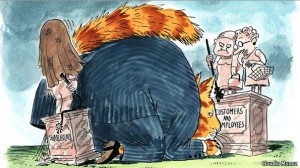
Should Shareholders Be Only One Stakeholder in a Corporation

Robert Reich writes: In recent weeks, the managers, employees, and customers of a New England chain of supermarkets called “Market Basket” have joined together to oppose the board of director’s decision earlier in the year to oust the chain’s popular chief executive, Arthur T. Demoulas.  Their demonstrations and boycotts have emptied most of the chain’s seventy stores.

What was so special about Arthur T., as he’s known? Mainly, his business model. He kept prices lower than his competitors, paid his employees more, and gave them and his managers more authority.  Late last year he offered customers an additional 4 percent discount, arguing they could use the money more than the shareholders.

In other words, Arthur T. viewed the company as a joint enterprise from which everyone should benefit, not just shareholders. Which is why the board fired him.

The Arthur T. business model pop up all over the place.  Pantagonia, a large apparel manufacturer based in Ventura, California, has organized itself as a “B-corporation.” That’s a for-profit company whose articles of incorporation require it to take into account the interests of workers, the community, and the environment, as well as shareholders.  The performance of B-corporations according to this measure is regularly reviewed and certified by a nonprofit entity called B Lab.

To date, over 500 companies in sixty industries have been certified as B-corporations, including the household products firm “Seventh Generation.”  In addition, 27 states have passed laws allowing companies to incorporate as “benefit corporations.” This gives directors legal protection to consider the interests of all stakeholders rather than just the shareholders who elected them.

We may be witnessing the beginning of a return to a form of capitalism that was taken for granted in America sixty years ago.  Then, most CEOs assumed they were responsible for all their stakeholders.

“The job of management,” proclaimed Frank Abrams, chairman of Standard Oil of New Jersey, in 1951, “is to maintain an equitable and working balance among the claims of the various directly interested groups … stockholders, employees, customers, and the public at large.”  Johnson & Johnson publicly stated that its “first responsibility” was to patients, doctors, and nurses, and not to investors.

What changed? In the 1980s, corporate raiders began mounting unfriendly takeovers of companies that could deliver higher returns to their shareholders – if they abandoned their other stakeholders.

The raiders figured profits would be higher if the companies fought unions, cut workers’ pay or fired them, automated as many jobs as possible or moved jobs abroad, shuttered factories, abandoned their communities, and squeezed their customers.

Although the law didn’t require companies to maximize shareholder value, shareholders had the legal right to replace directors. The raiders pushed them to vote out directors who wouldn’t make these changes and vote in directors who would (or else sell their shares to the raiders, who’d do the dirty work).

Since then, shareholder capitalism has replaced stakeholder capitalism. Corporate raiders have morphed into private equity managers, and unfriendly takeovers are rare. But it’s now assumed corporations exist only to maximize shareholder returns.

In retrospect, shareholder capitalism wasn’t all it was cracked up to be. Look at the flat or declining wages of most Americans, their growing economic insecurity, and the abandoned communities that litter the nation.

Then look at the record corporate profits, CEO pay that’s soared into the stratosphere, but the near meltdown in 2008 imposed collateral damage on most Americans).

You might conclude we went a bit overboard with shareholder capitalism.

Stakeholder Capitalism


US Attractive to Investors

Norton A. Schwartz and John K. Hurley write: The recent creation of a new international development bank by Brazil, Russia, India, China, and South Africa – the so-called BRICS – is just the latest challenge to America’s global leadership. But, from an international business perspective, the United States remains in a strong position.

Perhaps the best indication of America’s enduring stature is the dollar’s dominance in international financial transactions. Last year’s Foreign Direct Investment Confidence Index based on a survey of more than 300 executives from 28 countries, showed that, for the first time since the Iraq War began in 2003, foreign investors view the US as the world’s most attractive destination for future investment.

The ability to project power internationally begins at home. And, despite its historically slow economic recovery, there is plenty of reason for optimism in the US. Business in US is Strong 

Uncle Sam Flexes his Muscles

Where are the Women in the Food Business

You hear a lot about how women are underrepresented in fields like math and science, but the food world is also suffering from a staggering lack of ladies. Recently, the James Beard Foundation and the restaurant Vermillion hosted a panel discussion to address how few women there are in culinary leadership positions—and how the industry can better foster the advancement of women. Susan Ungaro, president of the James Beard Foundation, shared some pretty sobering information—namely that only seven percent of the people in leadership positions in the industry are women, even though more than 50 percent of culinary students are female.  Tips from the Top

Women in the Food Business