China Courts Africa with Solar Panels

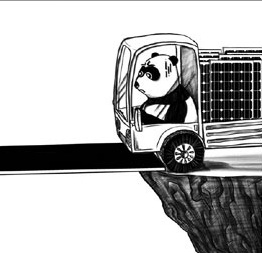
Chinese company JinkoSolar Holding Co Ltd on Tuesday officially opened a solar PV module production facility in Cape Town.  The plant is expect to produce 1,300 solar panels per day with a turnover of 600 million rand ($56 million) per year.

The solar panels, which are mounted onto the roof of a house or property, are expected to help in taking the load off the power grid of the state-run electricity utility Eskom, according to Morgan Peng of Jinko Solar, which is listed on the New York Stock Exchange.

Minister of Trade and Industry, Rob Davies welcomed the opening of this facility as part of his ministry’s drive to expand the capabilities of the South African manufacturing industry, to increase the country’s industrial base and create the much needed jobs in Cape Town.

Davies said the green economy has been identified as a key focus area in his department’s Industrial Policy Action Plan, and provides significant opportunities for job creation, localisation and economic growth.
Speaking at the launch, Western Cape Premier Hellen Zille said the company’s decision to open its first factory outside China in the Western Cape was good news for job creation.  “The reason I am excited is this plant will create 250 direct jobs. Other indirect jobs will be created, as we are not expecting jobs to be created within the plant only, but there will be more work created post production through installations,” Zille said.  Tthe Western Cape provincial government has forged a partnership with a local technology tertiary institution to send local students to China in a bid to train them.

China Brings in Solar Panels

China: Rising Wages and Low-Value Added?

Zhang-Monan writes on Project Syndicate: Last year, China ostensibly reached another milestone in its meteoric rise, surpassing the United States to become the world’s largest trading country, with its total trade turnover valued at CN¥25.83 trillion ($4.16 trillion). But this achievement is largely illusory – and should not be allowed to obscure China’s need to transform its trading model.

Since the 1990s, China’s has been building up its “proessing trade”– whereby it imports intermediate inputs from other countries, processes or assembles them, then exports them – causing the ratio of intermediate-product trade to overall external trade to grow rapidly. Intermediate inputs comprise around 28% of global exports, but 40% of China’s total exports. Given that traditional trade accounting is based on country of origin, the resulting global segmentation of value added and the multilayered international division of labor can distort trade figures.  How to Measure China’s Trade Figures

China Trade Situation?


Inequality Spread May be Even Larger Than Statistics Show

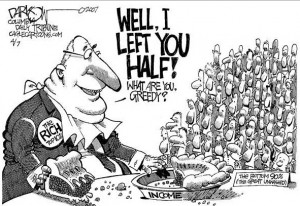
The one percent is literally rich beyond measure, depriving nations of billions in tax revenue and obscuring shifts in global inequality.

Research conducted separately by European Bank economist Philip Vermeulen and London School of econoics’ Gabriel Zucman show the weath of the super-affluent hidden by tax shelters and non responsive questionaires, is undercounted. Income inequality worse than reported

Income Inequality

Goldman Sachs Investigated for Alternative Trading

Goldman Sachs Group Inc. said it was being investigated for its U.S. alternative trading system and for the potential misuse and circulation of non-public information related to its corporate developments.

New York’s attorney general is investigating the alternative trading systems, also known as “dark pools,” run by Goldman and Morgan Stanley.  Goldman, in a filing on Thursday, did not specify who was conducting the investigation.

A unit of Goldman Sachs was fined in July over pricing rule violations stemming from its dark pool SIGMA-X.  Dark pools are broker-run trading venues that let investors trade shares anonymously and only make trading data available afterwards, reducing the chance of information leaking about trade orders.

Goldman also lowered its unreserved legal costs to $3.2 billion at the end of June from $3.7 billion at the end of March, it said in the filing.

 Dark Pool Trading

Are Americans Losing Their Interest in the World?

Lee Hockstader writing in the Pew Trusts Magazine says:  Between George Washington’s admonition to avoid alliances with other countries and John F. Kennedy’s pledge to support any friend and oppose any foe in liberty’s defense, Americans have been torn over their role and obligations in the world, practically from our nation’s birth. The isolationist impulse, never long dormant, has coexisted uneasily, and sometimes unhappily, with the muscular ambitions and restless idealism of a continental power whose interests and reach are formidable.

After a decade of foreign wars that has sapped the nation’s prestige and confidence, Americans are now in many ways more ambivalent than ever. Even as they want the nation to remain strong, well-armed, and engaged in trade and economic relations overseas, their appetite for an assertive geopolitical role is drastically diminished. Likewise, their faith in the country’s ability to project power has plummeted. Even as Americans worry about the threat posed by terrorist attacks, islamic extremists, the spread of weapons of mass destruction, and cyberwarfare, an unprecedented proportion of the public wants the United States to turn its gaze to domestic problems—quite literally, to mind its own business.

An America of two minds: That is the portrait painted by “America’s place in the World 2013,” the sixth edition of the Pew Research Center’s quadrennial survey of public attitudes on foreign affairs.    Is America Leaving the World Behind

US Imprint

China to Continue Monetary Policies to Shore up Economy

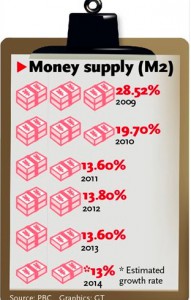
China’s central bank said on Wednesday that it will continue to implement a targeted approach in monetary policy in the second half of 2014 and shore up weak links in the economy.
More financial support will be provided to rural areas and small businesses to reduce their financing costs, according to a statement on the website of the People’s Bank of China.  It said it will accelerate work to establish a deposit insurance scheme in the coming months.

The statement came after a meeting between the central bank governor and heads of the bank’s branches across the country to review monetary policy in the first half and map out policies for the second.  The central bank also said it will strengthen monitoring of financial risks in key sectors and industries, and handle the risks in a timely manner to prevent regional and systemic risks.

Chinese Targets

Emma Fry Starts a Vegan Travel Company

When Emma Fry wanted to go on a vegan friendly holiday in Europe, she couldn’t find a company to help. It simply didn’t exist. So she decided to launch one (after riding her motorbike around Guatemala, drinking lots of coffee and overdosing on avocados).
Now, the 31 year-old (known to friends as ‘the vegan biker’) from Dorset, runs Veganbnb Travel and divides her time between Guatemala, Spain and the UK, where she runs foodie adventures for vegans, vegetarians – and just about anyone who’s interested in being happier and healthier.   Emma Fry Interviewed

Vegan Travel

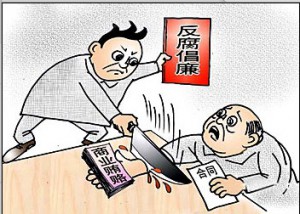
Fighting Corruption in China

Chinese President Xi Jinping’s anti-corruption campaign is the broadest and deepest effort to purge, reorganize and rectify the Communist Party leadership since the death of Mao Zedong in 1976 and the rise of Deng Xiaoping two years later. It has already probed more than 182,000 officials across numerous regions and at all levels of government. It has ensnared low-level cadres, mid-level functionaries and chiefs of major state-owned enterprises and ministries. It has deposed top military officials and even a former member of the hitherto immune Politburo Standing Committee, China’s highest governing body. More than a year after its formal commencement and more than two years since its unofficial start with the downfall of Chongping Party Secretary Bo Xlia, the campaign shows no sign of relenting.  Fighting Corruption in China

Fighting Corruption in CHina

US and Africa Business Forum in Washington DC

The US-Africa Business Forum brings together business executives and heads of state.  The event — part of the three-day U.S.-Africa Leaders Summit and co-sponsored by the Department of Commerce and Bloomberg Philanthropies — is the first such gathering.

There is reason to be optimistic that Africa may be at a turning point, given that seven of the 10 fastest-growing economies in the world are on the continent.  “This is not charity; this is self-interest” is how President Barack Obama described the new approach. In other words, growth in Africa can generate growth in the U.S.

The candor is refreshing. As the participants assemble, though, they should be mindful of the history of self-interested business dealings in Africa. While that history may be lost to Americans, Africans have a longer memory, and some sensitivity to past relationships may pay significant dividends for American business leaders operating now.

America has long traded with Africa. That’s the good news. The bad news is that for almost two centuries, the commercial connection was largely defined by the slave trade and the commerce it directly and indirectly generated, such as the shipment of sugar and the distillation of rum. Many merchants in New England built vast fortunes by shipping slaves to the New World until the cessation of the trade in 1808, accumulating enough capital to jump-start the U.S.’s industrial revolution.

After the end of the international slave trade, the era of “legitimate” exchanges with Africa commenced, as U.S. merchants, taking advantage of conflicts between European powers, managed to trade with west African countries, exchanging rum, tobacco, brandy and, eventually, manufactured goods in exchange for ivory, dyewood, gold dust and other natural resources.

The U.S.’s efforts to open markets in Africa were stymied in the second half of the 19th century. The problem lay with the European’s imperial conquest of the continent, which culminated in the Berlin conference of 1884-1885, when Europe’s powers effectively divided up the region, inaugurating a brutal period of exploitation that found fictional expression in Joseph Conrad’s “Heart of Darkness.”

Although the U.S. may have wanted a piece of the action and did what it could to profit from the mad scramble for African resources, it found itself shut out of trade with most of the new colonies, thanks to imperial trade protections. The Americans protested, with the U.S. Chamber of Commerce insisting in 1884 that places such as the Belgian Congo should remain “free from the interference or political control of any one nation.” But such entreaties generally fell on deaf ears, and American commerce in Africa dwindled.

By the early 20th century, the U.S. had managed to get a foothold in places such as South Africa, but in general, its trade paled compared with that of Britain. Moreover, it was lopsided. Americans, in other words, didn’t actually buy a whole lot from Africa. The continent was instead viewed simply as a dumping ground for U.S. products. In 1901, for instance, goods from Africa constituted a mere 1.2 percent of total U.S. imports. That figure barely budged in the succeeding years.

And actual direct investment in Africa was negligible, with the exception of Firestone’s investment in rubber plants in Liberia before the outbreak of World War II. Africa, when it appeared on the radar of U.S. businessmen, was a place to sell, not a place to make long-term investments. That job fell to imperial powers such as Britain, which had little interest in, say, setting up a competing manufacturing power in a colony.

The outbreak of World War II triggered a temporary spike in imports from Africa but little direct investment, a problem that would continue to loom large in the postwar era. South Africa’s finance minister complained in 1949 that “while American business has always been keenly interested in South Africa as a market, it has with a few notable exceptions neglected South Africa as a field of investment.”

Elswhere, the situation was worse. Investors steered clear of African nations for fear of losing assets to civil wars, nationalization campaigns and other perils that dominated the headlines in the 1950s and 1960s. (It didn’t help matters that the U.S. and the Soviet Union fought a series of proxy wars on the continent, further undermining investor confidence.)

In 1969, the book value of American direct investments in Africa was a paltry $2 billion. This was a drop in the bucket: The total book value of U.S. foreign direct investment at the time was $65 billion.

Trade imbalances remained a vexing problem throughout the postwar era. In 1979, Leopold Sedar Senghor, president of Senegal, called upon the Organization of Africa Unity to deal with the “scourges” afflicting Africa, in which “trade imbalances” ranked on par with apartheid, racial discrimination and “mercenarism.”

Business leaders now turning their eyes to Africa need to be mindful of precedent, particularly the tendency to view Africa only in terms of exploitation, not investment. Appeals to self-interest are appropriate in discussing business opportunities, but the attendees at this week’s conference should ensure that both sides’ “self-interest” gets equal representation going forward.

Doing Business in Africa


Business Lending Sluggish in US

Following the 2007–09 financial crisis, bank lending to businesses plummeted. Five years later, the dollar amount of bank commercial and industrial lending has finally surpassed the previous peak. However, despite very accommodative monetary policy and abundant excess reserves in the banking system, the spread of the commercial loan interest rates over the target federal funds rate remains above its long-run average. This suggests that business loans are not yet cheap relative to banks’ funding cost.  Simon Kwan of the Federal Reserve Bank of San Francisco

Bank Loans to Businesses in the US