No Diversity in Google Employment Stats

In a groundbreaking disclosure, Google revealed how very white and male its workforce is — just 2 percent of its Googlers are black, 3 percent are Hispanic, and 30 percent are women.

The search giant said Wednesday that the transparency about its workforce — the first disclosure of its kind in the largely white, male tech sector — is an important step toward change.

“Simply put, Google is not where we want to be when it comes to diversity,” Google Inc. senior vice president Laszlo Bock wrote in a blog.

The numbers were compiled as part of a report that major U.S. employers must file with the Equal Employment Opportunity Commission. Companies are not required to make the information public.

The gender divide is based on the roughly 44,000 people Google employed throughout the world at the start of this year. The company didn’t factor about 4,000 workers at its Motorola Mobility division, which is being sold to China’s Lenovo Group for $2.9 billion. The racial data is limited to Google’s roughly 26,600 workers in the U.S as of August 2013.

Facebook chief operating officer Sheryl Sandberg recently said the social networking company is headed toward disclosure as well, but it was important to share the data internally first.

Apple Inc., Twitter, Hewlett-Packard Co. and Microsoft Corp. did not respond immediately to queries about possible plans to disclose data.

Bock said Google has been working to diversify, not just its offices but in the broader tech sector. Since 2010, the firm has given more than $40 million to organizations working to bring computer science education to women and girls, he said.

The company also is working with historically black colleges and universities to elevate coursework and attendance in computer science, he said.

“But we’re the first to admit that Google is miles from where we want to be, and that being totally clear about the extent of the problem is a really important part of the solution,” he said.

Gender and ethnic disparities are reflected throughout the tech industry. About 7 percent of tech workers are black or Latino in Silicon Valley and nationally. Blacks and Hispanics make up 13.1 and 16.9 percent of the U.S. population, respectively, according to the most recent Census data.

In the coming months, Google said, it will work with the Kapor Center for Social Impact, a group that uses information technology to close gender and ethnic gaps in the Silicon Valley workforce. The center will be organizing a Google-backed conference in California focusing on issues of technology and diversity.

Co-founder Freada Kapor Klein, who started the Level Playing Field Institute 13 years ago to teach and mentor black and Latino students in science and math, said Google is showing leadership “which has been sorely needed for a long time.”

“Google is the company known for the moonshot, and applying that part of Google DNA to this problem is a breath of fresh air,” she said.

Earlier this year, the Rev. Jesse Jackson launched a campaign to diversify Silicon Valley, asking to meet with leaders of several iconic technology companies about bringing black and Hispanics into their workforce and leadership.

Since then, he’s been leading delegations to annual shareholder’s meetings at firms including Google, Facebook, eBay Inc. and Hewlett-Packard.

On Wednesday Jackson said Google is to be commended.

“It’s a bold step in the right direction. We urge other companies to follow Google’s lead,” he said. “Silicon Valley and the tech industry have demonstrated an ability to solve the most challenging and complex problems in the world. Inclusion is a complex problem — if we put our collective minds together, we can solve that too.”

Iris Gardner, a manager at nonprofit Code2040, which places high performing black and Latino software engineering students in internships with top tech companies, said Google’s disclosure could mark a pivotal moment in the push to diversify Silicon Valley.

“It is a big deal for them to be transparent about something that most companies haven’t in the past been willing to share,” she said

Not Google
Not Google


Fracking Will Go On, but Regulatory Vigilance is Needed


David Hasemyer reports: Between February 2010 and July 2011, Lisa and Bob Parr filed 13 complaints about air pollution from gas and oil operations near their ranch in Wise County, Texas. Sometimes they had trouble breathing, they told the Texas Commission on Environmental Quality (TCEQ). They also experienced nausea, nosebleeds, ringing ears and rashes.

Other families were also alarmed. Between 2008 and 2011, the TCEQ received 77 complaints from Wise County, in the Barnett Shale drilling area in North Texas. One said the odor was so powerful that the complainant “couldn’t go outside,” according to the TCEQ report.

Frustrated and angry, the Parrs decided to sue. Their attorney warned them that lawsuits against the oil and gas industry rarely, if ever, succeed. But the Parrs persisted and last month won what appears to be the first successful U.S. lawsuit alleging that toxic air emissions from oil and gas production sickened people living nearby. A Dallas County jury found that Aruba Petroleum, a privately owned company based in Plano, Texas, “intentionally created a private nuisance” that affected the family’s health and awarded the Parrs almost $3 million in damages.

“When you don’t have a strong regulatory system, a system to prevent what happened to this family, the only place left to turn for help is the courts,” said Robert Percival, director of the University of Maryland’s Environmental Law Program.

There are no assurances the verdict against Aruba will survive an appeal or lead to regulatory changes in Texas or any of the other states.  The issues are so complex that the industry, the public and policy makers may be sorting through them for years.

Aruba has asked Judge Mark Greenberg, who presided over the Parrs’ case, to reverse the jury’s verdict. Greenberg is expected to hear arguments over the verdict in June..

Aruba used two long-standing industry arguments in its defense: That the emissions could have come from one of its competitors’ wells, and that it was in compliance with Texas environmental rules.

The fact that those arguments failed in this case exposes every company to more possible litigation.

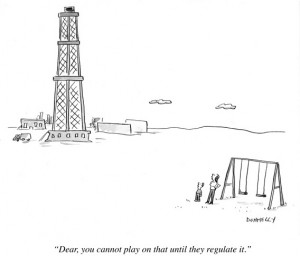
"Dear, you cannot play on that  until they regulate it."

“Dear, you cannot play on that
until they regulate it.”


Should Growth Cease to be the Goal?

George Monbiot writing in the Guardian:  Economic growth is an artifact of the use of fossil fuels. Before large amounts of coal were extracted, every upswing in industrial production would be met with a downswing in agricultural production, as the charcoal or horse power required by industry reduced the land available for growing food. Every prior industrial revolution collapsed, as growth could not be sustained(3). But coal broke this cycle and enabled – for a few hundred years – the phenomenon we now call sustained growth.

It was neither capitalism nor communism that made possible the progress and the pathologies (total war, the unprecedented concentration of global wealth, planetary destruction) of the modern age. It was coal, followed by oil and gas. The meta-trend, the mother narrative, is carbon-fuelled expansion. Our ideologies are mere subplots. Now, as the most accessible reserves have been exhausted, we must ransack the hidden corners of the planet to sustain our impossible proposition.

On Friday, a few days after scientists announced that the collapse of the West Antarctic ice sheet is now inevitable, the Ecuadorean government decided that oil drilling would go ahead in the heart of the Yasuni national park(5). It had made an offer to other governments: if they gave it half the value of the oil in that part of the park, it would leave the stuff in the ground. You could see this as blackmail or you could see it as fair trade. Ecuador is poor, its oil deposits are rich: why, the government argued, should it leave them untouched without compensation when everyone else is drilling down to the inner circle of hell? It asked for $3.6bn and received $13m. The result is that Petroamazonas, a company with a colourful record of destruction and spills(6), will now enter one of the most biodiverse places on the planet, in which a hectare of rainforest is said to contain more species than exist in the entire continent of North America.

The UK oil company Soco is now hoping to penetrate Africa’s oldest national park, Virunga, in the Democratic Republic of Congo(8); one of the last strongholds of the mountain gorilla and the okapi, of chimpanzees and forest elephants. In Britain, where a possible 4.4 billion barrels of shale oil has just been identified in the south-east(9), the government fantasises about turning the leafy suburbs into a new Niger delta. To this end it’s changing the trespass laws to enable drilling without consent and offering lavish bribes to local people.  These new reserves solve nothing. They do not end our hunger for resources; they exacerbate it.

The trajectory of compound growth shows that the scouring of the planet has only just begun. As the volume of the global economy expands, everywhere that contains something concentrated, unusual, precious will be sought out and exploited, its resources extracted and dispersed, the world’s diverse and differentiated marvels reduced to the same grey stubble.

A Sign of Growth

Continuing Education by Reading Books

The Australian Businesswomen’s Network invites their community to review books that have been helpful.  Since we have so little time, following someone else’s lead narrows the field.  Here are some titles that are suggested:
Launch by Michael Stelzner:  A whole new way of thinking about marketing.

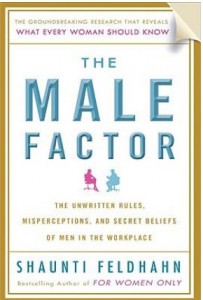
The Male Factor: The Unwritten Rules, Misperceptions and Secret Beliefs of Men in the Workplace by Shaunti Feldhahn.   She interviewed hundreds of men in corporations and asked them: What’s it really like to work with women? What she found out was eye-opening.

The Intention Economy: When Customers Take Charge by Doc Searls.
This book is for anyone who wants to understand the future around the Internet and the customer.

All these books are available from Barnes and Noble.  BN.com.

The Male Factor

Private Equity Funds Uses Debt to Become Oligarchs

Simon Johnson comments on a recent book by Eileen Appelbaum and Rosemary Batt.  He notes that only the very big funds can use debt to skew returns for insiders primarily because only they can raise the capital needed to buy well-established companies that are rich in fixed assets, and thus in potential collateral. Smaller private-equity funds typically buy into younger, smaller companies without such fixed assets, and the leverage in those deals is commensurately less.

Regulators have recently woken up to the incentives for excessive leverage in this sector – and to the risks that such leverage poses to lenders and the broader economy. Not surprisingly, big private-equity firms seem determined to ignore or otherwise circumvent new restrictions. As the policy debate on this issue heats up, one hopes that all participants will become better informed by reading Private Equity At Work.

Oligarchs

Inclusive Capitalism?

Lynn Forester de Rotchschild and Paul Polman argue for inclusive capitalism. 

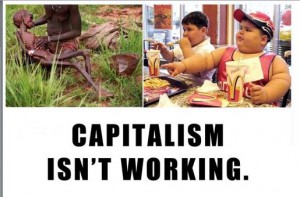
Capitalism has guided the world economy to unprecedented prosperity. Yet it has also proved dysfunctional in important ways. It often encourages shortsightedness, contributes to wide disparities between the rich and the poor, and tolerates the reckless treatment of environmental capital.
If these costs cannot be controlled, support for capitalism may disappear – and with it, humanity’s best hope for economic growth and prosperity. It is therefore time to consider new models for capitalism that are emerging around the world – specifically, conscious capitalism, moral capitalism, and inclusive capitalism.

Capitalism

Chinese Seize Opportunities in Africa

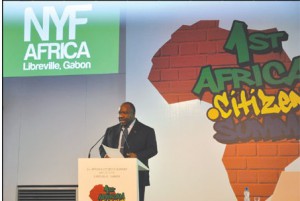
The New York Forum Africa has just met in Libreville, Gabon.  Chinese business interests were well represented.  China-Africa trade has grown rapidly in the past decade. In 2000, the bilateral trade between the two sides was around $10 billion, while in 2012 it topped $200 billion. Chinese foreign direct investments in African nations is expected to reach $50 billion by 2015, according to a report published by Standard Bank, a South African lender.
In March last year, Chinese President Xi Jinping visited Tanzania, South Africa and the Republic of Congo as part of his first overseas tour as president.
Earlier this month, Chinese Premier Li Keqiang made an eight day trip to Africa and visited Ethiopia, Nigeria, Angola and Kenya, as part of China’s efforts to expand economic ties with the continent. Li’s visit concluded with the signing of a number of deals on trade, energy, investment and development, including a call to expand cooperation in infrastructure and a pledge to increase Chinese aid to Africa by $12 billion (which includes $10 billion in loans and $2 billion for the China-Africa Development Fund).
In Kenya, Li signed agreements with Kenyan President Uhuru Kenyatta and other East African leaders to build a $3.6-billion, 380-mile railway line connecting Nairobi to the Kenyan port of Mombasa. Construction is expected to start in October and go on till March 2018 and will be part of a regional railway system that will extend through Rwanda, Uganda, Burundi and South Sudan. The Export-Import Bank of China will fund most of the project and the balance by the Kenyan government.
Attias says that China’s commitment to build infrastructure will help in forging long-term relationships with local communities in Africa.
“It’s important to understand the vision and strategies of the Chinese companies,” he says.
Wang Xiaoyong, secretary-general of China-Africa Business Council, says the railway agreement is an important milestone in Sino-African relations.
“Building the railway is a significant step for Kenya and other African countries. At the same time, it is also important for China to be part of this process and help in the actual construction,” Wang says.
According to Wang, constructing the railway line will involve not only financing and construction but also materials supply and vocational training of local workers. “Chinese investors can help on different fronts and it will help them build their reputation as investors in Africa,” Wang says.
Lankoande, the author of the book the political economy of China’s Foreign Direct Investments in Africa, says China stands out as an investor not by short term but “by long-term return on investment in Africa”.
“While oil and mining remain an important focus, Chinese investments are targeting sectors ranging from manufacturing to food. This diversification is very important for the African economy,” Lankoande says.  “I think the most important thing the Chinese investors can bring to Africa and make a difference is through technology transfer,” he says. “As we all know, China became a major player in technological innovation and it has several technologies that meet Africa’s needs, especially in terms of the features and cost,” Lankoande says.
Terming China, “a human resources power in the global market”, Lankoande says there is immense potential to create a win-win partnership with Africa in vocational training.
“China produces over 400,000 engineers every year, and this is huge compared to any other country in the world. These engineers can help make technology transfer from China to Africa a reality,” he says.
There are also opportunities for Sino-Africa technology transfer in natural resources also as Chinese engineers are facing the same development challenges that African engineers are striving to overcome, Lankoande says.
He says that most of the investment opportunities in Africa are still untapped. “Africa is the last frontier for growth,” Lankoande says. “Many African countries are generating wealth at a rate presently unmatched in any other part of the world and that makes them primary destinations for investment from all around the world.”
Opportunities with high return on investments exist in sectors such as infrastructure, manufacturing, agriculture and telecommunications, he says.
“Africa is a playground for ICT (information and communications technology) innovation, especially in the telecoms sector. With a mobile market of over 700 million people, Africa is definitely the place to be for any telecom company,” Lankoande says.
Chinese investors have already tapped into most of the industries including health, education, transport and storage sectors. There are now more than 1,600 Chinese development finance projects totaling $75 billion in more than 50 African countries.
Lankoande says Chinese investors are also facing challenges.  “These challenges are the political instability in some countries, macroeconomic instability, insufficient infrastructure and the lack of market insights.”

NYF Africa 2014  Gabon

Pfizer Acquisition of Astra Zeneca on Hold

The decision ends a month-long public fight between two of the world’s biggest pharmaceutical companies that sparked political concerns on both sides of Atlantic over jobs and corporate tax maneuvers.

Our US correspondents have raised the question of corporate taxes.  Clearly part of Pfizer’s interest in this merger is to move its headquarters to gain tax advantages.  Over and over we see American companies, who did 80 per cent of their business in the US, locating headquarters in countries that offer tax relief.

Is it time to ask whether we should remove corporate taxes altogether and just tax dividends.  Pressure to make the company look good often leads to these tax-motivated moves.  If taxes were not part of this calculation, would the government get more revenue of the holders of a company’s equity?  Worth asking, we think.

 US Corporate Tax Strategy

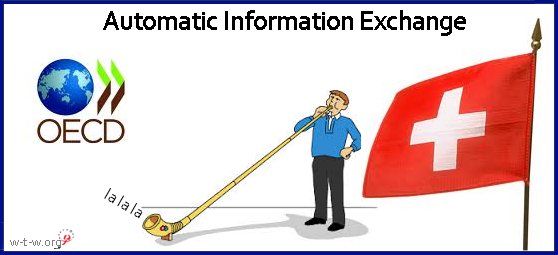
The Swiss and the OECD Automatic Information Exange

Two days after the Credit Swiss plea agreement, the Swiss Federal Council issued a statement making it clear what it thinks “the new global standard for the automatic exchange of information in tax matters” should look like.

The Swiss Federal Council is basically following the opinion of the Swiss Bankers Association (SBA) which was published on November 29, 2013.

Switzerland wants to portray itself in the domestic Fingerzeig
and international media as a clean, well-regulated and transparent financial centre that has broken with the historic haven for thieves and abusers.

However the Swiss Federal Council statement tells a different story. The Swiss statement is yet more evidence of what has been called a “circle the wagons” strategy, when under pressure from a world that’s moving forward, give ground only inch by inch, if at all, hold on to secrecy where possible – and particularly exploit the weaknesses of weaker and more vulnerable countries.

Multilateral negotiations with intransigent countries like Switzerland and Singapore are always more fruitful than bilateral. The Swiss government therefore plans to stick to a bilateral approach to AIE and engage in “cherry picking”

Switzerland wants to make sure it has maximum leverage over vulnerable developing countries and tries to exclude developing countries from AIE for as long as possible.

The Swiss government is not expecting any external resistance to this strategy of cherry picking. Neither the OECD nor the G20 have made a clear statement in favour of a multilateral approach to AIE. Nor have they asked for the inclusion of developing countries in such a multilateral approach. Nor have LIC/LDC (Low income countries/Low developed countries) governments made it clear that they wish to be included.

It can be expected that Switzerland, likely with the silent support of other rich nations, show what all this is really about: countries with which there are close economic and political ties will cooperate to not hurt each other economically, but that less fortunate countries of the world won’t benefit from this international drive against large-scale tax evasion.

In joining the OECD ministerial agreement, Switzerland and Singapore are suggesting that both countries would put an end to banking secrecy. In reality both countries are trying hard to cement the status quo which benefits their economies as well as international organized crime and money launderers.
Federal Council Press Release
The Swiss And The OECD Automatic Information Exange