European Privacy Rights Trump Big Data

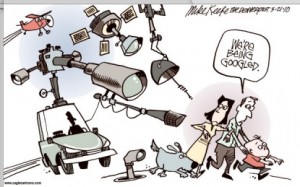
People should have some say over the results that pop up when they conduct a vanity search online, Europe’s highest court said Tuesday.  In a landmark decision, the Court of Justice of the European Union said Google must listen and sometimes comply when individuals ask the Internet search giant to remove links to newspaper articles or websites containing personal information. Campaigners say the ruling effectively backs individual privacy rights over the freedom of information.

Should US citizens be more sensitive to privacy issues?

Googled?


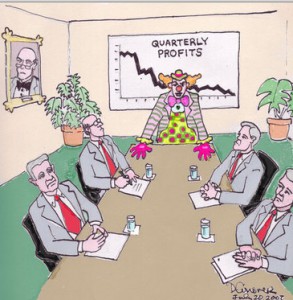
Boardroom Justice?

Lucy P. Marcus writes:  There is a real danger that corporate leaders, making decisions that seem correct behind closed doors, end up being tone-deaf in a soundproof room. It is clear that board members are often deeply disconnected from the world’s economic and social realities.
Consider executive pay packages. Board remuneration committees can explain them logically with complex formulas to justify them, and yet often they are completely out of line with common sense.
Board members need to rethink what they are doing in those rooms, and here individual directors’ guiding principle should be the “veil of ignorance” proposed by the political philosopher John Rawls in his 1971 treatise A Theory of Justice. Rawls proposed the veil of ignorance as a way to derive principles of social justice to which anyone who did not know in advance their identity and position in society would consent.
How would the veil of ignorance work in a boardroom? Board directors’ role is not simply to ensure return on investment; it is also to make decisions with due consideration for the community, employees, suppliers, consumers, and even the overall economy. The decisions made in that room have an impact beyond the company, so it is not just shareholders who hold board members accountable for their choices.
In order for board directors and senior executives to make judicious decisions, they cannot think only about whether they will directly benefit. As in Rawls, if we imagined that we did not know who we are or where we stand in society – whether we are rich or poor, male or female, young or old, CEO or shop-floor worker – our decisions would be more ethically grounded. The veil of ignorance changes the nature of the discussion on almost every issue, from executive pay, wage discrepancies, and working conditions to long-term strategy, succession planning, and much more.
Many issues that should be viewed through the veil of ignorance fall into the categories of environmental sustainability, social equity, and corporate governance. For example, if we didn’t know whether we would be working long days at a fast-food counter or overseeing the entire organization, we would think differently about compensation structures and the ever increasing gap between the most senior management and the most junior staff members. If we didn’t know whether we would be working on a factory floor in Bangladesh or in a shiny head office in the United States, no one would disavow responsibility for the health and safety of Bangladeshi workers.
The list goes on. If board members were making choices from behind the veil of ignorance –not knowing their position in the company – they would want everyone to have opportunities to implement change or be entrepreneurial. Not knowing whether they were male or female, they would ensure pay equity and better policies concerning parental leave and child care.
Likewise, knowing that they might be the customer would make them look differently at cost-cutting measures that weaken product testing and consumer protection. If they believed that they might live in a community affected by an oil spill, they would want robust, not minimal, environmental safety standards, and they would not seek to circumvent the rules.
There is a danger of taking this thought experiment too far. Getting caught up in factoring in all of the different perspectives would cause decision-making to gravitate toward the lowest common denominator, with outcomes that achieve very little for anyone. That is not the point. The point is to step outside of one’s comfort zones, distance oneself from the voices around the table that sound just like one’s own, and remember that board members are responsible for the direct and indirect impact of their decisions.
There is no doubting corporate directors’ responsibility for the growth and success of the company. But that responsibility also requires being thoughtful individuals who can see the bigger picture. Investors are more attuned than ever to companies’ social and environmental impact, and they are increasingly concerned about whether the companies in their portfolios are good corporate citizens.
If directors remind themselves each time they enter the boardroom why they are there, and pause for a moment to consider how their views would be affected if they did not know who they were, they would make better decisions for the company and for the entire system in which it operates. In this sense – and only this sense – ignorance in the boardroom is the right approach.

Closeted Boardrooms


The Gender Pay Gap

Harvard economist Sendhil Mullainathan writes:  It’s 2014, and women are still paid less than men.  Yet academically, girls have not merely caught up with boys in performance: they have overtaken them.

Boys actually underperform in school in the first place. The prime suspect for this underperformance is boys’ shortage of what social scientists call noncognitive skills. They have trouble sitting still, focusing and exerting self-control.

Employers demand these same noncognitive skills. Those that it takes to succeed in college — time management, writing ability, structuring tasks on your own, working in teams — are also needed in the modern workplace.

There are two reasons to believe that the trend seen in schools may not translate to the workplace. First, some evidence points to other gender differences in psychology.  Men fare better in competitive environments, in part because they are more confident and men show less risk aversion.

These differences — competitiveness, overconfidence and risk-seeking — could conceivably have greater benefits in the workplace, at least in some jobs, than they do in school.

A second factor is that jobs and society are still structured for traditional gender roles. Family commitments and household responsibilities will not disappear.

For the gender gap to reverse, these norms — or, at least, women’s responses to them — would have to change. Ms. Bertrand notes that in Asia, “where gender norms are particularly strong, successful women are opting out of traditional family structures to focus on work.” Rates of marriage and fertility are particularly low for successful Asian women. Of course, this may not be the way we would like to see norms change.

Maybe we shouldn’t be asking when women will catch up. Maybe they’ve already caught up, and we should instead ask whether society is holding them back.


Silvio Berlusconi’s links with Italian organised crime confirmed

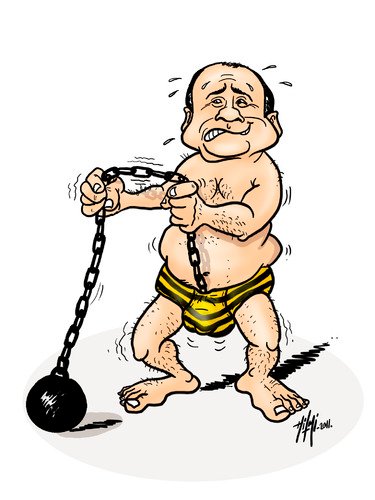
Silvio Berlusconi – Italy’s former Prime Minister and one of the world’s most recognisable politicians – did business with the mafia for nearly two decades.

That is the conclusion of the country’s Supreme Court of Cassation in Rome. The billionaire tycoon, nicknamed the Teflon Don, worked with Cosa Nostra, the Sicilian Mafia, via his conduit and former senator Marcello Dell’Utri after judges sentenced Dell’Utri to seven years for mafia association.
Silvio Berlusconis links with Italian organised crime confirmed

Hilmi Simsek

Hilmi Simsek

Will Carbon Pricing Be A Reality by 2020?

Lili Fuhr and Johnny West write:  Most oil contracts are structured so that the investor recovers costs first, with the remaining profits then divided between the producer and the government that granted it the concession. This means that, if carbon pricing reduces oil’s profitability, as intended, the loss in government revenue could be larger than the drop in overall profits.
Making matters worse, the details of these agreements are largely hidden, thereby preventing citizens from holding their governments accountable, which in turn undermines democracy and facilitates corruption.
To remedy the situation, ongoing efforts to increase transparency should go beyond revenue flows – which are set to face new transparency requirements in the United States and the European Union – to include contracts. Once a contract is public, future carbon-pricing scenarios can be modeled to demonstrate that most governments will earn less than they expect and, more important, that many potential projects and new discoveries could become stranded assets.

Carbon Pricing

Shadow Banking’s Impact in China

In the US , it was shadow banking that brought the economy down in 2008.  Securitized mortgages with meaningless ratings were bought by banks without a second thought.  When Bear Sterns crashed, it took banks with it.  Jamie Dimon of JP Morgan Chase may have gotten a “Stay Out of Jail” card because he bought Bear Sterns in response to a US government request.

Can the banks and the core economy operate without engaging shadow banking?  And do they want to?

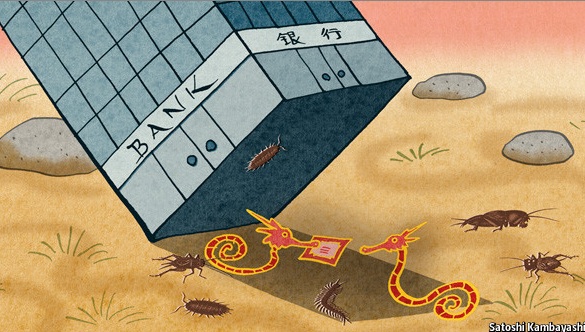
The Economist has taken on shadow banking this week, and points out one significant difference between China and other countries.  Shadow banking institutions are regulated by the same agency that supervises banks, the China Banking Regulatory Commission (CBRC). This means the CBRC can tell not only whether shadow banking institutions are themselves are wobbly, but also how any wobbles would affect banks.  The CBRC and other regulators have recently strengthened oversight of shadow banking , requiring clearer accounting and limiting dealings with banks.  Shadow banking in China

Shadow Banking in China

Indian Drug Companies May Benefit from US Generic Drugs Policy

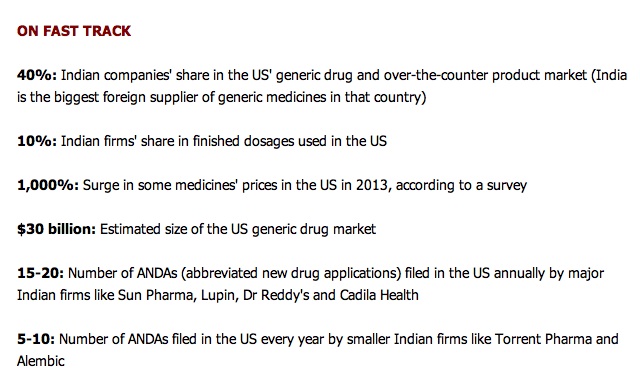
Sushmi Dey writes;  Indian drug makers, slammed for months in the US over issues related to quality and intellectual property rights, might soon get to breathe easy. The US regulator is set to expedite from October the approval process for generic drugs by lowering the application scrutiny period from three years to 11 months.

This is expected to translate into major gains for domestic drug makers like Sun Pharma, Lupin, Glenmark, Dr Reddy’s Laboratories, Cadila Healthcare and Torrent Pharma, which have a significant presence in that country’s $30-billion generic drug market.

According to a survey by America’s National Community Pharmacists Association, prices of some of the medicines spiked more than 1,000 per cent in 2013.

The US Food and Drug Administration’s (US FDA’s) proposed move to fast-track clearances to generic drug applications from October is aimed at bringing in more products to the market, so that more competition governs prices, says sources and industry officials in the know of the latest developments.

However, foreign generic drug makers like Teva, Mylan and Sandoz, which already have a considerable presence in the American market with extensive product pipelines across segments, are likely to face competition with other generic players entering early and vying for larger market share.

“Early penetration of more generic players will also allow faster price erosion. That will help bring down healthcare cost in favour of Obamacare, but might hurt existing players’ interests,” the senior executive said.

Indian companies, which account for 10-12 per cent of the total US generic market, will also benefit from the move because these companies have been paying hefty fees to the regulator since 2012 while applying for generic drug approvals there. However, instead of expediting approvals, US FDA prolonged the clearance time for applications to be filed before 2017. This disappointed generic drug makers, which planned to launch products during the patent cliff.

During US FDA Commissioner Margaret Hamburg’s visit to India earlier this year, representatives from domestic companies like Sun Pharma, Ranbaxy, Cadila Health and Torrent Pharma had also raised the issue of delay in product approvals hurting their revenues.

Also, generic drug makers were concerned that once they applied for approvals, their products were vulnerable to potential patent infringement litigation, which might add to their cost, while sales of these products were yet to take off.

Given that India is the largest foreign supplier of generic medicines to the US, which in turn is the biggest market for domestic companies, faster generic drug approvals will help both sides.

Industry estimates show, major domestic drug makers like Sun Pharma, Lupin, Glenmark, Dr Reddy’s and Cadila Health annually file 15-20 generic drug applications each. Even smaller companies like Torrent Pharma and Alembic file five to 10 ANDAs every year.

India and Generic Drugs

The Impact of China’s Banking Sector

Adair Turner writes:  Improved market discipline in China does have an important role to play in addressing the structural causes of imbalance. Wasteful construction investment is encouraged by the under-pricing of rural land. The lack of a normal ownership relationship between the central government and state-owned enterprises (SOEs) allows the latter to pay minimal dividends and over-invest in business expansion. Caps on interest rates on bank deposits result in household savers supplying a large subsidy to corporate borrowers. And SOEs have better access to credit from state-owned banks than private companies do.

Two distinctively Chinese factors and one inherent feature of all banking systems interact.  The first Chinese factor is the authorities’ focus on “urbanization” as an end in itself, rather than as a byproduct of industrialization. The second is China’s decentralized approach to economic development, with strong competition between regions and cities often focusing on prestige urban infrastructure projects.

Chinese Banking


Some Shareholders Protest Credit Suisse Compensation

Jonathan Weil reports:  Proxy advisers, like anyone else, can get pretty emotional. Take Dominique Biedermann. He runs Ethos, the largest proxy adviser in Switzerland, which recently recommended that Credit Suisse Group AG shareholders reject the bank’s compensation plan.

“It is shocking that management compensation has been increasing ever more for two consecutive years,” Biedermann said.  “It is high time to show the board of directors that many shareholders have lost their trust in them. We are no longer willing to support the way our bank is being managed.”

Ethos’s clients hold 3 percent of Credit Suisse shares.

Last year, Brady Dougan, the Credit Suisse chief executive officer, received a 26 percent pay increase to 9.8 million Swiss francs ($11.1 million). And for what? Well, if the Justice Department has its way, Credit Suisse or a subsidiary may soon have to plead guilty to criminal charges because it got caught helping thousands of wealthy Americans evade their taxes. And pleading guilty requires a lot of hard work. So maybe that explains it.

Dougan also gets bonus points for claiming to be unaware of any such activity while it was going on, notwithstanding that he joined Credit Suisse in 1990, has been on the bank’s executive board since 2003 and has been the CEO since 2007. As he told the U.S. Senate Permanent Subcommittee on Investigations: “While that employee misconduct violated our policies, and was unknown to our executive management, we accept responsibility for and deeply regret these employees’ actions.”

According to the Senate panel’s report, Credit Suisse employed 1,800 bankers in eight different areas of the bank to open and service Swiss accounts for U.S. clients. Yet heavens no, Dougan had no inkling that some of those clients were using Swiss bank accounts to hide money from the Internal Revenue Service.  Eight-one percent of the shareholders backed Credit Suisse’s compensation plan in a non-binding vote at the company’s annual shareholder meeting in Zurich.

There is much we can learn from this vote: 1) Credit Suisse shareholders don’t care if the bank committed crimes. 2) They don’t care if the bank pleads guilty to criminal charges, because it’s not as if the Justice Department is going to try putting Credit Suisse out of business. 3) They appreciate the raw skill and talent that are necessary for a CEO to both run a Swiss bank and stay oblivious to the widespread tax evasion going on around him.

It has been almost three years since the Justice Department first told Credit Suisse that it was the target of a criminal investigation. The bank spent the intervening years dragging out the probe. It delayed handing over information, hiding behind Swiss bank-secrecy laws. Meanwhile, its Swiss rival, UBS AG, signed a deferred-prosecution agreement with the Justice Department’s tax division in 2009, paid $780 million and got the matter over with.

If Dougan had been smarter about this, Credit Suisse almost certainly could have settled this case without the bank having to plead guilty to anything. But now the times and prosecutorial fashions have changed. After years of handing out deferrals and non-prosecution agreements like candy, the Justice Department is looking to make an example of a big bank (preferably a foreign one) and convince the American public that large financial institutions can’t break the law with impunity. Credit Suisse may become that poster child. And it all happened on Dougan’s watch.

The Future of Credit Suisse

Swiss Money Manager Sings to Avoid Criminal Charges in US

Our correspondent Andreas Frank writes:  Swisspartners Group, a Zurich-based money-manager, resolved a U.S. criminal tax probe by paying $4.4 million for helping American clients use secret accounts to evade taxes. In return, the government agreed not to prosecute the firm, citing its “extraordinary cooperation.”

The agreement resulted from Swisspartners’ voluntary production of the files for about 110 U.S. taxpayer clients, according to the Justice Department and Manhattan U.S. Attorney Preet Bharara.

From about 2001 to about 2011, according to a Justice Department statement, Swisspartners helped its U.S. clients open and maintain undeclared foreign bank accounts, which allowed them to avoid paying taxes in full.

“Swisspartners avoided criminal charges “as a direct result of its decision to self-report misconduct”, U.S. Attorney for the Southern District of New York, Preet Bharara said.

Swisspartners Group voluntarily took steps in 2008 to stop helping U.S. clients evade income taxes, according to papers filed today Manhattan federal court. Four years later, the firm, although not under investigation, reported its conduct to U.S. officials, according to the government agreement.

Swisspartners Group acknowledged it knew some U.S. clients were maintaining undeclared foreign bank accounts with its assistance in order to evade taxes.

Swiss Songbird

The firm has agreed to continue to cooperation with American prosecutors for at least three more years. If the government determines the firm has violated terms of the agreement it can face prosecution, according to the agreement.

As part of the accord, the money manager will forfeit $3.5 million, representing the fees it earned for the services, and $900,000 in restitution, according to court documents.

The Swisspartners deal, called a non-prosecution agreement, includes four Swisspartners entities: Swisspartners Investment Network AG, Swisspartners Wealth Management AG, Swisspartners Insurance Company SPC Ltd. and Swisspartners Versicherung AG. The agreement “does not apply to any other subsidiaries of Swisspartners Investment Network AG or any individuals” not named.

Insurance company subsidiaries of Swisspartners based in the Cayman Islands and Liechtenstein were also parties to the non-prosecution agreement with U.S. authorities, suggesting U.S. investigators may also be looking at the role of foreign insurance companies in helping Americans to evade taxes.

Related Reports: frank-cs.org