Gender Equality in the US Army

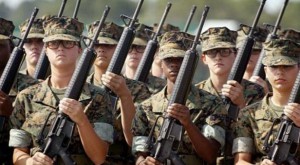
Anna Mulrine writes The secretary of Defense has ordered the Pentagon to let women serve beside men on the front lines of battle. Now, one year into the experiment to decide if that’s possible and how to do it, the military is already learning some unexpected things about how women adapt and how men interact with them. It is also highlighting some cultural differences between different branches of the military.

Under the Defense secretary’s order, each of the services must be ready to open all combat jobs to women by January 2016 – or come back with a marked reason why they shouldn’t and ask for an exemption.

To do this, the Pentagon has launched a grand plan to develop “gender-neutral standards” that involve breaking down precisely what it takes to be a warrior in the modern military. After this, military officials say, they will decide whether women – and some men – are capable of doing the job.

The Army is already opening up more than 33,000 jobs to women this spring and is “going full steam” in preparing to bring female soldiers into all other combat specialties, says Maj. Gen. Mike Murray, commander of the 3rd Infantry Division, whose soldiers are taking part in the study at Fort Stewart.

US Army

Thailand Facing Trade Sanctions Over Human Tracking

In a few weeks, Thai diplomats and officials will be hard pressed to explain the kind of progress, if any, the country has made in addressing the issue of human trafficking.  A United States government report, on the Trafficking In Persons (TIP), could potentially affect bilateral relations between Thailand and the US and will be released next month.

US law requires that its State Department rate nations across the world with regard to human trafficking. Countries rated in tier one fully meet minimum standards while tier two nations do not meet the minimum standards but are making an effort.

Tier three countries, on the other hand, do not meet the standards and are not showing any signs of trying to make a meaningful effort. What concerns many Thai officials is that tier three countries, which could very well include Thailand, face the threat of sanctions by the US government.

At the discretion of the US president, Thailand has received a waiver from such punishment and allowed to remain in tier two for past two years. But time is up and Thailand is hard pressed to show that progress has been made.  Judging from the previous report, in which Thailand was accused of slow progress in prosecuting trafficking-related cases, there is a real chance that the country could be rated down.

A few days ago, a US Congressional panel reminded us how bad Thailand’s performance and image is with respect to poor treatment of the Rohingya. The hearing in Washington DC was on “Effective Accountability: Tier Rankings in the Fight against Human Trafficking Lessons”.

Representative Chris Smith, chairman of the House Subcommittee on Africa, Global Health, Global Human Rights, and International Organisa-tions, listened to testimonies about how Thai government officials were involved in the trafficking of Rohingya.  Smith is not just another lawmaker. He is the author of the landmark law, the Trafficking Victims Protection Act of 2000, that created this three-tier system of reward and punishment for countries that do not comply with the requirements.

Human Trafficking


Inclusive Banking in India

Business Standard editorial comment on banking inclusiveness:  Perhaps on no issue have the finance ministry and the Reserve Bank of India (RBI) been in concordance over the past several years – except for financial inclusion. From the target of a banking presence in villages with a population of over 2,000 to the motivation to expand the banking sector by issuing new licenses and a host of other goals and initiatives, the agenda has taken centre stage, culminating in the Nachiket Mor committee’s report submitted to the RBI a few months ago. It might have been expected that the core recommendations of the report would have received priority attention from the RBI and the government with a view to initiating implementation wherever possible, while putting in place the supporting ecosystem for the more far-reaching ones.

Considering the importance that Governor Raghuram Rajan attaches to the agenda, one of the five pillars on which he is building his financial stability and development strategy, there were expectations of a big push based on the report. However, what seems to have come in the way are reservations expressed over their implementation. The new institutional model that is being proposed in the form of payment banks as a way to expand reach and access quickly apparently raises questions about appropriate prudential norms and, more importantly, the capacity to supervise and monitor them effectively. As is prone to happen in government, this process can continue endlessly, resulting in the whole initiative being stalled or, at best, implemented piecemeal, with no significant impact.  On the face of it, there is little question that mainstream commercial banks are pushing inclusion because they are mandated to, not because they see great opportunities in it. In whatever shape or form, other institutions must play a key role in the process. Whether as suggested by the Mor committee or in any other avatar, these will pose regulatory and supervisory challenges to the RBI. Either way, the bullet has to be bitten and it might as well be now rather than later.

Indian Banks

Measuring Economic Growth

Kemal Dervis sees different measure in the future.  Economic growth is going to slow in developed and emerging economies, in part because technological development will slow.   New technologists however argue that technology will bring us to the fourth industrial revolution with robots and intelligent machines making huge productivity increases possible.

If capital is becoming a substitute for all but the most highly skilled labor, and educational institutions are having a hard time training enough highly skilled workers for the future, the inequality between the highly trained and all other labor will worsen.

Climate change and natural resources constraints may also impede long term growth.

As these issues move to the top of policy agendas, growth defined as aggregate GDP and calculated on accounts invented a century ago may become less and less relevant.

Automated Maid

India’s President Describes Money Laundering As A Global Menace

Andreas Frank reports: President Pranab Mukherjee today asked Enforcement Directorate President Pranab Mukherjeeto achieve greater efficiency and cooperate with concerned international agencies to expedite steps to bring back “stolen assets spirited abroad”.
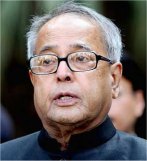
Mukherjee made this veiled reference to blackmoney during the second ‘Enforcement Day’ function organised by the Enforcement Directorate (ED).

The meeting was attended by President of the Financial Action Task Force (FATF) Vladimir Nechaev and Federal Office of Justice Swiss Confederation Mario Michel Affentranger among others.

“The Directorate should aim to work out modalities with international partners so that action with regard to restoration of stolen assets spirited abroad is expedited,” he said and asked it to interact with multilateral fora like FATF, the Eurasian Group on Combating Money Laundering and Financing of Terrorism (EAG) and the Asia Pacific Group on Money Laundering (APG).

He said the cooperation needs to be optimally utilised by the ED for bilateral exchanges and follow up with counterpart enforcement agencies for better mutual cooperation on Anti Money Laundering (AML) and Countering the Financing of Terrorism (CFT).

He also called for an international cooperation to tackle cross-border money laundering and terror financing so that a more “business friendly” legitimate investments flow into the country.

“Effective measures against Money Laundering and Terror Financing are essential in today’s global economic and security environment, and these are rightly being addressed on priority by most countries.

“Such measures also foster a more business friendly setting and facilitate legitimate investments and financial flows,” the President said at the function which was also attended by Revenue Secretary Rajeev Takru.

The President said India too has put in place a strong Anti Money Laundering legislation, the Prevention of Money Laundering Act (PMLA) to counter the menace.

“I also had the privilege of introducing in Parliament the Amendment Bill 2011 of the PMLA, through which, our nation strengthened the money laundering legislation, in line with the Recommendations of FATF,” Mukherjee said while recalling his days as the Union Finance Minister.

He drew attention about the presence of Affentranger and said it underlines the growing bilateral cooperation on law enforcement matters between Switzerland and India, as also the partnership between the counterpart agencies.

“Money laundering is a global menace, and law enforcement agencies of all countries have to cooperate to fight it,” he said.

India has been pressing Switzerland to give details of some Indians having money in the banks in that country but the Swiss authorities maintain they would be furnishing details of cases only after 2012 when Direct Tax Avoidance Treaty came into effect.

Switzerland does not cooperate in the matter of stolen data:

Swiss ambassador to India Linus Von Castelmur said his country could not cooperate in the matter as it related to stolen data, days after finance minister P Chidambaram sent a fresh letter to Switzerland pressing authorities to share information on Indian account holders in the HSBC Geneva list,

Swiss authorities had written to the finance ministry recently refusing to share data on the HSBC list. Following this, the FM had sent another letter – the third in four months – requesting Swiss authorities to expedite the matter.

The HSBC list had been given to India by French authorities who had obtained it from a disgruntled employee of HSBC. Switzerland has recently passed a law easing norms for sharing information of Swiss bank account holders with other countries. However, it does not cover stolen data.

Speaking at a function organized by Enforcement Directorate, Castelmur said, “We still have this position in our law that says that so-called stolen data cannot be used. I know India has not been stealing these data and they were given to Indian government by another European government but at the very beginning there was an act of robbery and obviously that is something that is disturbing.”

He said there has been stiff resistance in Swiss parliament on the issue of sharing of information on stolen data and though the matter was moving forward India would have to be patient. “Talking about taking time in India, you must be sympathetic to that because when I look sometimes to the speed, the pace of Indian judges and tribunals, I am sure you will give us another couple of months, even years,” he said.

Interestingly, tax authorities in India have already realized Rs 200 crore in taxes from account holders mentioned in the list and most accounts have been investigated.
GOV_Mukherfjee_Speech_1.5.14
Save India From Corruption

9 Million Pounds of Diseased Beef Recalled in US

A brave employee called the federal inspectors and in a raid, they found diseased body parts cut away from carcasses and federal approval stamps home-made for Rancho Feeding Corp. in Petaluma, California.  Earlier this year, a dusty little slaughterhouse in Northern California was ground zero for one of the biggest meat recalls in years.  The story of how millions of pounds of bad meat — products the U.S. Department of Agriculture called “unfit for human food” — made it out into the world and triggered a criminal investigation is one of staggering deception and cancerous cows,

 Whistleblower

Microfinance for Women in India

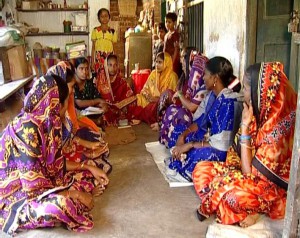
The Indian subcontinent was the first place where modern microfinance, at the time called “micro credit,” really became a phenomenon. While small scale lending has been going on for centuries, it was in the 1970s that Muhammad Yunus began to put together ideas which eventually led to the Grameen Bank being established in Bangladesh. The Bank, which provided small loans to extremely poor group borrowers, has been marked out by its success (leading eventually to it being awarded the Nobel Peace Prize in 2006, and by the fact that the vast majority of its borrowers (who are also its shareholders) are women.

When India’s finance minister, Palaniappan Chidambaram, announced his budget on the last day of February, one particular item stood out for those familiar with microcredit; that was the nearly $185 million appropriated to establish a small public bank for the poor run by and for women.

India already has several institutions which perform a similar task to the one described by Chidambaram. The Mann Deshi Mahila Sahakari Bank is a rural cooperative bank specializing in microfinance loans to women. Others, such as the MahilaSewa (Self-employed Women’s Association) Cooperative bank, perform similar functions. Some have argued that such co-op banks are more effective than public banks in performing such a role (lending to women, alleviating extreme poverty.)

Microfinance enterprises can also potentially be very profitable undertakings as excess urban capital is redirected to credit starved rural areas. Although traditional bankers who have become accustomed to talking millions or billions might doubt the impact a few hundred dollars can have, but the “bottom billion” effect makes this area one with huge potential.

For really small scale microcredit to work, some of the traditional tools of finance, such as credit history checks and requirements for collateral, have to be discarded. This naturally makes many bankers weary, and yet there are cases such as those highlighted above where genuine benefits can be achieved without the system collapsing into “charity disguised as something else.” Problems with credit history for example, (in the case of Grameen Bank), were dealt with by the institution adopting a “group lending” approach, capitalizing on the close sense of community in small rural villages.

Microfinance for Women in India

Lessons for Ukraine from Poland

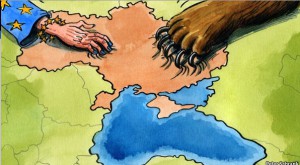
Erik Berglof, chief economist for the European Bank for Reconstruction and Development, comments on Ukraine’s position visa vis the EU.  He notes that Poland was a corrupt as Ukraine is now when the Iron Curtain first came down.  Now Poland is three times richer than Ukraine and Poland’s income gap with Western Europe is smaller than it has been since 1500.

Since the EU’s GDP is eight times greater than Russia’s it somewhat surprises that their trade relations continue.   Because both Poland and Ukraine are neighbors and enmeshed in industrial networks with Russia, exports continue.  The difference.  The EU has helped Poland.

The painstaking approximation of EU rules and regulation that helped Poland become a normal European country by the late 1990’s would offer Ukraine the prospect of taming its own demons of bribery, cronyism, and nepotism.

The EU and Russia

An Indian State Proposes to Sell Iron Ore Mines

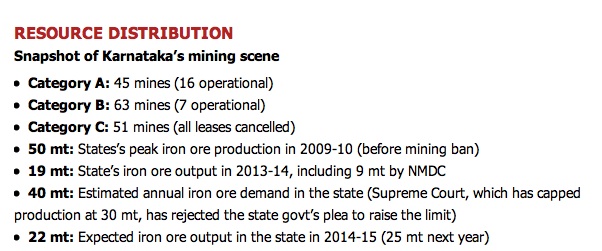
Malash Kulkarni writes:  In a court order on April 18, 2013, iron ore mines in the state of Karnataka south of Mumbai were classified in three categories. “C” signified large scale violations of the mining rules.  Fifty-one mines in this category had their leases cancelled and are up for sale to end-users.  End-users have the capacity to make use of the ore by breaking it through chemical reduction processes to final products which include pig iron, sponge iron and steel, but exclude pellets and the extraction of minerals and gangue.

The auction of mines is likely to benefit ‘end-users’ like JSW Steel, Kalyani Steel and BMM Ispat, which do not have captive iron ore mines and depend on e-auction of iron ore for their raw material requirements. As new mining leases are unlikely to be given out in the state in the near future, auction of mines could give steel mills a big opportunity to acquire the natural resource.

Karnatake Mines

A New Asset Class for Infrastructure Repair and Development

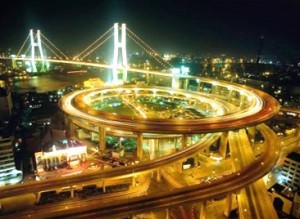
Justin Yifu Lin and Kevin Lu argue the importance of private financing for infrastructure, which contributes to growth in China and many sub Saharan countries.

Infrastructure projects should have a new definition, considering: a link between the internal rate of return and the economic rate of return.  Private-sector sponsors should be given space of initiate valuable projects.  The political risks of public-sector involvement and the lower return from infrastructure relative to private equity.

Infrastructure projects demand special technical expertise.  To make their projects more efficient and cost-effective, specially-trained overseers will have to be deployed.

Certainly in China, private investment is vital.  Maybe it is in the US too?

Infrastructure in China