Relationship between Fuel and Sanctions in the EU

John Fraher reporting:  The European Union’s eastern members, once united in their opposition to Soviet rule, are now split over how to respond to Russia’s Ukrainian incursion.

In one camp, Polish Prime Minister Donald Tusk and his Baltic allies argue that the EU and NATO need to face up to their historic responsibility and respond to Russian aggression with tougher sanctions. Others argue that such a stance is unrealistic given Europe’s dependence on Russian energy.

Germany gets 38% of its oil ad gas from Russia.  Greece, Estonia and eastern Austria get 75% of theirs.  Fuel and Sanctions Against Russia

Structure of Gas Imports

City of Providence, RI Sues to Stop High Speed Trading Manipulation

The city of Providence, RI, USA claims Bank of America and the New York Stock Exchange among others rigged securities markets to divert billions of dollars from buyers and sellers of shares to themselves.

One defendant in today’s complaint, Virtu Financial Inc., a high-frequency trader that delayed its initial public offering, has received inquiries from the office of New York’s attorney general, Eric Schneiderman, according to a person familiar with the matter. Schneiderman announced last month that he’s investigating high-frequency traders.

Last month, U.S. Attorney General Eric Holder promised Congress a full investigation into whether high-frequency traders violated laws against trading on inside information. The FBI has said it’s looking into whether firms that engage in high-speed trades get an improper jump on other investors by using information about their trading to make profits.

Providence claims the exchanges, the biggest brokerage firms and a group of high-speed trading firms allowed some traders to gain access to non-public data about investors’ trades. The scheme allegedly included electronic front-running, in which high-frequency traders learned of bids and offers, made transactions at better prices and then profited from the investors that made the original orders.

Providence named as defendants 14 brokerages, 16 securities exchanges and 12 high-speed traders.  “Public investors are entitled to be treated fairly and honestly by brokers and exchanges,” Providence said in its complaint. “In addition to destroying trust in the U.S. capital markets, the misconduct alleged herein has siphoned off billions of dollars from private and public pension funds and individual retirement accounts that millions of Americans depend on.”

The Case:  City of Providence, Rhode Island v. Bats Global Markets Inc., 14-cv-02811, U.S. District Court, Southern District of New York (Manhattan).

 High Speed Trading

Do You Have to Earn Less to Get a Husband?

Peggy Drexler reports:   Despite the fact that Republicans recently voted down the Paycheck Fairness Act (for the third time), no one dares to argue in favor of gender-based salary discrimination.

No one, that is, except for “pro-family” activist Phyllis Schlafly, who has made a long career of telling women their place is in the home. In case you’re not familiar with Schlafly, she’s a veteran right-wing activist and founder 44 years ago of the Eagle Forum, a conservative interest group that, among other things, opposes abortion, vaccines and working mothers.  Schlafly thinks widening the wage gap is good and that the entire institution of marriage depends on men continuing to earn more than women.

Providing women with equal pay for equal work, she wrote, would lower their chances of finding a “suitable mate,” since, as Schlafly argues, women prefer to marry men who earn more than they do while men prefer to marry women who earn less.

But do they? Or is it that neither gender has had very many choices to the contrary?

Talking about the salary gap between partners is the least romantic thing in marriages. But the truth is that women have long married men who earned more than they did for one main reason: Men have long earned more than women.

It’s not about desire. It’s about numbers. Schlafly says that “men don’t have the same preference for a higher-earning mate.” Maybe that’s because until very recently, the chances that men meet higher-earning women were pretty rare. They still are.

Schlafly doesn’t stop there, though.

She argues that beyond the case for “saving marriage,” women don’t actually deserve equal pay because they “work fewer hours per day, per week, per year.”

She goes on saying that women “place a much higher value on pleasant working conditions: a clean, comfortable, air-conditioned office with congenial co-workers” — as if A/C and friends to eat lunch with were not things that men like as well.

She also ignores the reality that professional men and women do not receive equal treatment or consideration in the workplace. Women earn less than men.  Although Schlafly proposes that the best way to empower women is to make job prospects better for men, that only works — if it works at all — for women who are able, or want, to marry.

She also says, “Suppose the pay gap between men and women were magically eliminated. If that happened, simple arithmetic suggests that half of women would be unable to find what they regard as a suitable mate.” That is, the more men that out-earn women, the more men there are from which those women might choose.

Reducing opportunity and financial independence for women does not empower them. In fact, the result is quite the opposite.

Of course, Schlafly’s latest manifesto isn’t about making logical arguments. She has long been known for courting controversy with her anti-feminism, anti-liberalism, anti-equal rights advocacy — it’s no surprise that she’d latch onto equal pay to further her own platform.

The truth is that a more likely deterrent to marriage is the higher tax burdens that married couples face. Under current tax codes, two-wage earning couples face higher taxes if they marry. This might be tolerable for middle class couples but is less so for those who earn less.

Economically speaking, there’s greater incentive for young couples of modest means to forgo marriage entirely in favor of what Schlafly might regard as (gasp!) living in sin. Schlafly’s message is immensely disempowering for women, but what else would we come to expect from a woman who has made a career of telling women that their place is at home?

Perhaps more importantly, Schlafly’s just got the whole “what women want” thing all wrong. Studies show that women are increasingly marrying men who are less educated and earn less.   Could it be that these women are just taking what they can get? Or could it be that there’s a new norm in town?


Rich Woman

Entrepreneurs: Tools for Teaching K-12 Computer Technology

This is one of the big growth fields for jobs around the world.  In the US, this discipline is seldom taught before college.  Entpreneurs gathered recently in Silicon Valley to pitch programs to teach computer science to the post-diaper pre-college student.  Seed money is available for good programs.

Computer science is not widely taught, even though programming may be one of the most important skills of the 21st century. While most schools do recognize the importance of helping students learn how to use new technologies, you’ll still find scant opportunities in K-12 classes for students to learn how to actuallybuild those very technologies.

A report issued last year by the Association of Computing Machinery found that very few states offer K-12 computer science education at all. Just nine states allow CS courses to count towards graduation requirements for math or science. And no states require computer science for graduation.

Teaching computer science isn’t simply about learning to program. It’s about computational thinking, logic, reasoning, and problem solving too.

There are, no doubt, increasing opportunities for kids to learn programming. But these often occur as after-school projects (things like the First Lego League)  or as self-directed programs (such as learning to code with online materials like Hackety Hack).   While these do attract those students who are interested in programming, they do little to expose the general student population to computer science.

Studies have repeatedly shown that early exposure to science, technology, engineering and math (STEM) subjects is important in convincing students to think about STEM careers. Earlier this year, Microsoft interviewed some 500 college students pursuing STEM degrees, and nearly four out of five of them said they had made the decision to be a STEM major in high school or earlier. One in five said they made the decision in middle school or earlier. These students pointed to the influence of a particular teacher or a particular class as sparking their interest — notably, almost 70% of girls said this was what made them decide to study STEM (versus just 51% of boys).

But just one in five of these college students said that their K-12 education helped prepare them extremely well for their college courses. While that can be interpreted as a challenge to the state of STEM education broadly, this is particularly true when it comes to computer science. There are plenty of opportunities for students to take biology before stepping into a Biology 101 class in college; there are very few opportunities for students to take programming before stepping into CS 101.

But teaching computer science isn’t simply about learning to program. It’s about computational thinking, logic, reasoning, and problem solving too. These skills are imperative to what K-12 students should be learning. The challenge: finding the support among administrators and teachers to make learning computer science the way in which students gain these skills.

Studying Computer Programming

UPenn Undergrad Brings MicroFinance to India

The University of Pennsylvania reports:  Pakistani girls and villagers to take one step forward from poor living conditions into better lives through different development initiatives.  Meher Rehman, University of Pennsylvania senior, is building on a mission she began while still in high school: working to empower women in developing parts of the world through micro-finance projects.

As a young Muslim, Pakistani woman, I hope to be a strong voice for reform in women’s rights in the Middle East and South Asia,” Rehman, who was born in Pakistan and is from Grand Rapids, Mich., told Penn News.  Rehman, who is pursuing a bachelor’s degree in international relations at Penn, has been involved in work to help vulnerable populations in Pakistan and in Saudi Arabia. She says issues of social and economic empowerment of women can be contentious in both countries.  “For me, growing up in these two places, it was always clear how much potential there was for change through women. My friends, their mothers and sisters, all the women I knew had ideas and opinions on what should change,” she says.  As a high school student in Michigan, Rehman founded a non-profit organization to facilitate development projects in rural Pakistan. The organization’s name, One Step Forward, enables Pakistani girls and villagers to take one step forward from poor living conditions into better lives through different development initiatives.

In one program, young women from rural areas in Pakistan receive vocational training at a local center. They learn to sew, bead and make handcrafted pieces that they sell to earn money for themselves and their families. Rehman helped raise thousands of dollars for the women though U.S. sales of their handmade bookmarks.

In the summer of her sophomore year, Rehman worked in an internship in Mumbai, at Dasra, one of India’s leading strategic philanthropic foundations. Rehman worked on projects to addresses sanitation problems in the slums of the city.

The following summer, she helped launch a series of micro-health insurance packages for women, their children and the elderly, as an intern with a leading micro-finance institution in Pakistan.

On campus Rehman has served as co-president of Penn International Business Volunteers, a student-run group that organizes and implements projects for students to consult with non-governmental organizations in developing countries.

Meher Rehman

Saudi Arabian Women, A Step Back

From Susie Khalil’s blog banned in Saudi Arabia:

Earlier this week, it was reported in the news here that women are no longer permitted to go out with girlfriends to enjoy smoking shisha, unless she is accompanied by her legal male guardian who must order it for her.
The ramifications of this are really confusing, as many hasty decisions here in KSA are.  If every woman who wishes to smoke shisha has to drag her husband, brother or son with her, the result will be scores of men and women mingling together in public!   Didn’t they think of that?
The message here is that women are not capable of making their own decisions and that men are more intelligent and superior in every way and must decide what is best for their wives, daughters, and sisters, regardless of the women’s wishes.  I don’t buy into the BS that a man needs to decide what is best for me.
By now we all know the harm that smoking can cause to humans.  But as long as there is no law against smoking, adults should have the right to decide for themselves whether to smoke or not.  I am an adult and I am perfectly capable of making my own decisions regarding my life, my image, and my health.  Ahmed Al-Shamman tweeted,  “I am totally supporting this idea because it is sad when I see young women smoking shisha in public.  It makes them look cheap and easy.”   It’s okay for men to smoke shisha because it makes them look cool, or what?  Sadly this is the mentality of so many ignorant and backward men in Saudi Arabia.
Double standards for men and women.
Smoking Shisha Only by Male Permission

Credit Suisse’s 1st Quarter Report

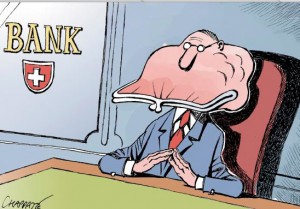
We have been following the bank and the US interest in stopping the outflow of taxable income to protected offshore countries.  Switzerland and Credit Suisse is in the cross hairs of the US Senate, Department of Justice, Internal Revenue and The New York State Department of Financial Services.  Interestingly, although the decline in profits is attributed to Credit Suisse’s investment-banking unit which fell 13% and pretax income slide 36%. Credit Suisse has trimmed its investment-banking operations recently, pulling back from its interest-rate swaps and options businesses. But the bank maintains a relatively large fixed-income trading operation, a business that singed results at J.P.Morgan Chase and Citigroup during the quarter.  Credit Suisse said revenue from fixed-income sales and trading fell 21% from the same period a year earlier.

The drop in investment-banking revenue was coupled with an unexpected bump in the bank’s risk-weighted assets that crimped its CET 1 capital ratio, a key international measure of bank stability.

However high income individual’s deposits are up by 8%.  We do not know how many American citizens this includes, and why they continue to bank in Switzerland instead of at home.   Credit Suisse Earnings Report

Swiss Banks


Luci for Solar Justice

About 1.7 billion people around the world live off the grid, most of them not by choice.  Children doing their studies at home at night are disproportionately impacted by not having light.

MPOWERD, a New York based company committed to ending poverty and to solar justice, is creating products to make living off the grid comfortable and affordable.

They lauched with Luci in 2012. A response to the earthquake in Haiti, which left so much of the population in the dark, MPOWERD brings light to places electricity does not reach.

Solar Justice day is April 15th.  Join the movement as an Ambassador.  Give the give of light.  Buy

Enlightened Functionality

Unlike other solar lamps, Luci offers the benefits of a task light, flashlight and diffused lantern in one attractive design. Never reliant on the power grid, she shines brightest where light is inaccessible or unaffordable. To light up life with clean energy, Luci is your girl.

Luci, an Inflatable Solar Lantern


US Taxpayers Pick Up Tab for Overseas Shelters

Senators Carl Levin and John McCain are fighting hard to retrieve these monies:

U.S. taxpayers would need to pay an average of $1,259 more a year to make up the federal and state taxes lost to corporations and individuals sheltering money in overseas tax havens, according to a report.

“Tax haven abusers benefit from America’s markets, public infrastructure, educated workforce, security and rule of law -– all supported in one way or another by tax dollars -– but they avoid paying for these benefits,” U.S. Public Interest Research Group said in the report released today, the deadline for filing 2013 taxes.

“Instead, ordinary taxpayers end up picking up the tab, either in the form of higher taxes, cuts to public spending priorities, or increases to the federal debt,” it said.

In total, the U.S. loses $150 billion in federal revenue and another $34 billion in state revenue annually because of money parked in tax havens, the Boston-based consumer advocacy group concluded.

That’s almost 5 percent of total federal revenue. The U.S. is projected to raise $3.032 trillion this year, up from $2.775 trillion for fiscal year 2013, according to the Congressional Budget Office.

U.S. PIRG released the report as it tries to increase pressure on lawmakers to change how companies pay taxes on income credited to foreign subsidiaries.

The largest U.S.-based companies have accumulated $1.95 trillion outside the U.S., up 11.8 percent from a year earlier, according to securities filings from 307 corporations reviewed by Bloomberg News.

Together, they added $206 billion to their stockpiles of offshore profits last year, leaving earnings in low-tax countries until Congress gives them a reason not to. Three multinational firms — Microsoft Corp., Apple Inc. and International Business Machines Corp. — added $37.5 billion, or 18.2 percent of the total increase.

Overseas Shelters

New Analysis of Income Inequality

Thomas Piketty, professor at the Paris School of Economics, isn’t a household name, although that may change with the English-language publication of his magnificent, sweeping meditation on inequality, Capital in the Twenty-First Century. Yet his influence runs deep. It has become a commonplace to say that we are living in a second Gilded Age—or, as Piketty likes to put it, a second Belle Époque—defined by the incredible rise of the “one percent.” But it has only become a commonplace thanks to Piketty’s work. In particular, he and a few colleagues (notably Anthony Atkinson at Oxford and Emmanuel Saez at Berkeley) have pioneered statistical techniques that make it possible to track the concentration of income and wealth deep into the past—back to the early twentieth century for America and Britain, and all the way to the late eighteenth century for France.   Why We’re in a New Gilded Age

Gold Gilded Bathrooms