International Women’s Day Is Marked Worldwide

“Equality for women is progress for all”.

That is the theme of this year’s International Women’s Day, being celebrated today, March 8, across the world.

Lamenting discrimination against women and girls worldwide, UN Secretary General Ban Ki-moon said: “Where men and women have equal rights, societies prosper.”

Organisers of a rally marking the event in the Philippines capital, Manila, couldn’t agree more.

“The reason why we are doing this is because we want to reaffirm our commitment to create an enabling environment for women to become better in what they do,” said Organising Committee Partner, Gilda Patricia Maquilan.

“In that way, they can help in uplifting the lives of their family and their communities.”

The Manila rally, at the Quirino grandstand,involved thousands of women standing in a giant human formation of the cross-like female scientific symbol.

Not only was it a huge statement on behalf of women but the female formation could also make it into the Guinness Book of Records.

Ukraine: Retrieve Money Laundered by Yanukovych

Our correspondent Andreas Frank writes:  The most effective near-term pressure that can be exerted on Russia in response to the Ukraine crisis should be financial and economic, according to a paper drafted by Chatham House – a leading think tank.

Chatham House maintained in this new report that much of President Vladimir Putins power is “predicated” upon Russia’s financial stability. Russia is also far more integrated into the world economy now than it was at the time of the escalation over Georgia in 2008.

Its growth had already faltered prior to this crisis, and the markets immediately exerted their pressure on Russia as a result of its actions, the institute observed.

The think-tank noted that freezing the assets of and denying visas to elite Russians suspected of money laundering or involved in the actions against Ukraine are likely to be measures that will influence Russian thinking and, possibly, the government’s behaviour.

The paper also noted while retaliatory Russian measures are possible and more Russians need to travel to the West than those in the West need to travel to Russia.

In addition, Chatham House urged the West to immediately ramp up its counter-narrative to the “Russian propaganda operation.” Meanwhile, the paper suggested that the statements by President Putin and other Russian leaders, and reporting by much of the Russian media, about Ukrainian refugees fleeing to Russia, violence in eastern Ukraine and there being no Russian troops in Crimea “can easily be exposed as lies.” “This should be done publicly, forcefully and immediately,” the paper proposed.

In the meantime, the institute urged the EU not go back on its commitment to the Association Agreement with Ukraine.

Furthermore, the EU should convey the message to Russian energy companies that “business as usual in not an option while intervention in the Ukraine continues,” the study concluded.   Ukraine Policy

Corruption in Ukraine

Silicon Valley Entrepreneur Talks Tech Startup

Susan Wu talks about some of the most important things she’s learned about start-ups so far, including focusing a team and vision around first principles rather than products.

“I’ve found that the best companies I’ve ever been involved with were ones where the founders were committed to delivering genuine, lasting value (either in the form of happiness or improved quality of life) to their users above all else, and were committed to being patient in accomplishing this goal,” Wu says.

For example, Stripe is a payment software, but the team are focused on boosting the GDP of the internet. At the moment this is through providing a frictionless payment system, but the scope to grow beyond that is unlimited.  She says this approach has been shared by many of the founders she’s worked with, including Twitter’s Jack Dorsey and Evan Williams, Flickr and Etsy founder Caterina Fake, Elad Gill from Google, and Stripe co-founders Patrick and John Collison.

“When I reflect upon it, I think that what all of these people have in common is an unusual curiosity and drive towards understanding the world. Being a leader in our industry isn’t just about building products that generate billions of dollars of revenue, it’s also about illuminating new ways of thinking about products, users and communities that lead to entirely new ways of interacting or transacting online.”

Focusing too much on generating revenue to the detriment of getting the user experience or core value proposition product can create a weak foundation she cautions.


Having survived and thrived in start-ups for decades, Wu says getting the relationships right – whether it’s between co-founders, company and customers or product and users – is critical.

“The most frequently repeated thing I counsel is that founding a start-up with someone is like getting married. In many ways, it’s just as emotionally intense, you’re stuck together for at least five to seven years (if the company goes well), and you had better make sure to do the same amount of diligence in figuring out that you want to be ‘married’ to your co-founder as you do your real life partner.”

Comparing the local start-up ecosystem to Silicon Valley in 1996 and 1997, Wu adds there is great opportunity for Australia to build the community they want.  “We don’t need to inherit all of Silicon Valley’s shortcomings. We can choose which parts we want to adopt and which parts we want to evolve,” she says. “It’s still relatively early days and there remains a lot of work we need to do to strengthen the community, but there’s plenty of promising talent and growing momentum.”

Wu agrees with ongoing local commentary that one of the primary issues facing the sector is a lack of risk capital, adding investors here don’t look upon past start-up failure as a positive signal as many investors do in Silicon Valley.  As an investor, team is the most important factor for Wu, who then looks at scope and slant or vision, and ability to execute.

“Though I’ve never articulated it as such before, there’s a simple litmus test: Am I learning something by talking to this founder? Are they saying something insightful that helps me see the world in a new way? Are they saying things that force me to question some of my basic assumptions?” she says.

Tech Startups

The Bitcoin Saga Continues

A young American woman who ran the First Meta bitcoin exchange was found dead in her Singapore apartment last week. Police are investigating the “unnatural death”.  A preliminary police investigation has ruled out foul play, but neighbors told police they suspected Autumn Radtke jumped from an apartment.

First Meta Ltd. issued a statement on its website, saying they were ‘shocked and saddened’ by the news and gave their deepest condolences to Radtke’s family.

The death of the 28-year old followed a tumultuous week for the virtual currency. Mt.Gox, once bitcoin’s largest online exchange filed for bankruptcy after $63 million worth of bitcoin went missing. 

Prices fell sharply, and the day Mt.Gox closed, the cryptocurrency was listed at $565, less than half its value in November.

Neighbor and fellow bitcoin start-up entrepreneur Steve Beauregard lived in the same residential complex as Radtke and said her death wasn’t related to her business. Beauregard is the CEO and founder of GoCoin, a bitcoin processer started in April 2013.

“This wasn’t a bitcoin-related death. She had other things going on in her life. Collectively, there were a lot of small factors. … It appears she picked a permanent solution to a lot of short term problems,” Beauregard told Reuters.

First Meta is an online exchange for virtual currencies and real money, and is funded by Silicon Valley incubator Plug and Play.

Scott Robinson, an employee at Plug and Play, described Radtke as ambitious, “She was a go-getter, she always worked very hard … she stuck out as one of the only women representing bitcoin.”

Like many governments, Singapore doesn’t recognize the legitimacy of the bitcoin currency, and has said they are not legal tender and users should know the risks.

Singapore has long attracted a large expatriate community because of the special tax exemptions it can offer as an independent state and has favorable conditions for start ups.

Radtke moved from California to Singapore in 2012, where previously she worked at a video game currency start-up company. According to her LinkedIn professional profile, she held positions at tech start ups Xfire and Geodelic Systems.

Currencies?

Tips to Getting Good Financial Advice

    1. Get a referralAsk your family, friends and colleagues if they have a financial adviser they are happy with and comfortable recommending to you. This is a great way to build trust quickly with an adviser, if they are already trusted by those close to you.
    2. Track RecordYou want to make sure your potential adviser has a track record of experience and success; things to look for are education, awards, industry presence, client testimonials/referrals. If an adviser is not forthcoming with this sort of information when you ask, they may not be the right one for you!
    3. Easy flow of conversationYour relationship with a financial adviser is not like that of an accountant, where all the numbers are considered and a tax return submitted. You need to feel comfortable with your adviser almost straight away. You need to want to share more than just the numbers. The best advice outcomes occur when your adviser understands who you are, where you have come from and where you want to go. This will enable them to provide advice you understand and are motivated to stick to.It can be a good idea to meet with a few different advisers until you find the right fit for you.
    4. EducationThe best way to ensure advice is right for you is to understand it. An adviser should seek to explain their advice to you in a way you can understand. You don’t need to know all the ins and outs, that is what you are paying for, but you should have the advice clearly explained to you and you shouldn’t have to ask this, it should form part of the service.
    5. Fee StructureAdvisers used to get paid solely by commission. This has now come to an end, replaced by a more transparent structure. The main thing to remember is that an adviser is providing a service to you and they need to be paid for it, in turn you need to be comfortable with those fees. The fees charged need to be clear to you from the start, you need to know in $$ what you will be paying upfront and what will be due ongoing.

In the absence of a referral from a friend or trusted adviser, try googling for financial advisers in a location easily accessible to you. Shortlist a couple that suit you (make sure their target market is you. You don’t want to be seeing a retirement adviser when you are 33). Call, find out some info about what they do, their education etc., arrange an initial meeting, where you can address all of the above points.

Remember women make good financial decisions, go with your gut and start enjoying the benefits of getting great financial advice!

Ore from Mexican Drug Dealers to China

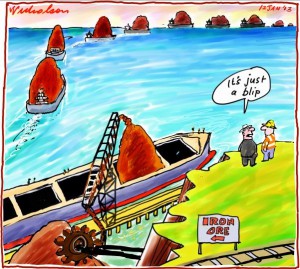
The Knights Templar cartel, steadily diversifying into other businesses, became so successful at exporting iron ore to China that the Mexican Navy in November had to move in and take over the port in Lazaro Cardenas, a city that has become one of the gang’s main cash generators.

This steelmaking center, drug smuggling hot spot and home of a rapidly growing container port in the western state of Michoacan occupies a strategic position on the Pacific coast, making it a natural gateway for burgeoning trade with China.  Ore to China

Iron Ore Mexico to China

Bank of England Clamps Down on Forex Trader

The Bank of England (BoE) has suspended a worker after a review of its processes triggered by a probe into the suspected rigging of foreign exchange trading, it said Wednesday.  However, the British central bank stressed that to date it had found no evidence that staff colluded in the alleged manipulation of the forex market.

“It is a matter of public record that the Bank of England has been conducting an internal review into allegations that BoE officials condoned or were informed of manipulation in the foreign exchange market or the sharing of confidential client information,” it said in a statement.

“This extensive review of documents, emails and other records has to date found no evidence that BoE staff colluded in any way in manipulating the foreign exchange market or in sharing confidential client information.

“However, the Bank requires its staff to follow rigorous internal control processes and has today suspended a member of staff, pending investigation by the bank into compliance with those processes,” the BoE added.

The central bank did not name the suspended individual, adding that it “does not condone any form of market manipulation in any context whatsoever”.

The BoE has meanwhile appointed law firm Travers Smith LLP to prepare a report on the matter.  Global regulators are investigating a number of firms linked to the suspected rigging of foreign exchange trading.  British banking giants Barclays, HSBC and Royal Bank of Scotland have all confirmed that they are part of the forex market investigations.

Deutsche Bank, Swiss lender UBS and US pair Citi and JPMorgan Chase have also revealed that they are co-operating with regulators over the affair.  Some lenders have meanwhile suspended and fired traders while investigations continue. The foreign exchange probe follows the Libor interbank interest rate-rigging scandal of 2012 that triggered heavy fines for some banks and a boardroom shake-up at Barclays.

Forex Trading

What Women (Chinese) Bring to the Table


Executive Director of Renmin University National Opera Study Center and celebrated Peking Opera artist Sun Ping stressed women’s role in public diplomacy and expressed her views about public diplomacy during an interview with a Women of China reporter on March 3, 2014. 

Sun defined what she believes to be a woman’s unique role. “Women are the core of a family and take responsibility for caring for both the old and the young, and building harmonious relations in the family. If women can endeavor in promoting morality and civilization of family, serious incidents will reduce in the society because a woman’s role is irreplaceable,” explained Sun.

“We will work on making Renmin University a Think Tank of public diplomacy. By integrating domestic universities, we are hoping to create a platform. We believe the institute can provide resources for public diplomacy for the whole country. It can spread relative knowledge among college students,” said Sun.

The phrase ‘public diplomacy’ was included in Chinese President Hu Jintao’s report, delivered at the 18th National Congress of the Communist Party of China (CPC). Spokesman Zhao Qizheng also outlined the diplomatic work of Chinese People’s Political Consultative Conference (CPPCC) at the first press conference of last year’s annual session.

Renmin University of China research institute on public diplomacy was founded in Beijing on February 26, 2014.

The institute, which will be headed up by Zhao Qizheng the former director of the State Council Information Office, will consist of research teams from the School of Journalism and Communication, the School of International Studies and the Peking Opera research center of Renmin University. Executive Director of Renmin University National Opera Study Center and celebrated Peking Opera artist Sun Ping will hold the post of vice president of the institute.

Public diplomacy has become a key issue at the annual Session, and CPPCC members have all made their contributions in this respect.

Sun is active in international cultural exchange activities among different countries, and has a deep understanding of diplomatic policies and the importance of public diplomacy.

As part of her proposal, Sun reveals that she hopes Peking Opera will become an elective course in universities.

Sun concluded the interview with the comment. “As a professional woman, I usually give consideration to both my family and work. Only if you take them as main tasks to grasp can you do good work overall.”

Chinese Family

Money Laundering in Hong Kong and Macao

PREVALENT MONEY LAUNDERING IN HONG KONG AND MACAU

Andreas Frank’s Conclusions:

The Survey forms part of the biennial 2014 PwC Global Economic Crime Survey on economic crime which involved more than 5,000 respondents from 95 countries worldwide.

Money laundering is more prevalent in Hong Kong and Macau than in most parts of the world, with rates far above the global average, according to an economic crime survey by PwC. In Asia, Hong Kong has the highest reported rate of money laundering and the ninth highest globally.

A poll by the accounting firm found 37 per cent of companies in Hong Kong and Macau, mainly banks and casinos, had experienced money laundering in the past two years. That compared with a global average of 11 per cent, the Asia-Pacific average of 11 per cent, Singapore’s 5 per cent and mainland China’s 4 per cent.

Hong Kong had the highest reported rate of money laundering in Asia and the ninth highest globally, behind Britain, South Africa, the Czech Republic, Russia, Zambia, Australia, Kenya and Ukraine.

PwC polled 5,128 company executives from 95 countries and territories, including 116 respondents in Hong Kong and Macau, of whom 49 per cent worked for listed companies.

It was the first time the survey, which began in 2001, took a substantive look at money laundering in Hong Kong and Macau.

“The concentration of financial services in Hong Kong and gaming in Macau drives the significance of money laundering in the local marketplace,” said John Donker, the lead PwC partner in forensic services for China and Hong Kong.

“The No1 concern found among financial services companies globally is money laundering. In Hong Kong, it is one of the top concerns.”

PwC’s poll found 27 per cent of financial services companies globally had experienced money laundering.

On Monday, a Hong Kong court found Carson Yeung Ka-sing, owner of English soccer club Birmingham City, guilty of laundering HK$721 million through Hong Kong bank accounts.

This case was a more substantive target prosecuted under the recent money laundering legislation. “It is important that targets are carefully selected to make sure the big fish, not the minnows, are selected”, Steve Vickers, chief executive of Steve Vickers Associates, a Hong Kong risk consultancy said.

The two previous major cases of money laundering in Hong Kong involved an elderly woman and a young man, and both of them received prison terms, Vickers noted.

A new law against money laundering and terrorist financing took effect in Hong Kong in 2012. Courts convicted 140 people of money laundering last year, 166 in 2012 and 246 in 2011. The government recovered HK$639.74 million of laundered money last year, HK$23.6 million in 2012 and HK$1.6 billion in 2011.