Money Laundering Out Of Control Worldwide

Our correspondent Andreas Frank points out:

In its 2014 International Narcotics Control Strategy Report, the US State Department is updating the list of major money laundering countries and jurisdictions around the world.

Major Money Laundering Countries in 2013 are:

Afghanistan, Antigua and Barbuda, Argentina, Australia, Austria, Bahamas, Belize, Bolivia, Brazil, British Virgin Islands, Burma, Cambodia, Canada, Cayman Islands, China, Colombia, Costa Rica, Curacao, Cyprus, Dominican Republic, France, Germany, Greece, Guatemala, Guernsey, Guinea-Bissau, Haiti, Hong Kong, India, Indonesia, Iran, Iraq, Isle of Man, Israel, Italy, Japan, Jersey, Kenya, Latvia, Lebanon, Liechtenstein, Luxembourg, Macau, Mexico, Netherlands, Nigeria, Pakistan, Panama, Paraguay, Philippines, Russia, Singapore, Somalia, Spain, St. Maarten, Switzerland, Taiwan, Thailand, Turkey, Ukraine, United Arab Emirates, United Kingdom, United States, Uruguay, Venezuela, and Zimbabwe.

A major money laundering country is defined by statute as one “whose financial institutions engage in currency transactions involving significant amounts of proceeds from international narcotics trafficking”.

However, the complex nature of money laundering transactions today makes it difficult in many cases to distinguish the proceeds of narcotics trafficking from the proceeds of other serious crime.


This year’s list of major money laundering countries recognizes this relationship by including all countries and other jurisdictions whose financial institutions and/or non-financial businesses and professions or other value transfer systems engage in transactions involving significant amounts of proceeds from all serious crime.

The report which describes the steps taken during the previous year by the governments of nearly 90 countries, to reduce illicit narcotics production, trafficking, and use, as well as money laundering and financial crimes, said that the “complex nature of money laundering transactions today makes it difficult in many cases to distinguish the proceeds of narcotics trafficking from the proceeds of other serious crime.

The United States has named several Caribbean Community (CARICOM) countries as major money laundering states whose financial institutions engage in currency transactions involving significant amounts of proceeds from international narcotics trafficking.

Germany:

The US State Department urged Germany again to become a party to the UN Convention against Corruption.  Germany is finally ready to sign UNCAC.

On February 21, 2014 the German Bundestag 582 against 7 for German regulations to stop bribery of parliamentarian. The issue is the last major obstacle to Germany’s ratification of the United Nations Convention against Corruption (UNCAC). Germany is expected to ratify UNCAC before the summer.  It has taken 11 years and three different governments to finally reach this breakthrough.

International Narcotics Control Strategy Reports:
Drug and Chemical Control
Money Laundering and Financial Crimes
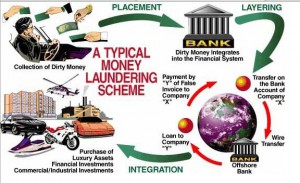
Note: Banks are not the only financial institutions money laundering.
Note: Banks are not the only financial institutions money laundering.
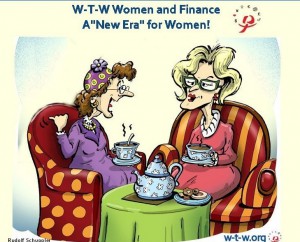
How Financial Advisors Mistreat Women

And What Women Can Do About It

Since the 1950s, women have increasingly assumed the breadwinner role in the household, yet many of them still don’t seek out financial advice. Instead, they rely on friends and family.

Why? According to some women in the financial services business, it’s because banks, brokerages and other related firms don’t treat women with respect. “Wall Street is largely male-dominated, and much of the language we use about money is very ego-based and women don’t relate well to it,” says Hilary Martin, a financial advisor and strategist with San Jose, Calif.-based Family Wealth Consultants, Inc., a registered investment advisor. “Traditionally, women haven’t taken an active role in their investments and financial planning. That fact is changing, but the truth is that it is changing slowly.”

We talked to several women who work in the financial services industry as financial planners, advisors and asset managers about the biggest problems they’ve observed in some financial advisors’ treatment of women and how women can proactively address these issues
How Financial Advisors Mistreat Women

How Financial Advisors Mistreat Women

Fighting Corruption in Indian Banks

The crisis-ridden United Bank of India is under the Central Vigilance Commission’s scanner for under reporting its NPAs or bad loans.The anti-corruption watchdog has sought a report from the Finance Ministry about the bank underreporting its gross NPAs that rose by 188.3 per cent to `8,546 crore at the end of December 2013. It had `2,963.8 crore of bad loans as on March 31, last year.

The CVC has asked for the report on the basis of a complaint filed about the alleged irregularities in the bank.  “A factual report has been sought from Department of Financial Services (DFS) under Finance Ministry on a complaint against the United Bank of India (UBI),” a senior CVC official said.

According to laid out rules, DFS has a maximum of 90 days to send the factual report to the anti- corruption watchdog. The Commission has already received a report on the matter from the bank’s Chief Vigilance Officer (CVO), who acts as a distant arm of the CVC.

Sources said there were allegations against the bank about ‘underreporting’ of NPAs and officials said that a DFS probe will lead to detailed understanding of the enormity of the situation.

Corruption

Meanwhile, with an administrative probe in the matter already underway, the Finance Ministry recently accepted the bank chairman, Archana Bhargava’s application in which she has sought voluntary retirement citing health grounds.

Bhargava, took over as CMD on April 23, 2013, her term was due to end on February 28, next year. The government is looking for a replacement for Bhargava. Sources said that it is probably after Bhargava’s voluntary retirement that the Department of Personnel and Training had come out with a directive that no such request can be accepted if a probe is pending.

According to the new rules notified by the DoPT on February 27, it shall be open to the appropriate authority to withhold permission to a government servant if the he or she is under suspension or if a charge sheet has been issued and the disciplinary proceedings against him or her are pending.

The DoPT said that the rules were revisited as per a 2010 judgment by the Central Administrative Tribunal. (With agency inputs)

China’s Economic Crimes Below World Average

BEIJING, March 1 (Xinhua) — A Pricewaterhouse Coopers (PwC) survey showed that 27 percent of respondents from the Chinese mainland reported suffering economic crime during the last 24 months.

The 2014 PwC Global Economic Crime Survey, released earlier this week by the auditor’s Beijing office, said the proportions in Asia Pacific and the whole world were 32 percent and 37 percent, respectively.

The survey showed that 48 percent of the Chinese mainland respondents who suffered economic crime reported that procurement fraud was one of the most commonly encountered crimes.

The survey also noted that bribery and corruption remains a persistent risk in the Chinese mainland, with 39 percent of the respondents having experienced it.

“This is consistent with mainland and global authorities’ concerted and ongoing anti-corruption drive, and we have already seen China government’s increasing efforts to address this,” said the survey.

PwC interviewed more than 5,000 executives from 95 countries and regions worldwide, and 55 percent of the respondents from the Chinese mainland represented listed companies.

Corruption China

Chinese Crackdown on Corruption

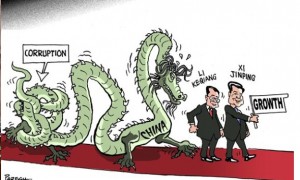
China’s leader Xi Jinping has made a crackdown on corruption a centerpiece of his administration. He’s vowed to root out corruption from the bottom to the top, or to use his expression, to “go after the tigers as well as the flies.”

When it comes to corrupt, high-ranking officials, there’s a reliable source for tips: scorned mistresses. Some have even taken to shaming their lovers on social media, and the scandals have made international headlines.  The Mistress Culture in China

Mistresses Against Corruption

Ageism in the Business World

This is the type of comment that we have regularly experienced over the years and while it certainly has been grating at times our focus has been on gender equality so the frequently heard age references have rarely received a second thought. Combine this with our Asian backgrounds however and you can expect even more colourful remarks. Some even attempt to justify their comments with a misguided attempt at a compliment “Oh, you Asians have great genes and always look so much younger!” It’s been raised so many times it got us thinking – is ageism the new sexism?

Being asked “Oh my – you’re young aren’t you?!” can be flattering in a social setting, but in a workplace context, it’s not and often infers inexperience or questions your right to participate in the space. The challenge for us is to convince the room we are in fact the expert in our field and command the respect we rightfully deserve.

The 2011 census reported that the average Australian is a 37 year old female, which makes the constant questions surrounding our age even more surprising. Sure we get the odd comment about being a ‘chick’ but more often than not, it’s our age that people feel entitled to question.

Occasionally (depending on your mood) it can be funny. Like when you are a keynote speaker arriving at said event and someone helpfully directs you to the childcare conference next door because you couldn’t possibly be the leadership presenter they were expecting.

Or you enter a room for a high profile function, and staff insist on matching your name against their invitation list. Yet you notice no one else get the same treatment, walking past you and into the function at leisure.

But when a 10 year old girl is adamant that only ‘old men with beards’ can be a politician, it does make you wonder how in this day and age, this myth still exists. Alarmingly, why do the younger generation who arguably have been born into an era of equality still have these antiquated pre-conceived notions?

Perhaps we do not have enough role models to normalise our expectations of who fits certain roles. We know that more often than not, gender and ages still gravitate to certain sectors and jobs. There certainly doesn’t seem to be one simple answer.

So what can we do to combat this little spoken about form of ageism? Well aside from avoiding moisturiser or perhaps dragging a partner and couple of kids everywhere with us to demonstrate our maturity.

All women who have experienced this type of interrogation over their perceived age and implied lack of experience need to tackle this issue head on. When someone next queries your age and how you could possibly have enough experience to be doing what you are doing, ask them why your age is relevant. Better yet, ask them how old they are. Or perhaps suggest they may want your weight and dress size next? No? Well the questions are just as inappropriate.

And it’s not all doom and gloom. For every person that scornfully queries your age, someone else not only marvels at it, they applaud you.

Ageism?

Citi Bank Under SEC Scrutiny for Fraud at Mexican Subsidiary

Citi announced on Friday that it had discovered a fraud at Banamex, the wholly-owned Mexican subsidiary that has been one of the bank’s best-performing divisions. Earnings for 2013 were reduced by $235m, Citi said.

The bank said the fraud was tied to loans made to Oceanografia, a troubled Mexican oil services company. Banamex was lending to Oceanografia based on invoices for work it said were approved by Petróleos Mexicanos, the state-owned company, which Citi said turned out to be falsified.

In a forceful statement accompanying the earnings revision, chief executive Mike Corbat said the company would be “relentless” in seeking to recover funds lost in “this despicable crime”.

Citi believes the fraud had help from at least one person inside the bank. In his statement on Friday, Mr Corbat pledged punishment for “any employee who enabled it, either through lax supervision, circumvention of our controls, or violating our code of conduct”.

“At this point, we believe this is an isolated incident,” Mr Corbat said. He added: “All will be held equally responsible and we will make sure that the punishment sends a crystal clear message about the consequences of such actions.”

Mr Corbat said the bank was co-operating with Mexican law enforcement. But even if the bank was the victim of the crime, the bank could be questioned by US authorities over its controls and disclosures.

Citi was rebuked by bank regulators in March last year for “deficiencies” in anti-money laundering controls, including at a unit of Banamex.

Banamax Fraud

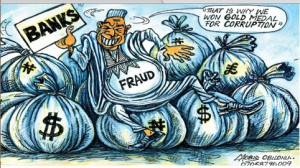
Central Bank Problems in Nigeria

The country’s president, Goodluck Jonathan, hemmed in by allegations of corruption at the state oil company, has yielded to a reckless gamble. The result has been a mini-crash in Nigeria’s financial markets and a grave setback to the country’s progress towards securing macroeconomic stability.

On February 20th Mr Jonathan suspended Lamido Sanusi, the boss of Nigeria’s central bank, on the grounds that he was guilty of financial misconduct and of distracting his institution from the business of setting interest rates and regulating banks.  Mr Sanusi, who planned to step down in June after a five-year term, was admired for achieving single-digit inflation and for cleaning up the banking system in 2009 after an orgy of ill-advised lending. News of his removal led to a slide in the naira, a sharp drop in the stockmarket and a temporary halt to bond trading. The announcement that Godwin Emefiele, an experienced banker, would succeed him in June has done little to restore confidence.

The sacking of the central-bank governor would cause investors to flee from most places, but it is especially damaging in Nigeria. A fortnight before his removal, Mr Sanusi presented evidence to parliament that $20 billion had gone missing from the state oil company. Such allegations are hardly new, but Mr Sanusi had given them the authority of his office. The timing of his suspension and its vague justification suggests that he is being punished for acting as a responsible public servant.

The consequences will be felt beyond Nigeria. In Africa it is the most populous country and, once revised estimates of GDP are published at the end of March, likely to be confirmed as the largest economy. So its fortunes are central to opinion about Africa, which had greatly improved. The continent’s GDP has grown by a healthy 5.6% a year in the past decade. Foreign-direct investment to Africa has been growing more quickly than to developing countries overall. Private-equity firms have snapped up assets from land to logistics companies. Kenya will soon join the dozen or so African countries that have sold blocks of dollar-denominated bonds to rich-world investors to finance roads, railways and power stations.

Not long ago African countries had to be relieved of the burden of past borrowing. The change in their fortunes owes much to budgetary discipline and to efforts by central banks to cap inflation. But Mr Jonathan’s bid to rid himself of a turbulent central banker is a setback. Investors may doubt that Mr Sanusi’s successor will keep interest rates high in the run-up to next year’s election, lest he incur the president’s displeasure and lose his job. And in a country where the oil industry accounts for almost 80% of government revenue, the sort of leakages alleged by Mr Sanusi undermine the maintenance of foreign-exchange reserves and fiscal buffers.

The damage to Nigeria’s reputation for economic management cannot rapidly be undone. But Mr Jonathan should hurry to mitigate it. He must first ensure that Ngozi Okonjo-Iweala, Nigeria’s respected finance minister, stays in office and is supported in her efforts to curb a pre-election splurge in public spending. Ms Okonjo-Iweala offers perhaps the best reassurance that the central bank’s main task of controlling inflation will not be compromised. Mr Jonathan should now go out of his way to bolster the central bank’s autonomy through his words and his actions.

He must also ensure that Mr Sanusi’s allegations are investigated thoroughly and that a promised audit of oil finances is credible. Tellingly, although Mr Jonathan chose to suspend Mr Sanusi on obscure grounds, he has supported Diezani Alison-Madueke, the oil minister and a close ally, in the face of more serious and concrete allegations against her ministry. Replacing her would send a strong signal that he was serious about fixing Nigeria’s oil industry. It might also go some way to repairing the dents Mr Jonathan has inflicted on Nigeria’s economy by his ill-judged manoeuvre against the central bank.

Nigerian Banks