John Cassidy writing in the New York suggests the rhythms of the technology business which differ from other businesses. Brian Arthur, an economist at the Sante Fe Institute, explained many years ago, the technology industry is different from most other businesses, where incumbents, such as Toyota and Hilton, build up franchises that are difficult to dislodge but which don’t take over the entire market. The tech industry, on the other hand, is defined by successive waves of innovation, and it operates more like a long-running lottery, with the prize for each drawing being a temporary monopoly. Microsoft is Microsoft because, back in the eighties, it won the lottery for the operating-system market. Facebook is Facebook because it won the lottery for the social-networking market. John Cassidy on Technology’s Future Refining the discussion is the assessment of Bill Gates’ return to Microsoft. Bill Gates Returns to Microsoft
Investment and Investment Finance in Europe
Combining in-house research and work by leading academics, this report assesses how the crisis has impacted investment across the non-financial sector, in small and medium-sized enterprises (SMEs), in infrastructure, and in R&D and innovation. It explains why and where investment has declined, looking at the impact of structural imbalances, policy uncertainty, new capital requirements for banks and the fragmentation of Europe’s financial markets. In terms of policy options, it warns against poorly targeted responses and provides, instead, support for key policy interventions at the European level. Download: Free
10 Women in Finance and Tech
to have made it onto Forbes’ top 30 under 30
Forbes has once again published its top 30 under 30 list. From Goldman Sachs to Pinterest, women have left a strong mark on today’s business and entrepreneurial world.
10 women in finance and tech to have made it onto Forbes’ top 30 under 30

India’s Central Bank Strong, but Questions Remain
India’s modernized central bank can’t do everything — and lately it has seemed that the rest of the government can’t do anything. The ruling United Progressive Alliance is mired in corruption scandals, with a leadership divided between an ineffective prime minister and an unaccountable Congress Party president.
Heightening the uncertainty is the rise of Narenda Modi, the charismatic leader of the main opposition — the pro-business, Hindu-nationalist, right-of-center Bharatiya Janata Party. Modi, chief minister of Gujarat (one of India’s most successful states), is an electrifying speaker and a hero to many business leaders. His followers can be fanatical — in both senses of the term. In the past, Modi has sided with anti-Muslim extremists. At the very least, he failed to prevent riots in 2002 that claimed more than 1,000 lives. The U.S. has revoked his visa as a result. India’s Central Bank and Narenda Modi
Pharmaceuticals for the Rich Only?
As the world divides more dramatically between the very rich and the very poor with fewer and fewer people in between, certain companies are thriving. Manufacturing for the rich is still highly profitable. This hit home when the CEO of Bayer said recently that Bayer’s new anti-cancer drug would cost $69,000 a year, over forty times the annual income of an Indian. Of course, remarked CEO Marjin Dekkers, this new drug was not developed for poor people.
In the US with attrition high in the middle class, manufacturers have given up making products that appeal to the average family, and are now pitching mostly to the upper end of the income scale.
How many companies will fail as they manufacture out of their comfort zone? Can any healthy economy survive without a middle class? Conventional wisdom says that the rich can only spend so much of their money and the poor can’t spend at all. Without the middle, the flow of goods and services becomes sluggish as best.
Can Janet Yellen Reverse the Damage of her Predecessors?
It took thirty years of guys running the Fed—Volcker, Greenspan, Bernanke—to create this messed-up economy. Now the woman has to clean up after them. From what we know about her, Yellen understands the challenge. She must undo the past. It took a generation of conservative Fed chairmen to tip the balance in one direction and accept the extreme inequalities of income and wealth. It might very well take another generation to correct the damage and restore equity. The Fed, of course, does not control every economic outcome, but, as Yellen knows, its policy levers can have decisive influence on jobs and wages. Can Janet Yellen Revitalize the Middle Class
First Anti-Corruption Report European Commission
Barclays CEO Gives up Bonus
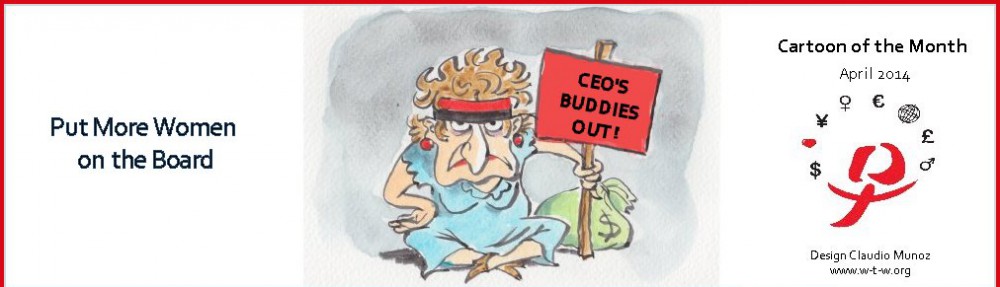
Things are done a little differently in “The City” — London’s version of Wall Street on the other side of the Atlantic. For example, if a bank is hit with scandal after scandal over the course of a year, the CEO of the bank doesn’t take home a fat check for his work. In fact, he gives up his bonus all-together. That’s what Barclays CEO Antony Jenkins will do for the second year in a row, In Japan, CEO’s commit harikari and in the US they laugh all the way to the bank, their bank. Barclays CEO Gives Up Bonus
Obama to Saudi Arabia in March
As Middle Eastern countries go, Saudi Arabia is relatively easy to do business in, if you are a man. For women, it is far more difficult. But the country is opening up and has rare opportunities for entrepreneurs. Saudi Arabia in Brief
Doing Business in Saudi Arabia
The Women’s Entrepreneurship Initiative is encouraging small businesses in Saudi Arabia. Background information is provided in an IFC report.
The WEI gives an overview of the current climate and possible issues. Saudi Arabian Initiative