L’Affaire Hollande

A not very French reaction:  Kim Willsher writes:

Twenty years ago, a French president could carry on any extramarital activity in the knowledge that privacy laws and a respectful press would keep his secret. Editors and politicians colluded to ensure the public would never know. Love lives were strictly off limits to the media. The pinnacle of this self-censorship came in 1994, when Paris Matchmagazine obtained photos of Mazarine Pingeot, then aged 20, illegitimate daughter of President François Mitterrand and his lover Anne Pingeot. In a move that still astonishes the British media, Paris Matchhad sought Mitterrand’s approval before publishing the pictures.

Today, France’s privacy laws remain as draconian as ever, but the celebrity press, battling with the internet and social media, has become much less respectful. The reason is largely financial: fines for breaking the privacy laws are paltry, and soon offset by boosted sales.

In 2008, Closer, whose circulation fell from 493,000 in 2008 to 341,000 in 2012-2013, was ordered to pay €30,000 to the former first lady, Cécilia Sarkozy, after showing her in a bikini looking at a picture of her successor, Carla Bruni. Last week’s “Hollande” edition is a sellout.

The President's First Lady Hospitalized

Impact of Volker Rule

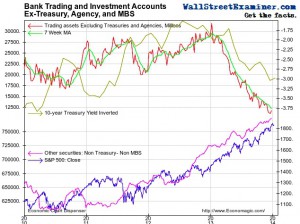
While the banks are dumping their trading account holdings, or suffering losses for the past year thanks to their fixed income trading positions, they’re apparently moving much of the money, as well as new money, over to their non Treasury, non Agency, and non-MBS investment accounts. Those accounts grew by about $50 billion between late December 2012 and late December 2013. The increase in those accounts has mirrored the rise in stock prices since the fourth quarter of 2011. Or did they lead?  Impact of the Volker Rule

Impact of the Volker Rule

The Year of the Woman Entrepreneur

The number of $10-million-plus women-owned firms increased by 57% — a growth rate nearly 50% more than $10-million-plus firms overall.

While the number is still small —  nearly 20% of angels in 2012 invested in women-led businesses — the percentage grew more than 40% from the previous year,  Even venture capitalists have increased their support of women-led companies. It’s still paltry, but the percentage of VC deals going to women-led businesses was 13% in the first half of 2013. That’s nearly a 20% jump over 2012.

There is room for improvement, but the U.S. ranked #1 among 17 countries on having the conditions that foster high potential female entrepreneurship. These conditions include entrepreneurial environment, entrepreneurial eco-system and entrepreneurial aspirations.   The Year of Woman Entrepreneur

Women Entrepreneurs

Big Data Big Pharma

Charles Ornstein Reporting:   Need another reminder of how much drugmakers spend to discover what doctors are prescribing? Look no further than new documents from the leading keeper of such data.

IMS Health Holdings Inc. says it pulled in nearly $2 billion in the first nine months of 2013, much of it from sweeping up data from pharmacies and selling it to pharmaceutical and biotech companies. The firm’s revenues in 2012 reached $2.4 billion, about 60 percent of it from selling such information.

The numbers became public because IMS, currently in private hands, recently filed to make a public offering.   The company’s prospectus gives fresh insight into the huge dollars – and huge volumes of data – flowing through a little-watched industry.

IMS and its competitors are known as prescription drug information intermediaries. Drug company sales representatives, using data these companies supply, can know before entering a doctor’s office if he or she favors their products or those of a competitor. The industry is controversial, with some doctors and patient groups saying it threatens the privacy of private medical information.

The data maintained by the industry is huge. IMS, based in Danbury, Conn., says its collection includes “over 85 percent of the world’s prescriptions by sales revenue,” as well as comprehensive, anonymous medical records for 400 million patients.

All of this adds up to 10 petabytes worth of material — or about 10 million gigabytes, a figure roughly equal to all of the websites and online books, movies, music and TV shows that have been stored by the nonprofit Internet Archive.    Big Data  Big Pharma
Big Data Big Pharma

Financial Experience & Behavior in US Women

A study by Prudential comes to these conclusions:

  • 53% of the more than 1,400 women surveyed were primary earners, as a result of partners losing jobs during the financial crisis, divorce, and deciding to marry later.
  • Only 23% of women feel “well prepared” to make financial decisions compared with 45% of men. 
  • Only 10% of female breadwinners feel very knowledgeable about financial products and services, and are only half as likely to feel well prepared to make wise financial decisions than men.
  • 33% of Asian American and 31 percent of African American married women are the higher-income earners, compared with 19 percent of white women.
  • Baby Boomer and younger women are “not prepared” for retirement, but women under 35 show more interest in both financial empowerment and the value of financial advice.   Financial Experience & Behavior in Women      Maya Zankoul