Insights for Entrepreneurs from Amazon’s Drone Program

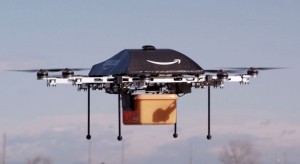
Since CEO Jeff Bezos’s 60 minutes showcase of Amazon’s unmanned drone delivery service, many have written the interview off as just another PR stunt to boost holiday sales. Considering the technology is estimated to be over a decade away, the doubters are most likely correct. When digging deeper though, Bezos’s latest octocopter obsession illuminates Amazon’s purpose perfectly, becoming the largest retailer on the planet (and not just online).

Unfortunately, these droning delivery men also reveal what Amazon believes to be their core hurdle in achieving this goal: competing with local brick and mortar retailers who also sell 95% of Amazon’s products. To combat this, Amazon has spent billions of dollars building Amazon Prime (guaranteed 2-Day delivery), purchased numerous urban locker shipping companies to circumvent the “I wasn’t home for my package” problem, and even brokered a deal with the US Postal Service to begin delivery on Sundays.

This intense focus and spending begs the question though: Do Amazon shoppers truly value and care about receiving their items almost immediately?  Insights for Entrepreneurs from Amazon’s Drone Program

Amazon's Drone

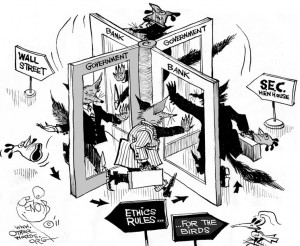
Definition of Corruption in the US

Zephyr Teachout, who teaches law at Fordham University, has identified anti-corruption as part of the US Constitution.     THE ANTI-CORRUPTION PRINCIPLE   She is expanding her arguments in a book to be published by the Harvard University Press.  An article by Lawrence Lessig traces Senator John McCain’s positions on this matter.  Definition of Corruption in the US

The Supreme Court case can be found on the SCOTUS blog.  http://www.scotusblog.com/case-files/cases/mccutcheon-v-federal-election-commission/

Anti Corruption in the US

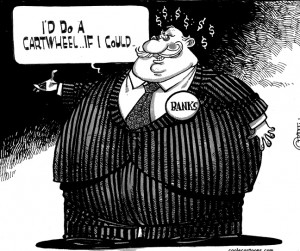
The Consequences of ‘Too Big to Jail’

Robert Shiller – one of the top housing experts in the United States – says that the mortgage fraud is a lot like the fraud which occurred during the Great Depression.   Shiller said the danger of foreclosuregate – the scandal in which it has come to light that the biggest banks have routinely mishandled homeownership documents, putting the legality of foreclosures and related sales in doubt – is a replay of the 1930s, when Americans lost faith that institutions such as business and government were dealing fairly.

Indeed, it is beyond dispute that bank fraud was one of the main causes of the Great Depression    Bankers Too Big to Jail

Too Big to Jail

When Capitalists Went on the Public Dole

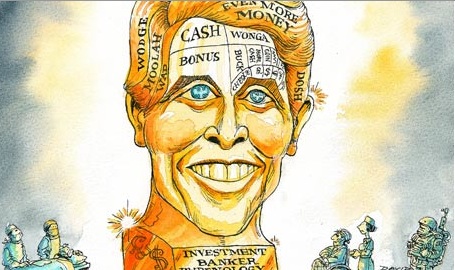
If you had to pick a city on earth where the American investment banker did not belong, London would have been on any shortlist. In London, circa 1980, the American investment banker had going against him not just widespread commercial lassitude but the locals’ near-constant state of irony. Wherever it traveled, American high finance required an irony-free zone, in which otherwise intelligent people might take seriously inherently absurd events: young people with no experience in finance being paid fortunes to give financial advice, bankers who had never run a business orchestrating takeovers of entire industries, and so on. It was hard to see how the English, with their instinct to not take anything very seriously, could make possible such a space.

Yet they did. And a brand-new social type was born: the highly educated middle-class Brit who was more crassly American than any American. In the early years this new hybrid was so obviously not an indigenous species that he had a certain charm about him, like, say, kudzu in the American South at the end of the nineteenth century, or a pet Burmese python near the Florida Everglades at the end of the twentieth. But then he completely overran the place. Within a decade half the graduates of Oxford and Cambridge were trying to forget whatever they’d been taught about how to live their lives and were remaking themselves in the image of Wall Street. Monty Python was able to survive many things, but Goldman Sachs wasn’t one of them.  Review of Capital by John Lancaster   Capital

Banker

Crowdfunding: Kickstarter versus Indiegogo

W-T-W.org will present a series of articles, audios and videos on this subject for the next two months.  This short piece gives a quick overview of the difference between the two main websites currently devoted to crowdfunding. Next week, we will present a discussion with two professors at the Jerusalem School of Business who had access to the records of 20,000 successful Kickstarter campaigns.  Kickstarter versus Indiegogo

Kickstarter versus Indiegogo and others

Kickstarter

Royal Bank of Scotland Fined 100 Million Dollars

Our correspondent Andreas Frank (frank-cs.org) writes:  

The Royal Bank of Scotland is paying $100 million in fines to New York and federal banking regulators to settle civil investigations into accusations that some of its former employees helped conceal transactions involving customers from Iran, Sudan and other nations subject to international sanctions for about a decade.

Bank regulators in New York contend the former RBS employees used a variety of techniques to conceal about 3,500 transactions involving the transfer of $523 million through New York banks.

“We have a vital responsibility to combat misconduct at banks and continue strengthening the long-term integrity of the financial system,” said Governor Cuomo. “In New York, we will continue our aggressive work rooting out global money laundering that puts our national security at risk.”

Benjamin M. Lawsky, Superintendent of Financial Services, said, “Our continued objective is to create higher standards for ethics and accountability at large banks. That will not happen overnight, but through a sustained effort – including strong enforcement of our anti-money laundering laws – we will work toward that critical goal. RBS took an important step by terminating a number of individual employees who engaged in misconduct. If we truly want to deter future wrongdoing, we should move increasingly toward exposing individual misconduct and holding individuals accountable.”

The joint action announced by the New York State Department of Financial Services, the Federal Reserve and the Treasury Department’s Office of Foreign Assets Control is part of a continuing crackdown on banks that violate American laws against money laundering, specifically banks that enable transactions with countries that are subject to international sanctions.

A person briefed on the matter said bank regulators were working on settlements with about a half-dozen banks over similar violations and those cases could be resolved in the coming months.

The bank regulators gave RBS credit in the settlement for beginning its own internal investigation into the matter in 2010 and dismissing the employees involved in the unlawful money transfers. Most of those employees were dismissed in 2012, said a person briefed on the matter.

“RBS took an important step by terminating a number of individual employees who engaged in misconduct,” Benjamin M. Lawsky, the New York superintendent of financial services, said in a statement. “If we want to deter future wrongdoing, we should move increasingly toward exposing individual misconduct and holding individuals accountable.”

In the settlement, R.B.S. will pay a $50 million penalty to New York bank regulators and a $50 million penalty to the Federal Reserve, of which $33 million will go to the Treasury Department. The British bank has fired four employees and clawed back bonuses from eight more employees. It also agreed to enact measures to stiffen its compliance with anti-money-laundering laws.

RBS said in a statement that the bank “deeply regrets” its failings.

The bank also said related criminal investigations by the Justice Department and the Manhattan district attorney’s office were concluded without those agencies taking any further action against RBS.

The four employees dismissed by R.B.S. included the bank’s former head of global banking services for Asia, the Middle East and Africa and the head of the money laundering prevention unit for corporate markets.

The bank regulators said the former employees helped customers and companies with ties to countries under sanctions strip out identifying data from payment messages. New York bank regulators found that some within RBS operated from written instructions “containing a step-by-step guide” on how to keep United States dollar payments from being detected.

The settlement with RBS is considerably smaller than the $1.92 billion HSBC paid to settle money-laundering accusations last year over transactions the bank processed for Latin American drug cartels and for violating sanctions policies against Iran and Sudan. The London-based HSBC settled with American prosecutors as part of a deferred-prosecution agreement.

Another British bank, Standard Chartered, paid a total of $667 million in fines to settle investigations into accusations that it too violated international sanctions against Iran. Standard Chartered also entered into a deferred prosecution deal with federal prosecutors in December 2012. The deal with federal prosecutors came several months after Mr. Lawsky broke with other regulators to bring his own action against Standard Chartered, which resulted in a settlement in September 2012.   NYState Versus Royal Bank of Scotland
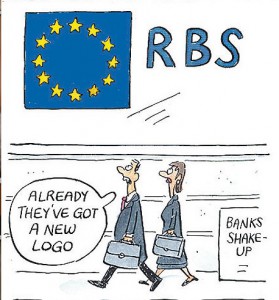
RBS

Investing in the Time of Taper

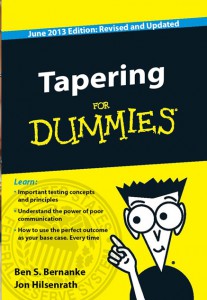
There are few sure bets in investing.  But here is one sure bet: The Fed will reduce it monthly purchases of securities and US interest rates will rise. The question then becomes what this means for investors. The McKinsey Global Institute has published an excellent report on the subject in which they attempted to quantify many of the effects. This article summarizes the McKinsey findings and goes on to spell out the investment implications.  Investments in the Time of Taper

Tapering for Not so Dummies