Europe and the Bitcoin

The European Banking Authority will on Friday issue a statement warning of the risk of “violent fluctuations in electronic currencies” value, the danger of “digital wallets” being hacked, and of the lack of legal protections for users.

The move comes as authorities worldwide try to get to grips with the rapid expansion and soaring value of unregulated cyber currencies.  The People’s Bank of China this month ruled that Chinese banks should not process or insure Bitcoin transactions , in a step towards regulatory oversight of a currency that has exploded in popularity – and in value – in recent months.

Other central banks have been more positive, with Ben Bernanke, the US Federal Reserve chairman, last month arguing they can be useful if money laundering can be prevented.   Bitcoin Warnings in Europe

Bitcoins

Turkey for Entrepreneurs?

Aside from the recent security challenges, which cancelled a trip to the Grand Bazaar, Ingrid Vanderveldt, an entrepreneur doing business in Istanbul said Turkey has some pronounced challenges for female entrepreneurs. “Probably the biggest difference about doing business here vs. in the U.S.,” she says, “is in the U.S., women doing business is almost this expected thing, and I think in Turkey it’s very much still an emerging thing, so there’s a lot of excitement around it, there’s a lot of encouragement.”  Turkey-A Country for Women Entrepreneurs ?  

An excellent report on the current condition of the country Current Conditions in Turkey

Turkish Entrepreneur

Too Big To Fail May Simply Be Too Big

Secretary of the Jacob J. Lew said: “Going forward, we cannot be afraid to ask tough questions, with an open mind and without preconceived judgments.” That requires that “we must remain vigilant as emerging threats appear on the horizon.” He reassured us that “we have made tough choices, and very significant progress toward reforming our financial system.”

This is not the stuff of persuasion. Simply asserting that the financial system becomes safer as regulators complete Dodd-Frank rules does not make it so. To those who don’t think those rules go far enough, the administration offers little. More important, the claim frames the issue in a discouragingly limited fashion.  Too Big to Fail Simply Too Big

Too Big

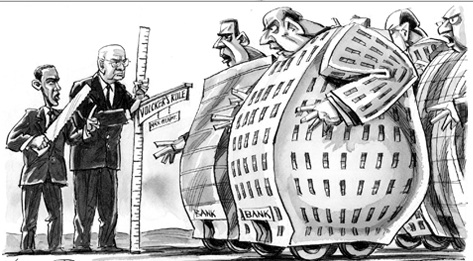
Volker Rule Ties Banks’ Hands When They Hold Depositors’ Insured Money

UPDATE  William Grieder:

Behind Paul Volker’s back, they called him “Tall Paul” in the 1980s and Volcker was indeed awesome then as Federal Reserve chairman alongside Ronald Reagan as president. Together they refashioned government—shifting everything rightward and setting up the triumph of the financial sector that has reigned ever since with its destructive qualities.

The Gipper did the fun part—cutting taxes from the top down—but Volcker did the heavy lifting. He presided over a long, brutal recession that broke inflation and labor wages and lots more. It was a decisive injury to organized labor He was a civil service giant, brave and also scary. At six-foot-seven, Volcker towered over the pedestrian ranks of Washington politics. Also important bankers and the US Senate. Reagan’s White House staff tried to push him around (though not Reagan himself) and Volcker brushed them off like gnats.

For all those reasons, I see his triumph—finally getting federal regulators to adopt his “Volcker amendment” to limit proprietary investing by the mega-banks—as a melancholy moment. It took three years for regulatory agencies to fend off the thousands of bank lobbyists and approve something. That’s better perhaps than a hollow victory but still far short of the reforms that are needed to get control over the out-of-control mega-banks.

I haven’t read the bill, but the financial press and Wall Street talkers are not impressed. It is something like 850 pages and so dense with loopholes and clever snares it will probably take another three years for bank examiners to understand what they are supposed to do with it.

Meanwhile, the too-big-to-fail banks will go on about their business, getting sweet on America’s troubles and pretty much ignoring prudent restraints. The real solution will not come until another Congress or a new president find the courage to break them up, cut them down to size and restore the old Glass-Steagall division of commercial banking from investment banking. A few years of experience with the Volcker Rule will probably be enough to demonstrate that it’s insufficient to change the behavior of JP Morgan and the banker gang. The risk is that the bankers will go wild again in the meantime.


Paul Volcker must be feeling a sense of personal regret if not guilt. He was present at the creation, after all. As Fed chairman. He blessed the first rounds of serious deregulation that repealed the caps on interest rates and doomed the savings and loan industry that financed housing. However reluctantly, Volcker also engineered the first big rescue of a too-big-to-fail bank—Continental Illinois in Chicago. He could have hung tough but he caved to the bankers. The Fed has lived off that precedent many times since.

The Federal Reserve and Treasury Secretary want us to believe they won’t do it again. I judge from his body language and muted comments that Paul Volcker doesn’t believe them.

While the Volcker Rule has been moderated since its inception, these limitations would have a significant impact on the ability of U.S. banking organizations to provide investment management products and services that are competitive with nonbanking firms generally and with non-U.S. banking organizations in overseas markets. It would also effectively prohibit short-term trading strategies by any U.S. banking organization, regardless of the location of its trading business, if those strategies involve instruments other than those specifically permitted for trading.  Analysis by a Prominent US Law Firm
The Volcker Rule

VolckerpreambleFinal Rule
Volker Rule

Mary Barra First Woman to Head General Motors

She worked her way, step by step, up the corporate ladder from the time she started working at General Motors as age 18.  Now she has reached the top.

In the statement announcing her new role as CEO, GM credited Barra with “revitalizing GM’s product development process,” saying that her efforts resulted in higher product quality ratings and increased customer satisfaction.

“With an amazing portfolio of cars and trucks and the strongest financial performance in our recent history, this is an exciting time at today’s GM,” Barra said in a statement Tuesday morning. “I’m honored to lead the best team in the business and to keep our momentum at full speed.”   Mary Barra Named First woman CEO at General Motors
Mary Barra to Head General Motors

Uzbek Bank Loses License Over Alleged Money Laundering

The Central Bank of Uzbekistan announced that the license for Credit Standard Bank to conduct banking operations was withdrawn due to violation of the banking legislation.

CSB informed its customers and partners that the bank was closed by the Central Bank of Uzbekistan by adding that “We bring our apologies for any inconvenience caused and hope for your understanding.”

By closing down Credit Standard Bank the Central Bank is sending out a “significant signal” insiders say. Credit Standard Bank (CSB) was allegedly engaged in money laundering for Gulnara Karimova, president’s Islam Karimov oldest daughter.

The dismantling of Gulnara Karimova’s business empire started in early October. The once omnipotent business mogul Karimova has lost many of her assets – TV and radio stations, clothing shops, movie theaters and her charity organization Fund Forum among others.

The president Islam Karimov and his regime have been silent on the situation surrounding the president’s daughter.

Karimova accuses her mother Tatiana Karimova in taking revenge on her for trying to intervene in her mother’s own corrupt business empire.

In 2012 investigators in Switzerland and Sweden were probing alleged links between a leading European telecommunications company and a high-level multi-million dollar fraud and corruption scandal in Uzbekistan.

The allegations stretch all the way to businesswoman, pop diva and one-time UN ambassador Gulnara Karimova, the eldest daughter of Uzbek President Islam Karimov.

Swedish-based TeliaSonera, which is partly state-owned, has been at the centre of a huge political storm since Swedish TV broadcast a report accusing it of making a $300m payment to an intermediary company for the rights to operate a 3G mobile phone service in the Central Asian republic.
Uzbekistan’s Lola Karimova-Tillyaeva reveals rift in first family

CBU_CSB_PressRelease_27.11.13-1
CSB_PressRelease_27.11.13

Uzbekistans Lola Karimova-Tillyaeva reveals rift in first family

OECD Assesses Education Worldwide: Asian Countries are Doing the Best Job

The OECD’s PISA 2012 tested more than 510,000 students in 65 countries and economies on maths, reading and science. The main focus was on maths. Math proficiency is a strong predictor of positive outcomes for young adults. It influences their ability to participate in post-secondary education and their expected future earnings. Shanghai-China, and Singapore were top in maths, with students in Shanghai scoring the equivalent of nearly three years of schooling above most OECD countries. Hong Kong-China, Chinese Taipei, Korea, Macao-China, Japan, Liechtenstein, Switzerland and the Netherlands were also in the group of top-performing countries.   Asian countries top OECD’s latest PISA survey on state of global education

 School Children

Music Entrepreneurs in Iceland

The annual Icelandic Airwaves Festival has come and gone.  Iceland now seems a brisk and bustling economy after the 2008 collapse.  Angry at the EU for their treatment of EU countries’ debts, Iceland has stalled on its application and now seems focused on the Arctic Council and the Far East.  Will this impact the country’s vibrant music culture. Iceland Music Entrepreneurs

Icelandic Airwaves

How Important Are Investment Managers?

Regulators are beginning to look at the impact, not of assets gone sour, but of the sheer volume of trades one institution makes.

Regulators want not merely to prevent a repeat of the last blow-up but also to identify the sources of future systemic perils, BlackRock investment managers raises a subtle issue concerning not the ownership of assets but the way buying and selling decisions are made. The $US15 trillion of assets managed on its Aladdin platform amount to around 7% of all the shares, bonds and loans in the world. As a result, those who oversee many of the world’s biggest pools of money are looking at the financial world, at least in part, through a lens crafted by BlackRock. Some 17,000 traders in banks, insurance companies, sovereign-wealth funds and others rely in part on BlackRock’s analytical models to guide their investing. A dangerous skew?

The Economist reports:  Black Rock Rocks the Financial World

Investment Advisors