Should the Renminbi Be Added to the IMF Reserve Basket?

Benjamin J. Cohen writes:  The Chinese government’s campaign to have its currency, the renminbi, included in the International Monetary Fund’s reserve asset appears to be on the brink of success. Last week, IMF staff formally recommended adding the renminbi to the basket of currencies that determines the value of its so-called Special Drawing Rights (SDRs).

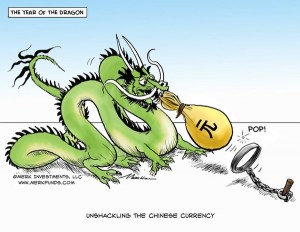
The addition of the renminbi to the basket, which currently includes the US dollar, the euro, the British pound, and the Japanese yen, would provide China with a boost to its prestige. More important, it would advance the government’s efforts to internationalize the renminbi. But it would also be a mistake. The decision to recommend the renminbi’s inclusion, far from having been made on sound economic grounds, can only be understood as political. As such, the long-term consequences are likely to be regrettable.

On a purely technical basis, the renminbi’s qualifications for inclusion in the SDR basket are questionable. Traditionally, the IMF has insisted on two criteria: a currency’s issuing country must be among the world’s leading exporters, and the currency must be “freely usable” – widely used and traded.

As the world’s largest exporter, China clearly meets the first condition. The second, however, is probably still beyond its reach. The renminbi is by no means in the same league as the SDR basket’s four incumbent currencies. In 2014, China’s currency ranked seventh in global central-bank reserves, eighth in international bond issuance, and 11th in global currency trading. Moreover, the renminbi remains non-convertible for most capital transactions, China’s financial markets are primitive, and trading margins for the exchange rate are still set daily by the monetary authorities.

Indeed, as recently as August, the IMF was skeptical about adding the renminbi to the SDR basket, saying that “significant work” was still needed, and suggesting that a decision should be put off until 2016 in order to ensure a “smooth” transition.

So why did the IMF flip? The answer is obvious: China mounted a full-court press to change minds. In August, the currency’s exchange-rate regime was loosened slightly. Renminbi-denominated government bonds were issued in London, and plans were laid to create new trading platforms for the currency in several European financial centers. And Chinese policymakers made it abundantly clear how unhappy they would be with a negative decision..

Many would argue that this is a positive development. Certainly, it mollifies China’s leaders, offering them a stronger incentive to continue to work within the existing international monetary regime. Recent Chinese initiatives, especially the creation of the Asian Infrastructure Investment Bank, have given rise to fears that the country intends to build a new set of international institutions to compete with Western-dominated organizations like the IMF.

On the other hand, the move sets a worrying precedent, injecting politics into a policy area that had been governed by objective economic considerations.

Of course, it can be argued that China’s recent economic trajectory means that it is only a matter of time before the renminbi does become a match for the SDR’s incumbents.

Use of the renminbi for the purpose of invoicing and settling trade with China is bound to continue growing.

Nor is inclusion of the renminbi in the SDR basket likely to provide as big a boost to the currency’s internationalization as many believe. Some central banks may decide to follow suit, adding renminbi-denominated assets to their reserves to match the composition of the basket. But the increase will be marginal at best – some $40 billion in the next few years, according to the IMF’s calculations. With global reserves now totaling more than $10 trillion, that is a mere drop in the proverbial bucket.

The political reasons for including the renminbi in the SDR are all too clear. Unfortunately, the risks of doing so are no less obvious.
Renminbi and IMF

Commodity Prices Boom and Trough

Carmen Reinhart writes:  The global commodity super-cycle is hardly a new phenomenon. Though the details vary, primary commodity exporters tend to act out the same story, and economic outcomes tend to follow recognizable patterns. But the element of predictability in the path of the commodity-price cycle, like that in the course of a roller coaster, does not make its twists and turns any easier to stomach.

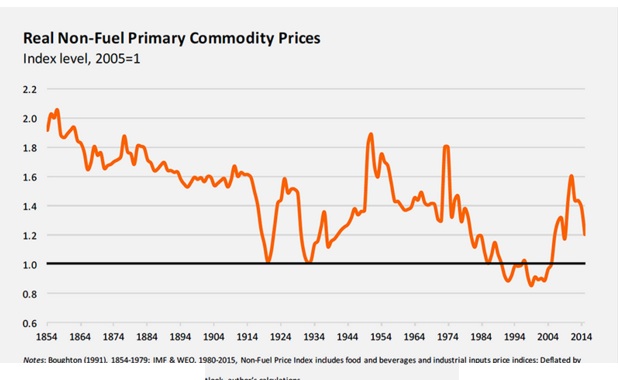
Since the late eighteenth century, there have been seven or eight booms in non-oil commodity prices, relative to the price of manufactured goods. (The exact number depends on how peaks and troughs are defined.) The booms typically lasted 7-8 years, though the one that began in 1933 spanned almost two decades. That exception was sustained first by World War II and then by the post-war reconstruction of Europe and Japan, as well as rapid economic growth in the United States. The most recent boom, which began in 2004 and ended in 2011, better fits the norm.

Commodity-price busts – with peak-to-trough declines of more than 30% – have a similar duration, lasting about seven years, on average. The current bust is now in its fourth year, with non-oil commodity prices (relative to the export prices of manufactures) having so far fallen about 25%.  Commodity Booms and Troughs

Non Fuel Commodity Prices


Dubai Initiative to Heal and Empower

Dubai has launched a global foundation, with an initial budget of AED1 billion ($272 million), which aims to combat poverty, unemployment and education challenges in the region.

The Mohammad Bin Rashid Al Maktoum Global Initiatives will bring together the work or 28 organizations under one umbrella body. The program will co-ordinate over 1,400 human development programs in more than 116 countries around the world.

“The world today is facing great challenges on all levels; in terrorism, wars and mass immigration and the only solution lies in human development which can be achieved by educating people and helping them build their future,” Sheikh Mohammed said launching the new foundation.

The foundation will have four key objectives: spreading knowledge, combating poverty, empowering communities and encouraging innovation for the future. The Dubai Media Office on Sunday issued the list of objectives and goals which the foundation is aiming to achieve by 2025:

– Print and distribute 10 million books

– Provide educational support for 20 million children

– Invest AED1.5 billion in education and knowledge projects

– Provide 500 million books to students for reading

– 30 million people to be treated for blindness and eye diseases

– Two million households to be provided with support

– AED2 billion to be invested in the establishment of research centres and hospitals

– AED500 million to be invested in water research in the region

– 5,000 innovators to be supported and incubated across the region

– AED5.5 billion to be invested in innovation and creating incubators

– 500,000 new job opportunities to be created

– 50,000 young entrepreneurs to be trained and supported

– One million participants to take part in awards and forums to help empower communities

– AED150 million to be awarded to encourage creatives, intellectuals and journalists

– 25,000 books to be translated into Arabic

– AED600 million to be invested to promote a culture of tolerance

Curing Poverty in Dubai

US Mexicans Returning Home

Mexicans are staying in Mexico or moving back from the US.

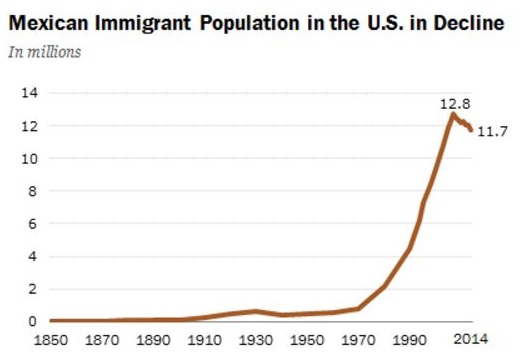
Between 2009 and 2014, the Mexican population in the U.S. declined by 1,140,000 as well over 1 million left their wealthy northern neighbor to go back to their country of origin, according to the Mexican National Survey of Demographic Dynamics (ENADID).  One clue to the recent change in the trend is in current perceptions: today one-third of Mexicans believe their standard of living would be no higher north of the border, compared to less than one-quarter who thought so in 2007. And less than half (48%) believe life would be better in the U.S.  The ENADID survey also indicated that family ties had played a large part in the rising numbers of Mexicans moving back south of the border: six in 10 of those who said they had lived in the U.S. five years ago but were back in Mexico as of last year cited reunification with loved ones as the main reason. Just 14% said they had been deported.

Mexicans Going Home from US

Iran Discusses Oil Production as Sanctions are Lifted

Iran is returning the world, at the conference table on foreign policy matters and now asking for accomodations on oil production.

OPEC should make room for increased Iranian crude production within its ceiling of 30 million barrels a day, the nation’s oil minister said, adding the group will probably leave that limit unchanged when it meets next month.

Iran has asked OPEC to accommodate its return to previous production levels when international sanctions are lifted, Bijan Namdar Zanganeh told reporters in Tehran. Iran plans to add 1 million barrels a day within five to six months of the curbs being removed and that increase should be within OPEC’s production ceiling, Amir Hossein Zamaninia, deputy minister for commerce & international affairs, said in Tehran on Saturday.

Brent crude tumbled more than 60 percent since the middle of last year as OPEC followed Saudi Arabia’s strategy of defending its share of the global market against competitors such as U.S. shale producers. The Organization of Petroleum Exporting Countries, which accounts for about 40 percent of global supply, has been pumping above its target level for 17 months. It is scheduled to meet on Dec. 4 to discuss the ceiling.

“I don’t expect to receive any new agreement” at the OPEC meeting, Zanganeh said. “OPEC is producing more than its approved ceiling and I asked them to reduce production and to respect the ceiling, but it doesn’t mean we won’t produce more because it is our right to return to the market.”

Iran was OPEC’s second-largest producer before sanctions over its nuclear program were tightened in 2012. The nation, which reached an agreement with world powers in July over the trade restrictions, is currently the group’s fifth-largest supplier, pumping 2.7 million barrels a day last month, according to data compiled by Bloomberg.

“I sent a letter to OPEC to consider our return to the market and to manage it,” Zanganeh said. “We don’t need to receive any permission from any organization for our return to the previous level of production. It is a sovereign right.”

Most OPEC members see $70 a barrel as a fair price for oil, Zanganeh said. Brent crude last traded at that level in December, days after OPEC gathered in Vienna and opted to resist calls from members including Venezuela to cut output. Brent settled near $45 a barrel in London on Nov. 20.

Venezuela President Nicolas Maduro is scheduled to meet Russian President Vladimir Putin in Tehran on Nov. 23 to work together on oil prices, he said on state television last week. Russia, which isn’t a member of OPEC, is facing competition in Europe after Saudi Arabia reduced pricing for buyers in northwest Europe and started selling in established Russian markets such as Poland.

Russia was lobbied last year by Venezuela as it sought to coordinate action with non-OPEC producers to halt the collapse in oil prices. Global supply and demand is best balanced by the market, Russian Energy Minister Alexander Novak said Saturday in Tehran. Any discounts on Russian crude are a matter for the oil companies and not the Energy Ministry, Novak said.

Iran's Oil Production

ISIS Elusive?

IS and its ilk are skilled recruiters, using the internet and informal networks. They can therefore rely on a steady flow of terrorists ready and willing to fight. Instead of going through a tightly controlled and highly competitive recruitment process, IS has a well-funded web and social media propaganda campaign disseminating videos of brutal violence and destruction to appeal to potential followers. It also distributes an English language magazine,.

Taking advantage of improvements in technology and transportation, the Islamic State (like al-Qaeda) contrasts with past terrorist groups that remained more domestic and nationalist. Today’s terrorist groups are transnational – European and North African recruits are incorporated into cells based in Europe and beyond. Unable to migrate to fight in Syria, they are being used to stage attacks in the countries in which they are based.

Driven by ideology, the conventional terrorist organisations of yesteryear mostly received their support from state sponsors. But today, most terrorist groups engage in organised criminal activities to keep their organisations thriving. IS has flexible and lucrative sources of funding. Most of this comes from illicit proceeds from occupying territory such as controlling banks, oil and gas reservoirs, extortion and theft of economic assets. IS also earns funds by donations from non-profits and foreign fighters.

By not relying on foreign funding, the group is not vulnerable to a sudden loss of support. Additionally, the group’s motives also mutate. Lucrative criminal opportunities motivate the group. They also provide a constant flow of funding for further attacks.

Holding territory

Occupying territory is also a something that distinguishes terrorist-hybrid organizations from terrorist groups of the past. Typically it is insurgencies that hold territories by force, whereas terrorist groups have been too weak to hold territory and must rely on a safe haven provided either passively or actively by a state sponsor.

IS holds territory roughly the size of Belgium, which it uses as a base to train its militias and conduct and plan its operations. More than 60% of its funds goes towards paying its military. By holding territory and providing services to the people who live there, it can operate more freely than groups which lack a large base for its headquarters.

Though the organization is transnational and cellular, it also has a robust organization capable of planning carefully orchestrated attacks and offering the financial and logistical support necessary to make its attacks highly deadly. The Paris attacks were too sophisticated and effective to be the work of leaderless resistance or lone-wolf terrorism. As the French prime minister, Manuel Valls, said, they were very probably planned from the top in Syria, rather than by an autonomous cell based in France.

But in spite of its unusually clear hierarchical leadership structure, simply killing IS’s top leaders and destroying its resources and supply lines will still be ineffective. The only way to deal effectively with the group will require a long-term plan of eliminating the deep sources of frustration in the region, such as government corruption, mismanagement and state violence.

Isis Power

Pressures of Financing Anti-terror Security

Security measures will be costly for western countries.

French President Francois Hollande’s increased spending to boost security in the wake of the deadly attacks in Paris should be given special treatment under Europe’s budget rules, European Commission President Jean-Claude Juncker said.

“We are faced with terrorist acts. France and other countries need additional means and these additional means should not be dealt with on the same footing as regular spending,” Juncker told an audience in Brussels on Wednesday.

Following the assaults in the French capital that killed at least 129 people on Nov. 13, Hollande said he is ready to breach the European Union’s budget-deficit ceiling to spend whatever is needed to ensure security. He promised more money for intelligence services, additional police officers and no cuts to the army’s personnel numbers.

“For an extraordinary situation we need extraordinary spending,” Juncker said on Wednesday. “And it goes the same for other countries,” he added.

The European Commission has already said that extra spending by governments to deal with the influx of refugees into the bloc may receive a reprieve under the budget rules, which include an annual deficit limit of 3 percent of gross domestic product.

When nations are faced with “unusual events outside the control of the government,” then spending can be increased without drawing sanctions, the commission said on Nov. 17. While the statement referred to refugee-related spending, Commission Vice President Valdis Dombrovskis said the EU executive would assess the impact of France’s security spending.

Financing Security

Entrepreneur Alert: High Tech Toilets?

Luxury toilets a big item for big spenders.

Guarded by heavy metal gates, it feels like a secret base in the heart of Tokyo. Inside a typical office building in the Akihabara district is a high-tech factory that is created for use by anyone with innovative ideas.

To the uninitiated, a makerspace is a physical housing area (it could be a library or a community centre, for instance) that provides technology, manufacturing equipment and/or educational opportunities to the public.

Here the Toto electric toilet seat with water spray feature was created.

Japan has long pioneered high-tech toilets. This one allows users to check blood pressure, urine protein, weight and body fat on the control panel.

Is this an opportunity for creative entrepreneurs around the world?

High Tech Toilets

Chinese Slowdown Slows Baltic Shipping

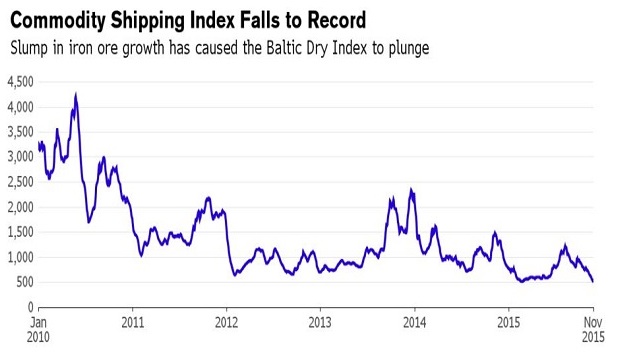
The cost of shipping commodities fell to a record, amid signs that Chinese demand for iron ore and coal is slowing, hurting the industry’s biggest source of cargoes.  The Baltic Dry Index, a measure of shipping rates for everything from coal to ore to grains, fell to 504 points on Thursday, the lowest data from the London-based Baltic Exchange going back to 1985. Among the causes of shipowners’ pain is slowing economic growth in China, which is translating into weakening demand for imported iron ore that’s used to make the steel.

Baltic Shipping

Warren Tackles Women’s Pay

Elizabeth Warren proposes a women’s economic agenda.

“Achieving pay equality for women isn’t enough,” Senator Elizabeth Warren, D.-Mass., said.  “We have to make sure that all workers – men and women – are earning enough to live on.”

A recent Economic Policy Institute study shows that the gender pay gap has closed some 40 percent. It’s not because women are earning more. It’s because men are earning less.

Wages for all workers have been suppressed, because of national policies consciously adopted to guarantee that most of the wealth being created through increased productivity goes to those who are already the richest, most powerful people in America.

It hasn’t always been this way. For decades following the end of World War II, Gould said, pay for the vast majority of American workers went up as productivity rose.

Then economic policies turned against workers. Productivity grew 72.2 percent between 1973 and 2014, but hourly pay for the typical worker rose just 0.20 percent annually. From 2000 to 2014, the gap between productivity and pay grew faster and wider. Productivity rose 21.6 percent but pay increased only 1.8 percent for the typical worker.

If the fruits of higher productivity had been shared with those who had produced the wealth instead of being lapped up by the top one or two percent, Gould said, no one with a full time job would be living in poverty today. Overall, wages would be up 70 percent.

However, because of current economic policies some 35 million working Americans are living in poverty. Many are working two or three jobs.

In presenting the Women’s Economic Agenda, Senator Warren pointed out that more than half of low wage workers are women and that some 14 million children are being brought up in poverty.

“This is an economic issue,” Warren said, “but it is also an issue of American values. No one who works full time should be living in poverty.”

Schedules That Work bill

Warren discussed her Schedules That Work bill. If passed (which is unlikely in today’s Republican-controlled congress) it would prevent employers from calling workers in at the last minute. It would also stop managements from calling workers in, deciding they aren’t needed and sending them home without pay.

“Women especially need some control over their work schedules,” Warren said, “because a large number have sole responsibility for children. How can you plan for childcare if you don’t know what your schedule will be day to day?”

“Congressional representatives such as myself,” DeLauro said, “can take off as many days as we want to. Yet, one quarter of all workers have been fired or threatened with being fired for taking just one day off to take care of their kids.”

Women’s Economic Agenda

EPI’s economic agenda for women addresses the issues Sen. Warren and Rep. DeLauro discussed. It calls for equal pay that’s also a living wage. It stresses the importance of fair scheduling and paid family and medical leave.

“Women in unions are more likely to be paid higher wages and have access to needed benefits and protections. When unions are strong, those benefits and protections spread to nonunion workers as well.”

The agenda also calls for raising the minimum wage for all workers and eliminating the subminimum wage;  the nation must protect and strengthen Social Security and pensions.

The agenda ends by calling for national monetary policies that “prioritize wage growth and very low unemployment.”

Women's Pay?