Mali Swept into World Terror Attacks

Drug trafficking to Europe often passes through West Africa and Mali and proceeds provide part of the financing of terrorist organizations.  Home-grown terrorist MUJAO, the National Movement for the Liberation of Azawad (MNLA), and Ansar Eddine in Mali.  Terrorism in West Africa

Background of terrorist activity in Mali:

  • October 2011: Ethnic Tuaregs launch rebellion after returning with arms from Libya
  • March 2012: Army coup over government’s handling of rebellion, a month later Tuareg and al-Qaeda-linked fighters seize control of north
  • June 2012: Islamist groups capture Timbuktu, Kidal and Gao from Tuaregs, start to destroy Muslim shrines and manuscripts and impose Sharia
  • January 2013: Islamist fighters capture a central town, raising fears they could reach Bamako. Mali requests French help
  • July 2013: UN force, now totalling about 12,000, takes over responsibility for securing the north after Islamists routed from towns
  • July 2014: France launches an operation in the Sahel to stem jihadist groups
  • Attacks continue in northern desert area, blamed on Tuareg and Islamist groups
  • 2015: Terror attacks in the capital, Bamako, and central Mali

118 Years to Cure Gender Pay Gap?

Will it take 118 years to close the women’s pay gap?

A recent report from the World Economic Forum suggests this time frame.

It says progress on closing the gap has stalled in recent years at a time when more women are entering the workplace.

In fact, nearly a quarter of a billion more women are in the global workforce today than a decade ago.

In several countries, more women are now going to university than men but – crucially – this is not necessarily translating into more women occupying skilled roles or leadership positions.

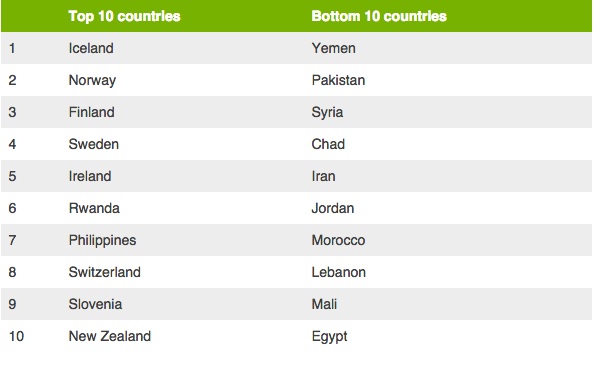
The WEF report looks at whether men and women have the same rights and opportunities in each country in four areas: health, education, economic participation and political empowerment.

Gender Pay Gap

Where Do Highly Educated Migrants Come From?

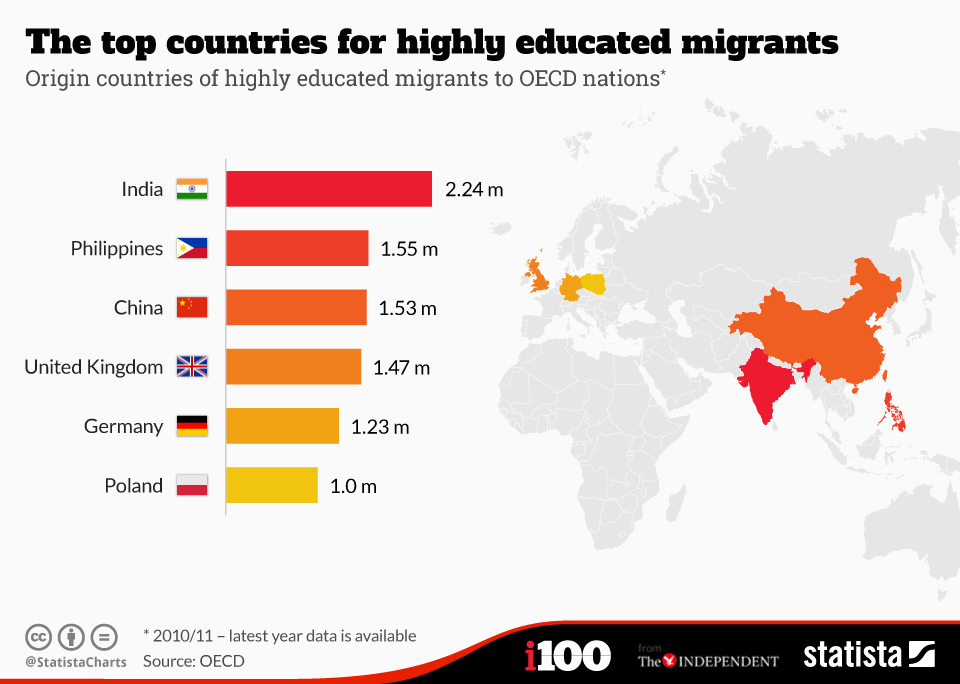
chartoftheday_4015_the_top_countries_for_highly_educated_migrants_n

Between 2000 and 2013, the number of migrants across the world increased by a third, reaching 232 million.

More and more of them are highly skilled. According to the OECD, India has the highest number of educated migrants, followed by the Philippines and China. Statista was asked by i100 to visualise the OECD’s data and you can read the entire feature here.

This chart shows the origin countries of highly educated migrants to OECD nations.

I

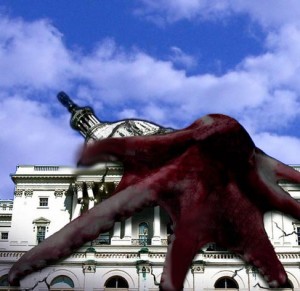
Curbing the Tentacles of the Big Banks

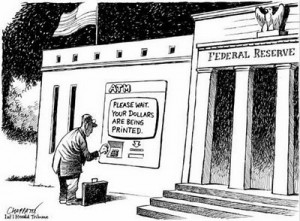
The Federal Reserve is on the verge of relinquishing the tools it used to rescue American International Group Inc. and Bear Stearns Cos. That probably won’t appease lawmakers who’ve said they’re still concerned the central bank might abuse its powers as the lender of last resort.

After the Fed released an initial proposal almost two years ago, a bipartisan group of lawmakers including Democratic Senator Elizabeth Warren complained that it didn’t go far enough and left regulators too much wiggle room to orchestrate a backdoor bailout that violates the intent of Congress. Yellen, testifying before a House panel this month, rejected the idea that the Fed should relinquish its role as potential savior in a crisis.

Warren and other lawmakers argue the expectation that the Fed will rescue failing banks, incentivizes reckless behavior on Wall Street. Lawmakers also are trying to shrink the number of banks that receive heightened supervision from the Fed and are threatening to boost Congress’ authority over the Federal Reserve Bank of New York, which oversees giant U.S. lenders such as JPMorgan Chase & Co. and Citigroup Inc.

Before Dodd-Frank, the central bank had the authority “in unusual and exigent circumstances” to lend to virtually any company or person, thanks to section 13(3) of the Federal Reserve Act. In March 2008, the Fed, then led by Ben S. Bernanke, used that power to extend credit to Bear Stearns through JPMorgan, which acquired the failing securities firm. Six months later the Fed began a bailout program to keep insurer AIG afloat.
Now the Fed is prohibited from rescuing individual firms, but Dodd-Frank permits the central bank to provide “broad-based” liquidity to the financial system if it gets the approval of the Treasury secretary. Though Dodd-Frank laid out the basic emergency lending restrictions, the Fed has to write the policies and procedures.

The lawmakers urged the Fed to revise its proposal to establish both clear time limits for how long banks could receive emergency lending and procedures for the orderly unwinding of such programs. They asked Yellen to improve how the Fed defines terms such as insolvent and broad-based. To prevent the so-called moral hazard associated with the Fed’s lending authority, the group requested that any emergency loans be made at unfavorable, or penalty, interest rates.

Yellen has indicated that she might partly, but not entirely, appease the politicians. The Fed expects to release the final rule by the end of November and will address “concerns about the definition of broad-based eligibility, insolvent borrowers, and penalty rates,” she told the House panel. She didn’t discuss the lawmakers’ other requests.  Yellen also must contend with Republican efforts led by Shelby to limit the Fed’s authority. Legislation he drafted that would reduce Fed oversight of regional banks, including eliminating stress tests for many of them, was added to a spending bill that Congress must pass next month to avert a federal government shutdown.

Tentacles of the Big Banks

US Fed and Interest Rate Liftoff

Is the US Fed making accurate assessments of its interest rate policies?


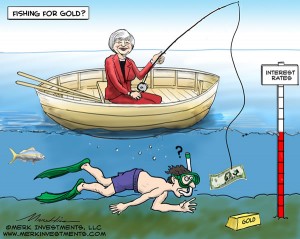
Barry Eichengreen writes: For much of the year, investors have been fixated on when the Fed will achieve “liftoff” – that is, when it will raise interest rates by 25 basis points, or 0.25%, as a first step toward normalizing monetary conditions. Markets have soared and plummeted in response to small changes in Fed statements perceived as affecting the likelihood that liftoff is imminent.

But, in seeking to gauge changes in US monetary conditions, investors have been looking in the wrong place. Since mid-August, when Chinese policymakers startled the markets by devaluing the renminbi by 2%, China’s official intervention in foreign-exchange markets has continued, in order to prevent the currency from falling further. The Chinese authorities have been selling foreign securities, mainly United States Treasury bonds, and buying up renminbi.

This is the opposite of what China did when the renminbi was strong. Back then, China bought US Treasury bonds to keep the currency from rising and eroding the competitiveness of Chinese exporters. As a result, it accumulated an astounding $4 trillion of foreign reserves.

And what was true of China was also true of other emerging-market countries receiving capital inflows. These countries’ foreign reserves, mainly held in US securities, topped $8 trillion at their peak last year.

The effects of these purchases attracted considerable attention.  Although no one outside official Chinese circles knows the exact magnitude of China’s foreign-exchange intervention, informed guesses suggest that it has been running at roughly $100 billion a month since mid-August. Observers believe that roughly 60% of China’s liquid reserves are in US Treasury bills. Given that reserve managers prefer to avoid unbalancing their carefully composed portfolios, they probably have been selling Treasuries at a rate of roughly $60 billion a month.

The effects are analogous – but opposite – to those of quantitative easing. Menzie Chinn of the University of Wisconsin has examined the impact of foreign purchases and sales of US government securities on ten-year Treasury yields. His estimates imply that foreign sales at a rate of $60 billion per month raise yields by ten basis points. Given that China has been at it for 2.5 months, this implies that the equivalent of a 25-basis-point increase in interest rates has already been injected into the market.

Some would object that the renminbi is weak because China is experiencing capital outflows by private investors, and that some of this private money also flows into US financial markets. This is technically correct, but it is already factored into the changes in interest rates described above.

Another objection is that QE operates not just through the so-called portfolio channel – by changing the mix of securities in the market – but also through the expectations channel. It signals that the authorities are seriously committed to making the future different from the past. But if Chinese intervention is just a one-off event, and there are no expectations of it continuing, then this second channel shouldn’t be operative, and the impact will be smaller than that of QE.

The problem is that no one knows how long capital outflows from China will persist or how long the Chinese authorities will continue to intervene.

Interest rates?

What Pressures Are Suppressing Inflation?

Stephen S. Roach writes:  Fixated on inflation targeting in a world without inflation, central banks have lost their way. With benchmark interest rates stuck at the dreaded zero bound, monetary policy has been transformed from an agent of price stability into an engine of financial instability. A new approach is desperately needed.

The US Federal Reserve exemplifies this policy dilemma. After the Federal Open Market Committee decided in September to defer yet again the start of its long-awaited normalization of monetary policy, its inflation doves are openly campaigning for another delay.

For the inflation-targeting purists, the argument seems impeccable. The headline consumer-price index (CPI) is near zero, and “core” or underlying inflation – the Fed’s favorite indicator – remains significantly below the seemingly sacrosanct 2% target. With a long-anemic recovery looking shaky again, the doves contend that there is no reason to rush ahead with interest-rate hikes.

The Fed’s presumption that the US will soon approach full employment has caused the so-called dual mandate to collapse into one target: getting inflation back to 2%.

Here, the Fed is making a fatal mistake, as it relies heavily on a timeworn inflation-forecasting methodology that filters out the “special factors” driving the often volatile prices of goods like food and energy.

This approach failed spectacularly when it was adopted in the 1970s, causing the Fed to underestimate virulent inflation. And it is failing today, leading the Fed consistently to overestimate underlying inflation. Indeed, with oil prices having plunged by 50% over the past year, the Fed stubbornly maintains that faster price growth – and the precious inflation rate of 2% – is just around the corner.

Missing from this logic is an appreciation of the new and powerful global forces that are bearing down on inflation.  Rather than recognize a seemingly chronic shortfall of global aggregate demand amid a supply glut and a deflationary profusion of technological innovations and new supply chains – the Fed  would rather attribute low inflation to successful inflation targeting, and the Great Moderation that it presumably spawned.

Unable to disentangle the global and domestic pressures suppressing inflation, a price-targeting Fed has erred consistently on the side of easy money.

This is apparent in the fact that, over the last 15 years, the real federal funds rate – the Fed’s benchmark policy rate, adjusted for inflation – has been in negative territory more than 60% of the time, averaging -0.6% since May 2001. From 1990 to 2000, by contrast, the real federal funds rate averaged 2.2%. In short, over the last decade and a half, the Fed has gone well beyond a powerful disinflation in setting its policy interest rate.

Over the same 15-year period, financial markets have become unhinged, with a profusion of asset and credit bubbles leading to a series of crises that almost pushed the world economy into the abyss in 2008-2009. But rather than recognize, let alone respond to, pre-crisis excesses, the Fed has remained agnostic about them, pointing out that bubble-spotting is, at best, an imperfect science.

That is hardly a convincing reason for central banks to remain fixated on inflation targeting.

Today’s enemy is financial instability. On that basis alone, the case for monetary-policy normalization has never been more compelling.

FederalReservePrintingMoney1

Financial Regulation for Crowdfunding?

Robert Shiller writes:  If one were seeking a perfect example of why it’s so hard to make financial markets work well, one would not have to look further than the difficulties and controversies surrounding crowdfunding in the United States. After deliberating for more than three years, the US Securities and Exchange Commission (SEC) last month issued a final rule that will allow true crowdfunding; and yet the new regulatory framework still falls far short of what’s needed to boost crowdfunding worldwide.

True crowdfunding, or equity crowdfunding, refers to the activities of online platforms that sell shares of startup companies directly to large numbers of small investors, bypassing traditional venture capital or investment banking.

Regulators outside the US have often been more accommodating, and some crowdfunding platforms are already operating. For example, Symbid in the Netherlands and Crowdcube in the United Kingdom were both founded in 2011. But crowdfunding is still not a major factor in world markets. And that will not change without adequate – and innovative – financial regulation.

There is a conceptual barrier to understanding the problems that officials might face in regulating crowdfunding, owing to the failure of prevailing economic models to account for the manipulative and devious aspects of human behavior. Economists typically describe people’s rational, honest side, but ignore their duplicity. As a result, they underestimate the downside risks of crowdsourcing.

The risks consist not so much in outright fraud – big lies that would be jailable offenses – as in more subtle forms of deception. It may well be open deception, with promoters steering gullible amateurs around a business plan’s fatal flaw, or disclosing it only grudgingly or in the fine print.

It is not that people are completely dishonest. On the contrary, they typically pride themselves on integrity. It’s just that their integrity suffers little lapses here and there – and not always so little in aggregate.

The SEC’s new rules for crowdfunding are complex, because they address a complicated problem. The concept underlying crowdfunding is the dispersal of information across millions of people. Most people, even the cleverest, cannot grasp the next breakthrough business opportunity. Those who can are dispersed.

The problem is that the promise of genuine “unique information” comes with the reality of vulnerability to deception. That’s why channeling dispersed knowledge into new businesses requires a regulatory framework that favors the genuinely enlightened and honest. Unfortunately, the SEC’s new crowdsourcing rules don’t go as far as they should.

The SEC with rulemaking for crowdfunding platforms specified that no startup can use them to raise more than $1 million a year. This is practically worthless in terms of limiting the scope for deception. In fact, including this provision was a serious mistake, and needs to be corrected with new legislation. A million dollars is not enough, and the cap will tend to limit crowdfunding to small ideas.

Some of the SEC rules do work against deception. Notably, crowdfunding platforms must provide communication channels “through which investors can communicate with one another and with representatives of the issuer about offerings made available.”

That is a good rule, fundamental to the entire idea of crowdfunding. But the SEC could do more than just avow its belief in “uncensored and transparent crowd discussions.” It should require that the intermediary sponsoring a platform install a surveillance system to guard against interference and shills offering phony comments.

The SEC and other regulators could go even further. They could nudge intermediaries to create a platform that summarizes commenters’ record and reputation. Indeed, why not pay commenters who accumulate “likes” or whose comments on issuers turn out to be valuable in light of evidence of those enterprises’ subsequent success?

For the financial system as a whole, success ultimately depends on trust and confidence, both of which, like suspicion and fear, are highly contagious. That’s why, if crowdfunding is to reach its global potential, crowdphishing must be prevented from the outset. Regulators need to get the rules right (and it would help if they hurried up about it).

crowdfunding-featured5

ISIS: Horrifying and Baffling

ISIS  An important review of two books by an ‘ananymous’ contributor who has been involved with ISIS.

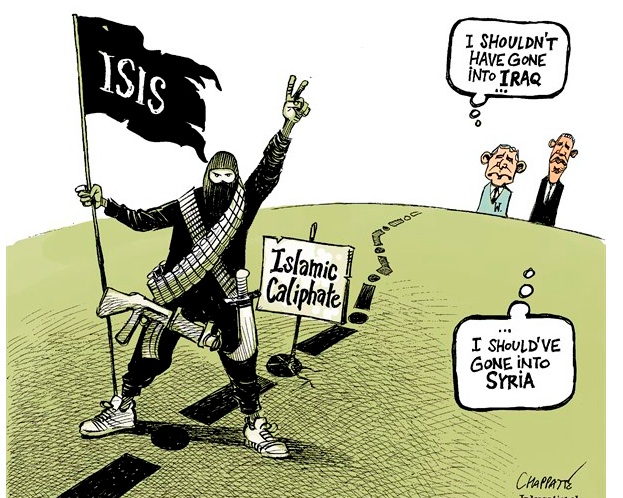
New York Review of Books: The rise of Ahmad Fadhil—or as he was later known in the jihad, Abu Musab al-Zarqawi—and ISIS, the movement of which he was the founder, remains almost inexplicable. The year 2003, in which he began his operations in Iraq, seemed to many part of a mundane and unheroic age of Internet start-ups and a slowly expanding system of global trade. Despite the US-led invasion of Iraq that year, the borders of Syria and Iraq were stable. Secular Arab nationalism appeared to have triumphed over the older forces of tribe and religion. Different religious communities—Yezidis, Shabaks, Christians, Kaka’is, Shias, and Sunnis—continued to live alongside one another, as they had for a millennium or more. Iraqis and Syrians had better incomes, education, health systems, and infrastructure, and an apparently more positive future, than most citizens of the developing world. Who then could have imagined that a movement founded by a man from a video store in provincial Jordan would tear off a third of the territory of Syria and Iraq, shatter all these historical institutions, and—defeating the combined militaries of a dozen of the wealthiest countries on earth—create a mini empire?  ISIS

Isis

Cutting Off ISIS Funds?

Cutting off the financing for ISIS is critical.  Mark Gilbert writes: Dr. Christina Schori Liang, a senior fellow at the Geneva Centre for Security Policy, notes in a paper for the IEP that IS (also known as ISIL or ISIS) is “the richest terrorist organization in history, with an estimated wealth of $2 billion.” IS earns about $1.5 million a day from selling oil, producing as many as 40,000 barrels per day and selling for as little as $20 a barrel. The oil is smuggled through Iraq and Kurdistan, border guards are bribed, while donkeys and trucks traverse deserts and mountain passes to avoid detection. IS has its own underground pipelines and refineries; while coalition forces had destroyed 16 mobile refineries by the end of last year, they can be rebuilt for as little as $230,000.

Its income is boosted by trafficking people and auctioning slaves, kidnapping for ransom (raising $45 million last year), extortion, taxes on income, business revenues and consumer goods in the lands it controls, as well as looting and selling antiquities. The Financial Action Task Force reckons IS stole about $500 million late last year just by raiding state-owned banks in the territories it controls. As Liang argues, “the West has so far failed to impede ISIL’s financial gains which are marked by a fluidity and wealth never seen before.”

Strangling the flow of cash that allows IS to arm its jihadists and fund the local infrastructure in the regions it occupies could smother the organization in ways that may prove even more effective than bombing its bases. As the journal Studies in Conflict and Terrorism noted as long ago as 2004 in a report on al-Qaeda, though, terrorist groups typically rely on informal money transfer networks and under-regulated Islamic finance channels which are harder to close down.

Thomas Sanderson, co-director of the Transnational Threats Project at the Center for Strategic and International Studies, said:

Our options and appetite for more investment of blood and treasure in the fight against terrorism may be limited, but without addressing all dimensions of the financing threat, our progress over the years may be lost. If groups like ISIS can fill their coffers, run economies and consolidate their hold on power, we may be facing a new, more dangerous brand of global terrorism that will threaten the United States and its allies for years to come.

Driving a wedge between IS and the dollars it needs demands greater cooperation between the various countries that profess to oppose the group, more punishing sanctions against any nation found to have turned a blind eye to stolen oil crossing its borders, a coordinated refusal to pay ransoms, and severe retributions against anyone found to participate in the trading of looted treasure. Waging financial war on IS to undermine its ability to operate as a nation state should clearly be more of a priority than it has been so far.

1220226400918821922oil drill.svg.hi (1)

Connection of Refugee Movement to Jihadists Complicates Welcome

Nationalism and unity plays out in the EU

Ka Leers writes: When voters in both the Netherlands and France rejected a new EU constitution by referendum in 2005, governments across Europe were aghast. How could these voters come out in such numbers against the European Union, the machine that had so obviously ensured peace and prosperity for more than 50 years?

“Voters operate on the premise that they are the boss, not politicians,” says Hans Anker, a successful Dutch pollster who used to work with the famous American voter researcher Stan Greenberg. Anker was asked by the Dutch government to find out what the heck had happened.Extensive research and focus groups involving great numbers of Dutch voters after the referendum showed why many voters simply took it as an opportunity to slap the sitting government on the wrist. They felt that EU expansion – at the time the Union was on its way to adding 10 new member states – was being carried out without their permission.

Most voters in the referendum didn’t vote against the EU constitution itself, Anker found. Rather, they voted as they did because they felt that the European Union’s ever-expanding power was a train that kept moving forward – a locomotive commandeered by an elite that never asked them whether they approved of its chosen direction. “Nobody ever asked me anything; now I’ll show them.” That was the gist.

It appears that the refugee crisis is now driving this sentiment back to the fore, perhaps more than any other topic ever did – including the EU’s shock expansion in 2005. Wherever government leaders go against the grain and welcome refugees, as Germany Chancellor Angela Merkel did, massive swings in the polls are seen. In countries such as Switzerland and Poland, political parties that take an explicit stance against refugees have scored landslide electoral wins. In Germany itself, the Alternative for Germany – until quite recently fading in the polls – is now back with a vengeance, picking up additional voters with each passing poll. This is scaring even Merkel into taking a step back. She now supports building refugee centers on Germany’s southern borders in an effort to stop the influx, a proposition she vehemently opposed just a couple weeks back.

The attack on Paris and its connection to refugee movement complicated the issue.