Emerging from Low Interest Rates: US 1994

How does a central bank normalize monetary policy after a long spell of unusually low interest rates? This may seem like a question very much of the present, as Fed leaders ponder interest-rate policy following the Great Recession of 2007- 2009 and the tepid U.S. recovery. But it’s also a challenge the Fed confronted two decades ago. In 1994, the Federal Open Market Committee (FOMC) wrestled with a similar dilemma as it considered emerging from a sustained period of low interest rates, amid signs of a reviving economy, growing aggregate demand, and no obvious signals of inflation.

The Richmond Fedeal Reserve reports Emerging from Low Interest Rates

Low Interest Rates

QE Slow to Show its Mark

Euro money supply increasing..

The Eurozone’s money supply grew at its second fastest rate since 2009 in October, according to figures released today by the European Central Bank (ECB).

Lending to the private sector expanded at its joint quickest rate since 2012.

The Eurozone’s M3 money supply, which adds up the notes, coins and bank deposits held by Eurozone consumers and businesses, increased 5.3 per cent in October compared with the same month last year.  Money supply growth has been boosted by the ECB’s €1.1 trillion (£780bn) quantitative easing programme, but was also beginning gaining traction in the run up to its launch.

There was €10.8 trillion euros in circulation in the Eurozone at the end of last month, the ECB said.

Bank lending to the private sector increased one per cent in October.

Despite the improvement in the Eurozone’s financial conditions, economists are still betting there will be an expansion of the QE programme at the next meeting. . The ECB is concerned by persistently low inflation – it was 0.1 per cent in October, well below the central bank’s two per cent target.

Economist Jack Allen from Capital Economics said the growth in the money supply “is still slow by past standards and suggests that the ECB might struggle to hit its inflation target.”

“M3 growth has been broadly flat since QE began in March and is consistent with core inflation of around 1.5 per cent – below the ECB’s target for the headline rate.”

Printing Money

Should We Try to Stabilize the World’s Monetary System?

During the Second World War,70 countries met in 1944 to work out an agreement about monetary policy which would ensure some stability about the War.  The agreement reached in Bretton Woods helped to achieve this goal, until the US stopped supporting the dollar with gold.

Roger Lowenstein writes:   The world’s monetary system moves from tumult to tumult. Europe’s economy is stagnant and menaced with deflation. Greece has flirted both with leaving the euro and with default. America’s economy has fallen into a discouraging pattern of hopeful growth spurts followed by dispiriting slowdowns. Such turmoil has played havoc with world currencies. Late last year, the value of the euro crashed. Earlier this year, the cautious Swiss stunned traders by freeing their currency, permitting it to soar against the euro and raising—sharply—the price of its chocolates and ski chalets for people from Lisbon to Rome. Such volatility has lately been increasing. If, as the Harvard political scientist Jeffry Frieden has asserted, “the exchange rate is the single most important price in any economy, for it affects all other prices,” then global economies have rarely looked so unstable.

Lately, the instability has spread to Asia. Since 2012, the Japanese yen has lost nearly a third of its value. This has enhanced the competitiveness of Japanese products, putting pressure on its Asian neighbors. China’s economy—in recent years the biggest contributor to the world’s growth—is rapidly decelerating. In August, China stunned markets by devaluing its currency. As for the US, the dollar has risen sharply against the euro and other currencies, but this rise has put America’s fragile recovery in jeopardy, by rendering its manufactured products less affordable overseas. And it has spelled bankruptcy for some of the foreign firms that borrowed in dollars (now too expensive for them to repay). A certain amount of gyration among currencies is normal, of course; that is what currencies do. But the instability has been alarming to traders, businesses, and statesmen.

Since the financial crisis, individual banks have been subject to a welter of new laws and regulations, but not so the international monetary system in which they operate. This system serves as a conducting rod for transmitting local disturbances around the globe. Even this metaphor presumes too much, for the international monetary “system” is, in fact, not a system at all. Its various pieces are simply too disjointed. America and most countries in the West permit capital to freely cross their borders. But China, the most important emerging power, tightly controls the movement of capital.

If, say, Coca-Cola wants to build a factory in China, it must apply to the government to exchange dollars for local renminbi. Many other emerging countries maintain weaker, or periodic, capital controls. Some allow their currencies to float; others “peg” them to the euro or the dollar. Switzerland maintained such a peg—until, in January, it didn’t. The dollar is the linchpin—the usual standard for other currencies and for international trade. However, no agreement or formal convention assures the dollar.  The New Financial Order

Stablizing Currency

Entrepreneur Alert: Climate Change in Politics of Myanmar

Start up opportunities as climate changes in Myanmar’s political landscape.

Myanmar-startups.com present the Rice Bowl Startup Awards held during the ASEAN Entrepreneurship Summit in Kuala Lumpur, November this year. It is the first ASEAN award that recognizes breakout startups that harness technology innovatively. What sets the awards apart from other accolades is that they are developmental in nature and focus on enhancing the nominees and giving them regional exposure.

Fantasy Sports Gambling and the Market Not?

A hearing on the fantasy sports case mounted by the New York Attorney General Eric Schneiderman ended inconclusively.

Daily fantasy sports sites FanDuel and DraftKings have always maintained that the services they offer don’t count as gambling because they’re contests of skill.  Schneiderman defines daily fantasy sports as illegal gambling under New York state law, saying that “winning or losing depends on numerous elements of chance to a ‘material degree.’” If public officials in other states agree, it could be the end of the daily fantasy sports industry in the U.S.

FanDuel and DraftKings have cited a 2006 federal law to distinguish themselves from illegal gambling. But that law explicitly defers to state definitions of what counts as betting. In most cases, states determine the legal status of contests with cash prizes by examining whether the activity is based on skill (like playing in a bowling tournament) or chance (like pulling the arm on a slot machine). Many activities are a mix of both, of course, and states have different thresholds for how much chance is acceptable before something becomes gambling. For Schneiderman, season-long fantasy sports are tolerable in part because they involve long-term strategy over several months. Daily fantasy games can turn on a single play.

New York’s standard is in the middle of the pack, according to Daniel Wallach, a sports and gaming attorney with the firm Becker & Poliakoff. Wallach says about 10 states have said games involving any amount of chance count as gambling, while about 20 states say chance must be the “predominant factor” in the outcome.

 Given New York’s influence, states with similar thresholds may follow its lead.

While the legality of daily fantasy sports turns on the skill-vs.-chance question, the cases made by both advocates and critics have a fundamental contradiction. At the same time Schneiderman argues that participating in daily fantasy sports resembles playing the lottery, he complains that a small number of top players win almost all the time. He even compares the games to poker, which many academics see as heavily skill-based. Considering that Schneiderman’s letter doesn’t weigh in on allegations of cheating, it stands to reason that some players win all the time because they’re just better than everyone else.

FanDuel and DraftKings, on the other hand, describe daily fantasy as a skill-based activity when discussing legal matters. But they push back against the idea that the success of elite players makes it less likely for less-savvy users to win.

Schneiderman raises concerns that daily fantasy sports will lead to the same kinds of public-health and economic problems that illegal gambling has caused. Potential problem gamblers are likely to be lured by “the quick rate of play, the large jackpots, and the false perception that it is eminently winnable,” Schneiderman wrote. “Ultimately, it is these types of harms that our Constitution and gambling laws were intended to prevent in New York.”

 None of these points directly address the legal standard of chance vs. skill.


Esteves, Better Than Goldman, Gets a CarWash

The Petrobras scandal has widened to indict Andre Esteves, who claims he is better than Goldman Sachs bankers.

The chief executive of Brazil’s largest independent investment bank and a powerful ruling party senator were arrested early Wednesday as part of an investigation into a massive corruption scandal at state-controlled oil company Petróleo Brasileiro SA.

Authorities in Brasília arrested Sen. Delcídio do Amaral, a member of the governing Workers’ Party and the Senate whip, whose help is seen as critical for President Dilma Rousseff to pass unpopular austerity measures to shore up Brazil’s shaky finances.

Prosecutors say the two men were conspiring to pay millions in bribes to a key witness in the Petrobras investigation, then spirit him out of Brazil on a private jet to prevent him from turning state’s evidence that could implicate them in the sprawling graft scheme.

The arrests were stunning even by the standards of Brazil’s biggest-ever corruption probe, which has toppled elites at the highest levels of the nation’s business and government. The developments are yet another blow to Ms. Rousseff, whose popularity has plummeted as Brazil’s economy has deteriorated and her party, known as the PT, has become mired in the scandal.

Through his attorney, Mr. Esteves denied wrongdoing. Mr. Amaral’s lawyer said his client is fighting the charges against him.

Messrs. Esteves and Amaral were taken into custody on suspicion they were trying to stop a former Petrobras executive, Nestor Cerveró, from cutting a plea bargain with prosecutors and providing testimony that would link the men with the corruption scandal, according to Brazil’s Supreme Court, which authorized the arrests.

Mr. Cerveró is accused of taking bribes in exchange for awarding supplier contracts as part of a massive graft ring that operated at Petrobras for more than a decade. Court documents portray the efforts by Messrs. Esteves and Amaral to free Mr. Cerveró from custody.

At a November meeting at an upscale Brasília hotel, Mr. Amaral met with Mr. Cerveró’s son, Bernardo Cerveró and two other men to discuss ways to free Mr. Cerveró from prison and have him flee the country, according to the documents.

According to the documents, Mr. Amaral proposed using a legal maneuver to secure Mr. Cerveró’s release from prison while he awaits trial.

Supreme Court Justice Teori Zavascki said that Mr. Amaral “is part of a criminal organization,” citing the senator’s alleged participation in “an escape plan” that could jeopardize the corruption probe known as Operation Car Wash.

The court documents didn’t expressly indicate a link between BTG and the investigation.

But Brazilian authorities have been investigating BTG’s $1.5 billion purchase of a 50% stake in the African operation of Petrobras in 2013 following allegations that the price paid the bank may have been too low.

BTG also is a major investor in troubled oil rig supplier Sete Brasil Participações SA, which also was ensnared in the Operation Car Wash investigation.

Mr. Esteves’s arrest is a dramatic setback for one the nation’s best-known financial executives. One of Brazil’s richest men, Mr. Esteves, 46, has a net worth estimated at $2.1 billion, according to Forbes.

Mr. Esteves quickly developed a reputation for innovative deal making and built BTG into Brazil´s largest independent investment bank, with 245 partners and 3,500 employees. The bank manages about $112 billion and has offices in 20 countries.
 

Trump Populism in the US Presidential Campaign

Republican presidential candidate Donald Trump is echoing Senator Elizabeth Warren (D-Mass.) in his push to make college tuition more affordable, saying Thursday that the U.S. should “start some governmental program.”

Trump said,  “Well, the only way you can do it is you have to start some governmental program and you have governmental programs right now…We’re going to do something very big with loans because you have to get these people going. They really feel down and out.”

Warren has proposed such measures during her tenure in the Senate, calling for reforms to the way college education operates in the United States.

In June, Warren unveiled a plan that would create a new government program that would give states money so that they could keep tuition low. As Inside Higher Education notes:  “Warren wants a new federal program that would provide funds to states that make some public higher education options so inexpensive that borrowing would not be required, and she wants more federal funding to come with more strings attached.”

In addition, Senator Bernie Sanders (I-Vt.) has proposed “free” tuition by reforming the education system, making it a central theme of his 2016 campaign for the Democratic Party’s nomination.

Warren has also stated that there are too many institutions of higher learning, traditionally a conservative position.  For people around the globe who are confused by the 2016 Presidential  campaign in the US, I is well to look at Trump, Warren and Sanders as populists.

Wives Earn More than Husbands?

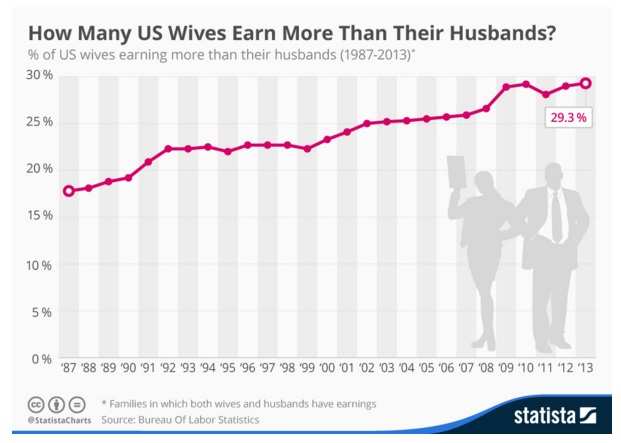
How many wives earn more than their husbands in the US?

Back in 1987, only 17.8 percent of American wives outearned their husbands, according to data from the Bureau of Labor Statistics. Even though the situation is gradually improving, it quite rare to find a wife that takes home more money than her husband. In 2013, 29.3 percent of American wives were the main breadwinners in US families (where both wives and husbands have earnings).

This chart shows the % of US wives earning more than their husbands from 1987 to 2013.

Wives Earn More than Husbands?

Can We Kickstart Stagnation by Investing in Clean Energy?

Can we kickstart economic stagnation with investments in clean energy?

Dean Baker writes:   As the world prepares for another round of climate negotiations in Paris starting Nov. 30, it is worth repeating a few simple points.

It is becoming increasingly obvious that the world is already paying a substantial price for global warming. Sure, extreme weather events will never come with a stamp that says “caused by global warming.” But we know that global warming will change weather patterns in ways that are not entirely predictable. That means that we will see unusual weather events where global warming was likely a factor, but we can never know for certain.

One of the leading candidates in this respect is the extreme drought that afflicted Syria in the last decade, destroying much of its agriculture and leading to a mass migration to its cities. This migration was likely a factor in the unrest that led the country’s civil war starting in 2011. Syria’s conflict in turn has led to hundreds of thousands of deaths, the displacement of millions, and of course the rise of the Islamic State in Iraq and the Levant (ISIL).

It is likely that we will see, or are already seeing, other weather disruptions with comparable human consequences. Unfortunately, there has been much attention to low-lying and relatively sparsely populated islands as the main victims of global warming. In fact, there will almost certainly be hundreds of times more victims in relatively densely populated areas facing droughts or countries such as Bangladesh, which could be hit by devastating floods.

The time has long since passed for arguing about whether global warming is happening or whether the consequences will be serious. The question is what we are prepared to do about it. Here also, we have seen reality largely turned on its head.

Most countries are still suffering from the fallout of the Great Recession. They are struggling to contain budget deficits even as their economies remain well below full employment. This creates a situation where the leaders planning to meet in Paris are looking to address climate change on the cheap.

This logic is 100 percent backwards. The economic problem that the United States, most of Europe, Japan and even China now face is secular stagnation. This is a prolonged period of inadequate demand. The constraint on further output in all of these places is not the limit of the economy’s ability to produce goods and services, but rather of the demand for goods and services.

We should be paying for India and other developing countries to build out a modern electric grid that is based on clean energy.

This is a problem for which measures to confront climate change present an obvious solution. We know that reducing greenhouse gases (GHG) to acceptable levels is a massive undertaking. It will take an enormous amount of capital and labor to make our homes and businesses more energy efficient, and to convert them to clean sources of energy as quickly as possible. The same applies to our transportation network: We have to promote mass transit and make all of our transportation vehicles cleaner.

This can be done, though it costs money. But the story that is missed is that secular stagnation means we have the money. The resources are the unemployed and underemployed workers who could be employed in this massive undertaking. In terms of money, contrary to the whining of the deficit hawks, there are no practical limits to how much the United States, Europe and Japan can borrow right now. We hit limits on our ability to borrow when the economy is near full employment, not when there are still large numbers of unemployed workers.

It’s not necessary to take my word on this issue; the financial markets are saying the same thing. Long-term interest rates in the United States remain at extraordinarily low levels. The major European countries face long-term interest rates of less than 1.0 percent. And that debt-ridden basket case Japan has to pay a tiny 0.3 percent interest rate on its long-term debt. These markets are telling us that we can borrow hundreds of billions more each year to address global warming or other major needs.

There is one other point that is worth noting in this context. We should want to reduce GHG emissions at the lowest possible cost. Since it doesn’t matter for the environment whether the GHG comes from the U.S. or India, it would make sense to reduce emissions in the places where we get the greatest reductions per dollar.

That would mean having the U.S. and other wealthy countries pay developing countries to reduce their GHG emissions. We should be paying for India and other developing countries to build out a modern electric grid that is based on clean energy. That would be enormously beneficial to these countries, since they desperately need more energy, but it would also be beneficial to the wealthy countries, since we could avoid an enormous amount of coal usage. And paying India to develop clean energy should even help create jobs in the U.S., although the route is a bit circuitous.

Anyhow, this would be an obvious case where we could do something that would be very good for people in the developing world and for the U.S. economy today, and hugely important for all of our children and grandchildren in the years to come. Unfortunately, when we have a Congress controlled by people who doubt evolution or question whether global warming is happening because they are not scientists, we may not make much progress along.