Bank Equity Requirements Up. Size of Banks May Be Up Too

Equity requirements upped for banks and questions about the size of banks subject to US Fed regulation.

The largest U.S. banks would face a $120 billion total shortfall of long-term debt under a Federal Reserve proposal aimed at ensuring their failure wouldn’t hurt the broader financial system.

Banks such as Wells Fargo & Co. and JPMorgan Chase & Co. will be required to hold enough debt that could be converted into equity if they were to falter, according to a Fed rule that was approved by a unanimous vote on Friday. The Fed’s proposal, which applies to eight of the biggest U.S. banks, requires debt and a capital cushion equal to at least 16 percent of risk-weighted assets by 2019 and 18 percent by 2022.

Ian Katz writes: The broad strokes of the proposal, including the lengthy phase-in period and the 18 percent target instead of what some bankers thought could be as high as 20 percent, are easier than many in the industry expected.

The proposal, along with other measures regulators have taken to avoid chaotic bank failures, “would substantially reduce the risk to taxpayers and the threat to financial stability stemming from the failure of these firms,” Fed Chair Janet Yellen said in a statement. The plan “is another important step in addressing the ‘too big to fail’ problem,” she said.

The rule on total loss-absorbing capacity, or TLAC, is a key part of regulators’ efforts to avoid another financial crisis. If U.S. banks were to fail, investors in their stock would lose everything, but the debt would be converted into equity in a new, reconstituted bank under the plan. It’s an element of the so-called living wills banks must submit to the Fed and Federal Deposit Insurance Corp. each year to map out their hypothetical demise.

The reason for the provision: When a bank fails, regulators want it to have a war chest to fund a new, healthy version of the company — hopefully without a dime from taxpayers.

Wells Fargo had been perceived as facing the toughest road under the rule because of its reliance on deposits rather than debt.

Jaret Seiberg, an analyst at Guggenheim Securities LLC, said in a research note that the Fed “passed up several opportunities to be even more onerous.”

The Financial Stability Board, a group of global regulators that makes recommendations to the Group of 20 nations, plans to phase in a TLAC rule requiring long-term debt of at least 16 percent of risk-weighted assets starting in 2019 and 18 percent by 2022.

The Fed also approved mandatory levels of minimum long-term debt, which vary depending on how large and complex the banks are.

Since the financial crisis, the Fed has consistently written rules that have been more stringent than global regulatory accords on capital and liquidity.

Banks are now subject to regulation if they have $50 billion in assets.  Banks have asked to up this to $500 billion.  The Fed set new requirements to help protect against bank failures;  “The final rule establishes a number of enhanced prudential standards for large U.S. bank holding companies and foreign banking organizations to help increase the resiliency of their operations. These standards include liquidity, risk management, and capital. It also requires a foreign banking organization with a significant U.S. presence to establish an intermediate holding company over its U.S. subsidiaries, which will facilitate consistent supervision and regulation of the U.S. operations of the foreign bank. The final rule was required by section 165 of the Dodd-Frank Wall Street Reform and Consumer Protection Act.”  from the US Fed.

Bank Regulation?


On the Oil Cliff?

Who is on the Oil Cliff?

The Saudi economy is short of cash, prompting both the public and the private sector to cut their expenditures; meanwhile, bank clients are withdrawing their deposits and taking new loans, meaning the economic outlook for the oil-reliant nation is rather gloomy.  Although the Saudi economy hasn’t been badly shaken yet by the decline in oil prices, it has by now lost its development momentum, meaning the nation’s capability to expand oil production is limited. As most Saudi energy projects are bound to falter amid the mounting disinvestment, crude prices will settle at a more stable foundation and the Kingdom will lose some of its historic pricing power.

For Russia, $30 is the number to watch.  Crude prices at that level will push the economy to depths that would threaten the nation’s financial system, according to 15 of 27 respondents in a Bloomberg survey. Lower prices for the fuel are next year’s biggest risk for Russia, which is unprepared to ride out another shock on the oil market, most economists said. Other dangers for 2016 include geopolitics, strains in the banking industry and the ruble, according to the poll of 27 analysts.

On the Cliff


India and China Enveloped in Smog as Leaders Tackle Climate Change in Paris

The Rocky Road to Globalization

The capitals of the world’s two most populous nations, China and India, were blanketed in hazardous, choking smog on Monday as climate change talks began in Paris, where leaders of both countries are among the participants.

China’s capital Beijing maintained an “orange” pollution alert, the second-highest level, on Monday, closing highways, halting or suspending construction and prompting a warning to residents to stay indoors.

The choking pollution was caused by the “unfavorable weather.”

In New Delhi, the U.S. embassy’s monitoring station recorded an air quality index of 372, which puts air pollution levels well into “hazardous” territory. A thick smog blanketed the city and visibility was down to about 200 yards (metres). Air quality in the city of 16 million is usually bad in winter, when coal fires are lit by the poor to ward off the cold. Traffic fumes, too, are trapped over the city by a temperature inversion and the lack of wind. However, the government has not raised any alarm over the current air quality and no advisories have been issued to the public. Thirty thousand runners took part in a half marathon at the weekend, when pollution levels were just as high.

In Beijing, a city of 22.5 million, the air quality index in some parts of the city soared to 500, its highest possible level. At levels higher than 300, residents are encouraged to remain indoors, according to government guidelines. The hazardous air underscores the challenge facing the government as it battles pollution caused by the coal­burning power industry and will raise questions about its ability to clean up its economy at the talks in Paris. Chinese President Xi Jinping and Indian Prime Minister Narendra Modi are both in Paris and both were scheduled to meet U.S. President Barack Obama on Monday to give momentum to the two­week negotiations. ”

Modi sought to highlight India’s green credentials writing: “The instinct of our culture is to take a sustainable path to development. When a child is born, we plant a tree.” But at Connaught Place, a city centre landmark in New Delhi, people chided the government for failing to minimize the risks to their health from air pollution. “The pollution level is so high it’s just unbelievable,” said Aisha, a 19­year­old student. For Beijing’s residents, the poor air makes breathing hard. This sort of weather, you can see that all of Beijing has been completely enveloped in smog.

Image by Susan Rennie

Image by Susan Rennie

Balance Between Criminal Charges in Banking and Fines?

The Rocky Road to Globalization

French companies are complaining that they pay huge fines to the US government when they do not comply with American law, but that France is not benefitting by reciprocal fines.  In the US, the policy has been to exact fines, big by the ordinary citizen’s standards, but the cost of doing business for most corporations.  There are no crimes charged.

Only when Credit Suisse was forced to plea one criminal charge as citizens and some lawmakers joined the hue and cry against big banks’ seeming immunity.  Promises made by the SEC and the Department of Justice helped the Swiss bank accept the charge.  They must have been told that the bank would not loose its 2 billion dollar pension business in the US if they pleased guilty.

US Representative Maxine Waters and Senator Elizabeth Warren demanded that the US Labor Department justify its exemption for Credit Suisse, enabling the bank to continue its pension business in the US despite its criminal status.

Hearings were held last January 15th.  Testimony about Credit Suisse’s corrupt culture was given by important people in finance around the globe.

The outcomeL  Instead of granting the ten-year exemption Credit Suisse had applied for, they were given a five-year exemption.  The criminal plea counted for almost nothing.

Do we want laws on the books that are not enforced?  Why exact a criminal plea if it is not enforced?   ANd where do these monies the government collects go?

Jail Bankers?


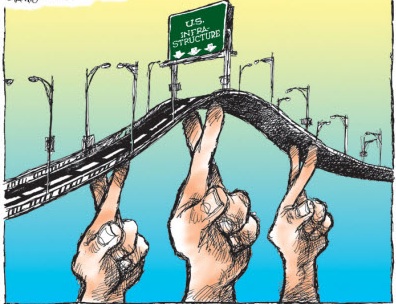
Innovative Highway Bill Passes in the US

US moves to address infrastructure building and repairs with innovative, one-off financing from the US Fed.  Important progress in infrastructure building and job creation.

The US  House of Representatives has passed a long-term U.S. highway funding plan, paving the way for the first multi-year transportation law since 2012.

Bankers also won a last-minute change that will use Federal Reserve surplus funds to pay for highway improvements, instead of reducing a payout they receive from the central bank.

“It cuts waste, it prioritizes good infrastructure, it will help create good-paying jobs. And it is the result of a more open process,” House Speaker Paul Ryan, a Wisconsin Republican, said at a news conference after the vote. “It’s a good start. It’s a glimpse of how we should be doing the people’s business.”

The Senate has passed its own version of the legislation, and a conference committee will try to resolve the differences before current highway funding ends Nov. 20.

The House measure would provide a six-year blueprint for spending on roads, bridges and mass transit projects and provide funding for three of those years. Companies that may get a boost include Caterpillar Inc., one of the top Ex-Im beneficiaries and the world’s biggest maker of mining and construction equipment. Contractors may feel secure enough to purchase new equipment after renting in recent years.

The $339 billion House highway plan, H.R. 22, would be financed in part by surplus capital from the Fed. That mechanism — sponsored by Representative Randy Neugebauer, a Texas Republican — was adopted just minutes before final passage of the highway measure. The Fed’s surplus capital comes from the nation’s 12 reserve banks, and totaled $29.3 billion as of Oct. 29.

House members agreed to abandon the Senate’s funding mechanism, which would reduce to 1.5 percent the annual 6 percent dividend national banks receive from the Fed. Banks vigorously fought that provision, and a group comprised of 27 banking organizations sent House leadership a letter Wednesday endorsing Neugebauer’s amendment.

Infrastructure

Entrepreneur Alert: Not to Go Public?

Jimmy John’s, the sandwich chain with about 2,300 restaurants across the U.S., has shelved plans for an initial public offering.

Chief Executive Officer Jimmy John Liautaud, a majority owner of the company, said he spent the past two years talking to bankers and exploring an IPO before deciding that he wanted to stay focused on running the business he founded in 1983.

Liautaud, who didn’t attend college, opened the first Jimmy John’s in Charleston, Illinois, after graduating from high school. The 51-year-old expects the chain to finish the year with more than $2 billion in sales. It has 51 company-owned stores, with the rest operated by franchisees. Private-equity firm Weston Presidio bought 28 percent of Jimmy John’s in 2007 and still owns the stake, Liautaud said.

Jimmy John’s had been pursuing an IPO and had scheduled road-show meetings. Morgan Stanley was serving as the lead book runner for the deal, which would have valued Jimmy John’s at about $2 billion, the website said.

The road show never happened, and Liautaud scrapped the IPO plan in October because he wanted to focus on managing the sandwich chain in what’s become a tough climate for restaurants. The decision wasn’t based on conditions in the IPO market, the company said.

The chain, which had early success opening near college campuses and staying open late, is currently making an expansion push in California. An additional 1,300 restaurants are slated to open in the U.S. over the next five years, Liautaud said.

“I need to be here balancing all the dishes that are spinning,” he said.

Jimmy Johns Independent

Special Drawing Rights for Renminbi?

The IMF will add the renminbi to its Special Drawing Rights basket today.

Matt Levine writes about how China fulfilled the IMF’s two requirements:
The staff’s findings hinged on the renminbi meeting two criteria. The first is that China and the renminbi have a significant role in global trade, a bar which Beijing passed years ago. But the second — that the renminbi be both widely used and “freely usable” internationally — has proved more contentious.

In a number of the measures that ascertain how widely it is used — such as its use in central bank foreign exchange reserves and in international debt markets — the renminbi fell below the Australian and Canadian dollars, neither of which is a member of the SDR basket.

Operational and free-usability issues remain, but on the other hand I suppose nothing will encourage Chinese currency liberalization like SDR inclusion. That

The inclusion puts new pressure on Beijing to change everything from how it manages the yuan, also known as renminbi, to how it communicates with investors and the world. China’s pledges to loosen its tight grip on the currency’s value and open its financial system will come under new scrutiny.

A working group that includes former Treasury secretaries Henry Paulson and Timothy Geithner hopes to build a framework for the trading and clearing of the Chinese currency in the U.S., the Wall Street Journal reported Monday, citing a statement from Michael Bloomberg, who will chair the group.

Remninbi


Entrepreneur Alert: Technologies Impacting the Future

First there was the rise of smartphones, than tablets came along and finally cloud services hit the mainstream. But what’s next? Which technologies will shape the near future, especially from a professional point of view? IBM asked more than 5,000 C-level executives from 70 countries which technologies they think will be particularly important in the next three to five years. Most CxOs agree that cloud computing and mobile solutions will continue to play a key role, while the Internet of Things is expected to make a big impact as well.

Technologies Shaping the Future

Are Climate Change Policies Economical?

The Paris meeting on climate change will tackle this question: Is combatting climate change economical?

Andrew Walker writes:  Economists have been wrestling with the question since at least the early 1980s.  The approach most often adopted is to treat the problem rather like an investment appraisal, to do a cost-benefit analysis – though this method has its critics even among economists.

The investment side of it is shifting the world to an economic system that produces much less by way of climate changing gas emissions, or even none at all.  You then compare the cost of doing that with the benefits, in the shape of climate-related harm avoided.  It sounds straightforward. But of course it isn’t.

Measuring both elements -the costs and the benefits – is fraught with difficulty.  So is a third factor: how you compare costs in the near future with more distant benefits. More on that later.

There’s another way of looking at it.

One of the basic ideas in economics is that you tend to get the best results if people or businesses that take decisions have to take account of all the benefits and costs.

Pollution is the text book example of a situation where that may not happen. The polluter has no incentive to consider the impact of the pollution.

It is what economics textbooks call an externality, which in turn is one example of what they call “market failures”.

The standard economic analysis of climate change sees in those terms.

There are externalities: emissions produced by a person or business lead to costs – and sometimes benefits – for others which the emitter has no incentive to consider.

What do you do about it if you accept that view? The mainstream economic view of how to deal with an undesirable externality is that you tax it.

It’s called a Pigouvian tax after the British economist Arthur Pigou who set out the case in a 1920 book.  But what on earth is that damage? There are several layers of uncertainty. How sensitive is the climate to emissions? How much damage would be done by any specific amount of warming?

Moderate warming might actually be beneficial at least for some, with reduced heating costs and cold weather related health problems, and increased crop yields in some places.

But how rapidly does the impact deteriorate at higher temperatures?

And how should we factor in the possibility of damage that is seen as unlikely but very detrimental if it were to happen – what are sometimes called catastrophe or tail risks?

Then there’s the fact that much of the damage there might be from unabated emissions will be in the future, decades, even centuries ahead.

The usual practice in economics and in any investment appraisal is to “discount” future costs and benefits to give what’s called the present value.

That’s to say you take that future cost, apply a discount rate to it and you get a lower value present value.

Suppose you are looking at $1bn worth of damage in 100 years.  t’s all very well to “discount” your own future income or spending.  But is it right to do that for people who haven’t even been born?


If you take the annual discount rate used in the Stern review, 1.3%, which is about as low as any, then to avoid $100 of damage in a hundred years from now, it would make sense to pay $25 today.

If you go for a higher rate of, for example, 5% you get 76 cents.

A low discount rate supports the case for a very high carbon tax now.

Well it will be politicians in charge in Paris not economists, so maybe they will.

In this case it is greenhouse gas emissions that would be taxed. This approach is generally known as a carbon tax or sometimes as a carbon price.  Curbs in emissions would be made by those businesses that could do it at the lowest cost.  Emitters have to pay and in doing so are in effect forced to take account of the externality.

The other main approach has been to use regulation or subsidies to promote particular low emissions technologies, especially in electricity generation.

Markets are generally seen as more effective than governments, although needing a bit of a nudge in cases of market failure, such as climate change.

The carbon tax approach sits more squarely in this tradition. It could also be simpler to run.


Image by Susan Rennie

Image by Susan Rennie

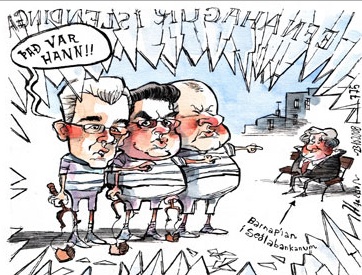
Iceland’s Economic Recovery?

Islandic Horse ToltSabina Zawadzki writes:  Iceland, whose spectacular 2008 meltdown came to symbolize the greed and mismanagement of the global financial system, is expected to begin unwinding the bankruptcies of its three main banks and lifting controls on the movement of capital in and out of the island within months.

For Iceland, these moves will signal rehabilitation and a return to the international financial community after the collapse of a banking system which at one time held assets worth a staggering ten times the nation’s gross domestic product.

The collapse infuriated some European countries which were left on the hook for billions of dollars in compensation to depositors in failed Icelandic banks, and left Iceland shunned by Western nations in its hour of need.

At the low point in October 2008, Britain used anti-terrorism legislation against the country – forcing international bankers to pick up their bags in the middle of crisis meetings and head to the airport.

Now, Iceland hopes that by finally lifting capital controls it can draw a line under the crisis, restore its credit rating, lower its borrowing costs, boost its economy and revive the living standards of its 330,000 people. But to do so, it must find a way to let investors withdraw funds without provoking a catastrophic stampede.

Officials say they will put rules in place to ensure a managed, not free, float of the currency. The government is considering taxing the removal of cash to prevent an exodus. And it will clip the wings of domestic banks to make sure a similar crisis can never happen again.

“We’re talking here about the third largest bankruptcy in the history of mankind being unwound in one of the smallest countries,” the country’s central bank governor, Mar Gudmundsson, told Reuters in a recent interview in Reykjavik.

“That is just a huge complication in its own right so we shouldn’t be surprised that it is taking some time,” he said.  Iceland’s Economic Recovery

Iceland's Economic RecoveryCentral Bank of Iceland