IMF Recommends Debt Structuring for Greece

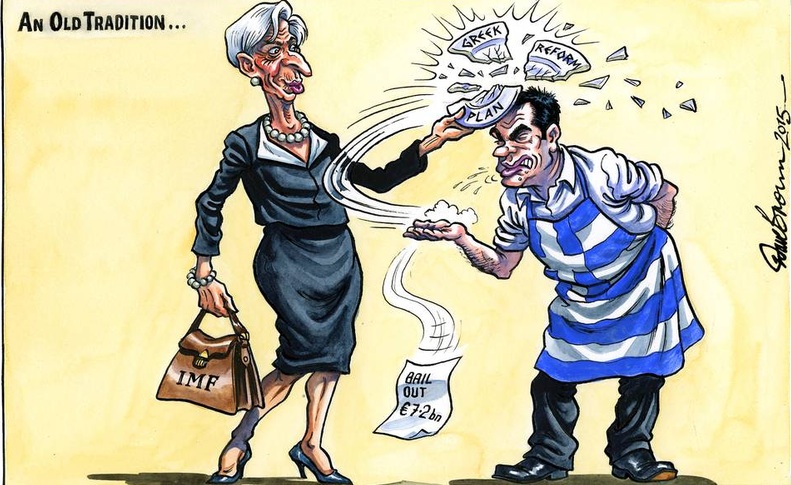
The IMF is skirting the issue of actual cash to help relieve Greece’s debt burden.

A form of debt restructuring rather than outright forgiveness should enable Greece to handle its “unviable” debt burden, the head of the International Monetary Fund was quoted as telling a Swiss newspaper.

The IMF has yet to make clear if it will participate in the third 86-billion-euro ($96 billion) international bailout that Greece signed up to in early August, having argued in favor of a partial writedown of a debt burden it considers unsustainable in its current form.

Greece’s euro zone creditors, notably Germany, have ruled out a writedown but are willing to consider other forms of restructuring such as a lengthening maturities.

Asked about those differences, IMF Managing Director Christine Lagarde told Saturday’s edition of Le Temps: “The debate on cancelling the debt has never been open I don’t think it is necessary to open it if things go well…

“We are talking about extending maturities, reducing rates, (making) exemptions for a certain period of time. We are not speaking about cancelling debt.”

Lagarde has said the IMF will make a decision by October.

IMF and Greece

Hyperinflation in Venezuela?

Megan McArdle writes: Venezuela seems to be hovering on the edge of tipping into hyperinflation. Or perhaps it has already fallen into the abyss. 

Using those rates, economist Steve Hanke recently wrote that annual cost-of-living increases are running at about 722 percent. To put that in some perspective, it means that a $400 monthly grocery bill would climb to $2,888 in a year. That may not approach the legendary status of Hungary’s postwar inflation, which reached 41.9 quadrillion percent in a single month, but it’s devastating for savers, or for people like pensioners whose incomes consist of fixed payments. It’s also pretty bad for the economy.

Or is it Seigniorage! That’s the fancy name for the profit a government makes by printing bills and minting coins. If you can buy more goods and services with the cash you made than it cost you to make it, you have essentially collected a stealthy sort of tax on the people who take the money from you and give you valuable stuff in exchange.

In general, seigniorage revenue is trivial — indeed, it costs the U.S. government more to make nickels and pennies than the coins themselves are worth. But even with higher-value bills, the revenues pale in comparison to, say, the income tax. 

Governments can try to jack up the amount of seigniorage revenue by stealthily inflating the currency. Basically, they exploit an information asymmetry between them and the people they trade the money to: The government knows how much money there is, and its citizens don’t. So they’ll probably accept fewer units of currency than they would if they knew the government was going to print extra money and thus cause prices to rise again.

But this is a terrible way to make money, which is why governments normally don’t resort to this one clever trick for raising government spending without raising taxes. 

The core thing to understand about inflation as a policy tool is that in general, steady-state inflation doesn’t do you any good; what you need is accelerating inflation.

Once inflation starts to accelerate, it’s kind of hard to stop because people also start pricing the acceleration into their expectations. Hyperinflation has all sorts of bad knock-on effects: It hurts your capital base and makes people unwilling to plan for the future because they have no idea what their money will be worth. But the supreme irony is that after a certain point, the government actually starts losing money.

Part of the answer is that in the early days, inflating does make the government a little more money, and the point at which it starts to lose money is also the point at which the freight train is traveling 120 miles an hour. 

The larger answer is that this is the end game of Chavismo. For about a decade, some sectors of the left hoped that Hugo Chavez represented an alternative to the neoliberal consensus on economic policy. 

In real terms, the price of a barrel of oil is barely higher than it was in August 2000, but Venezuela is producing something like 700,000 fewer barrels each day. Policies that looked great on the way up — more revenue and more social spending — became disastrous on the way down as the population was hit with the double whammy of lower production and lower prices.

Now falling oil prices are crushing government revenues at exactly the time the country most needs money to help the people who are suffering great misery as the oil cash drains out of their economy. In the beginning, printing money may have looked like the best of a lot of bad options. By the time it became clear that the country was not fudging its way out of a temporary hole, but making a bad situation worse, it was committed to a course that is extremely painful to reverse.

Venezuela may be able to pull back from the edge, though it can only do so with great pain. Or it may end up in a hyperinflationary spiral, which will ultimately mean even greater pain. I don’t envy the decisions it will have to make. Or the millions of Venezuelan people who will have to live with them.


End of Chavez

Gambling as Business?

Noah Feldman writes:   The New Jersey public, not to mention Governor Chris Christie, wants to reinstate sports gambling in Atlantic City in the hopes of reversing the trajectory of a place that has totally cratered.

The nominal justification for the federal law that effectively banned sports gambling in the U.S. was protecting professional and amateur sports against the taint of gambling, and hence of point-shaving or game-throwing.

The law exempted Nevada’s legalized sports gambling. It also grandfathered sports lotteries in three states. Finally, it gave New Jersey the option of reinstating sports gambling in Atlantic City — provided that it did so within a year from the passage of federal law. New Jersey didn’t take advantage of the option within the time limit.

Whatever its original motives, Paspa today serves as guarantor of Nevada’s pre-eminent position in the vast U.S. sports gambling industry. 

New Jersey’s efforts to allow sports gambling included a 2011 statewide referendum that endorsed a change in the laws; Christie signed a bill decriminalizing such betting in 2012. The 2013 decision blocking that initial effort grew out of litigation by the National Collegiate Athletic Association, as well as the National Football League, the National Hockey League and Major League Baseball to block  that law. 

In response, New Jersey argued that Paspa violates the Constitution. They put most of their eggs in the wrong basket, emphasizing the claim that Congress lacked the authority to “commandeer” state resources for federal objectives.

Roberts’s argument was that such differential treatment of states required a strong justification, which existed when the Voting Rights Act was passed in 1965 but no longer existed today. This claim was strongly criticized, and the eminent and acerbic Judge Richard Posner commented that he’d never heard of the “equal sovereignty” doctrine because it didn’t exist. But equal sovereignty is now the law of the land.

Paspa treats states differently from one another by enshrining Nevada’s special gambling preserve — and hence violates the equal sovereignty of New Jersey voters by denying them the right to do what Nevada does. This isn’t just a matter of constitutional doctrine. It also makes constitutional common sense. 

Many laws may have differential effects in the real world. A coal mining regulation will affect West Virginia more than it affects Hawaii. And the courts shouldn’t be in the business of reviewing every federal law to see whether it helps some states over others.

But a law that explicitly gives some states rights that others lack goes too far. And it’s worse when the public in one state wants to change its laws to compete with another state — and is denied that right by the federal law in question.

 Equal Gambling Rights

Interest Rates and the Markets

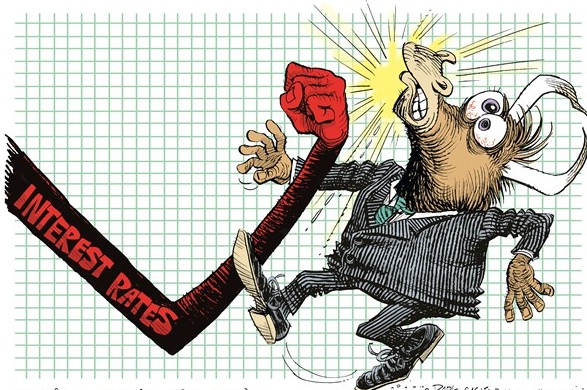
Barry Ritholts writes:  The Federal Reserve says the timing of its first interest rate hike in nine years depends on the data, but that doesn’t mean the Fed will be digging through the jobs, growth and inflation reports for the all-clear signal.

Instead, the Fed will be doing what millions of people have been doing for the past couple of weeks: Watching the stock market.

Many investors have assumed that the recent selloffs in markets from Shanghai to New York meant that the Fed definitely won’t pull the trigger on a rate hike at its Sept. 16-17 meeting.

From 1987 to today, the Fed has reacted to nearly every market hiccough and tantrum by flooding markets with liquidity and reassurances. They’ve given the markets rate cuts, quantitative easing and promises that easy-money policies will continue for a long time, if not forever.  This “Greenspan put” means investing in the stock market is a one-way bet.

New York Fed President Bill Dudley seemed to close the door on a September rate hike when he said that,a rate hike next month no longer seemed as “compelling” as it once did. 

What sort of additional information would make a rate hike more compelling? Dudley said the Fed is looking at more than the economic data, widening its scope to examine everything that might impact the economic outlook. They are looking at the value of the dollar, the price of commodities, the risk of contagion from Europe, from China, and from emerging markets. And, above all, the U.S. stock market.

The market selloff has made a September rate hike even more compelling than it was before, because it gives Fed Chair Janet Yellen the opportunity she needs to kill the “Greenspan put” once and for all.

End of the Greenspan Put?

Google Gets Tough with the EU

Leonid Bershidsky writes: Google has lost patience with its soft approach to the European Union’s bureaucracy in Brussels, showing a new fighting spirit in its answer to antitrust charges against the company. This is a path that led Microsoft nowhere and cost it more than a billion dollars in fines.

The company’s general counsel, Kent Walker defends the way Google prominently displays results from its own shopping comparison service, but not from its competitors — a practice at the heart of the European Commission’s case:  

Walker also reveals that Google hired Bo Vesterdorf, the former president of the General Court, part of the EU’s judicial branch, to write a separate response. This argues that Google has no duty to supply its own rivals, as if it controlled an input that was both essential and not available anywhere else. That just isn’t the case on the Internet, Vesterdorf said.

Before reaching this stage, Google had tried a more pliant approach, seeking to satisfy the antitrust commissioner and avoid the large fine that would come with an adverse ruling.

Last year, Google doubled its EU lobbying budget to 3.5 million euros ($3.9 million).  That isn’t much less than Deutsche Bank or ExxonMobil is spending. According to data on the same site, Google has held more meetings with EU officials than any other company since last November — 32 in all.

In the comparison shopping case, though, Google’s competitors and the European Commission remained unhappy. So the company stopped smiling and nodding and decided to get tough: It’s no longer proposing any compromises, just boldly stating that the way it displays offers from various online merchants is within the law and good for users. .

Older tech companies know it’s useless to tell the EU — and, inevitably for such a strategy, European courts — that they don’t understand what they’re doing. The bureaucrats and judges may be unable to produce another Google, but they are good at listening to experts and far from dumb. And they often hate what they see as American arrogance.

Microsoft can tell Google exactly what happens next; indeed, Google’s lawyers realize there will be other antitrust investigations. One, concerning the Android operating system and its links to Google services, is already in the works, although no official charges have been brought. Another may soon hit Google where it really hurts, challenging its dominance in online advertising. Google will fight and probably lose, because Europe doesn’t like big U.S. companies to dominate its markets. 

Lobbying and complying with whatever demands still can’t be avoided is a less painful path. Microsoft spent 4.5 million euros last year, a million more than Google, on efforts to get EU officials to see its points on issues such as data protection and cloud computing. 

It’s admirable that Google now wants to fight for its principles and against the dilution of its superior offering. It makes me cringe, however, to think of the time and money that will be burned in this hopeless battle.

Google versus the EU

US Corruption in Afghanistan

US dealings in Afghanistan fraught with fraud.

Jorge Scientific, now named Imperatis, received a sole source contract last year to help the Office of Personnel Management patch security holes in its network after hackers made off with sensitive government personnel information. The award has raised eyebrows, as the company had been in hot water after ABC released video of the company’s security personnel in Afghanistan, tasked with protecting American officials, incoherently drunk and high on drugs. A subsequent Inspector General investigation also found the company could not account for $135 million spent on a contract for training Afghan security forces.

Corruption in Afghanistan

Spiffing Up the Dept. of Defense

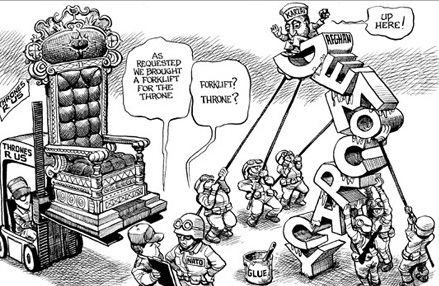
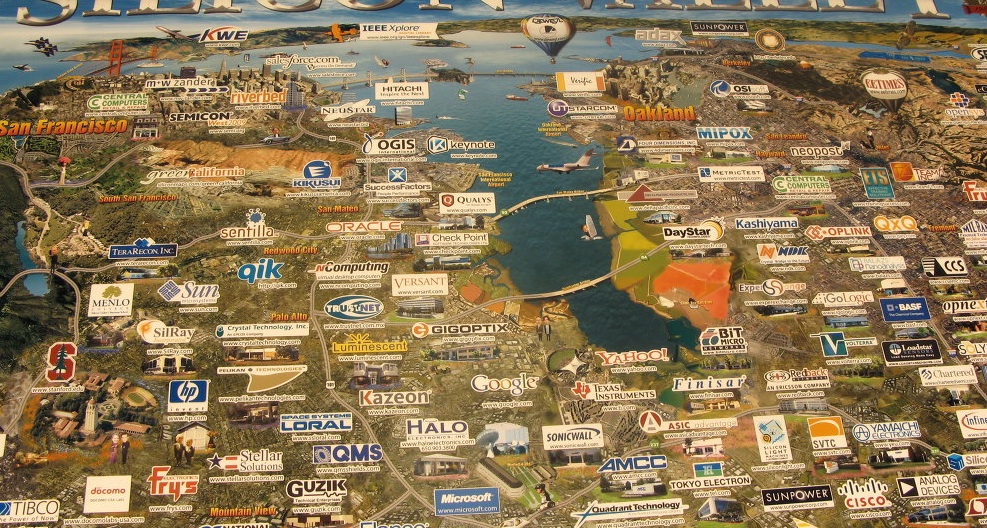
Shaping up the way governments do business, the US Defense Department has formed an alliance with Silicon Valley businesses.

Defense Secretary Ash Carter is back in Silicon Valley to sell his vision for a collaboration between fast-moving tech giants and the more “traditional” Pentagon bureaucracy. In his second trip there in four months, Carter will unveil the $171 million FlexTech Alliance award, a collaboration between a consortium of tech companies and the Pentagon whose goal is to produce flexible sensors that can be stretched over clothing or fitted on ships and airplanes.

Backed by 162 companies, universities, and research labs, the alliance includes names like Apple and Lockheed Martin and will be managed by the Air Force Research laboratory. Overall, it’ll receive $75 million in Defense Department funding over the next five years, along with $96 million from the civilian sector.

Allying with the Defense Department

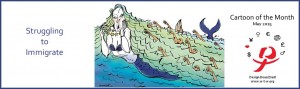
Migration: A Human Dilemma

The Rocky Road to Globalization

UN News writes:   The European Union should establish a human rights-based, coherent and comprehensive migration policy which makes mobility its central asset, a United Nations expert today advocated, assuring is the only way in which the EU can reclaim its border, effectively combat smuggling and empower migrants.

“Let’s not pretend that what the EU and its member states are doing is working. Migration is here to stay,” Mr. Crépeau of the UN stressed. “Building fences, using tear gas and other forms of violence against migrants and asylum seekers. Democratic borders are porous by nature. Providing migrants and asylum-seekers with legal and safe mobility solutions will ensure such a control.”

The Special Rapporteur urged Europeans to start focusing on regaining control of their external border from the smugglers by increasing mobility solutions available to most migrants, investing in integration measures– especially through supporting the action of cities – and developing a strong public discourse on diversity and mobility as cornerstones for contemporary European societies..

“Opening up the regular labour markets through smart visas allowing people to come to look for work and incentivize them to return if they don’t find the job in question would allow for a much better regulated and controlled official labour market,” Mr. Crépeau noted.

Welcoming the positive steps taken by the EU in rescuing migrants and asylum-seekers at sea so far, Mr. Crépeau however warned that rescuing people who arrive by sea and then turning a blind eye to their plight leaving them vulnerable to human rights violations is irresponsible,” the expert said.

“Talking about ‘flows,’ ‘marauders,’ and ‘swarms’ is an unsubtle way of dismissing the legitimacy of the asylum-seekers and migrants’ claim to human rights, by creating images linking them to toxic waste or natural disasters” he noted. “We are talking about men, women, children and even babies, who have faced traumatic experiences. These are people just like you and me, and none of us have the moral high ground to say that we would never do the same if we were in their shoes.”

The UN Special Rapporteur warned that the political and popular discourse in Europe has seen a race to the bottom in the anti-migrant sentiments and use of inappropriate language which is often linked to criminalizing migrants. “Migrants are human beings with rights. When we dehumanize others, we dehumanize ourselves,” he underscored.

Mr. Crépeau therefore called on European political leaders “to show moral and political leadership in fighting much more vigorously racism, xenophobia and hate crime, in consolidating the common human rights culture that is now framing the evolution of all traditions, in strengthening the free movement of persons throughout the EU while developing regulated mobility solutions at its external borders, and in celebrating the diversity of cultures and religions as enrichment for everyone, citizens and foreigners alike.”

An equitable redistribution of refugees and asylum-seekers across the European Union was needed, the spokesperson stressed.

Porous Borders in Democratic Countries?

Immigration: An Economic Issue?

The Rocky Road to Globalization:

Immigration as an economic issue.  Who gets the immigrants out of their countries?  Who benefits?  How do destiny countries pay for services to immigrants in tough economic times?

Janosch Delcker writes:  After keeping a studied silence about the anti-migrant violence in eastern Germany the past week, Angela Merkel went to visit this town near Dresden on Wednesday to show her sympathy with the asylum seekers. The locals gave her a rough reception, indicating that her open-door policy on immigration is running into stern resistance.

“Politicians, lowlifes!” yelled one man among the booing crowd when the normally popular German chancellor descended from her limousine and turned to wave — from a safe distance — to locals in Heidenau.

After a spate of arson attacks this year against asylum shelters, anti-immigrant protesters last Friday clashed with police in Heidenau during a demonstration against the imminent arrival of a new batch of refugees.

The incident sparked another outpouring of angst about how to respond to a record influx of refugees, which is expected to quadruple this year to 800,000, testing the country’s liberal laws on asylum.

Overall in Germany, the population appears to support the idea of providing shelter to people fleeing persecution or violence in their homeland. In a poll by public broadcaster ZDF, 60 percent said they believed the country could cope with the arrivals.

Another right-wing party, Alternative for Germany, which was founded in 2013, has won seats in the European Parliament and German state assemblies, especially in the former communist east, mixing Euroskepticism with calls for restrictions on immigration.

Saxony and other eastern states where the far-right thrives are also redoubts of nostalgia for the days of the German Democratic Republic, when the state provided jobs, housing, health care and schooling and immigration was almost unknown.

Immigration?

Does China Protect Investors?

Jennifer Carpenter and Robert Whitelaw write:  The government promise of investor protection runs deep in China. To stand by and let the stock market seek its own level will take a strong stomach. In a country where markets are routinely managed and defaults are rare, investors may feel betrayed by the government’s lack of direct stock market intervention to mitigate the 15 percent drop this past Monday and Tuesday, especially after the propping up we saw last month. To let the market reveal new pessimism about China’s growth prospects will even further test the nerves of a government accustomed to managing information flow.  Does China Protect Investors

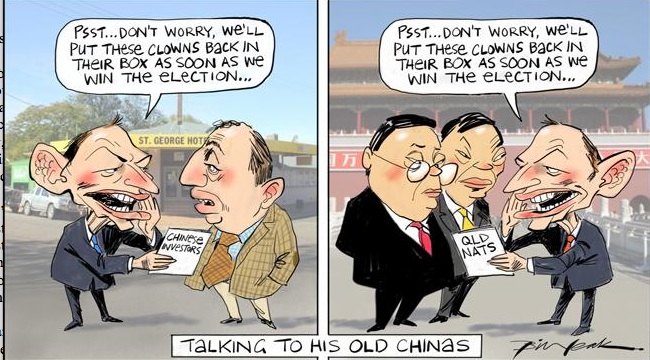
Chinese Investors?

However, while this week’s monetary policy measures targeted at the broader economy may be warranted, direct stock market intervention causes more problems than it solves. If China’s regulators can stand their ground, this week’s turmoil will provide them with an opportunity to clarify their stock market regulatory stance, reduce distracting policy uncertainty, let China’s stock prices find their fundamental value, and continue on the promised reform path to more sustainable economic growth.

Stock markets are messy and the price discovery process can be roiled by exuberance on the upside and panic on the downside. But these same emotions are precisely what underlie the market’s ability to generate new information so effectively. Greed and fear drive investors to produce private information about potential gains and losses and buy and sell stocks accordingly. The clearing of these trades then aggregates this diffuse information into public signals to corporate managers and other investors, leading to more efficient corporate investment and capital allocation across firms.

Our research suggests that, contrary to perception, China’s stock prices have been surprisingly informative about future corporate earnings and have been generating useful signals for managers.