Shell Companies Revealed in Argentine Bond Investigation

The Economist reports:  “VULTURE” funds, which chase distressed borrowers for payment of outstanding debt, have few friends outside finance. Occasionally, though, their hunt for profit aligns neatly with calls for greater financial openness by campaigners, winning the rapacious funds unlikely admirers. So it has proved as Elliott Management looks to enforce court rulings demanding that Argentina cough up $2 billion it owes to the hedge fund. A collateral benefit of the fund’s hunt for assets is that it has put a crack in the wall of secrecy around American shell companies, which are among the world’s most impenetrable and thus often used for nefarious purposes.

The case involves $65m suspected of having been embezzled and laundered abroad by Lazaro Baez, a building tycoon with ties to Cristina Fernández de Kirchner, Argentina’s president, and her late husband (and predecessor), Nestor. Elliott joined the sleuthing, its logic being that any stolen money was misappropriated state funds and could therefore be grabbed to satisfy judgments in its favour.

The money trail led to Nevada, home to 123 brass-plate firms that Elliott suspected of being linked to the alleged fraud. But piercing the corporate veil in the state is far from easy. Its record-keeping requirements are minimal even by American standards.

Elliott sued in Nevada for information on the shell companies from their agent, MF Nevada, and, by association, Mossack Fonseca, the Panamanian law firm understood to be MF’s parent. Even if no records were held in Nevada, Mossack could be ordered to disclose what was on file in Panama or a third jurisdiction, Elliott hoped.

MF Nevada claimed, implausibly, that it was independent of Mossack. In a series of legal skirmishes, Elliott established numerous links between MF and Mossack: for instance that MF sets up Nevada companies exclusively for Mossack’s clients and that the employment contract of MF’s sole employee was signed by Mossack’s bosses.

Satisfied that MF was an “alter ego” of Mossack, a judge recently ruled that Mossack was subject to the jurisdiction of American courts and had to comply with the information subpoena. This was a big win for Elliott—and for anyone wanting to know more about shell companies. America is on some measures less compliant with anti-money-laundering standards for corporate vehicles than any other country.

The ruling will also increase scrutiny of one of the biggest purveyors of such vehicles: Mossack is an industrial-scale incorporator of anonymous companies. Shells it helped set up (but is not legally liable for) have been linked to tax evaders and kleptocrats. Mossack says it does not advise clients on the use of companies it forms, and that “we have never been investigated for any crime, including money-laundering.”

Elliott is not alone in trying to penetrate the murk, but its combination of money, tenacity and legal nous is rare. The fight is not over, however. If the relevant records are in Panama, a country with strict secrecy laws, they are unlikely to be produced in a hurry. Mossack has challenged the alter-ego ruling. The case will now move to a federal court. Separately, Elliott has won an order in the Seychelles, requiring Mossack to provide information on firms there linked to the Nevada entities. But the law firm is yet to hand over any documents.

Elliott is confident it can build a clear picture of the alleged fraud and use it to claw back some of what it is owed. Its efforts have a collateral benefit, too. Argentina’s elites are no longer universally hostile towards the firm, some of them applauding its fight to expose the corruption of political and business rivals.

Shell Companies

Entrepreneur Alert: Maple Syrup Cartel

Twenty-five years ago, Quebec made a bold move to produce the most maple syrup in the world. Today, the syrup giant is unstoppable.

Just ask those in its path, like small producer Angèle Grenier, who will face criminal charges if she sells this year’s harvest to her buyer of choice.

In previous years she has sold syrup to a broker in New Brunswick. But this year, a Quebec court order will force her to hand all the syrup produced on her small patch of land to the Federation of Quebec Maple Syrup Producers.

The family has three choices for the upcoming harvest — capitulate to the demands of the court, cease production, or continue to sell it outside the province and face criminal charges.

“The federation’s goal by taking our maple syrup is that by taking our income, we cannot pay our lawyers,” says Grenier. “We’ll send our syrup to them this year because we need the money.”

Welcome to Big Syrup.    Maple Syrup Cartel in CanadaMaple Syrup

Should the Carry Trade be Regulated?

Harold James writes” During the early years of the global financial crisis, exchange rates were the least interesting part of the macroeconomic debate. A French proposal in 2011 for a sweeping reform of the international monetary regime went nowhere. Today, the subject has become the focus of intense anxiety – and with good reason.

Currency wars are a reminder of the fragility of the process of globalization.

The expectation that interest rates in the United States will rise is driving up the value of the dollar, even as monetary easing in Japan and Europe is pushing down the yen and the euro.

The euro’s depreciation has been greeted with delight by Europe’s business leaders. But in the US, where the dollar’s gains are threatening to choke off economic recovery, officials at the Federal Reserve are expressing signs of concern.

The swing in exchange rates could have an impact that extends far beyond the short-term rebalancing of the global marketplace.

Indeed, surges in the dollar’s value have long coincided with increased political pressure for trade protectionism. After all, the most obvious way to compensate for the apparent overvaluation of a country’s currency is by imposing import restrictions.

In the mid-1980s, the dollar’s appreciating exchange rate undermined US competitiveness, inaugurating a period of rapid and painful deindustrialization.

If anything, today’s exchange-rate swings are likely to be more extreme, and to last longer, than the surge in the dollar’s value in the 1980s or the volatility of the 1930s, when, in the aftermath of the financial crash that triggered the Great Depression, countries competed to devalue their currencies.

The problem is what is known as the carry trade, a common financial strategy in which an investor borrows money in a currency subject to a low interest rate in order to buy assets in a currency subject to a higher rate. The interest-rate differential, often combined with high amounts of leverage, provides a profit when the loans are paid off.

When exchange rates are stable and predictable, the carry trade is relatively safe. But this is rarely the case. For starters, the practice has the tendency to push exchange rates further apart, as investors sell the currency in which they borrowed to make their purchases.

The large corporate borrowers engaged in the carry trade consider themselves sophisticated investors, capable of predicting when exchange rates are about to reverse. Unfortunately, this only increases the risk, boosting the possibility of a sudden reversal as money pours back into the borrowed currency in an attempt to repay loans before the exchange rate soars to loss-generating levels.

The dangers are very real.

There is one historical precedent that could serve as a model, should we be able to muster the political will to consider it. In the 1930s, John Maynard Keynes championed limits on the movement of capital in order to blunt the more damaging consequences of globalization. The equivalent today would be to introduce regulations on the carry trade. Policymakers would do well to consider this option – before it is too late.

Issues for Hillary Clinton

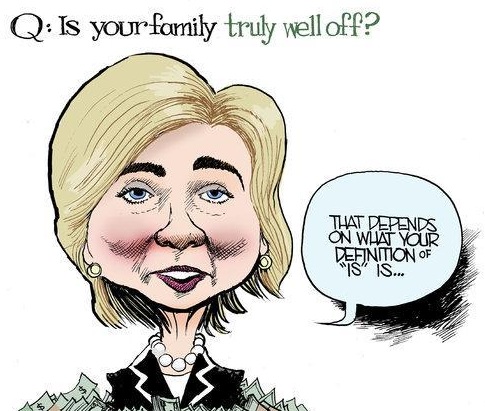
Former Secretary of State Hillary Clinton will announce her run for the presidency tomorrow.   Here are the words we are looking for:

Inequality

End Glass Steagall

Break up of banks

Education reform

Afforable housing for all

Diversion of public funds by corruptioin

Commodities trading

High speed trading

Inclusive foreign policy

Mrs. Clinton AnnouncesAdd to the list on twitter or below.


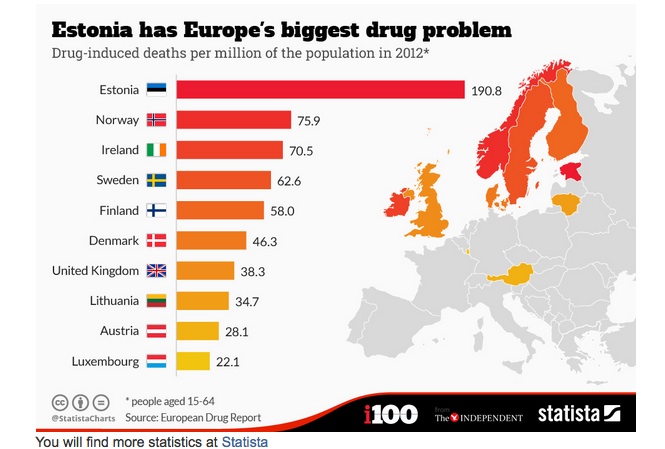
Estonia: Europe’s Largest Drug Problem?

The small baltic state had 190.8 drug-induced deaths per million of the population in 2012, more than double second placed Norway. The reason for Estonia’s high death rate is an overdose boom caused by fentanyl, a synthetic form of heroin produced clandestinely in neighbouring Russia. For more infographics about Europe, read more in Statista’s latest Independent feature.

This chart shows drug-induced deaths per million of the population in 2012.

Estonia- Europe's Biggest Drug Problem

Fishing Poacher’s Rescued on Africa’s West Coast

Environmental activist group Sea Shepherd said it rescued 40 crew members from a sinking “poaching” ship it was pursuing for months for allegedly illegally fishing in the Southern Ocean, but described the ship’s sinking as suspicious.

Sea Shepherd said its ships Bob Barker and Sam Simon picked up the crew, which included the captain, from life rafts from the Nigerian-flagged boat Thunder.

They had been sailing in the waters of Sao Tome and Principe, an island nation off Africa’s western coast.

“It is an incredibly suspicious situation, to say the least,” Bob Barker’s captain Peter Hammarstedt said in a statement.

“When my chief engineer boarded the Thunder in the hours leading up to the sinking, he was able to confirm that there were clear signs that the vessel was intentionally scuttled.

“Usually when a vessel is sinking, the captain will close all hatches so as to maintain buoyancy. However, on the Thunder, the reverse was done — doors and hatches were tied open and the fishhold was opened.”

Sea Shepherd said the crew were given food and water and were transferred to Sam Simon.

Video recorded by the activist group showed the ship sinking just hours after it said Thunder issued a distress signal on Monday afternoon.

Hammarstedt said Thunder’s captain, who was not named, complained about being rescued and “started applauding and cheering” when the vessel sank.

“We’ve been chasing the Thunder for 110 days now, and I think they’re basically at the end of their fuel, and they would have had to make a port call,” Hammarstedt told the Sydney Morning Herald.

“I think the captain of the Thunder made the decision that he preferred the physical evidence on board… was better on the ocean bottom than going into port with him.”

Thunder, on a list of boats deemed to have engaged in illegal, unreported, or unregulated fishing activities by multi-national body the Conservation of Antarctic Marine Living Resources (CCAMLR), is suspected of illegal fishing for Patagonian toothfish and other rare species in the Antarctic.

Toothfish is sold as Chilean sea bass, which is popular in high-end restaurants. It sells primarily in the United States, Europe and Japan, although there is also a growing market in China.

Fish

Dutch Banks

The Economist:  Misreading the public mood can be costly when the government owns your bank, as the directors of ABN AMRO found out last week. The bank has been in the hands of the Dutch state since it was bailed out in 2009 as part of the global financial crisis that also dumped Royal Bank of Scotland in the laps of British taxpayers. The Dutch government had hoped to begin privatising ABN AMRO this autumn—until the news broke that the bank’s directors had awarded themselves a salary bump of €100,000 ($107,000) a year. An outcry in parliament led the directors to forgo their raises and Jeroen Dijsselbloem, the Netherlands’ finance minister, to postpone indefinitely the bank’s return to the markets.

The directors’ error of judgment is perhaps understandable. As in Britain, public sentiment in the wake of the collapse was furious with fat-cat bankers. But the Dutch board had been correspondingly cautious. The directors receive no bonuses, and their raise had been approved by parliament in 2011 but renounced each year until now.

Why, despite the good economic news, is the Dutch public mood still sour? Partly because of a problem that many European governments face: they have not delivered the policies their constituents were promised. The Dutch government, like the German one, is a centrist, two-party grand coalition. In the 2012 election, leftists voted for the largest centre-left party, Labour (PvdA), in opposition to austerity and the dismantling of the welfare state. Conservatives voted for the largest centre-right party, the Liberals (VVD), in opposition to redistribution, Europe and immigration. What they got instead was a Liberal prime minister, Mark Rutte, at the head of a hybrid government whose horse-trading led to an unsatisfying mix of policies.

That Dutch government has carried out a series of far-reaching reforms which have left nobody entirely happy.

Confusingly, voters have scattered in all directions.

It all chimes oddly with a brightening economy. The government’s reforms, disruptive at first, have started working, says Dimitry Fleming, an economist at ING Bank. “People feel we have seen the major necessary reforms, so policy uncertainty is diminishing.” House prices and residential investment are rising. Exports are up. The tulips are sprouting. Maybe public enthusiasm will too.

Dutch Banks

HSBC Massaged by DOJ Nominee?

William K. Black writes:  HSBC got a sweetheart deal from the Obama administration. It laundered vast amounts of money for Mexico’s murderous Sinaloa cartel, helped bust sanctions for terrorists and mass murderers, and did not cooperate with the investigation. The U.S. Attorney in charge of the case, Loretta Lynch, refused to prosecute any of the HSBC bankers or even sue them individually. Instead, there was a pathetic non-prosecution agreement limited to HSBC.  HSBC’s Sweetheart Deal

Silk Road Bitcoin Drama, Act after Act

 Gabrielle Bluestone writes: Two former federal agents who worked on the 2013 bust of underground drug market Silk Road were charged with multiple felonies this week alleging that the pair used the operation for their own gain, blackmailing defendants and stealing more than $1.5 million worth of bitcoin under the cover of darknet.

ust a month after Ulbricht, the head of Silk Roa was convicted, two agents connected with the case were arrested in connection with their work on the investigation.

The criminal indictment against the agents was unsealed Monday, laid out an array of felony charges, including money laundering, wire fraud, theft of government property and conflict of interest.

For example, the government alleges, one agent created several online personas during the investigation, which he used to anonymously contact Ulbricht offering to sell information about what the federal investigation. After “converting to his own personal use” close to $776,000 worth of Bitcoin, he clumsily faked a subpoena to try to trick Venmo into unfreezing his account.

Prosecutors say another agent—a computer forensics expert—was a little more elegant, quietly diverting close to $800,000 worth of Bitcoin. According to the indictment, he moved the money off the Silk Road site and onto currency exchange site Mt Gox, where he was able to cash out and transfer the balance to a personal bank account via an LLC called Quantum International Investments.

Both men resigned from government as soon as they learned they were under investigation, but it one of them—the Secret Service agent—got the better deal. One was reportedly arrested this weekend in Baltimore, where he’ll remain in custody until at least Thursday. Meanwhile, the other got to turn himself in in San Francisco, where he was released on bond not long after.

Bitcoin Drama