La La Rules for Banking

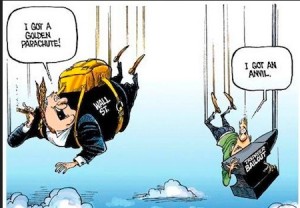
Nicollas Hirst writes:  MEPs will revisit the causes of the 2008 financial crisis on Wednesday (21 January) as they debate new rules that could lead to some of Europe’s largest banks being broken up.

Centre-left and Green members will accuse the centre-right of being unwilling to take on banks that they describe as “too big to fail, too big to save and too big to resolve”.

Many MEPs believe that the revision of the law advanced by Gunnar Hökmark, who is the European Parliament’s lead rapporteur on the matter, ignores the lessons of the financial crisis, namely that risk-taking universal banks – like Royal Bank of Scotland was in the UK, or Bankia in Spain – pose a systemic risk to European economies.

By contrast, Hökmark, a Swedish centre-right MEP, argues that universal banks ought to be cherished rather than broken up. Would this levae us with “ineffective shell regulation”?

Perhaps the MEPs’ first priority should be to ensure investment and growth for the real economy.  But the landscape of the banking sector has changed considerably since Erkki Liikanen, Finland’s central bank governor, recommended that all banks over a certain size be broken up in a 2012 report for the European Commission.

Michel Barnier, the European commissioner for internal market and services 2010-12, rowed back from this, proposing a year ago that the European Central Bank should have the power but not the obligation to break up banks over a certain threshold.

Hökmark , who was also the rapporteur for the proposal that set out last year how member states should restructure failing banks, in the wake of several costly bank failures, is adamant that the EU should concentrate on reviving investment in the economy and not making it more difficult for big banks to provide it.

He warns against attempting to imitate the banking model of the United States when the European system has developed over hundreds of years.

Christophe Nijdam, secretary general of Finance Watch, disagrees. “‘Too-big-to-fail’ banking […] distorts incentives so that Europe’s megabanks are more focused on financial trading than on financing commercial investments,” he said in a statement.

Hökmark’s EPP does not have a majority on the committee for economic and monetary affairs, with 18 MEPs out of 61. The S&D has 16 MEPs on the committee, the Liberals have five, the Greens have four and the European Conservatives and Reformists have five. Hökmark expects a committee vote on the proposal at the end of March or in April.
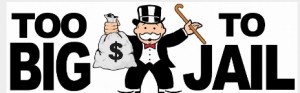
Too Big to Jail  EU Banks

1% to Own 50% by 2016?

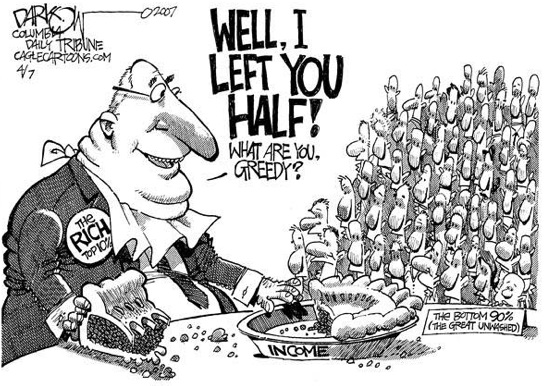
Oxfam reports: Wealth accumulated by the richest one percent will exceed that of the other 99 percent in 2016, the Oxfam charity said Monday, ahead of the annual meeting of the world’s most powerful at Davos, Switzerland.

“The scale of global inequality is quite simply staggering and despite the issues shooting up the global agenda, the gap between the richest and the rest is widening fast,” Oxfam executive director Winnie Byanyima said.

The richest one percent’s share of global wealth increased from 44 percent in 2009 to 48 percent in 2014, the British charity said in a report, adding that it will be more that 50 percent in 2016.

The average wealth per adult in this group is $2.7 million (2.3 million euros), Oxfam said.

Of the remaining 52 percent, almost all — 46 percent — is owned by the rest of the richest fifth of the world’s population, leaving the other 80 percent to share just 5.5 percent with an average wealth of $3,851 (3,330 euros) per adult, the report says.

Byanyima, who is to co-chair at the Davos World Economic Forum taking place Wednesday through Friday, urged leaders to take on “vested interests that stand in the way of a fairer and more prosperous world.”

Oxfam called upon states to tackle tax evasion, improve public services, tax capital rather than labour, and introduce living minimum wages, among other measures, in a bid to ensure a more equitable distribution of wealth.

The 45th World Economic Forum that runs from Wednesday to Saturday will draw a record number of participants this year with more than 300 heads of state and government attending.

Rising inequality will be competing with other global crises including terrorist threats in Europe, the worst post-Cold War stand-off between Russia and the West and renewed fears of financial turmoil.

France’s Francois Hollande, Germany’s Angela Merkel and China’s Li Keqiang will be among world leaders seeking to chart a path away from fundamentalism towards solidarity.

Italian Prime Minister Matteo Renzi and US Secretary of State John Kerry are also expected.

Beyond geopolitical crises, hot-button issues like the Ebola epidemic, the challenges posed by plunging oil prices and the future of technology will also be addressed at the posh Swiss ski resort.

Oxfam Reports

Take RIsk out of Executive Pay?

Executive compensation is set by managers themselves to maximise their own pay, rather than by boards on behalf of shareholders. Indeed, many commentators argue that executives’ pay schemes were major contributors to the financial crisis, encouraging them to take on too much risk and manage their company for short-term profit. In response, President Obama has proposed new executive compensation rules for firms seeking government aid. However, several critics have argued that the recent changes are politically motivated and focus on the level of pay, rather than the incentive structures (e.g. the relative amount of cash versus shares), which have the greatest economic impact.

Existing schemes have two main problems. First, stock and options typically have short vesting periods, allowing executives to “cash out” early. For example, Angelo Mozilo, the former CEO of Countrywide Financial, made $129 million from stock sales in the twelve months prior to the start of the subprime crisis. This encourages managers to pump up the short-term stock price at the expense of long-run value – for instance by originating risky loans, scrapping investment projects, or manipulating earnings – because they can liquidate their holdings before the long-run damage appears. Long-term incentives must be provided for the manager to maximise long-term value, which we call the “long-horizon principle.”

Second, current schemes fail to keep pace with a firm’s changing conditions. If a company’s stock price plummets, stock options are close to worthless and have little incentive effect – precisely at the time when managerial effort is particularly critical. This problem may still exist even if the executive has only shares and no options. Consider a CEO who is paid $4 million in cash and $6 million in stock. If the share price halves, his stock is now worth $3 million. Exerting effort to improve firm value by 1% now increases his pay by only $30,000 rather than $60,000 and may provide insufficient motivation. To maintain incentives, the CEO must be forced to hold more shares after firm value declines. Our research has shown that, to motivate a manager, a given percentage increase in firm value (say 10%) must generate a sufficiently high percentage increase in pay (say 6%). In the above example, this is achieved by ensuring that, at all times, 60% of the manager’s pay is stock. We call this the “constant percentage principle.” The appropriate proportion will vary across firms depending on their industry and life cycle, but we estimate 60% as a ballpark number for the average firm.

Alex Edmans and Xavier Cabaix write that two principles should govern executive pay:  Rebalancing to address the constant percentage principle and gradual vesting to satisfy the long-horizon principle.  Executive Compensation

Executive Pay

Russia Cuts Oil Deliveries to the Ukraine

Ken Hanly writes:  Russian president Vladimir Putin has ordered Gazprom to cut supplies to and through the Ukraine by 60 percent. He accuses the Ukraine of siphoning off supplies for Europe and stealing Russian gas.

Russia  claims that due to “transit risks for European consumers in the territory of the Ukraine” the supply cuts had to be made. As a result of the move Gazprom gas supplies to Europe plunged by 60 percent. Ukraine reportedthat Russia had shut off the gas supply. A total of six countries reported a complete shut off of Russian supplied gas.

Bulgaria, Greece, Macedonia, Romania, and Turkey  there had been a stop to gas shipments from Russia coming through the Ukraine. Croatia said that it had to reduce supplies to industrial customers. Bulgaria claimed that it was in a crisis situation and had gas for only a few days. The EUimmediately issued a statement condemning the cut off: ‘Without prior warning and in clear contradiction with the reassurances given by the highest Russian and Ukrainian authorities to the European Union, gas supplies to some EU member states have been substantially cut.’ The statement went on to demand that the gas supplies be restored immediately and that Russia and the Ukraine negotiate an end to their commercial dispute, which is the root cause of the situation.

The head of Gazprom  said that Russia plans to shift all natural gas flows now crossing the Ukraine to an alternative route through Turkey. About 40 percent of present Russian gas shipments to Europe pass through the Soviet area link via the Ukraine. Originally Russia planned a link through Bulgaria but dropped the plan after EU opposition. Bulgaria is now being made to suffer as no supplies at all from Russia enter the country. Russia supplies about 30 percent of EU natural gas.

Gazprom’s viewpoint appears to be that the EU will be the one to deal with that problem as it will simply deliver gas to the border of Greece and it will be up to the EU how gas is delivered from that point.
Russia may be using its plans as a bargaining chip but the EU is itself planning an energy union to reduce dependence on Russian gas and hence it may make sense for Russia to itself reduce reliance on the Ukrainian transit system, especially given the political conflict with the Ukraine.
Turn off the Spigot?

Money Laundering Post 9/11

Munich-based economic journalist Markus Schulze Wehninck writes:  Money laundering has been an international issue since the end of the 1980s but its career on the global agenda did not start until September 11, when it was connected to the fight against terrorist financing. After the attack on the World Trade Center, a global Counter Terrorist Financing (CFT) regime was built up by the United Nations and pre-existing anti-money laundering (AML) measures were expanded. It was believed that the expertise of AML professionals could be used for the fight against terrorist financial flows. The main task of the Financial Action Task Force (FATF) – an OECD-based international body established by the G7 in 1989 – was extended to the combined ‘label’ of anti-money laundering and counter terrorist financing (AML/CFT).

The connection of these two phenomena has had significant consequences. The ‘dirty money’ to fight is no longer only affiliated with crimes already committed, as money laundering only concerns funds from illicit activities, but as well with future terrorist activities. This boosted the international efforts to fight dirty money flows and new obligations for the private sector.

With its ’40 recommendations’, the FATF had already published an extensive blueprint for financial institution regulation to fight money laundering in 1990. The recommendations, which are implemented – at least in part – by most states, commit banks and other institutions to analyse their customers and financial flows, keep records and report suspicious activities to the authorities.

In 2003, the FATF published nine special recommendations for counter terrorist financing and included “designated non-financial businesses and professions” like (internet-)casinos, real estate agents, dealers in precious metals and stones, and lawyers or notaries. Furthermore, alternative remittance systems, like the informal value transfer system ‘hawala’, and non-profit organisations have been taken into the regulatory focus of the international expert body.

At the same time, other standard setters like the Basel Committee on Banking Supervision or the private sector initiative Wolfsberg Group have expanded and further specified the duties of banks in analysing customers and their financial behaviour. A global system of financial surveillance has emerged which obliges the everyday customer’s local bank to act as a financial watchdog. This surveillance system has merits, as it makes tracking dirty money flows more easy and efficient. But, nevertheless, it creates problems which did not exist before 9/11.

Firstly, the global financial surveillance system clearly violates the banking secrecy provision. The FATF recommendations point out, the secrecy laws of financial institutions are to be constrained where they may “inhibit the implementation” of the recommendations. States get what they wanted for a long time – access to private sector financial data. This data is not only supposed to be shared among domestic state agencies, but in cooperation with their foreign counterparts on a global scale..

The financial surveillance system has its weak points and carries the risk of customers beinging suspected by mistake, a ‘false positive’. Private sector institutions use IT-tools to trace suspicious money flows within the huge amount of financial data. A whole industry sector has evolved to commercially exploit the needs of financial institutions, that is, to find the ‘needles in the haystack’. Data management software develops ‘patterns of normality’ in order to identify abnormalities in financial transactions – an error-prone system.

The best strategy of blame avoidance is thus: reporting, reporting, reporting. How many transactions, banking accounts or credit cards are audited by this surveillance system is not known. However, a 2004 evaluation of the private sector reporting behaviour in Germany notes that 6400 suspicions had been reported the year before, from which about 900 had been false alerts, or just a little over 1 in 7 reports.

Another negative effect is that the fight against dirty money threatens to exclude poor people from financial services. Before 9/11, AML measures were merely associated with rather high sums and certain transaction thresholds, while the relatively small amounts of money used for 9/11 have refocused the dirty money chase on daily retail banking.

Their obligations force banks to prove identity and residence of their customers, which might be a minor problem in developed countries, but is of extreme significance in the developing world. As evaluations of the impact of the FATF-recommendations on the access to financial services show, ‘know your customer’-rules pose problems in countries where many households do not have formal addresses. This adverse impact has been shown in South Africa, Indonesia, Kenia, Pakistan and Mexico.  Cash Limits by Fernando Llera

Tigers for Profit?

Tiger Trade:  In 1991, wildlife investigator J. A. Mills went to China to verify rumors about tiger farming.  “I mainly pretended I was a student of traditional Chinese medicine to try to figure out not only what was being traded, but why it was being traded,” Mills told National Public Radio.

She says she found China’s first tiger farm — complete with a hand-written ledgers filling up with orders for tiger bone.

Back then, when tiger trade was first flagged as an issue, the main demand for bone was for use in traditional Chinese medicine. Today, the trade has changed to more of a luxury goods market — and Mills says that although China banned the trade of tiger bone in 1993, demand for luxury items still thrives today. She estimates that there are 6,000 tigers on farms in the country.

A tiger farm is basically a feed lot for tigers where they’re bred like cattle for their parts to make luxury goods such as tiger bone wine and tigerskin rugs. This is about wealth, not health.  This is about a handful of investors poised to launch a multi-billion-dollar-a-year luxury goods market. This about products looking a market, rather than a market looking for products.

Tigers in the wild are solitary, of course, except when … they’re mothers with cubs. These [farmed] tigers are basically kept in cages. They are speed-bred. Cubs are taken from their mothers almost right after birth so the mothers can breed again. And the males run around in packs.

It’s something you would never, ever see in the wild.

The problem with tiger farming is that it stimulates demand for tiger products, which in turn stimulates poaching of wild tigers because tiger products from wild tigers are considered superior, more prestigious and exponentially more valuable. Some people are even buying tiger products as an investment — much as they would, say, rare art or antique jewelry. And if even a tiny fraction of China’s 1.4 billion people seek wild tiger products, we could lose the last 3,000 wild tigers before we know it.

The same forces are driving the slaughter of elephants for their ivory and rhinos for their horn. It all involves organized criminals supplying investors hoping to profit from extinction. Unfortunately what’s happened in the United Nations in the context of the treaty that governs … international trade and endangered species is that everyone’s gone silent.

 Tigers for Profit

Credit Suisse Gets Out of Jail Free?

Neil Weinberg writes: Credit Suisse Group AG (CSGN)’s bid to continue managing U.S. pensions after its conviction for helping American clients evade taxes should be rejected by the Labor Department unless the bank improves controls against wrongdoing, according to Representative Maxine Waters.

Waters, the top Democrat on the House Financial Services panel, sent a letter to Labor Secretary Thomas Perez today ahead of an agency hearing in Washington on Credit Suisse’s status as a pension manager, which Waters and two colleagues had pressed the department to hold.

“I believe that at this point, the waiver should be denied given the lack of important public facts and the insufficient proposed conditions,” Waters wrote. If regulators continue to routinely approve waivers, they will be “throwing away valuable enforcement tools and enshrining a policy of too-big-to-bar.”

Unless Labor grants a waiver, the Swiss bank will be disqualified from handling U.S. pension funds following its guilty plea last year to helping thousands of Americans evade U.S. taxes. Credit Suisse oversees billions of dollars of assets for more than 100 U.S. pension plans, according to a July court filing.

Credit Suisse has three asset management units seeking waivers to continue managing U.S. pension funds, Roger Machlis, head of Credit Suisse Asset Management’s legal and compliance unit, said at the hearing. John Popp, managing director of the asset management unit, who also spoke at the hearing, estimated more than 1 million individuals are in the pension plans it manages.

Credit Suisse Get out of Jail

Reform Iran’s Banks?

At the beginning of January, Tehran hosted the most significant economic conference held in Iran since 1979, with President Hassan Rouhani, his economic team and 1,500 economists focusing on economic hardships that have surfaced in recent years.

The need for restructuring the banking system was among major issues discussed in the two-day event, while top monetary officials on the second day of the conference called on the commercial banks to be selective when offering loans.

Akbar Komijan, the deputy governor of the central bank, implied that if the commercial banks do not provide enterprises with loans, the reason would be lack of eligibility of loan seekers, and not a lack of finances.

In the eight months ending Dec. 21, more than 60% of the granted loans were made to address cash flow issues.  The banks have been faced with a massive number of non-performing loans due to the combination of government’s lending directives to support failing enterprises and harsh depreciation of the rial in 2013 against major foreign currencies.

The commercial banks, troubled with a lack of cash, are now left with few options to meet their daily needs. The central bank is complaining that the banks have been borrowing to much from the treasury.   Komijani said at the conference that the banks’ overdraft from the central bank is “inconveniencing” and called on them to find other ways to meet their needs for cash.

A monetary expert in Tehran said the banks usually fail to pay off their debt, given the high interest rate of 32% for such loans. The banks have no choice but to borrow from either the central bank or one another.

Some struggling banks are even given one-day loans by other financial institutions. These loans would let the banks meet their immediate needs for cash. Monetary officials are fearful that they would soon face a desperate situation as the non performing loans cannot be recovered.

Another option the banks could consider to boost their lending ability is to use the money held by the public in the form of gold and foreign currency, which is estimated to be around $21.5 billion.  The amount is more than five times the estimated gold reserves of the central bank, which is nearly $3.9 billion.

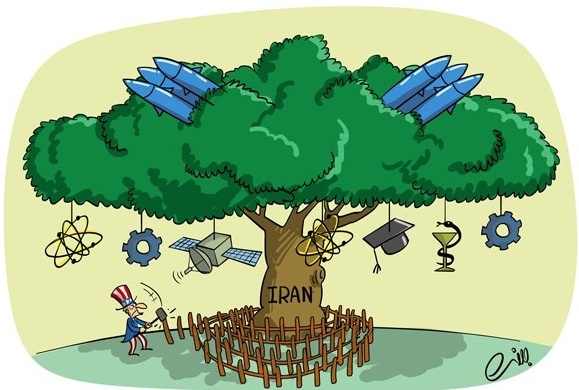
Many believe that the lifting of sanctions is a shortcut to prosperity as they have so far blocked the Iranian government from tapping into the reduced oil income.

The lifting of sanctions would let Iran access $100 billion in foreign assets blocked in international banks in one go and resume economic relations with world nations, a move that would give a boost to the economy and the private sector in particular, which is heavily indebted to the banking system. But for now the negotiations are unlikely to result in a swift deal and the government can do little to shore up the stressed banks.

Among the few measures the regulator may take to help recover the sizable NPLs is create a specialized team or entity to address problems of bad debt. If a list of top defaultors connected t politicians were published, this might also improve matters.

Iran

Jamie Dimon Whines

Hugh Son writes: Jamie Dimon, grappling with multibillion-dollar legal costs and rising capital requirements at JP Morgan Chase  said overlapping efforts by U.S. regulators place banks “under assault.”

“We have five or six regulators or people coming after us on every different issue,” Dimon, 58, said today on a call with reporters after New York-based JPMorgan reported fourth-quarter results. “It’s a hard thing to deal with.”

JPMorgan, the largest U.S. bank, posted a drop in fourth-quarter profit amid $990 million of legal expenses, about double what some analysts predicted. The legal costs, mostly tied to probes into currency rate-rigging, follow even bigger payments in 2013 related to mortgage bonds sold before the 2008 crisis by JPMorgan and firms it acquired.

Dimon, who previously blamed regulators for stifling economic growth, struck a more conciliatory tone last year. The bank had a “tin ear” when dealing with overseers before settling probes into mortgage lapses and trading losses, he said in an April letter to shareholders.

New Federal Reserve rules that exceed the global standard also could mean JPMorgan needs more than $20 billion in additional capital by 2019.

“The regulators clearly want even more capital,” Dimon said today. “We’ll meet those requirements. But those measures aren’t a measure of risk at all. It is simply a measure of size. This company is as sound as it gets.”

Dimon, who was lauded during the crisis for JPMorgan’s role in buying Bear Stearns Cos. and Washington Mutual Inc.’s banking operations, has criticized the government for penalizing JPMorgan for those firms’ actions.

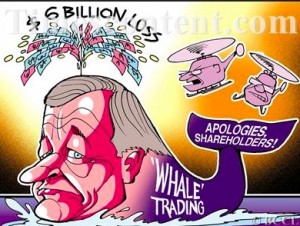
In 2013, Dimon settled a litany of disputes, including government probes of mortgage-bond sales, energy trading, oversight of a trader known as the London Whale, and scrutiny of services provided to Ponzi-scheme operator Bernard Madoff.

The bank settled foreign-exchange investigations with three regulators in November, paying about $1 billion, and still faces a Justice Department probe.

“In the old days, you dealt with one regulator when you had an issue, maybe two,” said Dimon, 58. “Now it’s five or six. It makes it very difficult and very complicated. You all should ask the question about how American that is. And how fair that is. And how complex that is for companies.”

Dimon’s bank, of course, does only 20% of its business as a conventional commercial bank.  It is in the derivatives market, the commodities market and has already gotten spanked for its involvement in LIBOR.  Maybe Dimon should listen to Goldman Sachs, who has suggested the company should be divided up.  Then each section could deal with its own regulators.

Jamie Dimon

China Needs New Math

William Pesek:  As goes the US go go China’s exports.

The improving U.S. economy has brought some welcome cheer to officials in Beijing, which reported an unexpectedly high 9.7 percent jump in December exports.  If those numbers continued in months ahead, they’d also be good news for a global economy that’s running short on viable growth engines.

China will probably have to loosen monetary policy soon in order to ensure that GDP growth stays above last year’s target of 7.5 percent (it’s currently around 7.3 percent).

Already worryingly high compared to where Japan was 25 years ago when its own bubble burst, China’s GDP ratio  will only rise further with additional stimulus. The more China gins up growth in 2015, the more irresponsible lending it will have to service in the decade ahead.

The math simply doesn’t work out. Even if China could somehow return to the heady days of 10 percent-plus GDP growth, its debt mountain would by then be nearly unmanageable.

From Japan to Argentina to Greece, recent decades offer many examples of governments thinking 1 + 1 = 3. It took Japan more than a decade after its bubble burst in 1990 to create the Resolution and Collection Corporation, modeled after America’s Resolution Trust Corporation, to dispose of bad loans. China can’t afford to wait that long to head off a full-blown crisis. It’s one thing for a $24 billion economy like Argentina to blow up; it would be quite another if the world’s second-biggest plunged into turmoil.

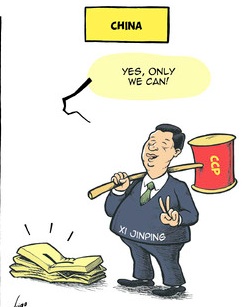
Yet for all the official talk about curbing borrowing and adjusting to a new normal of lower growth, Xi’s government still hasn’t shown the stomach necessary to bring China’s debt problems out into the open and deal with them. Even one of the first defaults on an offshore bond by a Chinese developer last week ended happily. Kaisa Group missed a $23 million interest payment, but quickly received a waiver from HSBC.

What should China be doing? First, clamp down more firmly on new borrowing, particularly to the state sector. While that would roil credit markets and crimp growth, it’s vital to gaining control of the financial system. Next, conduct a truly transparent audit of public debt and the shadow banking system.

Finally, China needs to create a mechanism to collect and write down bad assets. Only by doing so can Beijing prod wobbly banks to act openly and quickly to repair balance sheets. There are many ways China could go — a Japan or a Sweden-like purge and bank recapitalization. The point is to address its math problem frontally. However cheery, trade and GDP figures are the wrong numbers to focus on.

Xi's Purge?