US Community Banks Supported?

President Obama has nominated a community banker to the board of the Federal Reserve.  This nomination met with favorable comments from Senator Sherrod Brown, Fed board chair Janet Yellen and Frank Keating. It maybe time to take community banking functions away from the big banks, or me at least give them a ,choice between community baking sand investment banking.  Clearly a bank like JP Morgan Chase which only make 20 percent of its money on these functions would prefer to be an investment bank.   Goldman Sachs’ Richard Ramsden today suggests that the JPMorgan Chase that Jamie Dimon has taken years building would be worth more in pieces.  Can a break up be far behind?

The problem wirh break up of course is that the 80 percent of JP Morgan Chase’s acitivities that fall outside community banking might not be covered by tax payer dollars.  At any rate, they should not be.

An interesting side note:  Small banks benefit from regulation.  Is the flip side of this statement also true?

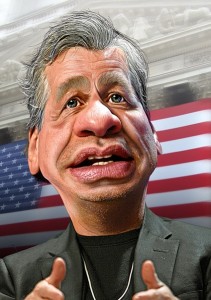
Dimon

Goldman Hints JPMorgan Chase Breakup

JP Morgan Chase’s parts are probably worth more to investors than the whole after regulators proposed tougher rules penalizing firms for size and complexity, according to Goldman Sachs Group Inc.

JPMorgan could unlock value by splitting its four main businesses or dividing into consumer and institutional companies, Goldman Sachs analysts led by Richard Ramsden wrote today in a research note. Units of New York-based JPMorgan trade at a discount of 20 percent or more to stand-alone peers, they wrote.

“Our analysis suggests that a breakup into two or four parts could unlock value in most scenarios, although the range of outcomes we assessed is wide, at 5 percent to 25 percent potential upside,” the analysts wrote.

The move would reverse much of Chief Executive Officer Jamie Dimon’s work since taking over JPMorgan in 2006. Under Dimon, 58, the firm grew to become the largest U.S. lender by assets and the world’s biggest investment bank after acquiring ailing firms during the 2008 financial crisis.

Dimon has said the firm’s size creates opportunities to cross-sell products and better serve clients.

“Each of our four major businesses operates at good economies of scale and gets significant additional advantages from the other businesses,” Dimon wrote in a letter to shareholders last year. “This is one of the key reasons we have maintained good financial performance.”

The logic of a breakup would rely on the consumer business, commercial bank, investment bank and asset management unit being valued closer to so-called pure-play financial companies, the Goldman Sachs analysts wrote. The parts probably could operate with lower capital levels as stand-alone firms, resulting in higher returns on equity, they wrote.

The maneuver would risk some of the $6 billion profit JPMorgan says it makes tied to synergies between businesses, though a split into halves would preserve much of those benefits, the analysts wrote.

The Federal Reserve laid out a plan last month that may require JPMorgan to add more than $20 billion to its capital by 2019. The rules could get even stricter, prompting banks to consider new business models, the Goldman Sachs analysts wrote.

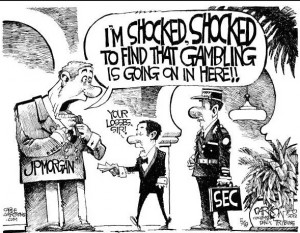
JP Morgan Chase Breakup


Poppy Growing and Heroin Addiction up in Afghanistan

A fascinating interview with Kirk Meyer, former Director of the Afghan Threat Finance Cell, suggests why.  Meyer reports:  The Taliban were collecting taxes on opium in the south. They were going to mirabs, who were the local officials who managed the water supplies in the villages. The mirabs knew which farmers were growing opium, and could estimate the size of their operations by the amount of water they used. The Taliban would have the mirabs calculate the amount of tax owed to the Taliban by individual opium farmers, and then also use the mirabs to collect the tax, which was paid in opium.

I went to a lot of meetings about crop substitution and eradication, but the problem with that approach is in the way the opium system works in Afghanistan. The opium farmers are given credit by opium brokers at the beginning of the growing season. This debt can be repaid only with opium. These opium brokers act like the company stores in the old coal-mining towns in the United States, where miners always had debt so they could never get out. Until they got their wages, they were always being paid in goods, and they could never leave because they owed rent on the house and money for groceries. Well, that was what would happen with the opium farmers. The opium brokers would loan the farmers money at the beginning of the season, and the only way the farmers were permitted to pay it back was in opium. Let’s say a farmer won the lottery or had some other financial windfall; he couldn’t go and give the opium broker money for his debt. The debt had to be paid in opium. So when the Karzai government eradicated opium or tried to substitute crops, it often worked against the individual farmers who owed debt in opium, and possibly made them into Taliban supporters.

I remember one farmer I interviewed who told me that when the government came and eradicated his crop, he couldn’t pay the opium broker, and so his father gave the farmer’s four-year-old daughter to the opium broker, who was some 72-year-old man, to try and settle the claim. Anyway, these young ATFC analysts came up with the idea that the military should focus on the mirabs and their relationship with the Taliban. We should wait until the mirabs gathered the opium owed to the Taliban for taxes, and at that point, conduct military and/or law enforcement operations, because then the farmers would be out of the equation. I believe that was the innovative thinking we should have been using to deal with Taliban funding through the drug trade.

You would have to monitor, either through legal wiretaps or other means, the phones of the mirabs, or recruit the mirabs as informants. By doing that, you should also be able to identify the Taliban members involved in the tax collection. This way, you could intercept the Taliban when they came to pick up the stockpiled opium from the mirabs.

Here is the December report of the US Senate Committee.  2014-12-23 Afghanistan Report Final


Will Plummeting Oil Prices Cramp ISIS?

America will have a tough time defeating the brutal jihadists of Islamic State (IS).  IS is one of the best-financed terrorist organisations in the world, except for state-backed ones. There is no credible estimate of the group’s net worth,  It is known to pay its fighters around $400 a month, which is more than Syrian rebel groups or the Iraqi government offer. It appears to have no trouble purchasing weaponry, either on the black market or from corrupt officials or militias. And it runs services  across the areas it controls, paying schoolteachers and providing for the poor and widowed. So where does it get all its cash from?

Without this wealth, IS, the latest evolution of al-Qaeda in Iraq, could not have expanded so rapidly. It announced itself in its current form in March 2013 when it expanded into Syria from Iraq.  By June 2013 it had taken control of Raqqa, a city in Syria, and in June 2014 it took over Mosul, Iraq’s second city. By then in control of an area that is home to 6m-8m people, it declared a caliphate at the end of that month. Fighters have flocked to join the group. By September 2014 it was estimated to have 30,000 men (and some women, in a female police force), including 15,000 foreign fighters.

Unlike other terrorist groups, including al-Qaeda in Iraq, IS largely funds itself rather than relying on rich supporters.  Although IS receives donations, especially from Gulf-based financiers, they are a relatively insignificant contributor to its coffers. Instead the bulk of its money comes from oil revenues from fields under its control in western Iraq and eastern Syria. American officials estimated that it was making $2m a day from oil before air strikes started, but in December an official said the strikes, some of which have been against oil facilities in Syria, meant the group’s oil revenues had “significantly” dropped. Controlling so much land also helps IS make money from extortion and taxing people in the areas it controls. Like other jihadist groups, it has learned that kidnapping can be profitable. IS earned at least $20m last year from ransoms paid for hostages, including several French and Spanish journalists.

The group cannot be defeated without cutting off its funds. That is why the coalition says it aims to attack the sources of its revenue as well as stopping the group from advancing militarily. America and its allies have carried out air strikes on IS-controlled oil refineries in Syria. America and Britain, which have a strict policy against paying ransoms for hostages, are pressuring European countries to stop paying up.  Several countries have applied sanctions against IS leaders as well as those known to raise funds for the group. But officials are keen to emphasise it will be a long fight. For now, IS still seems to be able to pay for everything it needs.

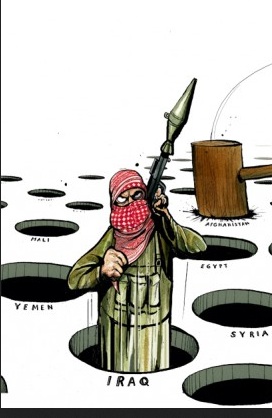
ISIS and Oil

Can Venezuela Run on Cheap Oil?

Bloomberg editorializes: Venezuela had a banner year in 2014: the world’s highest misery index (inflation plus unemployment), a fresh recession, and a currency whose black-market value fell even faster than the Russian ruble.  Venezuela’s homicide rate has risen to the second highest in the world.

Unfortunately, President Nicolas Maduro doesn’t seem to have any good ideas for improving things. In his year-end review he used the phrase “economic war” more than 60 times but offered no concrete plans for waging it.

Maduro said he plans “to perfect the currency system,” but he should instead junk the controls already in place that, along with a multi-tiered exchange system, have raised black-market currency rates to 27 times higher than official ones. In a nation that imports three-fourths of its goods, this would greatly reduce the shortages of everything from medicines to milk and toilet paper.

Despite having the world’s largest oil reserves, Venezuela can no longer afford to provide its citizens with the world’s cheapest gasoline, a subsidy that costs the government more than $12 billion a year and benefits Venezuela’s rich more than its poor. Better to phase the subsidy out, with cash payments to blunt the impact on the poorest.

Maduro said he would also trim unnecessary spending, hinting at cuts to Venezuela’s diplomatic presence. Why not cut military spending instead? From 2009 to 2013, Venezuela was the largest arms importer in South America and the 17th largest in the world. Venezuelans need less guns, more butter.

To achieve these and other reforms, Maduro will have to work with his political opponents — and he might start by, say, letting them out of jail. Opposition leader Leopoldo Lopez, in particular, needs to be released from prison, and Maduro should drop his far-fetched allegations against other opposition members.  He also needs to stop tampering with Venezuela’s election processes.

This won’t happen without some quiet but firm pressure from Maduro’s fellow Latin American leaders, whose economies have also been hurt by Venezuela’s economic dysfunction, beginning with its failure to pay for imports.

Happily, President Barack Obama’s gambit to normalize relations with Cuba has given these leaders more ideological room to apply such pressure.

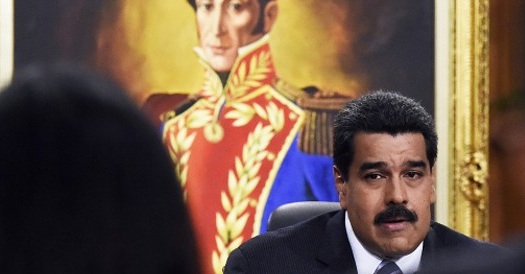
Venezuela

Handouts Slip Through Yemen

Peter Salisbury writes: Yemen was already a poor country when a 2011 popular uprising descended into inter-elite violence, bringing the economy to a standstill and tipping millions of people into poverty. Today, more than half of Yemenis live on $2 a day or less. 

In November 2011, Ali Abdullah Saleh, Yemen’s president of 33 years, agreed to step down. He ceded power to his longtime deputy Abd Rabbu Mansour Hadi, who was tasked with guiding Yemen through a political transition that is meant to end with a referendum on a new constitution, followed by general elections.

This October,  a new premier, Kahled Bahah, declared the economy to be a top priority for the supposedly technocratic cabinet he put together a month after being appointed. But that doesn’t mean that things are about to get better. There’s simply no money left.

The government is on course to spend $14 billion in 2014, almost three times its expenditures of a decade earlier. Meanwhile it’s been bringing very little in. Repeated attacks on a major oil export pipeline have cut off an important source of state revenues, while collection of taxes and payments to state utilities has been minimal.

The government’s response to the mounting fiscal crisis: Ask the neighbor for more money and keep on spending. The backers of the transition — the United Nations, the United States, the United Kingdom, and the states of the Gulf Cooperation Council — have imposed practically no accountability on the president, offering him seemingly limitless political support and refraining from criticism even as he has foundered.

Take the $435 million the Saudis gave to underwrite the cost of welfare payments. Although the money was transferred to the government in July, the fund has struggled to get the finance ministry to cough up the cash it needs to make quarterly payments.

Similarly, in December 2013, Qatar pledged $350 million towards reparations to military officers, civil servants, and landowners who were forcibly retired or had property stolen after 1994 north-south civil war.

A punishing debt repayment regime now accounts for around a fifth of all state spending. Yet Sanaa has spent practically nothing on investment and infrastructure improvements —  the kind of spending that produces growth and jobs.

Keeping track of the money being spent hasn’t been a priority.  International interventions in countries like Yemen come with their own moral hazards. The West feels the need to back transitional administrations and presidents because they see them as the best option for stability — and because that often serves western interests in other realms, such as security. Hadi, for example, has given firm support to U.S. counterterrorism efforts in Yemen.

That helps to explain the muted response to the missing money for welfare payments to Yemen’s large population of poor people. Members of the diplomatic community in Sanaa acknowledge that there’s an issue and talk about “pressuring” Hadi to resolve the problem, but say that they can’t push too hard because of the need to keep the president onside.

Yemen

Karimova’s Corrupt Tentacles into Norway?

David Crouch reports: Norwegian businesses who partner with businesses from other countries can become involved in corrupt acctivities unwittingly.  Transparency Internationa suggests that three reent investigations in Norway should be a wakeup call to caution.

In Norway. Jon Fredrik Baksaas, chief executive of Norwegian telecoms group Telenor, turned a blind eye to the payment of bribes by VimpelCom in Uzbekistan. Telenor holds 33 per cent of the shares in VimpelCom and 43 per cent of the voting rights.

US and Dutch authorities are investigating allegations that VimpelCom acquired telecom licences by paying bribes through a Gibraltar-based shell company controlled by the Uzbek president’s daughter Gulnara Karimova, who herself is under investigation in Switzerland for money laundering.

The VimpelCom investigation widens a probe into corruption at Scandinavian telco TeliaSonera, which led to a clear out of senior management in 2013 at the company, part owned by the Swedish and Finnish governments.
Telenor said in a statement that by stepping down from VimpelCom’s board, Mr Baksaas would “eliminate any potential conflict of interest under the circumstances” while the allegations are investigated. The company denies that it could have done more to ensure transparency at VimpelCom. A hearing will be held  in Norway’s parliament on the case on January 14.

Telenor is 54 per cent owned by Norway’s government.

The recent focus on Telenor follows a scandal in which Yara International, a Norwegian fertiliser company, received the largest fine in Norwegian corporate history for paying bribes in Libya. Four former senior managers, including the former chief executive, were charged with serious corruption, which they all deny. A spokesman for Yara said it is a different company today than when the issues in question took place.

A Norwegian defence group Kongsberg was charged with “gross corruption” relating to its activities in Romania. As part of an ongoing investigation, Romanian and Norwegian authorities raided assets in Romania in September. Norway’s prosecutor declined to comment on progress in the case. The company said it has zero tolerance for corruption and is co-operating with the investigation.

All three scandals this year concern overseas business practices in countries that are struggling with corruption. The Norwegian state has significant stakes in each of the three companies.

Trade Andersen, a business adviser at government agency Innovation Norway, said, “It is often easy to engage [Norwegian] management in anti-corruption efforts at management meetings, but all too often good intentions and ambitions are not translated into practice in the organisation.”

Gulnara Karimova, Corrupt Tentacles into Norway?

Goldman Sachs Teams with US Government?

Stan Gilani writes: The truth about crony capitalism, at the highest level, is being laid bare.

The public is finally getting a look inside the black box where the titans of Wall Street and their inside-jobbers in Congress and at the highest levels of the U.S. government make decisions.  Star International is suing the US for ripping off American International Group, AIG and its shareholders.   Starr is an insurance company controlled by Maurice “Hank” Greenberg, the former CEO of AIG, not long ago the largest insurance company in the world.

Apparently, this closely watched 37-day trial that was supposed to have ended in November is far from over.  Greenberg’s lawyers just got more than 30,000 new documents they were denied before.  What was covered up when the U.S. government and the Federal Reserve Bank of New York bailed out AIG (as the Fed and the government called it) washow Goldman Sachs inserted one of its directors, Edward Liddy, into the top position at AIG when the government saved it from itself.

Only no one knew how deep the Goldman connection went. No one knew how Liddy, the former CEO of Alllstate Corp. helped push through the bailout with the AIG board – without giving shareholders a chance to vote on it.

The problem for the New York Fed, the U.S. government, and Goldman Sachs was that Greenberg’s stock position was enough to kill the bailout if he had a chance to vote his shares.

He never got the chance…

It wasn’t enough that Goldman’s former CEO was Hank Paulson, the then-Secretary of the U.S. Treasury, and that Goldman got bailed out itself when the Fed and the U.S. government gave it a windfall of profits right out of AIG’s pocketbook for some credit-default swaps that weren’t even worth anywhere near what the government paid Goldman for them. That was theft, plain and simple.

it’s not theft if it’s government-sanctioned.  So, we’re finding out now how deep the rabbit hole is in this trial.

Rabbit Hole?

Oil Price Decline a Black Swan?

Kent Moors writes:  Oil prices are struggling to stabilize.  Some think it is a black swan, a theory popularized by Nassim Nicholas Taleb.  According to Taleb, a black swan event has three characteristics:

  1. It is a surprise. Nothing in the past can convincingly point to its possibility.
  2. It has a major impact.
  3. People contend that they expected the event to take place (in hindsight).

Almost 15 years ago, Taleb applied this approach to the stock market.  As a consequence, the black swan is being used as an “explanation” for all kinds of things. It’s the obverse of the mantra “this time is different.” And that leads us back to the true nature of the 40% drop in oil prices.  Is the stunning fall of crude is a black swan event?

It isn’t. But calling it one may be a good way of clouding up what really is happening.

First off, there were always indications on both the supply and demand side that matters were softening. Second, the OPEC non-decision on Thanksgiving to keep production levels unchanged was both predictable (from the Saudi perspective) and telegraphed in advance. Then, the orchestration of the talking heads commentary on the tube made the whole move “legitimate.”

Unless, of course, there is another motive at work and the black swan becomes a convenient cover. Instead, this is what is really happening when it comes to oil prices.

Yes, there are traditional pressures driving down the price of crude. Rapidly increasing supplies and slower demand would have created a correction in oil prices in any event.  But dropping over $40 a barrel has required something else entirely.

When it comes to oil we are in a new age of massive short plays and swaps. The coordination of these moves is staggering, creating an impact that is immediate. Especially if there is a segue to important policy makers.

For instance, a Kuwaiti official tells the world oil can fall to $60 and… presto, within 48 hours, that’s where oil lands.

Of course, the targets of all of this are well known and have been discussed here at length: Russia, recalcitrant members of OPEC, and U.S. shale producers.

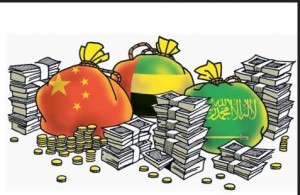
But we should look also at the positioning of sovereign wealth funds (SWFs).These funds have been designed to invest the proceeds from national revenues. Usually, the better a country’s balance of payments, the stronger the SWF. This is always a result of a trade surplus – as more is exported out of a country (being paid for by somebody else) than is being imported (requiring payment).  China, for example, is in this category.

But most of the SWFs of consequence involve investing the proceeds of oil sales. In the case of oil producers, that has usually meant the success of an SWF was perceived as dependent on the price of crude. The higher the price, the greater the leverage for an SWF.

Now these funds are almost always conservative, preferring guaranteed or long-term gains over a higher but riskier return. That explains SWF investments in Rockefeller Plaza and hotels on the one hand, or dull but secure 1.5% annualized return from somebody else’s sovereign low-interest bond on the other.

There is also the problem of limiting the financial downside from introducing the proceeds directly into a domestic economy. Given that oil revenues are in U.S. dollars, a direct flow into the economy ends up inflating the local currency rather quickly.

So the proceeds from export sales are largely segregated from domestic trade, kept outside the country, with the profits from investing introduced in ways to minimize the inflationary impact.

All of which has triggered a new development. SWFs have now become a player in the market, shorting the very product responsible for the funds to begin with. In other words, some OPEC members are making money on both sides of the crude pricing curve.

Transacting the deals outside their own borders via SWFs, these countries are hedging the product in both directions. That means they are currently pushing the lower cost of crude forward by pairing shorts to actual oil consignments.

Plain and simple: This is manipulating the market. It’s equivalent to being a poker dealer who is able to read everybody’s hand while taking a seat at the table.
Sovereign Wealth Funds

Should Big Banks Be Primary Dealers for Central Banks?

What impact do primary dealers have on the economics of any country, the EU, or the world economy for that matter, Lee Adler asks.  Here is a table of primrary dealers he has prepared.  World Primary Dealers

Adler looks around at the central banks: The PBoC (China) is also playing a growing role as it integrates its financial markets with the rest of the world’s, but its system does not use Primary Dealers, per se, and its linkages to the rest of the world are more obscure. The BoE (UK) is a small player.

Adler aruges that Central Banks’ policy doesn’t mean much. With Quantitative Easing, the central banks bring the money into existence by making deposits in the Primary Dealers’ accounts at the central banks in payment for the securities the central banks purchase from the Primary Dealers, or by making loans to them. What the dealers do with the money from there is up to them, although they are loosely required to purchase government securities when the central government auctions them. Since there are always plenty of other bidders for the government paper, the Primary Dealers end up with billions in excess cash.

Certainly the US is making the break up of Big Banks a big issue, and this may be why it is important to simplify and clarify their role and divide up their functions.

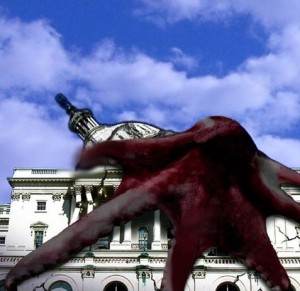
The Tentacles of Big Banks Crush Governments