Anti-Competition and Tax Breaks in the EU

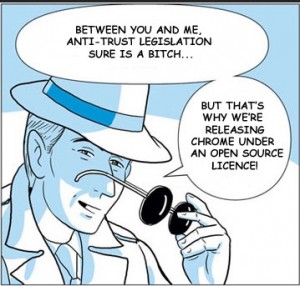
Joaquín Almunia steps down as ‘competition” commissioner.  Many European politicians have objected to his anti-trust efforts, particularly against Google.  He also tried to investigate tax favoritism for big corporations who promised to bring jobs to countries in exchange for low tax rates.  Among the companies he targeted: Apple in Ireland, Starbucks in the Netherlands, Amazon and Fiat SpA in Luxembourg.

The Google case has caused the most furor.  Almunia has said that it should not be a poitical football, but his efforts to come to a peaceful resolution with the company have come to naught.

Search engine favoritsm for consumers who subscribe to many Google products is being challenged as anti-competitive. In the US too people are beginning to realize that there is no free lunch.  Products you use for free from Google, Facebook, Twitter and Skype also subject your personal data to wide dissemination.

Google


Oil Prices and Governance

As oil prices plummet, consumers are delighted. Oil producers retrench.

OPEC is scrambling to gain control of the market again and meets at the end of November.  Countries desperate to boost prices, like Venezuela and Russia, are also the least democratic. Oil revenue is used to pay off a powerful elite or pay expensive subsidies to the poor. Neither tactic works well over time.

Norway’s example is of a society that decided to secure its own power and position vis  a vis the big oil companies.  Norway is the world’s fifth largest exporter,  They have tried to distribute money fairly and leave an economy for the future which is not oil-based.  Fighting a tendency to have personal favoritism in government is particularly important for oil rich countries.  High levels of trust and transparency are essential.  These stand out in a country like Norway when oil prices fall.

Falling Oil Prices

The Lagarde List in Greece

During the worst of the economic crisis in Greece, Christine Lagarde, former French Finance Minister, gave a list of 2,000 Greek tax evaders who had Swiss bank accounts.  Government officials in Greece claim to have lost the CD the list came on, and then lost the USB drive they copied it on to.  They dragged their heels for months.

In the fall of 2012, a Greek journalist got hold of the list and published it.  Fifty police officers were sent out to arrest the journalist and not the tax evaders.

Corruption has plagued Greece and helped precipitate the economic crisis.  A handful of super-rich, well-connected people own practically all the country’s TV, radio and newspapers.  They also control major banks, as well as oil, shipping and construction businesses.  Tough for the press and independent citizens to go up against.

Lagarde's List

Testosterone and Greed

To keep libidos active after menopause, some women take testossterione.  It turns out that this may make them greedier.

Joe Pinsker wrires:  Results of a study done by researchers at the University of Lausanne ecently published in The Leadership Quarterly suggest that  people with high levels of testosterone were more likely to behave greedily.

There’s already a thorough body of research on how power contorts morality and reason. Power, it’s theorized, turns people selfish because it makes them feel entitled and emotionally detached. It can make them view others as less worthy, which is of course compounded by the finding that power can increase bias. Given also that power makes people feel immune to bad consequences, it makes sense that some of those in power do so many awful things.

Hormones are a less-scrutinized variable in moral decision making. High levels of testosterone have been linked to diminished generosity and empathy, but the connections between testosterone and corruption—defined by Lausanne’s researchers as ignoring social norms for personal gain at others’ expense—hadn’t been sketched until this study.

To trace this relationship, researchers designed two experiments—both variants of what’s called “the dictator game”—that culled subjects from a Swiss university. In the first setup, subjects were randomly assigned to be leaders or followers. Each leader was solely responsible for deciding how to distribute prize money given to the group. For example, leaders at one point chose between “$100 for me; $70 for you,” “$90 for me; $90 for you,” and “$150 for me; $10 for you.” These numbers were selected such that the more the leader chose the receive, the less his or her followers would get. The leaders with more power—that is, with more followers or more distribution choices—behaved more greedily.

The second experiment was more ambitious. Weeks before subjects were assigned leader/follower roles, they filled out a survey about the fairest way to distribute the money. The vast majority of people agreed that the “$100 for me; $70 for you” arrangement was fair—which allowed the researchers to declare that picking “$150 for me; $10 for you” would be violating a norm that everyone agreed on. Subjects also had their mouths swabbed to measure testosterone levels.

During the experiments, once subjects had been named either leaders or followers, they were frequently reminded of the survey results, making them aware of what their peers expected of them. When leaders’ power over a situation was relatively low, roughly half of them stayed true to the social norms they helped develop; this dropped to 19 percent when they were given more power. Also, the greediest behavior was linked to high baseline levels of testosterone.

Susan Case, a professor of organizational behavior at Case Western notes that the average age of the subjects is about 21 years—an age too collegiate to use in generalizing about the corporate world.

From the Lausanne study, it’s not clear whether testosterone levels control corrupt behavior, or whether high levels of it are linked to the presence of some other physiological feature that does.

David Mayer, a management professor at the University of Michigan, points out that this research is similar, in spirit, to fMRI studies indicating which parts of the brain light up when a certain decision is made.

Indeed, what can be done to make business executives more likely to act with the public good in mind?  Iit appears the best way to curb selfish behavior is to turn away from hormones and toward oneself. “Being self-aware … actually reduces people’s tendency to morally disengage from the tasks they are doing and act with greater integrity,” says Fordham University’s Kyle Emich. Specifically, Emich recommends installing mirrors in the offices of the powerful—”so people are forced to look at themselves,” he says.

Testosterone and Greed

Japan Not Moving on Tsunami Repairs

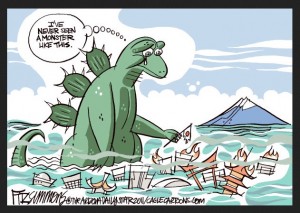
Taiga Uranaka and Antoni Stockowsky write: Japanese government funds budgeted for reconstruction and transferred to local governments are stuck in banks across the tsunami-ravaged northeast.  The central government has paid out more than $50 billion directly to local governments in Miyagi, Iwate and Fukushima prefectures, the areas hardest hit by the disaster. But about 60 percent of that money remains on deposit in the region’s banks.

Ishinomaki, where more than 3,700 people died in the tsunami – the most casualties of any city in the disaster – has been deeply affected by the funding paralysis. The port city, where 56,000 buildings were damaged, has been showered with money for reconstruction – about $4.1 billion in the three years after it was hit.

But almost 60 percent of the money, or $2.3 billion, remains in bank deposits. And fewer than five percent of the planned new homes for the city’s nearly 25,000 evacuees have been completed.

Makoto Kitamura, the deputy director general of the Reconstruction Agency, says local government spending of reconstruction money has been accelerating. “The pace of the construction projects has also been picking up,” he told Reuters, sitting in his office in Tokyo. “So it is not something you should worry about.”

For Prime Minister Shinzo Abe, the reconstruction delays are a potential time bomb. Before he became prime minister in December 2012, Abe campaigned in parliamentary elections on a pledge to speed up reconstruction – a promise he has repeated on both anniversaries of the disaster since he took office.

As prime minister, he vowed in March 2013 that “reconstruction will have made a lot of progress and our lives will be better by March 11 next year.” A year later he repeated the promise: The government would make the year ahead one in which “everyone in disaster-hit areas feels the progress of reconstruction.”

So far, about 2,700 housing units of a planned 29,000 have been completed in the tsunami-hit areas. In its housing plan issued more than a year ago, the government said it aimed to complete 15,000 homes by March next year. It has since scaled back that target to 10,000 units.

A labor shortage exacerbated by the siphoning of workers away from the disaster zone to build commercial facilities for the 2020 Tokyo Olympic Games has slowed reconstruction. So have a spike in the cost of building materials and problems in procuring land in the disaster zone.

Much of the reconstruction cash has ended up on the ledger of 77 Bank in Sendai, some 50 kilometers west of Ishinomaki. Government deposits at 77 Bank, the region’s largest lender, have jumped four-fold to almost $17 billion in the past three years as reconstruction money flooded in, the bank said.  Like 77 Bank, other regional lenders have also ploughed funds into Japanese government bonds, creating a closed loop of financing. By buying government bonds, the banks’ investments are essentially helping to fund the borrowing that the government undertook to make the disaster-related allocations in the first place. The central government issued $130 billion worth of reconstruction bonds in the three years after the disaster.

The unspent funds sitting in bank deposits also come at a cost to Tokyo. The government is under mounting pressure to cut a public debt load that is more than twice as large as annual economic output.

Separate from the money allocated directly to the prefectures, the central government has poured $140 billion into disaster-relief and reconstruction projects, including emergency loans to small- and medium-sized businesses hit by the tsunami.

The government’s five-year reconstruction plan was built on unrealistic assumptions, said Yoshikiyo Shimamine, the chief economist at Dai-ichi Life Research Institute in Tokyo. “Given bottlenecks such as labor shortages and material cost rises and difficulties in getting consensus among residents who are relocated, reconstruction budgets are not something that can be spent within five years,” he said.

Officials in Ishinomaki, home to 150,000 people, say spending the more than $4 billion in reconstruction aid has proven tough. With all of the city-owned land having been designated for temporary housing after the tsunami, the local government had to negotiate the purchase of an additional 9,000 plots to build permanent homes. That inflated the price of a plot of land in Ishinomaki by 15 percent last year, the biggest jump anywhere in Japan.

Before the city could buy land, it had to track down the legal owners. That proved tedious, said Oka. Officials discovered that in many instances, properties had been passed down without proper inheritance procedures.

After the tsunami, about a third of public works projects in Miyagi failed to attract bidders in the first round as construction companies say they held back for fear the projects would be unprofitable.

A strip of Ishinomaki’s shoreline where 6,500 homes once stood has been declared too dangerous to build on. And many local government officials, who would otherwise have played a role in reconstruction, either died in the tsunami or had their homes destroyed and are themselves living in temporary dwellings.

Tsunami Repairs

Hezbollah Sanctions?

Juan Pecquet writes:  European officials, not the Lebanese, are the ones raising sharp questions about Hezballlah sanctions legislation that unanimously passed the House in July.  European officials are worried about crippling Lebanon’s economy even as Beirut’s bankers say they’re OK with the House-passed Hezbollah sanctions bill.  The legislation has stalled in the Senate partly as a result, but the bill’s backers are confident they can address any concerns.

Lebanese bank officials in  contrast have said they can live with the new restrictions, especially after a lengthy “findings” section that could have cast the country’s financial sector in a negative light was cut from the bill.

Concern is not as much with the American financial institutions as it is with some of the European financial institutions — and the pushback is coming primarily from that entity.

The EU has been reluctant to break ties with the Shiite militia — it labeled Hezbollah’s so-called military wing a terrorist organization only last year under rising US pressure — and has not blacklisted the group’s bank accounts and assets. Countries such as France insist on maintaining open channels with the most powerful political force in Lebanon.

“We are in contact with working-level staffers of Congress on a very regular basis to exchange on many foreign policy issues,” a French diplomatic source said. “Lebanon is one of the issues discussed, as are Africa, Ukraine, Syria, Iraq or Ebola to name just a few over the last few months.”

The British government did not respond to a request for comment.

Joseph Gebeily, president of the Lebanese Information Center in Washington, said Hezbollah relies on the European financial sector in part because it actively avoids Lebanese banks.  “Hezbollah’s image is important to Hezbollah. They don’t want to be seen as doing damage [to the Lebanese banking sector],  Even Hezbollah parliamentarians can’t open an account.”

How to Measure a Bank’s Solidiity?

Matt Levine writes:  Ever since about mid 2008, when everyone had a massive panic about bank capital, there has been a community of people who wanted to ignore the Basel Committee on Banking Supervision, and their “Tier One Ratio” (based on equity divided by “risk weighted assets” or RWA). Instead, people like Anat Admati or Andy Haldane have suggested that we should just take the equity in the balance sheet, and divide it by the assets to get a “leverage ratio” without any of this complicated risk weighting stuff.

Are they right? In my opinion, yes to the extent that they want to look at the leverage ratio, but very much no to the extent that they want to get rid of risk weighting. It’s true that risk weighted assets and the Basel framework have gone badly wrong in the past and even contributed to some failures. But to take that as a reason for throwing the whole system away is not helpful.

MYTH — Leverage is a “simple” and objective calculation

FACT — Only if you think that calculating a bank balance sheet is simple and objective

MYTH — Leverage is a more conservative standard than RWA

FACT — Unless you make major adjustments to the “simple” leverage ratio, it misses whole categories of risk.

MYTH — Leverage ratios can’t be “gamed” by the banks.

FACT — Leverage ratios are very often gamed

MYTH — Risk weighted asset calculations are always fudged and faked by the banks

FACT — No evidence has been found of this despite a dozen studies

There are two, related, legitimate reasons why the leverage ratio is a big step forward.

First, it acts as a checksum. Most of the things that a bank might do to fool the risk-weighted asset ratio would have the effect of making the balance sheet bigger and the leverage ratio worse. Most of the things that a bank might do to fool the leverage ratio would have the effect of piling up tail risks and making the risk-weighted assets ratio worse. It’s comparatively difficult to think of measures which can fool both ratios at the same time.

Second, and related to this, it helps to avoid “corner solutions”. What you don’t ever want to do in banking is to create the impression that a particular line of business has a zero capital requirement.  If you have more than one ratio, you have much less chance that any activity is going to get a very low capital charge.

Leverages are useful but not simple.  Leveraging

No Simple Answers

No Simple Answers


Phone Companies Tracking Customers

Wired and Forbes report earlier that the two largest cellphone carriers in the United States, Verizon and AT&T, are adding the tracking number to their subscribers’ Internet activity, even when users opt out.

The data can be used by any site – even those with no relationship to the telecoms — to build a dossier about a person’s behavior on mobile devices – including which apps they use, what sites they visit and for how long.

MoPub, acquired by Twitter in 2013, bills itself as the “world’s largest mobile ad exchange.” It uses Verizon’s tag to track and target cellphone users for ads, according to instructions by devleopers posted on its website.

Twitter declined to comment.  Who is Tracking You

Phone Companies TrackingPhon


Geithner Surprisingly Frank in AIG Court Papers

Jeff Gerth writes about papers Timothy Geithner, Obama’s first secretary of the treasury, wrote which has cropped up as part of an ongoing legal case concerning AIG and the bailout.  With the SEC focused on insider trading, which Geithner descibes as disgusting but not the cause of the financial crisis, and poor supervision of the various institutions that bundled subprime mortgages, the aftermath of the crisis has still not be dealt with.

Weak remarks from Wiliaim Dudley, head of the New York Fed which Geithner ran before he went to the White House, illustrate how ineffective supervision of Wall Street was and is.  Specific criticisms are summaried in Geithner’s notes.  Timothy Geithner Talks About the Financial Meltdown, Somewhat Frankly

Geithner’s points: Illegal stuff was hard to prove, supervision was weak. Government relief programs were tepid and corporate wrongdoers have not been punished.

Geithner to the Rescue

Can the New York Fed Supervise Wall Street?

Can the New York Federal Reserve supervise Wall Street?

The financial crisis could never have happened without the passivity of federal bank regulators. And no agency’s failure was more pivotal than that of the Fed, which had the authority to crack down on the abusive lending that drove the financial system and the economy over the cliff, but repeatedly failed to exercise it

The New York Fed is a key part of the Federal Reserve, acting as the on-the-ground supervisor of the major Wall Street banks. According to an internal New York Fed report, written in 2009 but revealed recently, bank supervisors in the pre-crisis years ”saw issues but did not respond,“ were not ”willing to stand up to banks and demand both information and action,“ and were excessively deferential to the banks they regulated.

Five years later, a whistleblower’s tape recordings reveal a disturbingly similar pattern of inappropriate deference to regulated banks. A still more recent official report adds fuel to the fire by criticizing the New York Fed for sloppy oversight of the JPMorgan Chase office responsible for the $6.2 billion “London Whale” disaster.

Roles of the US Federal Reserve