Economic Impact of Turkey’s Ambivalence on Middle East Wars

The Turkish government has not recognized the true nature of the Islamist group. It may already have been too late, however, with foreign policy tactics beginning to become contaminated with apprehension. Corruption, ineptitude and chaos within Turkey’s security apparatus no doubt also played a role, all of which made it more difficult to control the border.

Now, Ankara is facing an extremely difficult situation. Providing care to the masses of refugees costs billions of euros and weighs on the country’s already weak economy. Social tensions are on the rise with poor Turks in the region envious of the relatively good care received by the refugees and concerned about increased competition for jobs. Well-off Syrians have also driven up rents in the cities.

 The government’s biggest fear is of terror attacks. “Tourism is one of the most important economic sectors,” he says. “If a bomb goes off in a hotel and a couple of vacationers die, it’s over.” The fear is certainly well-founded. Several hundred Islamic State fighters come from Turkey and, in contrast to jhihadits from elsewhere,  they can move about freely in their home country.

Like Ahmet, a 21-year-old from Istanbul who fights for the Islamic State. “We are everywhere in Turkey, in Istanbul, in Ankara, in Gaziantep,” he says. It is impossible to confirm such claims, but Western intelligence agents believe that the Islamic State actively tries to recruit young men in Turkey. One intelligence agent who asked not to be identified says that warnings have been delivered to Turkey for years. “But the government always insists that it has the radicals under control.”

Ahmet was recruited two years ago in Istanbul by a precursor group to the Islamic State. Even then, he was full of admiration for the older boys at the Koran school who spoke about their dreams of joining the jihad. He says he has already been in Syria twice and is planning to return soon to fight “to the end.” His final battle, he says, is rapidly approaching.

Turkey and ISIS


Atlanta Prosecutes Teachers Who Helped Students Cheat

Prosecutors outlined the case against a dozen former principals, teachers, and administrators accused of orchestrating a massive cheating conspiracy in 2009 in Atlanta public schools, as the high-profile trial got under way.

Prosecutors had brought charges against 35 individuals in the case, one of the most sweeping and widespread cases of cheating to come to light in US public education. Most of those individuals have pleaded guilty and won’t go to trial. According to the charges, educators allegedly used a variety of schemes to inflate students’ test scores, including erasing incorrect answers, telling children to change their answers, and opening sealed exams ahead of time to coach students on the answers.

It’s a case that has received widespread attention both because of the nature of the charges and the fact that it seemed to have emanated from the very top – former Atlanta superintendent Beverly Hall is one of the defendants, though her trial has been delayed while she deals with a health issue  – as well as the questions it raises about the possible negative incentives from the culture of high-stakes standardized testing.Prosecutors on Monday outlined the case against a dozen former principals, teachers, and administrators accused of orchestrating a massive cheating conspiracy in 2009 in Atlanta public schools, as the high-profile trial got under way.

Test Cheating

Australians Arrest ISIS Financier

Melbourne raids follow a heightened terror alert earlier in September and the tabling of new security laws in Australia’s parliament.

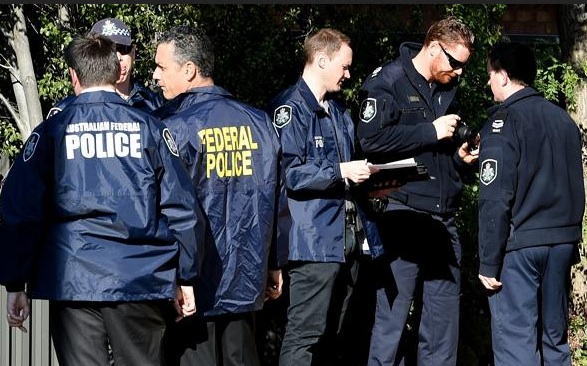
Security forces in Australia carried out a new round of anti-terror raids, resulting in the arrest of a 23-year-old man in Melbourne on suspicion of funding a US citizen to fight for Islamic State.

Hassan El Sabsabi, is accused of sending about $12,000 to a US citizen he met on social media, in order to help fund his travel to Syria, where IS and other jihadist groups are active. Mr. El Sabsabi was arrested today after an eight-month investigation by Australian police, which were tipped off by the FBI.Security forces in Australia carried out a new round of anti-terror raids today, resulting in the arrest of a 23-year-old man in Melbourne on suspicion of funding a US citizen to fight for Islamic State.

Arrests in Australia

US Treasury’s Anti-Inversion Measures

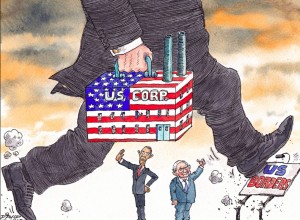
Howard Gleckman writes: Treasury could not change that threshold, though Congress could (and bills have been introduced to do so). However, Treasury did block several techniques firms have used to manipulate the ownership test. For instance, the U.S. firm can no longer reduce its value by paying shareholders a big dividend in advance of a deal. Similarly, the new foreign parent can no longer inflate its size by counting passive assets not used in its regular business.

Treasury also attempted to stop several common post-inversion techniques firms use to avoid paying tax when they bring back to the U.S. pre-merger foreign profits that are sitting in overseas affiliates. For instance, the new rules aim to block a practice known as “hopscotching” where an old foreign subsidiary lends money to the new foreign parent which in turn either distributes  the proceeds to U.S. shareholders or invests in the U.S., bypassing the U.S. firm. This allows the funds to come to the U.S. tax-free.   Treasury and Inversion

Inversion

Russia’s Banking Sector Under Pressure

Ben Aris writes from Moscos:  Five of Russia’s six largest banks are now on the US sanctions list, which is hurting the whole sector and could eventually precipitate another financial crisis.

Russia’s largest lender, the savings bank Sberbank, was included in a new sanctions list for the first time in September. It joins its sister state-owned banks VTB, which concentrates on corporate financing; the retail specialist VTB24; Gazprom-owned Gazprombank; Bank Moskvy, which was acquired from the City of Moscow in 2011 by the VTB Group; and Russian Agriculture Bank (Rosselkhozbank), which finances the agricultural sector.

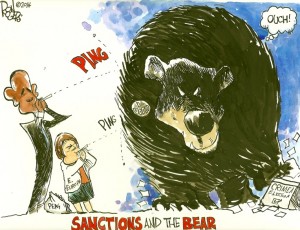
Sanctions are being imposed an already extremely sick sector and will only add to the deterioration. Cut off from international capital markets and an economic malaise at home depressing retail deposit growth, the sector is currently being supported by the Central Bank of Russia (CBR). Lending by the CBR is approaching levels last seen during the blackest days of the 2008-09 crisis. The government has already been forced to recapitalise two state-owned banks – VTB and Russian Agriculture Bank – and is pouring more money into the sector.

A recent report from Standard & Poor’s says that Russian banks have sufficient resources to weather the storm for now. “We believe that the credit quality of Russian banks will not suffer immediately from the restrictions on tapping EU and capital markets. Our analysis suggests the sector has enough liquidity to refinance its international debt falling due until the end of 2015,” the rating agency says in a September 18 report entitled, “Sanctions Will Increasingly Weigh On Russian Banks’ Funding And Liquidity Profiles.”

However, it adds that, “the longer restrictions on capital market access last, the larger funding imbalances will become, potentially calling into question the banks’ capacity to adequately finance the economy.”

While the list of sanctioned banks is short, they still represent more than half of all Russia’s banking assets. Luckily, following the 2008 crisis Russian banks became a lot more cautious in their borrowing and are not heavily exposed to international lenders. S&P estimate that banks total external obligations for the 2014-15 is $57bn, which they should be able to cover from their liquid reserves and maybe with some help from the CBR.

Impact of Sanctions

China to Cut Off Corrupt Officials from Escape Routes

A Chinese senior prosecutor has pledged efforts to chase fugitive corruption suspects as well as to “resolutely cut off the escape route of suspects.”

At a conference on an international manhunt of duty-related crime suspects on Saturday, Qiu Xueqiang, deputy procurator-general of the Supreme People’s Procuratorate (SPP), urged prosecutors to intensify their work to prevent relevant suspects from escaping.

Such efforts include proper risk evaluation of the targets’ fleeing and early warning against such situations, Qiu said.  Prosecutors should enhance the information sharing with other authorities and formulate detailed plans to prevent suspects’ absconding.  Qiu told the prosecutors to target on suspects both in China and abroad and they should take measures to chase the suspects at large and at the same time stop potential fugitives.

The SPP announced the launch of a half-year campaign targeting fugitive suspects of corruption and other duty-related crimes. On Saturday, Chinese police announced that it has seized 102 suspects in a separate campaign targeting corrupt officials and suspects in economic crimes that have fled abroad.

In a latest move, Chinese police escorted four suspects captured in Thailand to Beijing.  One of the four was suspected of loan fraud and has been at large for 10 years. The other three were suspected of contract frauds with one case involved money up to 67 million yuan (10.9 million U.S. dollars), the Ministry of Public Security (MPS) said in a statement.

It was also the fourth time Chinese police conducted arrests in Thailand amid the police’s recent manhunt campaign and to date a total of 16 suspects of major economic crimes in the country have been seized and brought back to China.

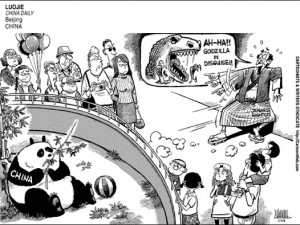
China launched the Fox Hunt 2014 operation in July to “block the last route of retreat” for corrupt officials and other economic criminals at a time when China’s major crackdown on graft has already narrowed the space for abuse of power.

Meng Qingfeng, director of the economic crime investigation bureau of the MPS said the international pursuit is an important step of China to crack down on graft and to promote the rule of law.  Meng said Chinese police will continue the efforts to deepen international cooperation of law enforcement and diligently practice its duty to fight crimes and protect the people.

Capturing Economic Criminals


Cutting Off Criminal Funds to ISIS

Jamie Dettmer writes:  Turkey needs to stem money laundering and to stop traders in Turkey buying smuggled oil from the Islamic State.

For years, Ankara has fallen foul of international money-laundering agreements, and despite passing a law last year aimed at preventing the financing of terrorism, Turkey remains on a global list of uncooperative countries. It languishes on what is known as the gray list overseen by the Financial Action Task Force, an inter-governmental body.

The G7-founded body, which is tasked with implementing global standards to counter illicit financing, says Turkey has a weak framework for identifying and freezing terrorist assets. With the U.S. gunning for ISIS and determined to hit its funding, Turkey will be pushed to play its part on hitting the militants in their wallets.

From racking in millions in ransom money for Western hostages to trafficking in rare antiquities looted from museums and archaeological sites in Syria and Iraq, militants of ISIS have turned their jihad into a cash cow and become terror tycoons. Analysts say they are the world’s first self-funding terrorist organization and, unlike al Qaeda, don’t need to go cap-in-hand to wealthy sympathizers in the Gulf—although they don’t say “no” when offered donations.

Depriving ISIS of its oil revenue is going to be a monumental task. Hitting a dozen rudimentary refineries isn’t going to undercut the group, according to analysts.

Even more than bombing, a key component in stopping ISIS from profiting from oil will be blocking militants from getting their oil to market by locking up the border with Turkey and Jordan and pressing Kurds to stop dealers in semi-autonomous Kurdistan from trading. The Turks have shown little enthusiasm for halting the trafficking in the past, although in recent weeks they have interdicted some tankers carrying illicit oil.

Western and Iraqi officials were given a good rundown on where the militants’ wealth comes from when ISIS computers and databases were seized by Iraqi intelligence officers from the Mosul home of an ISIS courier, Abdulrahman al-Bilawi, a few days before jihadists overran the northwestern Iraqi city. The breakdown of the group’s financial resources shocked even senior Iraqi officials and it suggested ISIS was worth more than $800 million even before it added loot pillaged in Mosul to its coffers.

The databases revealed ISIS is receiving cash not only from oil trafficking but also from selling to overseas traders, other Syrian insurgent groups and even the Assad regime. It is also reaping profits from selling industrial machinery from plants and factories pillaged in Aleppo, priceless antiquities stolen from archaeological sites and museums, and cars and weapons captured from the Syrian army.

ISIS leaders on the ground prioritize quickly what is to be looted when they capture new territory, and there is strict management of resources.

Turkish Money Laundering

Retiring USAG Holder Did Not Hold Individuals Liable for Criminal Activity

Attorney General Eric Holder has efforts and achievements to be proud of, no doubt, but will probably be remembered above all for something he didn’t do: prosecute top executives for their role in the 2008 financial crisis.

He declined to hold senior executives accountable not because he wished to be soft on financial crime but because of a strategic error. In a 1999 memo written when he was deputy attorney general under President Bill Clinton, he’d explained how prosecutors could charge corporations as criminal enterprises. In 2002, the testing of that doctrine on Enron Corp. auditor Arthur Andersen LLP caused the company to fold, and thousands of innocent people lost their jobs.

During and after the financial crisis, Holder kept the focus on corporations, but moved more cautiously. Fearing a repeat of the Arthur Andersen debacle, prosecutors were careful to leave companies standing, even as they extracted tens of billions of dollars from banks for transgressions ranging from mortgage-related fraud to laundering money for drug cartels.

The inhibition was understandable. Yet it arose because, under Holder’s leadership, prosecutors lost sight of what mattered most: holding individuals, not companies, accountable for crimes. Of 21 separate actions against major financial companies from 2009 through May 2014, only eight were accompanied by charges against individuals, and none of them were high-level executives. The authors of any offenses related to the 2008 financial crisis can relax: In most of the cases, the statute of limitations now applies.

Could it be that nobody went to prison because no crimes were committed? This seems unlikely, at the very least.

Holder’s successor should strive to put this right. First, insist that prosecutors taking action against companies charge individuals, too. Second, eliminate non-prosecution agreements, in which prosecutors settle without pressing charges. These make it too easy to hide bad behavior or subject companies to shakedowns. Third, ask Congress or the Judicial Conference which drafts changes to the rules of criminal procedure — to give judges power to review deferred prosecution agreements, in which prosecutors file and settle charges, to make sure these serve the public interest.

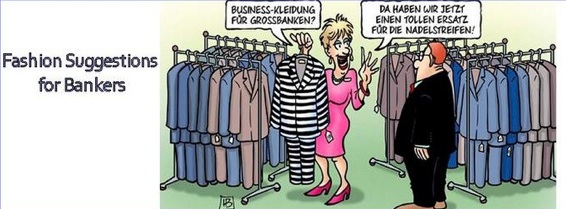
Jail Offending Bankers.

Barclays Fined for Failing to Safeguard Customer Assets

 British bank Barclays was fined 38 million pounds ($62 million) on Tuesday for exposing customers to unnecessary risks by failing to ensure client assets were properly safeguarded and adequate records kept.

Imposing its highest fine for client asset breaches, Britain’s financial regulator said there were “significant weaknesses” in Barclays’ systems and controls between November 2007 and January 2012 that put 16.5 billion pounds of client’s assets at risk.

The Financial Conduct Authority (FCA), which has tightened rules governing client asset protection since the collapse of Wall Street bank Lehman Brothers in 2008, said that customers risked incurring extra costs, lengthy delays or losing their assets if the bank had become insolvent.

“Barclays failed to apply the lessons from our previous enforcement actions, numerous industry-wide warnings and exposed its clients to unnecessary risk,” said Tracey McDermott, the head of enforcement and financial crime at the FCA.

Protecting Assets

UK to Make Market Manipulation a Criminal Offense

Bloomberg notes: Amid a spate of scandals over the rigging of financial benchmarks ranging from commodities to currencies to interest rates, the U.K. government is making a bold move toward restoring confidence: By the end of this year, it plans to make manipulation a criminal offense in all the affected markets.

The U.K.’s plan — aimed at maintaining London’s role as a major financial center — raises some questions. Can’t investors look out for themselves? Wouldn’t tweaking the way markets are designed, combined with the risk of damage to reputation, suffice to keep traders in line? No and no.

“Buyer beware” doesn’t apply. These markets aren’t casinos, where people can choose whether to play. Trade in money and commodities is central to the functioning of the global economy. The prices set in these markets affect what people pay for everything from gasoline to mortgages. If insiders manipulate them for personal gain, they do so at the expense of millions of ordinary consumers.

And reputation, by itself, isn’t enough of an incentive to keep traders honest. The profits from manipulation — and the bonuses they entail — can be huge, and traders and executives change jobs too often for the good name of an institution to carry much weight. Consider: Many of the world’s largest banks lied about their borrowing costs for years, in some cases with the knowledge of senior executives.

Regulators are rightly taking steps to make benchmarks less vulnerable to manipulation, in part by requiring them to be based on observable transactions (rather than relying on traders to tell the truth) and administered by independent parties (rather than by the same banks that set the prices). Good market design will help, but it’s no panacea.  Traders managed to rig currency benchmarks that already met regulators’ guidelines.

Stronger deterrents are needed. Fines alone fall short: The billions of dollars that banks have paid hit shareholders, whose control over corporate culture and behavior would be limited even if they chose to exert it. The threat of criminal penalties will be much more potent.

UK Clamping Down on Bankers