Credit Suisse Banker Guilty Plea Confirms The Use Of Nominee Tax Haven Entities

Our correspondent Andreas Frank reports:  A former Credit Suisse banker pleaded guilty to helping Americans hide money in Switzerland and agreed to cooperate with the U.S. government as it investigates banks and their employees for aiding tax evasion.

Andreas Bachmann admitted to one count of conspiring to defraud the U.S., which carries a potential penalty of five years in prison. Prosecutors agreed to recommend a reduced sentence in return for his cooperation.

In 2011, federal prosecutors accused Mr. Bachmann and seven other Credit Suisse bankers of conspiring to set up offshore accounts for wealthy Americans that hid up to $3 billion in assets, according to the indictment.
US Bachmann PressRelease
Related Reports:

A nominee director is someone who is renting his or her name to hide the beneficial owner by taking the position on paper of the company’s directors. The term of straw man or front man has been used to describe someone who is acting as the nominee. Legally, according to the incorporation documents, the nominee is responsible for the company or entity. In addition, if it is the case of a nominee that is also listed as the nominee shareholder, then they in effect also have the related ownership responsibilities as well.

The basic function of the nominee director is to shield working executives of other companies from the public disclosure requirements. It is designed to help a person who would rather not disclose their interest or association with a given corporate body. Anyone performing a company search on a company with a nominee director would be unable to discover in whose name the nominee director was registered.
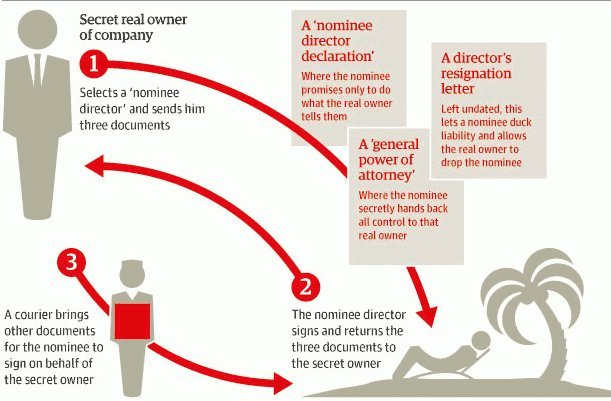
Secret Real Owner Of CompanyMore about

China’s Bank Card Used to Smuggle Money

Growing numbers of Chinese are using the country’s state-backed bankcards to illegally spirit billions of dollars abroad, a Reuters examination has found.

This underground money is flowing across the border into the gambling hub of Macau, a former Portuguese colony that like Hong Kong is an autonomous region of China. And the conduit for the cash is the Chinese government-supported payment card network, China UnionPay.

In a warren of gritty streets around Macau’s ritzy casino resorts, hundreds of neon-lit jewellery, watch and pawn shops are doing a brisk business giving mainland Chinese customers cash by allowing them to use UnionPay cards to make fake purchases – a way of evading China’s strict currency-export controls.   China’s Official Bank Card Used to Smuggle Money

Macau

Going After Individual Wrongdoers in the Banking Industry

Benjamin Lawsky, New York State’s Banking Regulator. wants to bypass corporations which are legal fictions and go after individuals and ‘name and shame’ them.

“People do cheat. We want to preserve the reputation of our financial sector and make people realize the vast majority of people on Wall Street and banking do good work,” Mr Lawsky said.

Mr Lawsky, a former federal prosecutor, worked closely with Andrew Cuomo – formerly New York’s attorney-general now the state’s governor. Mr Cuomo created DFS three years ago by merging the state’s banking and insurance regulators and tapped Mr Lawsky to run it. DFS supervises 4,400 entities, with assets of about $6.2tn.

Mr Lawsky’s ambition is to establish New York as the financial technology capital of the world. He’s working on a regulatory blueprint that will woo Bitcoin exchange operators to set up in the state.

He sees regulators as having to adapt and be more nimble to developing technologies – and that includes striking a balance between a bank’s application that can take a year to be approved and the reality that a new technology can become outdated in six months.

Mr Lawsky has personally adopted a revolutionary approach to bank regulation. He tweets from a personal Twitter account – with a modest 2,113 followers – and last month participated in a two-hour long “ask me anything” session on reddit, an open forum social media website, to discuss and learn from users of Bitcoin.

He noted that more than “14,000 people from 117 countries tuned into those hearings online, which was not the usual turnout we get!”

DFS continues to investigate foreign banks for violating US sanctions laws saying the number of existing cases is “not as small as a handful but not dozens”. His office is also actively investigating consulting firms for failing to act independently when advising banks.

Going After Individuals

US Clamping Down on Yanukovych

Our correspondent Andreas Frank reports:  The U.S. Treasury formally warned banks Thursday to watch out for transactions by ousted Ukraine President Viktor Yanukovych and his relatives and associates, citing sanctions by Canadian and European officials.

Mr. Yanukovych, some of his family members and other former government officials have been accused by the new government in Kiev of stealing state assets. The European Union and Canada signed orders to freeze the assets of 18 people incriminated by Ukrainian prosecutors.

“The measures being taken against these former Ukrainian officials and their close associates increase the risk that they will seek to move their assets in a deceptive fashion,” Treasury’s Financial Crimes Enforcement Network said in an advisory.

FinCEN’s notice updates an advisory last week warning that banks need to apply “enhanced scrutiny” to transactions by either Mr. Yanukovych or former senior officials in his government. The advisory was designed to protect against “misappropriated or diverted state assets, the proceeds of bribery or other illegal payments, or other public corruption proceeds.”  FINCEN Advisory


70 Billion Dollars Leave

Honoring Anat Admati on International Women’s Day

Anat Admati is the George G. C. Parker Professor of Finance and Economics at Stanford University.  She is both rigorously and passionately concerned about facing the deep economic issues of the US and the world.  A paperback of her book, “The Banker’s New Clothes” will be issued soon.  This book, co-authored with Martin Hellwig, challenges conventional techniques used to regulate the banking industry and suggests ways to make the operation of banks safer for the world.  She has campaigned hard to make her ideas understood by policy makers and common citizens alike.  Bankers New Clothes

Banker's New Clothes

Celebrating International Women’s Day

March 8, is International Women’s Day. The earliest Women’s Day celebrations were organized in the early twentieth century by commie firebrand types like Germany’s Clara Zetkin and Russia’s Alexandra Kollantai. The purpose was to bring together two great political movements, feminism and socialism, and to pay tribute women’s revolutionary potential. The March 8th date was chosen to commemorate the historic protests that took place on March 8, 1857, when female garment workers in New York City took to the streets to protest low wages and dangerous working conditions. The Triangle Shirtwaist Factory fire, which killed 146 women in 1911, led to renewed activism that popularlized  International Women’s Day celebrations throughout the world.

Women's Day in Iraq

International Women’s Day Is Marked Worldwide

“Equality for women is progress for all”.

That is the theme of this year’s International Women’s Day, being celebrated today, March 8, across the world.

Lamenting discrimination against women and girls worldwide, UN Secretary General Ban Ki-moon said: “Where men and women have equal rights, societies prosper.”

Organisers of a rally marking the event in the Philippines capital, Manila, couldn’t agree more.

“The reason why we are doing this is because we want to reaffirm our commitment to create an enabling environment for women to become better in what they do,” said Organising Committee Partner, Gilda Patricia Maquilan.

“In that way, they can help in uplifting the lives of their family and their communities.”

The Manila rally, at the Quirino grandstand,involved thousands of women standing in a giant human formation of the cross-like female scientific symbol.

Not only was it a huge statement on behalf of women but the female formation could also make it into the Guinness Book of Records.

Ukraine: Retrieve Money Laundered by Yanukovych

Our correspondent Andreas Frank writes:  The most effective near-term pressure that can be exerted on Russia in response to the Ukraine crisis should be financial and economic, according to a paper drafted by Chatham House – a leading think tank.

Chatham House maintained in this new report that much of President Vladimir Putins power is “predicated” upon Russia’s financial stability. Russia is also far more integrated into the world economy now than it was at the time of the escalation over Georgia in 2008.

Its growth had already faltered prior to this crisis, and the markets immediately exerted their pressure on Russia as a result of its actions, the institute observed.

The think-tank noted that freezing the assets of and denying visas to elite Russians suspected of money laundering or involved in the actions against Ukraine are likely to be measures that will influence Russian thinking and, possibly, the government’s behaviour.

The paper also noted while retaliatory Russian measures are possible and more Russians need to travel to the West than those in the West need to travel to Russia.

In addition, Chatham House urged the West to immediately ramp up its counter-narrative to the “Russian propaganda operation.” Meanwhile, the paper suggested that the statements by President Putin and other Russian leaders, and reporting by much of the Russian media, about Ukrainian refugees fleeing to Russia, violence in eastern Ukraine and there being no Russian troops in Crimea “can easily be exposed as lies.” “This should be done publicly, forcefully and immediately,” the paper proposed.

In the meantime, the institute urged the EU not go back on its commitment to the Association Agreement with Ukraine.

Furthermore, the EU should convey the message to Russian energy companies that “business as usual in not an option while intervention in the Ukraine continues,” the study concluded.   Ukraine Policy

Corruption in Ukraine

The Bitcoin Saga Continues

A young American woman who ran the First Meta bitcoin exchange was found dead in her Singapore apartment last week. Police are investigating the “unnatural death”.  A preliminary police investigation has ruled out foul play, but neighbors told police they suspected Autumn Radtke jumped from an apartment.

First Meta Ltd. issued a statement on its website, saying they were ‘shocked and saddened’ by the news and gave their deepest condolences to Radtke’s family.

The death of the 28-year old followed a tumultuous week for the virtual currency. Mt.Gox, once bitcoin’s largest online exchange filed for bankruptcy after $63 million worth of bitcoin went missing. 

Prices fell sharply, and the day Mt.Gox closed, the cryptocurrency was listed at $565, less than half its value in November.

Neighbor and fellow bitcoin start-up entrepreneur Steve Beauregard lived in the same residential complex as Radtke and said her death wasn’t related to her business. Beauregard is the CEO and founder of GoCoin, a bitcoin processer started in April 2013.

“This wasn’t a bitcoin-related death. She had other things going on in her life. Collectively, there were a lot of small factors. … It appears she picked a permanent solution to a lot of short term problems,” Beauregard told Reuters.

First Meta is an online exchange for virtual currencies and real money, and is funded by Silicon Valley incubator Plug and Play.

Scott Robinson, an employee at Plug and Play, described Radtke as ambitious, “She was a go-getter, she always worked very hard … she stuck out as one of the only women representing bitcoin.”

Like many governments, Singapore doesn’t recognize the legitimacy of the bitcoin currency, and has said they are not legal tender and users should know the risks.

Singapore has long attracted a large expatriate community because of the special tax exemptions it can offer as an independent state and has favorable conditions for start ups.

Radtke moved from California to Singapore in 2012, where previously she worked at a video game currency start-up company. According to her LinkedIn professional profile, she held positions at tech start ups Xfire and Geodelic Systems.

Currencies?

Ore from Mexican Drug Dealers to China

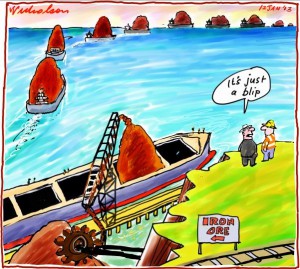
The Knights Templar cartel, steadily diversifying into other businesses, became so successful at exporting iron ore to China that the Mexican Navy in November had to move in and take over the port in Lazaro Cardenas, a city that has become one of the gang’s main cash generators.

This steelmaking center, drug smuggling hot spot and home of a rapidly growing container port in the western state of Michoacan occupies a strategic position on the Pacific coast, making it a natural gateway for burgeoning trade with China.  Ore to China

Iron Ore Mexico to China