Fees Don’t Create Real Wealth

Rentier skims do not contribute to real wealth,  Charles Hughes Smith suggests.

The classic example is a fee collected to pass from one fiefdom’s border to the next: no value is provided to the person paying the border fee; it is a rentier skim that transfers wealth from serfs to the fiefdom’s landowning nobility.

In the modern economy, rentier skims take a variety of forms. The government is adept at levying rentier skims. Harsh penalty fees piled on top of minor traffic violations are one example; another is extra fees to “expedite” services government is supposed to provide in a timely manner.

A California architect recently recounted the new fee structure in a Northern California municipality: the fee to have the city planning department review your building permit application leaped to $6,000. Since the department warned applicants it will take at least six months for the agency to process the application, they kindly offer an alternative: for a mere $4,000 more (an “expedited fee”), the applicant can get his application reviewed in a mere four months rather than six months.

Planned obsolescence provides many other examples of rentier skims. Microsoft’s operating systems and hardware makers both operate a form of rentier skim, in that each new OS and device offers marginal benefits (if any) in terms of productivity. The rare printer that doesn’t break down in a few years is obsoleted as software drivers are no longer available on the new OS.

Cartels and quasi-monopolies offer a wealth (ahem) of rentier skims. Monopolies can raise prices and degrade services at will. Cartels maintain price controls while denying they do any such thing.

Finance offers the richest opportunities for rentier skim. Load up college students with tens of thousands of dollars in high-interest student loans for marginal educations that could be provided at a fraction of the cost.

The net result of an economy of endless rentier skims is stagnation and rising wealth inequality. Money that could be saved and invested in productive enterprises and infrastructure is skimmed off.

Simply put, the rich get richer and the poor get poorer. This is the teleology of every rentier economy: the built-in consequence of rentier skims is increasing wealth inequality and economic stagnation.

Rentier Schemes

Does the Nobel in Economics Need to Get Real?

David Spenser writes:   Academic economics won in this year’s Nobel Prize Award.  Academic economics is still stuck in an intellectual and ideological rut. Despite the global financial crisis – the worst in a lifetime – academic economists are more likely to win awards and the respect of their peers by producing abstruse models than by tackling and resolving real-world problems.

The economics Nobel awards advances in economic analysis – meaning the development of formal models and the application of particular mathematical and statistical techniques. In essence, solving puzzles within economics matters more than dealing with grand societal challenges.

It should be a cause of concern, not least for members of the public tuning in to learn who has won the economics Nobel, that acute economic and social issues are not high on the agenda of academic economics.  Thomas Piketty was ignored.  Academic economics is still all of a type – it stands for some version of neo-classical economics.  Cosmetic differences aside, research in academic economics applies concepts and methods found in this narrow school of thought.

It has dominated economic thinking since the late 19th century and has marginalised all challengers. The award of the economics Nobel is, in fact, an award for conformity to neo-classical economics. Other schools of economic thought do not get a look in.

And this is in spite of the fact that neo-classical economic thinking failed to foresee the global financial crisis and advocates the kind of austerity policies that prevent recovery. It is alternative thinking – whether from Keynesian, Marxian or ecological economics – that can help us to understand how to build a fairer and more equal economy.

A prize for thinking differently and building a better economics would be a great thing, but sadly it is not one that is awarded by the committee of the economics Nobel. Indeed, given the acute problems that exist in academic economics, it may even be time to call an end to the economics Nobel. The world certainly would not be a worse place without it.

Real World Economics


US Creeps Closer to Women on the Presidential TIcket

Hillary Clinton has all but announced in the US, but signs from her campaigning for candidates in Southern states during the US 2014 election cycle are not promising.  While her husband was first and foremost an economics specialist, she has not put forward any ideas for the economic future of the US.  Tmidity may well characterize her Presidential run and even her Presidency if she makes it that far.

Elizabeth Warren is heading for Iowa, the state in which the first Preisidential primaries are held.  A darling of progressives, she is really a centrist:  work hard and play by the rules and you should succeed.  An expert in banking, and fearless with her facts, she has put the banking industry that now controls US politics on notice.  She probably can’t run.  The US citizens experience with Obama’s inexperience will be used against her, but she would make a great VIce President.

Clinton and Warren

Domestic Banks Face Different Challenges than Global Banks

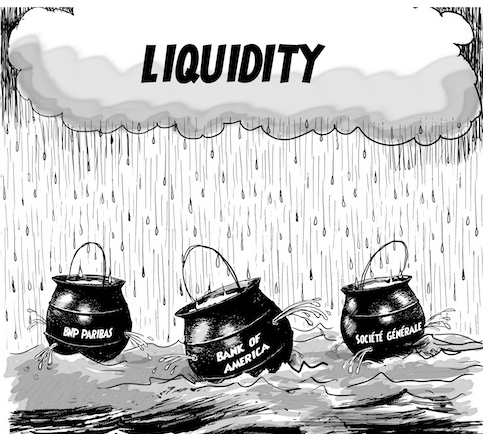
Economists at the New York Federal Reserve write: Large global U.S. banks—that is, those that have offices in foreign countries and are able to move liquidity from affiliates across borders have an advantage over large domestic U.S. banks, which have to rely on financing raised in capital markets and from depositors to extend credit and issue loans..  The internal liquidity management by global banks has, on average, mitigated the effects of aggregate liquidity shocks on domestic lending by these banks.

If a bank has stable deposit funding or maintains more liquid assets on its balance sheet, its lending might be less affected by aggregate liquidity shocks.

There also might be different responses to liquidity risk by U.S. banks that are domestically oriented compared with banks that are global.   Because these two types of banks have very different business models, the channels and magnitude of transmission of liquidity risks into bank lending may differ significantly. Small domestic banks have relatively strong lending responses to liquidity risks.  By contrast, banks with foreign affiliates, particularly large banks, move funds across their organizations to offset such risks, and potentially insulate lending in their home markets.  However, these same banks may decrease lending abroad as they move liquidity into their home country.

For both types of banks, changes in aggregate private liquidity are likely to influence lending differently in crisis than in normal periods, in part because of the availability of and willingness to use official sector liquidity facilities in periods of aggregate liquidity stress. When banks have access to central bank liquidity facilities priced at terms below private market rates, this might relax the constraints imposed by the composition of banks’ balance sheets on their access to external funding, leading to a different relationship between those balance sheet characteristics and the banks’ lending,  Is Liquidity a Measure of Stability

Bank Liquidity


No Shortcuts to European Recovery?

There is a growing consensus that austerity is contributing to the Eurozone’s macroeconomic malaise, but also that spending cuts are needed in the long run to achieve fiscal sustainability. Some commentators have advocated a temporary tax cut financed by unsterilised ECB purchases of long-term public debt, accompanied by a commitment to future spending cuts. This article argues that such commitments are simply not credible – especially given the moral hazard problem created by central bank monetisation of debts. No Shortcuts to European Recovery

No Shortcuts?


Can Service Industries Replace Manufacturing?

Can Services Replace Manufacturers as the drivers of the economy?  Dani Rodrik writes: The global discussion about growth in the developing world has taken a sharp turn recently. The hype and excitement of recent years over the prospect of rapid catch-up with the advanced economies have evaporated. Few serious analysts still believe that the spectacular economic convergence experienced by Asian countries, and less spectacularly by most Latin American and African countries, will be sustained in the decades ahead. The low interest rates, high commodity prices, rapid globalization, and post-Cold War stability that underpinned this extraordinary period are unlikely to persist.

A second realization has sunk in: Developing countries need a new growth model. The problem is not just that they need to wean themselves from their reliance on fickle capital inflows and commodity booms, which have often left them vulnerable to shocks and prone to crises. More important, export-oriented industrialization, history’s most certain path to riches, may have run its course.

Ever since the Industrial Revolution, manufacturing has been the key to rapid economic growth. China, which has emerged as the archetype of this growth strategy since the 1970s, traveled a well-worn path: industrial manufacturing.

But manufacturing today is not what it used to be. It has become much more capital- and skill-intensive, with greatly diminished potential to absorb large amounts of labor from the countryside.

While global supply chains have facilitated entry into manufacturing, they have also reduced the gains in terms of value added that accrue at home. Many traditional industries, such as textiles and steel, are likely to face shrinking global markets and over-capacity, driven by demand shifts and environmental concerns. And one downside of China’s success is that many other countries are finding it much harder to establish more than a niche in manufacturing.

Can service industries play the role that manufacturing did in the past?

Among the optimists are Ejaz Ghani and Stephen D. O’Connell of the World Bank argue that service industries could serve as a growth escalator, the role traditionally assumed by manufacturing.

In particular, they show that services have exhibited “unconditional convergence” in productivity recently. That is, countries furthest away from the global frontier of labor productivity have seen the fastest productivity growth in services.

This would be very good news, but there are reasons to be wary. The Ghani-O’Connell evidence includes data starting in the early 1990s, during which developing countries were experiencing economy-wide convergence, boosted by capital inflows and commodity windfalls. It is unclear whether their conclusions extend to other periods.

Two things make services different from manufacturing. First, while some segments of services are tradable and are becoming more important in global commerce, these typically are highly skill-intensive sectors that employ comparatively few ordinary workers.

Banking, finance, insurance, and other business services, along with information and communications technology (ICT), are all high-productivity activities that pay high wages. They could act as growth escalators in economies where the work force is adequately trained. But developing economies typically have predominantly low-skilled labor forces. In such economies, tradable services cannot absorb more than a fraction of the labor supply.

That is why, for all of its success, the ICT sector in India has not been a primary driver of economic growth. By contrast, traditional manufacturing could offer a large number of jobs to workers straight off the farm, at productivity levels three to four times that in agriculture.

In today’s developing countries, the bulk of excess labor is absorbed in non-tradable services operating at very low levels of productivity, in activities such as retail trade and housework. In principle, many of these activities could benefit from better technologies, improved organization, and greater formalization. But here the second difference between services and manufacturing comes into play.

Partial productivity gains in non-tradable activities are ultimately self-limiting, because individual service activities cannot expand without turning their terms of trade against themselves. By contrast, in services, where market size is limited by domestic demand, continued success requires complementary and simultaneous gains in productivity in the rest of the economy.

So I remain skeptical that a services-led model can deliver rapid growth and good jobs in the way that manufacturing once did. Even if the technological optimists are right, it is difficult to see how that will enable developing countries to sustain the kind of growth they experienced over the last couple of decades.


Manufacturing

Chicago Fed Measures the Great Recession

Fiscal policy describes how the expenditure and revenue decisions of local, state, or federal governments influence economic growth. In this article, we create a comprehensive measure of fiscal policy called fiscal impetus, which estimates the combined effect of purchases, taxes, and transfers across all levels of government on growth. Our goal is to use this measure of fiscal impetus to examine how fiscal policy has behaved during business cycles in the past, how it responded to the most recent recession, and how it is likely to evolve over the next several years. Our analysis reveals that policy was more expansionary than average during the 2007 recession and has been significantly more contractionary than average during the recovery. By the end of 2012, fiscal impetus was below its historical business cycle average and it is forecast to remain depressed well into the future.   ChicagoFed on the Great Recession

EU Becoming Less Transparent

Xavier Sol and Ana Colovic write   Transparency, once a ‘conditio sine qua non’ for democracy and good governance, is suffering a clear backlash in Europe.

In a post-Occupy, post-Wikileaks world, transparency has nestled in the public consciousness. Outraged by the abuses of power, people took to the streets demanding more say in decisions influencing their lives and more accountability by political leaders. People demanded better representation and they knew transparency was crucial to get it.

Yet at the same time we are witnessing a silent backlash against participation and transparency. Citizens are being surreptitiously pushed back from control over public life.  It could be seen very clearly during the economic crisis when, despite protests against austerity measures day after day, the EU and individual governments were pushing through with unpopular austerity measures.

Increasingly crucial economic decisions are being made by a narrow group of decision-makers including the Troika, members of the European Council, bankers and economic experts. Another symbolic example is the total emasculation of the “European Citizen Initiative”. –

And yet earlier this month a citizen initiative to give Europeans a say in the Transatlantic Trade Investment Partnership(TTIP) was struck down by the Commission on questionable legal grounds.

Despite the “citizen initiative” being one of the main arguments EU institutions would invoke to prove their openness to citizens, the Commission seems to reserve a right to decide on which issues citizens can speak.
The EU’s bank kicks back

When it comes to European public investment banks, we fear the same dynamics are taking root in the way public money is spent. The European Investment Bank’s (EIB) draft for a new transparency policy is a major setback from what has been gained since we first started campaigning for the bank to be more open.

Instead of bringing further improvements, the current draft would mean a major step backwards. Among other things, the bank is proposing a significant expansion of its existing exemptions on information disclosure – going beyond what is requested by EU legislation. As a result, EU citizens would be unable to access most EIB internal documents, even if they were of public interest.

The EIB is already ranked as “poor” in the 2013 International Aid Transparency Initiative. If the policy is adopted as it currently stands, it would turn the EIB into one of the world’s most secretive financial institutions.

This is happening despite earlier commitments to greater transparency and accountability to EU citizens made by the bank when it benefited from a capital increase in 2013.

And in spite of the European Parliament repeatedly calling on the EIB to increase the transparency of its operations and to make more information available.

This planned decrease in transparency comes as the institution is gearing up to play a core role in a pro-growth strategy prepared by the new European Commission run by Jean-Claude Juncker. The strategy involves the generation of an extra €300 billion in new investments into the European economy.

It seems that EU leaders are willing to pour more public money into another debatable growth package without allowing public oversight, let alone a voice for EU citizens.

Transparency

y.

Federal Reserve of New York Builds a DSCG Model for Policy Analysis and Forecasting

In recent years, there has been a significant evolution in the formulation and communication of monetary policy at a number of central banks around the world. Many of these banks now present their economic outlook and policy strategies to the public in a more formal way, a process accompanied by the introduction of modern analytical tools and advanced econometric methods in forecasting and policy simulations. Official publications by central banks that formally adopt a monetary policy strategy of inflation targeting—such as the Inflation Report issued by the Bank of England and the monetary policy reports issued by the Riksbank and Norges Bank—have progressively introduced into the policy process the language and methodologies developed in the modern dynamic macroeconomic literature.
The development of medium-scale DSGE (dynamic stochastic general equilibrium) models has played a key role in this process.2 These models are built on microeconomic foundations and emphasize agents’ intertemporal choice.    New York Federal Reserve DSCG Model

Intertemporal Choice

Upcoming G 20 Meeting

Wayne Swan writes:  One structural reform that could drive global growth is substantial infrastructure investment in developing and developed countries alike. Unfortunately, no G-20 leader has seriously articulated this need, let alone lobbied for a solution. Apart from a World Bank presentation for a possible pilot infrastructure program, there is little to suggest how the 2% target could be met over the medium term.

The G-20’s upcoming meeting in Brisbane, Australia, comes at a time when a precarious global economy requires big decisions to be made. But it is far from clear who will provide the decisive voice needed to set a bold agenda – and then shepherd its implementation.     G 20 in Brisbane

Economies