Efforts to End Elephant Poaching

Proceeds from poaching have become a fcator in financing terrorism.  Defense departments,anti-terrorism departments and enforcement institutions are now working to prosecute poachers and end this trade.

1. Big Business
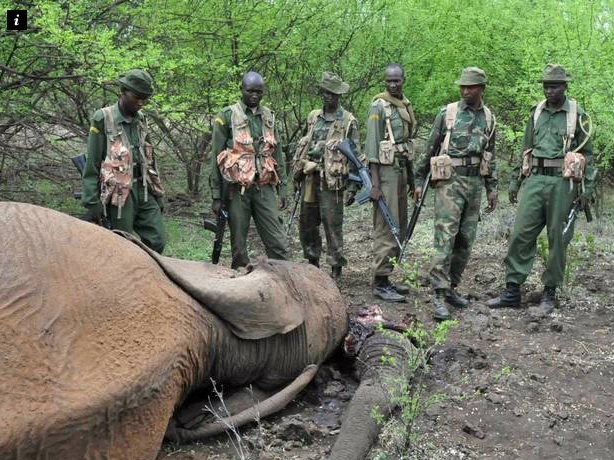
Wildlife hunting is big business – a recent 2013 estimate valued the illegal poaching trade in Africa as being worth $17 billion dollars a year and growing.

2. Big WeaponsThe most common poaching gun in east Africa is the AK47. Increasingly poachers spot elephant herds from helicopter and target their prey from above. On-the-ground poachers have been known to use machetes, spears and watermelons spiked with cyanide.

3. Big Profits
According to gun policy officials the going rate for a rifle in Kenya is around $100-120 – a fortune by local economic standards but a mere fraction of the money that can be made from just one elephant (a single tusk can be worth up to $240).

4. Chinese Prices
In China such a tusk would sell for more than $2000 – its value therefore increasing tenfold by the time it is shipped out of Africa and arrives in Asia.

5. Local Misunderstanding
A recent study found that less than a third of Chinese people surveyed knew that elephants are killed for their tusks.

6. Common mythology
A separate study showed 70 per cent think they grow back like fingernails. Another myth propagated is that elephants’ tusks fall out naturally.

7. 104 Deaths a Day
Animal rights groups estimate that poachers in Africa kill between 25,000 and 35,000 elephants annually – meaning about 104 die a day.

8. An Offence Without Prosecution
Of the 157 poaching-related cases detected in Kenya in the past three years, less than five per cent have been prosecuted and only three of those convicted were sentenced to jail.

9. Pulverizing the Trade
The Obama administration destroyed the US reserve of elephant tusks on November 5, 2013 – announcing that the pulverizing of 6 tons (5.4 tonnes) of ‘blood ivory’ would send out the right message to the world.

10. Not Far from Human
Elephants are more like us than you may know. They can be gay, left-handed, have the ability to grieve and – true to reputation – have amazing memories.
Illegal Poaching

Is Greece Quarantined?

Brendan Simms writes:  When the Greek crisis first blew in 2010, there were widespread fears that if Greece defaulted on its public debts, contagion would bring down banks across the eurozone and destroy the market for government bonds in the next-in-line states, such as Italy, Spain, Portugal, and perhaps even Ireland.

To be on the safe side European officials and banks have spent the last five years quarantining Greece so that any fallout could be safely contained and a G2K avoided For this reason, the European Union provided emergency bailouts for Greece, writing down a substantial proportion of the debt in return for commitments to reform state and economy.

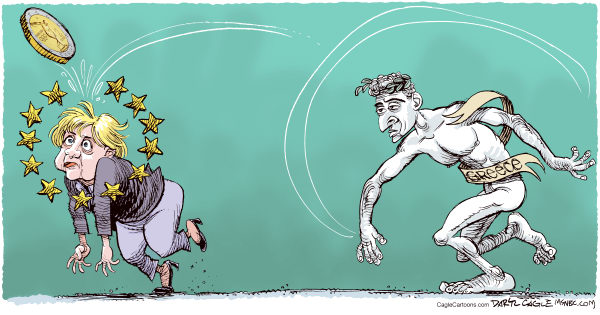
In some sense, contagion will probably be contained. Sunday’s referendum was framed by the Greek government as a vote against austerity, not against Europe or even the euro. Observers must thus deal with the paradox that some of the most pro-European Greeks (along with many extreme leftist and rightist anti-Europeans) voted against the bailout deal. Greek Prime Minister Alexis Tsipras and his Syriza party want a return to the drachma. They know that most of Greece wants to stay in the euro, so they will not be in any hurry to leave it. Much better to wait until Brussels forces them out. Athens will play this game, in which the resignation of Yanis Varoufakis as finance minister is only the latest move, to the bitter end.

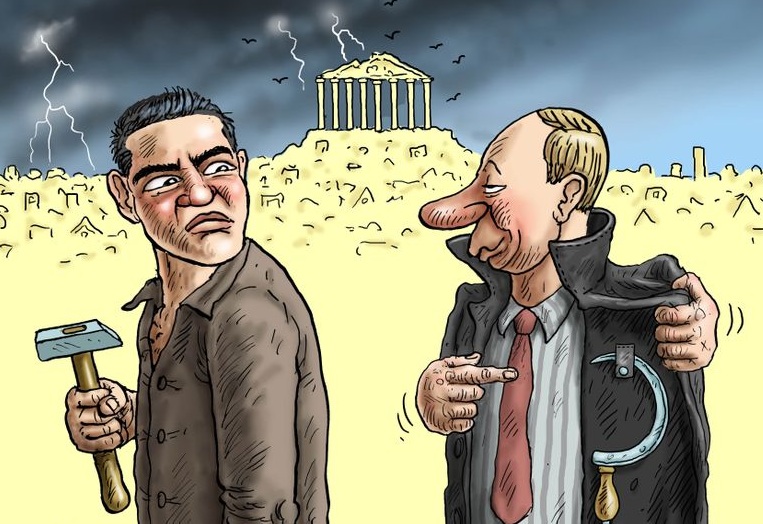
It may be that the financial contagion in Europe can be contained, but the strategic and political contagion will be immense. Unless it also leaves the EU, Greece may become an open door, as some Syriza ministers have already threatened, through which migrants pour in. The country will drift even more into the Russian orbit, with potentially fatal consequences to the EU’s common foreign policy, especially its sanctions over Ukraine. Above all, the irreversibility of monetary union will be called into question, with huge implications for all kinds of political and economic bets placed over the past three decades. No amount of modeling can quantify the likely damage to the union, but it will be colossal and perhaps fatal to deeper integration.

Either way, the Greeks are faced with an impossible choice: either to agree to an austerity program that is crushing the life out of its young people and its weakest or to return to the failed national politics that got the country into this mess.

Greek Quarantine?

Is Greece to Blame?

Mark Blythe writes:  When the anti-austerity party Syriza came to power in Greece in January 2015, at some point, Europe was bound to face an Alexis Tsipras, the party’s leader and Greek prime minister, because there’s only so long you can ask people to vote for impoverishment today based on promises of a better tomorrow that never arrives.  Despite attempts by the eurogroup, the European Central Bank, and the International Monetary Fund since February 2015 to harangue Greece into ever more austerity, the Greeks voted by an even bigger margin than they voted for Syriza to say “no” once more. So the score is now democracy 2, austerity 0.

When the euro came into existence in 1999, not only did the Greeks get to borrow like the Germans, everyone’s banks got to borrow and lend in what was effectively a cheap foreign currency. And with super-low rates, countries clamoring to get into the euro, and a continent-wide credit boom underway, it made sense for national banks to expand private lending as far as the euro could reach.

The ECB is not only violating its own statutes by limiting emergency liquidity assistance to Greek banks, but is also raising the haircuts on Greek collateral offered for new cash. In other words, the ECB, far from being an independent central bank, is acting as the eurogroup’s enforcer, despite the risk that doing so poses to the European project as a whole. We’ve never understood Greece because we have refused to see the crisis for what it was—a continuation of a series of bailouts for the financial sector that started in 2008 and that rumbles on today. It’s so much easier to blame the Greeks and then be surprised when they refuse to play along with the script.  Is Greece to Blame

Bonds?

Can the Euro Work for Greece?

David Ignatius writes:  The Greek financial nightmare is a reminder of why countries benefit from having their own currencies. In the old days, a flexible drachma could have been devalued to boost exports and economic growth. But today’s euro trades at a single exchange rate that may suit some of its member nations but not others. For Greece, it has become the equivalent of a straitjacket.

So why doesn’t Greece drop the euro and restore its freedom of maneuver? A cheap drachma would boost exports and tourism — and it might be the easiest means of post-crisis financial adjustment. But separating from the euro zone would mean rewriting thousands of contracts and deals. And it could put Greece in a monetary free fall, perhaps forcing Athens to look east to Moscow, Riyadh or even Tehran for support.

The euro zone’s problem is that although the euro has a flexible exchange rate, it’s a one-size-fits-all currency for the 19 member countries. Local adjustments can be made only through fiscal policies, such as the harsh austerity measures Greece was forced to implement.

The ERM was created in 1979 to encourage monetary stability among European nations, which had formed a free-trade zone in the 1950s. The idea was that each member would peg its currency to a European basket; the national currencies would be allowed to fluctuate several percentage points above or below. The system was known as a “floating band,” an oxymoronic term for a system that, to its critics, combined the worst features of fixed and flexible currency regimes.

Greeks overwhelmingly voted against a strict bailout package proposed by the E.U.

If Greece should someday restore the drachma, one question would be whether it should be pegged to the euro. Such an arrangement might seem attractive. Athens could speak of its devalued currency as a hybrid “Greek euro.” And there’s certainly precedent: The currencies of Hong Kong, Saudi Arabia and Venezuela are linked to the dollar; those of Singapore and Malaysia are tied to a basket of currencies.

The problem for Greece is that a euro-pegged drachma would be an easy target for speculators.

What about a completely free-floating drachma, whose price would be set entirely by the currency markets? That might be stable in the long run, but it could lead to wild swings as traders respond to rumors. This sort of unpredictability would be the enemy of the investment and growth that Greece needs.

As Greece is discovering, it’s difficult for small, ailing economies to threaten big, strong ones.

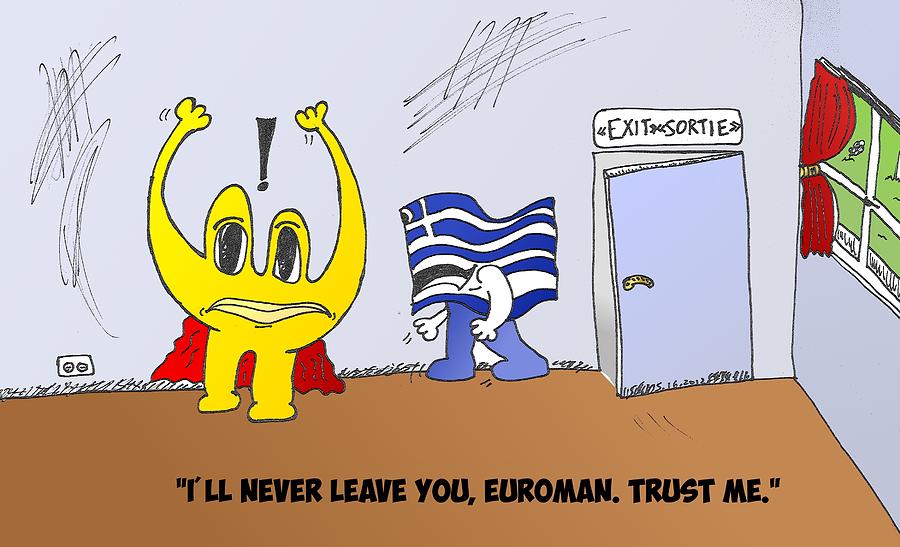
Greece and its creditors need the monetary equivalent of a divorce lawyer who can help reckon the costs and benefits of a breakup. Restoring the drachma would give Greece more flexibility, but at the price of much greater vulnerability. For the euro zone, a Grexit would signal that the promise of monetary union was conditional — and unreliable. Bad divorces happen when each side is too angry for rational decision-making.

Drachma?

Is Cheating Endemic in India?

Even by Indian standards, the ongoing Vyapan corruption scandal is simply staggering for what it says about the gaps in systemic coherence, safeguards – and yes, the way the country still conducts examinations. The alleged scam, which is said to have run for years in the central Indian state of Madhya Pradesh, revolves around a massive scheme to manipulate the results of entrance examinations for medical colleges and government jobs. Every job one can think of – doctor, dentist, vet, forest ranger – is said to have been up for grabs. Police say that for at least eight years, tens of thousands of students and job aspirants paid hefty bribes to rig test results.

Nearly 2,000 people have been arrested so far, hundreds of medical students are in prison, as are several bureaucrats. Even the state’s governor is implicated. What’s more, many witnesses and alleged participants have been dying under “mysterious circumstances”, most recently a TV reporter who was investigating those deaths. One Indian news portal has described the scandal as one of the most complex to affect public life and one that “is fast acquiring the shades of a macabre crime thriller”.

Several corruption scandals have rocked Asia’s third-largest economy in the past decade but the alleged scam in Madhya Pradesh says something larger. It focuses attention on India’s outmoded exam system – a process that interrogates mostly rote learning and all at one go, rather than grading after a series of aptitude and ability tests whose results cannot be bought (or faked) however hard anyone tries. Though cheating in examinations is commonplace in India, what’s different about the alleged racket in Madhya Pradesh is its sophistication – different methods were used, including fake identity cards for people who impersonated examinees and crooked testing board officials inflated scores. This is low-level graft, yes, but the stakes are high.

It was once said that two intertwining strands run through Indian history: the incredible potential of the place and the betrayal of that potential, for example, by corruption.

Exams in India?

Fearing Greek Contagion?


George Friedman writes:  The European leaders have backed themselves into the corner they didn’t want. If they hold their position, then they open the door to the idea that there is life after the European Union, and that is the one thought the EU leaders do not want validated. Therefore, it is likely that the Europeans, having discovered that Syriza is not prepared to submit to European diktat, will now negotiate a deal Greece can accept. But then that is another precedent the European Union didn’t want to set.

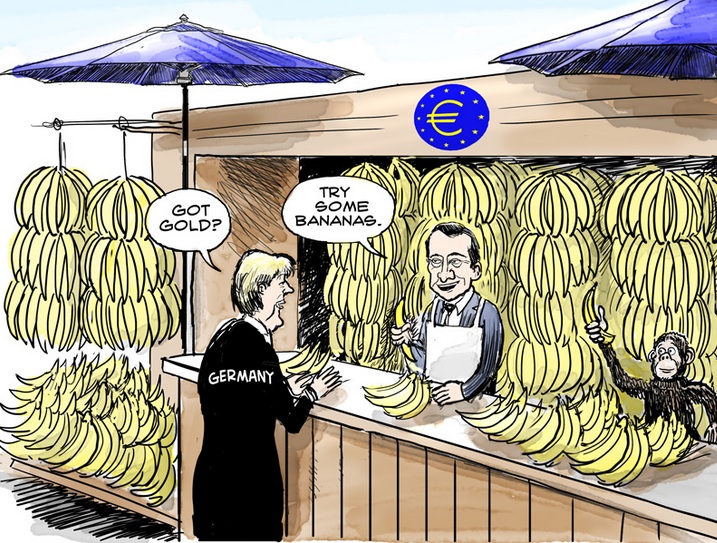
Behind all this, the Germans are considering the future of the European Union. They are less concerned about the euro or Greek debt than they are about the free trade zone that absorbs part of their massive exports. With credit controls and default, Greece is one tiny market they lose. The last thing they want is for this to spread, or for Germany to be forced to pay for the privilege of saving it. In many ways, therefore, our eyes should shift from Greece to Germany. It is at the heart of the EU leadership, and it is going to be calling the next shot – not for the good of the bloc, but for the good of Germany, which is backed into the same corner as the rest of the European Union.  Greece

Greece and the Eurozone

Renovate the IMF?

The international system of economic governance is at a turning point. After 70 years, the Bretton Woods institutions – the International Monetary Fund and the World Bank –appear creaky, with their very legitimacy being questioned in many quarters. If they are to remain relevant, real changes must be made.

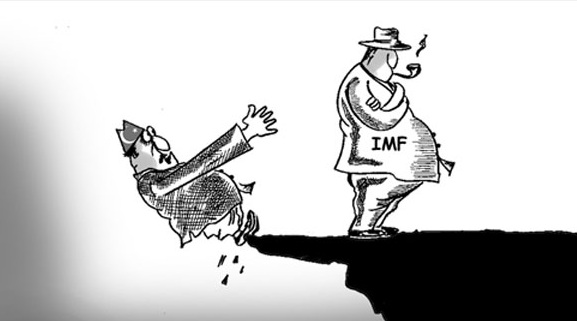
The IMF, in particular, is facing challenges on all sides. In the United States, Congress is stalling not only on international issues like trade, but also on the implementation of reforms that would expand the role of emerging economies in the IMF. For its part, Europe has drawn the organization into its debt crisis, with Greece having already missed a payment on its IMF loans (though the Fund is not calling it a default). And, in Asia, the IMF still carries a stigma, because of its flawed response to the region’s financial crisis in the late 1990s.

How can the IMF reprise its role as a guardian of international financial stability?  Modernizing the IMFIMF?

US Tired of SameOldSameOld?

Lagarde and Putin PowWow

The search for an optimal solution for resolving the Greek debt crisis will continue, taking into account the interests of all parties,” Dmitry Peskov told reporters.

The phone call between Putin and Lagarde was not linked to any potential Russian help for Greece, he added.

The IMF said earlier yesterday that it was monitoring the situation in Greece and was ready to lend a hand if asked following a referendum that rejected the bailout conditions of international creditors.

Meanwhile, the Dutch prime minister Mark Rutte said Greece would have to accept deep reforms if it wanted to remain in the eurozone.

In a debate in parliament in the wake of Greece’s No vote, Mr Rutte said his government was unwilling to give any new funding to Greece unless it committed to reform.

“If things stay the way they are, then we’re at an impasse,” he said. “There is no other choice, they must be ready to accept deep reforms.”

Putin and Greece