Warren Takes on the “I” in F.I.R.E.

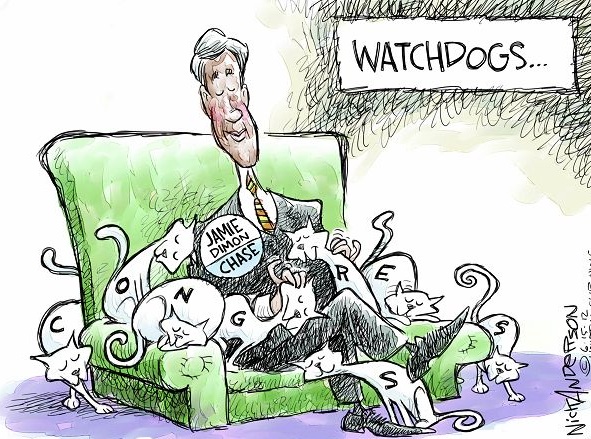
Pam and Russ Martens write:  In 2013, it was only because of Senator Warren that we learned that the so-called Independent Foreclosure Reviews to settle the claims of 4 million homeowners who had been illegally foreclosed on by the bailed out Wall Street banks were a sham. The “independent” consultants were hired by the banks, paid by the banks, and the banks themselves were allowed to determine the number of victims.

It was Senator Warren who put the high frequency trading scam described in the Michael Lewis book, “Flash Boys,” into layman’s language the American people could understand.

In 2013, Warren, together with Senators John McCain, Maria Cantwell and Angus King, introduced the “21st Century Glass-Steagall Act.” Warren explained why the legislation is critically needed:

“By separating traditional depository banks from riskier financial institutions,” said Warren, “the 1933 version of Glass-Steagall laid the groundwork for half a century of financial stability. During that time, we built a robust and thriving middle class. But throughout the 1980’s and 1990’s, Congress and regulators chipped away at Glass-Steagall’s protections, encouraging growth of the megabanks and a sharp increase in systemic risk. They finally finished the task in 1999 with the passage of the Gramm-Leach-Bliley Act, which eliminated Glass-Steagall’s protections altogether.”

Nine years later, the financial system crashed, leaving the economy in the worst condition since the Great Depression.

Last December, Warren made headlines again, stepping onto the Senate floor to reveal to the American people how Citigroup, the bank that received the largest taxpayer bailout in the history of the country after it imploded from its own derivatives bets in 2008 – had just slipped language into the spending bill to overturn part of the Dodd-Frank financial reform bill meant to rein in that behavior going forward. Despite her pleas, the bill passed both houses of Congress and was signed into law by President Obama.

Today, Warren is under fire by the “I” in F.I.R.E. – the insurance industry. On April 28, she sent letters to 15 insurance companies, including AIG, the international insurance company that blew itself up in 2008 by taking on the risks of Wall Street’s credit default swap bets and was bailed out with $182 billion from taxpayers.

The letters asked the insurance companies to provide Warren with the specifics on the incentives they offer to push the sale of annuities, the number and value of the incentives awarded, and the companies’ policies for disclosing these potential conflicts of interest. The letters were sent to the 15 companies with the highest 2014 annuity sales to individuals: Jackson National Life, AIG Companies, Lincoln Financial Group, Allianz Life, TIAA-CREF, New York Life, Prudential Annuities, Transamerica, AXA USA, MetLife, Nationwide, Pacific Life, Forethought Annuity, RiverSource Life Insurance, and Security Benefit Life.
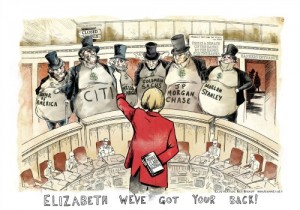

Elizabeth Warren Won't Let Go

What Would Happen if Women Were the Financial Regulators?

William Greider asks:  If women were in charge of banking regulation, could they save us from the Wall Street cowboys who crashed the global financial system?

That provocative question was the implicit subtext for an all-day conference of banking and financial officials in Washington this week, held at, of all places, the soberly serious International Monetary Fund. The IMF’s managing director, as it happens, is a woman—Christine Lagarde of France—and she appeared alongside an even more powerful woman—Janet Yellen, chair of the US Federal Reserve System. Neither of them was in charge when the system crashed in 2008.

The IMF event was not a rump rally of feminists who somehow crashed the halls of power. But all of the 18 speakers on various panels were women, prominent as bank regulators or financial authorities. The one-sided gender line-up was not exactly an accident. The men in suits could hardly miss the message.

But just in case they did, IMF Director Lagarde prompted them with a droll question: “What would have happened if Lehman Brothers had been Lehman Sisters?”

What she meant was that different values might have prevailed if women had held the controlling positions at the brokerage or were the government regulators enforcing prudent standards. Women, as Lagarde has observed, worry more about financial exclusion. Worldwide, 42 percent of women have no access to financial services. Only a measly 3 percent of bank CEOs are women.

More to the point, Largarde said research shows women are more risk-averse—a quality utterly missing in the reckless banks and brokerages rushing like lemmings to the cliff. Women in charge might have asked tougher questions.

Fed Chairwoman Yellen stayed away from the gender question. But Lagarde has invoked “Lehman Sisters” numerous times since the financial collapse and disappointing recovery.

“It takes a great deal of will power to direct the French economy,” Largarde wrote in 2010 when she was France’s finance minister. “I am not doing this for women but as a woman I am, perhaps, more keenly aware of the damage that the crisis has done through greed, pride and a lack of transparency…. I am determined to do everything within my power to change the rules of the game and do my best to ensure that a crisis such as this can never happen again.”

What women want, she wrote, is to be judged, like men, on the basis of their deeds. She added what Eleanor Roosevelt had to say on the subject. “A woman is like a tea bag—you never know how strong it is until it’s in hot water.”

One of the conference speakers, Brooksley Born, is a courageous example. Born was nearly drowned by “hot water” dumped on her by Robert Rubin, Alan Greenspan, and Larry Summers during the Clinton administration. As a regulator she was trying to impose some limits on dangerous derivatives. The men hammered her, blocked her, and effectively drove her out of government.

Institute for New Economic Thinking was co-founded and funded by investor George Soros and others, and it set out to sweep worldwide in search of new ideas and new economists who are breaking free of the old orthodoxy that failed.

Johnson was once asked,“If you could wave a magic wand and do one thing to make the financial system better, what would it be?” Johnson had a quick answer: “Only women get to regulate finance.”

Adamti, Provocateur, Instigator

Adamti, Provocateur, Instigator

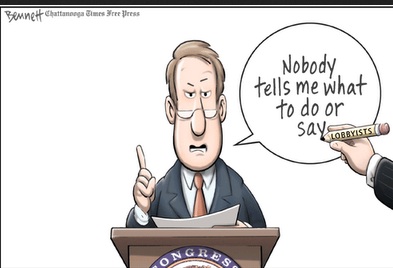
States’ Attorneys’ General Targeted by Lobbyists and Lawyers

Pro Publica reports on the campaign contributions and lobbying efforts of businesses and organizations targets by States’ Attorneys General.

Attorneys general are now the object of aggressive pursuit by lobbyists and lawyers who use campaign contributions, personal appeals at lavish corporate-sponsored conferences and other means to push them to drop investigations, change policies, negotiate favorable settlements or pressure federal regulators, an investigation by The New York Times has found.

A robust industry of lobbyists and lawyers has blossomed as attorneys general have joined to conduct multistate investigations and pushed into areas as diverse as securities fraud and Internet crimes.

But unlike the lobbying rules covering other elected officials, there are few revolving-door restrictions or disclosure requirements governing state attorneys general, who serve as “the people’s lawyers” by protecting consumers and individual citizens.

A result is that the routine lobbying and deal-making occur largely out of view. But the extent of the cause and effect is laid bare in The Times’s review of more than 6,000 emails obtained through open records laws in more than two dozen states, interviews with dozens of participants in cases and attendance at several conferences where corporate representatives had easy access to attorneys general.

Often, the corporate representative is a former colleague. Four months after leaving office as chief deputy attorney general in Washington State, Brian T. Moran wrote to his replacement on behalf of a client, T-Mobile, which was pressing federal officials to prevent competitors from grabbing too much of the available wireless spectrum.

“As promised when we met the A.G. last week, I am attaching a draft letter for Bob to consider circulating to the other states,” he wrote late last year, referring to the attorney general, Bob Ferguson.

A short while later, Mr. Moran wrote again to his replacement, David Horn. “Dave: Anything you can tell me about that letter?” he said.

“Working on it sir,” came the answer. “Stay tuned.” By January, the letter was issued by the attorney general largely as drafted by the industry lawyers.

The exchange was not unusual. Emails obtained from more than 20 states reveal a level of lobbying by representatives of private interests that had been more typical with lawmakers than with attorneys general.

“The current and increasing level of the lobbying of attorneys general creates, at the minimum, the appearance of undue influence, and is therefore unseemly,” said James E. Tierney, a former attorney general of Maine, who now runs a program at Columbia University that studies state attorneys general. “It is undermining the credibility of the office of attorney general.”

Lobbyists

Some US Senate Democrats Vote for TPP

The Rocky Road to Globaliation

Alexander Bolton writes: Washington Sen. Patty Murray is breaking with the rest of the Senate Democratic leadership over trade legislation.

Murray supports granting President Obama fast-track authority to negotiate trade deals, such as the Trans-Pacific Partnership. She also favors moving the fast-track measure before the Senate recesses for its Memorial Day break.  But other Democratic leaders oppose fast-track.

Senate Democratic Leader Harry Reid (Nev.) has vowed to delay it until Republicans lay out a clear path for passing an extension of the Highway Trust Fund and the National Security Agency’s surveillance authority in the next two weeks.

Nearly 40 percent of Washington state’s jobs are tied to exports, according to local business leaders, and she doesn’t want to play with fire when she’s facing reelection next year.

Senate Democratic Whip Dick Durbin (Ill.) said Tuesday there are “major challenges” that give him pause over granting Obama fast-track authority, and noted he voted against a similar bill in 2002.

Murray and Durbin could face each other for the whip post at the end of this Congress.

Durbin said he agrees with Reid that trade legislation should not move until Republicans lay out a clear plan for highway funding and surveillance authority.

New York Sen. Charles Schumer, the third-ranking member of the Senate Democratic leadership, who is a lock to replace Reid as the Senate’s top Democrat in 2017, voted against TPA in the Finance Committee.

Murray downplayed tensions with other Democratic leaders over trade.

“We all accept that we come from different regions and different states,” she said.

Kris Johnson, president and CEO of the Association of Washington Business, said she hails from one of the most trade-dependent states in the country.

“Forty percent of jobs in Washington state are tied to trade in one manner or another,” he said. “I think last year alone we set an all-time high record of just over $100 billion in exports.”  He said Washington exports more per capita than any other state except for Louisiana, adding that the local aerospace, technology and agriculture industries depend on trade.

Microsoft is headquartered in Redmond, Wash., and Boeing employs more than 80,000 people across the state.

Sen. Maria Cantwell (D), Murray’s home-state colleague, said she will vote for fast-track if it moves with an extension of the Export-Import Bank and other measures.

 TPP in Washington State

Connect Bankers’ Salaries to Performance?

Banks need to do more to shake up bonus-heavy pay structures and attack corporate cultures that encourage excessive short-term risk-taking, the head of the International Monetary Fund warned yesterday.

Christine Lagarde, IMF managing director, said since the 2008 global financial crisis much had been done on the regulatory front to crack down on banks and bankers and avoid a repeat of the turmoil.

But in a speech in Washington she cautioned that risks to financial stability were still elevated and the “culture” of the financial sector was at least partly to blame.

She said pay practices needed to encourage the long-term performance of banks and other companies rather than short-term gains. Shareholders also needed to be given a bigger say on pay, while banks should have the power to claw back pay and bonuses in the event of misconduct or changes in performance, she added.

More also needed to be done to improve internal risk-management structures, she said, citing the case of JP Morgan’s “London Whale”, in which a trader at the bank ran up $6 billion in trading losses. In that case, “financial risks were either ignored or underestimated . . . Failure happened at both the management and board levels.”

“Regulation alone cannot solve the problem,” she said. “Whether something is right or wrong cannot be simply reduced to whether or not it is permissible under the law. What is needed is a culture that induces bankers to do the right thing, even if nobody is watching.

“Ultimately, we need more individual accountability. Good corporate governance is forged by the ethics of its individuals.”

Regulators around the world have since the crisis placed an increasing emphasis on conduct and risk-management issues amid concerns that banking scandals could trigger new systemic risks.

Addressing the same event as Ms Lagarde, she cited tougher rules governing capital and liquidity requirements and said the Fed had made improved risk management and internal controls at companies a “top priority”. Lax controls contributed to “unethical and illegal behaviour” by banks and employees, she said.

Bankers' Salaries

Yellen on Finance and Society

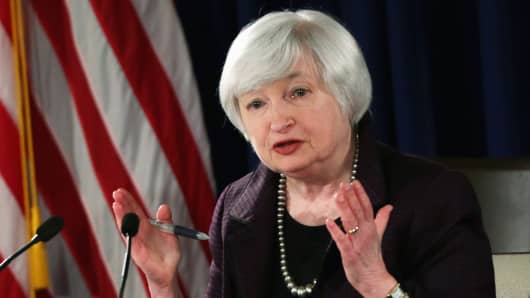
Federal Reserve Chair Janet Yellen warned that equity market valuations were “quite high,” though she said the Fed was not seeing the hallmarks of a bubble.

She also noted that the Fed was watching the issue closely.

“I would highlight that equity market valuations at this point generally are quite high,” Yellen said, according to Reuters. “There are potential dangers there.”

Yellen also made note of the risks to open-ended mutual funds, Reuters reported, particularly dangers to liquidity if redemptions rose.


Janet Yellen

Yellen said the Fed and other banking regulators have made significant progress in correcting flaws in the financial system that triggered the worst banking crisis in seven decades.

Banking regulators are remaining “watchful” for any areas where further reforms may be needed, she said in remarks at a financial conference.

Yellen cited the need to address the problem of “too big to fail”—the perception among investors that some institutions are so large that the government will step in and save them if they get into trouble.

She said the Fed and other regulators are taking steps to make sure that the collapse of even very large banking institutions can be handled in ways that don’t jeopardize the stability of the entire system.

Yellen’s comments came in a joint appearance with International Monetary Fund Managing Director Christine Lagarde at a conference sponsored by the Institute for New Economic Thinking.

Lagarde told the group that a recent IMF report found that risks to financial stability around the globe are rising with increasing risks at non-bank financial institutions and in emerging market countries.

“We need to build a financial system that is both more ethical and oriented more to the needs of the real economy—a financial system that serves society and not the other way around,” Lagarde said.

Yellen said a well-functioning financial sector promotes job creation, innovation and economic growth but that problems arise when the incentives become distorted, prompting bank executives to pursue risky strategies to increase profits.

“Unfortunately, in the years preceding the financial crisis, all too many firms took on risks they could neither measure nor manage,” she said.

“The result was the most severe financial crisis and economic downturn since the Great Depression,” the Fed chief said, noting that 9 million American lost their jobs and roughly twice that many lost their homes.

Modi’s Ambivalence?

Dhiraj Nayyar writes: Three weeks from now, India’s Prime Minister Narendra Modi will mark his first year in office. He swept into office with a clear center-right message — “minimum government, maximum governance” — and the biggest mandate of any leader since 1984; one might have expected him to establish a policy direction and priorities fairly quickly. Yet his administration still can’t seem to make up its mind what kind of government it wants to be. The government’s policies seem pulled in too many directions — both toward reform and against it.

The budget released in February gave a big and welcome fillip to public investment, especially in infrastructure, to kickstart a stalled investment cycle. The government has held steadfast in its determination to amend a restrictive land acquisition law. Last week, it made the first big move to revise India’s equally onerous labor laws by proposing to raise the limit at which employers need permission from the government to lay off workers from 100 to 300 employees, a major incentive for Indian firms to employ more formal workers rather than relying on informal and poorly-paid contract labor.

Modi’s administration has simultaneously engaged in blatantly regressive moves, especially on taxation. The decision to apply the Minimum Alternate Tax to foreign institutional investors has seriously dented investor confidence.

The government also caved to vested interests by withdrawing two welcome proposals that had been included in the February budget. One would have transferred responsibility for managing government debt from the central bank to an independent agency.

The central bank has a serious conflict of interest as the setter of interest rates and the manager of government debt. An underdeveloped bond market would have been served better by the efficient SEBI than a conflicted RBI.

Perhaps the biggest disappointment, though, has been the government’s total failure to privatize even one of India’s massively inefficient public-sector companies. One of Modi’s loudest applause lines during the campaign was that the government shouldn’t be in the business of business.

Perhaps Modi, acclaimed for his stewardship as Chief Minister of Gujarat state for more than a decade, still thinks he can run the Indian economy on a project-by-project basis rather than developing a coherent governing philosophy. His penchant for launching big schemes is unabated.

Modi Decisions

Is America Isolationist?

The Rocky Road from Iolsationism to Globalization:

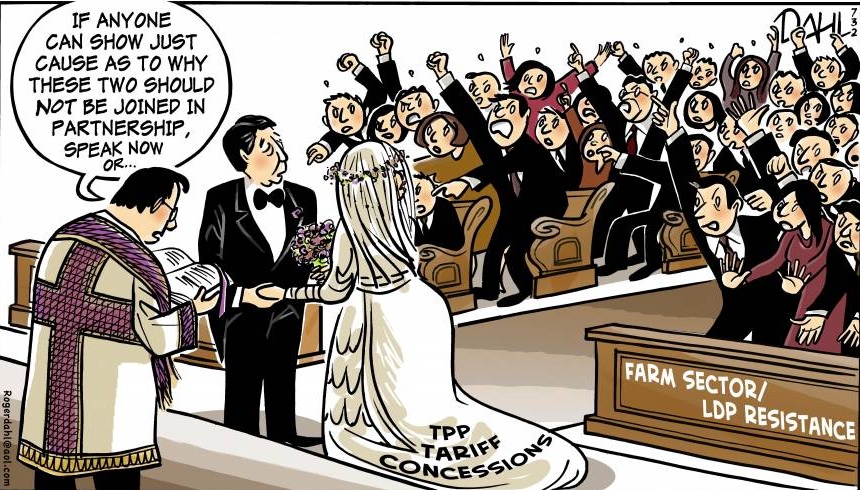
Scott Wong writes: In the US, swing-state Democrats are sounding the alarm that Obama’s free trade proposals, backed by their GOP opponents, would ship U.S. manufacturing jobs overseas and lead to greater unemployment at home.

Democrat Jason Kander, who is challenging Sen. Roy Blunt (R-Mo.), blasted the Trans-Pacific Partnership (TPP) as a “bad deal for Missouri.”

A progressive group led by former Sen. Russ Feingold (D-Wis.), who is polling ahead of GOP Sen. Ron Johnson in Wisconsin, called the TPP “ruinous for our middle class.”

Former Ohio Gov. Ted Strickland (D) said trade policy would be one of the “major defining issues” in his race against GOP Sen. Rob Portman, who served as the top trade official under former President George W. Bush.

Portman voted for the fast-track bill in committee but says he still wants to see language barring Chinese currency manipulation before he supports it on the Senate floor.  Portman hit back at Strickland, accusing the former governor of impeding the growth of the Buckeye State’s export industry.

The trade fight has made for unusual alliances in the Senate, where McConnell on Tuesday praised Obama’s efforts to win Democratic support for the bill.

In Pennsylvania, Sen. Pat Toomey (R), the former head of the free-market, free trade Club for Growth, voted for fast-track authority in the Finance Committee. But one Democratic challenger, Allentown Mayor Ed Pawlowski, said he’d fight the Pacific trade deal to protect jobs in the Keystone State.

Kander, Missouri’s 34-year-old Democratic secretary of State, blasted Obama administration for negotiating the Pacific trade deal “in secret.” He argued that Missouri’s auto industry has been doing fine without a new trade pact, adding about 20,000 auto manufacturing or related jobs in the past five years.

Kander also cited other statistics from American Automotive Policy Council — a jab at Blunt, whose son, former Gov. Matt Blunt, serves as president and the top lobbyist for the auto group.

Blunt made clear he has no plans to run from the tricky trade issue. Opening up new trade with Pacific markets will boost Missouri exports of corn, soybeans, rice, livestock and other products, he said, and mean more construction jobs as demand for ports and processing plants increase.

TPP?


Japanese As Inventors?

Noah Smith:  Every once in a while, you hear the old claim that Japan doesn’t create new things, but simply copies the West and makes small, iterative improvements. Most Americans no longer believe this canard and a recent Pew survey found that 75 percent of Americans think of Japanese people as “inventive.” But people still repeat the old saw from time to time, and it needs to die.

First of all, if anyone ever asks you “What did the Japanese ever invent?” you can quote them a long and impressive list. In the area of electronics, for example, Japanese inventors came up with the digital single-lens reflex camera, the floppy disk, flash memory, the VCR, the portable calculator, the Walkman, the laptop computer, the DVD and more.

Now, defenders of the old stereotype will be quick to point out that many of these inventions used technologies that were invented in other countries — for example, the charge-coupled devices that make digital photography possible were pioneered in the U.S. But if you look at the history of innovation, you see that almost all innovation stands on the shoulders of giants.  The Japanese team that came up with blue LEDs, which enable energy-efficient lighting, was awarded the 2014 Nobel Prize in physics. Pluripotent stem cells, which allow the creation of stem cells without the destruction of human embryos, were invented by Japanese scientist Shinya Yamanaka, who received the 2012 Nobel in chemistry.

And in 1804, before the end of feudal times, a Japanese surgeon was the first to use general anesthesia.

In the fields of entertainment and culture, Japan is also a pioneer. Many of our modern video-game genres come from Japanese games.

That should take care of debunking the stereotype. But it’s also true that there are at least two important ways in which Japan could bolster its inventive and innovative prowess.

The first is to improve its universities. Japan’s top-ranked university, the University of Tokyo, is only No. 23 on the worldwide list, while U.S. universities dominate.

The second thing Japan could do — but which many of its citizens will be reluctant to countenance — is to create a well-funded equivalent of the U.S.’s Defense Advanced Research Projects Agency.  DARPA has been responsible for a long list of transformative inventions and innovations, the Internet itself not least among them.

So Japan, which has always been a very creative, innovative country, is doing what it needs to do in order to maintain its inventive edge. Is the U.S. doing the same? It should be.

Invention

Tesla’s Home of the Future: Batteries

Elon Musk unveiled a new home-based battery that can store electricity and serve as a backup generator.

Cars used to be the ultimate symbols of freedom. A century ago Henry Ford’s Model T liberated millions of people from drudgery and slower modes of transport.

Since its arrival on the scene, Tesla has offered its well-heeled customers a different type of freedom, one that is gaining more currency as awareness of climate change and the ill effects of fossil fuels rise. That is the freedom from gas stations, from gasoline and oil, from gas taxes, from emissions.

Tesla’s new battery could finally sever the chain between transport and fossil fuels.  Energy storage is stationary. And a giant, expensive battery pack installed in your home doesn’t really enhance mobility. But it does contribute to freedom in two ways. First, it enables more people to liberate themselves from the electrical grid and fossil fuels at home. Second, it offers the potential to finally sever the chain between transport and fossil fuels.

Having an independent power source at home has become a bigger issue for people all over the country in recent years, as storms and floods tend to make electricity unavailable for longer periods of time.

A loud, fossil fuel-burning generator is comforting. But it would be more efficient—and more pleasing, and more green, and more quiet—to have a powerful battery in the basement that could kick in at times of need. Solar power is famously intermittent, which is a fancy of way of noting that the sun doesn’t shine for a big chunk of the day.

Storage in conjunction with solar achieves two goals. First, excess power created during daylight hours, if not sold to the grid, can be used to charge the battery. The battery can be used in times of emergency. Or, in theory, it could be tapped at night, to pick up the smaller electric load of a sleeping household—thus further reducing the need for dependence on the grid.

Tesla's Battery