Nothing Like a Game Dame for the NBA

David Zirin writes: Ccongressional shields and anti-trust exemptions enable pro sports to operate in a constitution-free zone, without the customary rights accorded in labor law. You get drafted to your city of work, a salary cap determines what you can make, and, arbitrarily, you can be deemed not old enough to work.

wages are artificially capped, with the supposed business geniuses that own NBA franchises protected from their own checkbooks like over-caffeinated teenagers. It does not change an accepted narrative that trickles down into the main vein of US life: that the bosses always know – and do – what’s best.

Michele Roberts took a blowtorch to this narrative, saying, “I don’t know of any space other than the world of sports where there’s this notion that we will artificially deflate what someone’s able to make, just because. It’s incredibly un-American. My DNA is offended by it.”

She also said that the current revenue split, where 50 percent goes to ownership, was ridiculous and would change when the players opt out of the current CBA – a CBA that shifted billions of dollars in wealth from players to owners – and renegotiates in 2017.

Game Dame

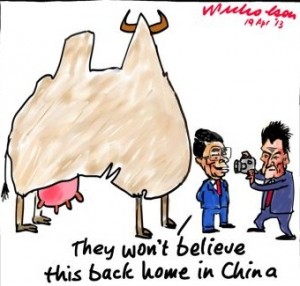
Trade Deal: Xi Whiz in Australia with Tony Abbott

Australia and China signed a trade deal which extends beyond mining.  Australia is the most China-dependent country in the world.  Exports to China count for 5.3 percent of the GDP.

Two-way trade, which reached A$151 billion ($132 billion) in 2013, has been driven by China’s insatiable appetite for resources and energy, while Australia mainly buys cheap Chinese manufactured products.

China supplied 20 percent of Australia’s A$256 billion of imports in 2013 and bought more than 35 percent of its exports last year, International Monetary Fund data show.

95% of Australia’s exports to China will be free of tariffs.

The issue of investnment by China’s state-owned enterprises was deferred in order to get the deal done.

Australia China Trade Agreement

Is Japan in Recession?

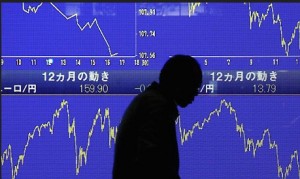
Technically yes, and European markets and oil prices responded ‘as if.’  But the growth rate could change quickly when next month’s figures come in.

Prime Minister Shinzo Abe may delay an unpopular sales tax hike and call a snap election two years before he has to go to the polls.

The recession comes nearly two years after Abe returned to power promising to revive the economy with his “Abenomics” mix of massive monetary stimulus, spending and reforms, and is unwelcome news for an already shaky global economy.

Gross domestic product (GDP) shrank by an annualised 1.6 percent in July-September, after plunging 7.3 percent in the second quarter following a rise in the national sales tax, which clobbered consumer spending.

 The world’s third-largest economy had been forecast to rebound by 2.1 percent, but consumption and exports remained weak.  Interstingly we have reported that the Japanese populace may not be as susceptible to a ‘nudge’ to buy as Americans have been.

An adviser to Abe termed the economic slide “shocking,” and urged the government to take steps to support the economy.

Economy Minister Akira Amari said some economic stimulus was likely, but added it would be hard to craft an exceptionally big package because of the need for fiscal disciplin

The yen slipped on the poor GDP reading, with the dollar briefly pushing to a seven-year high above 117 yen. The Nikkei stock average fell 3 percent.

Sluggish growth and easing price pressures due to sliding global oil prices prompted the Bank of Japan to unexpectedly expand its massive monetary stimulus last month.

Recession in Japan

Bezos Rule: Meetings Small Enough for Two Pizzas

Trying to find your two-pizza team magic? Here are three tips to get you started:

1. What’s the magic number?

Bezos’s two-pizza rule works out to at most 6 or 7 non-ravenous people. Teamwork expert Hackman pegs his magic number at 5 and fervently warns against going above 10. Management expert Bob Sutton cites the U.S. Navy Seals as having learned that 4 “is the optimal size for a combat team.”

It’s safe to say that a small team count sticks to single-digits, so start thinking of splitting into subgroups when you get beyond 10 people.

2. Follow the “Cheers” rule of effective teams.

Relational loss is a perception — so the more you can do to bring your teammates together, the better your team will be.

With thousands of employees, Zappos puts a lot of thought into scaling the same strong culture, familial atmosphere, and tight-knit feeling that it had when it was much smaller. They even hacked together a “face game” — when you log into the computer system, an employee’s face and bio pop up and you guess the person’s name. The smaller startup, Karma, follows the Cheers rule by eating family-style lunches together every day.

3. Make teamwork easier through transparency.

One crucial support structure found with effective teams is “an information system that provides teams the data and forecasts members’ need to proactively manager their work.” Every jump in relational links as groups get larger opens the door to more miscommunication and misinformation.

Providing self-service through systems, processes, and tools help distribute information and power so individuals can get aligned and move forward together as a team.

 One PizzaTwo pizzas

Sell Wine? Charge More. Get a Good Bottle Design. Brand It.

Elliott Morss writes:  The evidence from blind tastings of wines people like and their ability to tell differences between wines is growing rapidly.

Goldstein et al, based on data from 6,000 blind tastings, found: “Individuals who are unaware of the price do not derive more enjoyment from more expensive wine. …we find that the correlation between price and overall rating is small and negative, suggesting that individuals on average enjoy more expensive wines slightly less….”

More recently, Ashton has taken another look at Goldstein findings and provides data that reinforces them.   Lecocq and Visser analyzed data from three data sets totaling 1,387 observations on French Bordeaux’s and Burgundies. They report similar findings:  “When non-experts blind-taste cheap and expensive wines they typically tend to prefer the cheaper ones.”

The evidence suggests most people cannot tell one wine from another when only using sensory organs. So what really adds to wine’s value? Like doctors’ recommendations, there appear to be significant wine “placebo effects” from brand, label, price, country of origin, high ratings, and the recommendations of wine store staff.

If most wine is consumed with food and food changes the taste profile of wines, why are most tastings done “in isolation”? Sipping wines loaded with tannin (like Barolos) is not fun.  Such wines taste much better with food.

In tastings of the Lenox Wine Club, we tried to get tasters to consume wine with food before scoring the wines.  It did not work.  The tasters viewed the tastings as “work” and wanted to complete them before food and socializing at dinner.

  1. When eyes, tongue, and nose are used to taste wines, price makes no difference: people like inexpensive wines just as much as expensive wines.
  2. Limited evidence suggests further that when tasters are blindfolded (using only tongue and nose), 25% of tasters cannot tell the difference between red and white wines.
  3. Like women’s perfume, pocket books and sun glasses, wines are a “fashion good.”[7] That is, external signals, such as price (higher better), brand name, shape and color of bottle, ratings, wine salesmen, and country of origin all add value. Rough calculations suggest that of the roughly $250 billion of wine sales annually, $100 billion is attributable external “fashion” signals. People are starting to realize they can find good wines for $10, but as long as people are ignorant, vain, and insecure, there will be a “fashion premium” for wine.

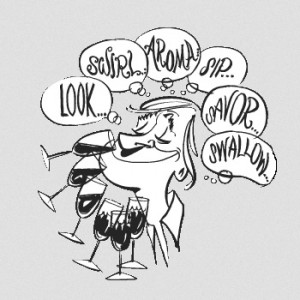
 What's A Good Wine?

US Trade: Win Win for Both Parties

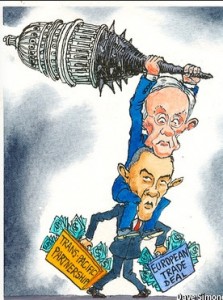
If Congress and the President can agree on anything it is trade.  The President has two pacts, the Trans-Pacific Partnership Agreement and the TransAtlantic Trade and Investment Partnership.

To complete the agreements, the President needs Congress to agree on only an up-and-down vote.  If Congress refuses, the agreements are dead on arrival.  Countries simply won’t negotiate complicated deals full of compromise if Congress cannot give the President this vote of trust.

Will this happen?  It is one area where it might and it is an important one.

Trade Deals

Deflation: Hope Does Not Spring Eternal

Central banks in the US, Europe and Japan have been pouring new dollars, euros and yen into the system in an effort to “nudge” consumers to buy.  People must be encouraged to act against their ‘irrational’ selves which can’t count on the future.

Bankers worry too that consumers may create ‘deflation’ by deferring their purchases and driving prices down.  Deflation is the opposite of inflation and its downward spiral is harder to stop.  The US Federal Reserve succeeded in doing this by the policy of quantitative easing.

Japan has tried to effect ‘reflation.’  The Bank of Japan governor will push about $720 billion into the economy.  WIll it work?  The Japanese are more skeptical than Americans.  They see themselves as just as rational if not more rational than bankers.

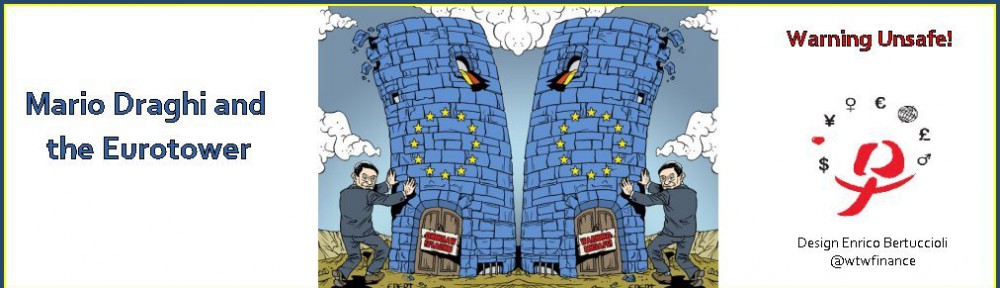
Draghi in Europe prefers to state things as they are and tell the truth.

Soft paternalism is complicated.  Are people really not capable of reasoned reflection?  Do they really need to be governed by careful ‘choice architecture?”  Answers to these questions are being given by the actions of central banks across the world.

Central Banks Nudge with QE


The Future of Commercial Aircraft

Ashley Dove-ay writes:  The aircraft industry is expecting a seven-fold increase in air traffic by 2050, and a four-fold increase in greenhouse gas emissions unless fundamental changes are made. But just how “fundamental” will those changes need to be and what will be their effect on the aircraft we use?

The crucial next step towards ensuring the aircraft industry becomes greener is the full electrification of commercial aircraft. That’s zero CO2 and NOx emissions, with energy sourced from power stations that are themselves sustainably fuelled. The main technological barrier that must be overcome is the energy density of batteries, a measure of how much power can be generated from a battery of a certain weight.

Tesla CEO Elon Musk says that once batteries are capable of producing 400 Watt-hours per kilogram, with a ratio of power cell to overall mass of between 0.7-0.8, an electrical transcontinental aircraft becomes “compelling”.

Another aspect is an exponential fall in the cost of solar panels, which have already become the cheapest form of power in most US states. The expected 70% fall in cost of lithium-ion batteries by 2025, and the rapid rise seen in the cost of kerosene-based jet fuel means that there will be a large and growing disparity in the costs of running aircraft that will greatly favour electrification.

Once electric aircraft are established, the next step will be to integrate a gimballed propulsion system, one that can provide thrust in any direction. This will remove the need for the elevators, rudders, and tailplane control surfaces that current designs require, but which add significant mass and drag.

The Future

Whose Afraid of the Big Bad Wolves of Wall Street?

William Black, Associate Professor of Economics and Law, University of Missouri Kansas City.  The former Director of the Institute for Fraud Prevention now teaches Economics and Law at the University of Missouri, Kansas City. During the savings and loan crisis, it was Black who accused then-house speaker and five US Senators, including John Glenn  and John McCain of doing favors for the S&L’s in exchange for contributions and other perks. The senators got off with a slap on the wrist, but so enraged was one of those bankers like Charles Keating,- after whom the senate’s so-called “Keating Five” were named – he sent a memo that read, in part, ‘get Black – kill him dead.’ Metaphorically, of course. Of course

During the Savings and Loan crisis 1000 FBI agents were assigned to Savings and Loans crisis.  Currently there are fewer than one hundred FBI agents assigned to financial crimes and they only go after the little guys.  They are unwiling to investigate.  CEOs like Jamiie Dimon, who orchestrate Chase’s policy,  handles the investigation of charges. Jamie Dimon’s main priority is not to decrease his bonus.

The 2008 crisis has produced no criminal convictions.  Zero.  None of the eite bankers have been brought to justice.  Everyone has gotten out of jail free.  The SEC, the office of currency control, the FED, and other regulatory agencies simply have not moved against big banks.

Eric Holder, the Obama Attorney General  said  that the banks were too big to fail.  Some regulators said they were unable to sleep at ngiht for fear of hurting big bankers.  There has been a steady decine in prosecuting white collar crims.

After 9/11, national secuirty became the highest priority.  The best FBI agents were transferred out of white collar crime.  We have two FBI agents per industry that investigated white collar crimes.  Banks don’t make criminal accusations against their CEOs.  Cirminal referrals have ceased.  Whistleblowers whistle infrequently.  There is no system for prosecuting frauds.  And we are getting near the statute of limiitations on this crime.

People who work for Justice and the SEC are afraid because the criminals are so big and regulators need the revolving door and their future with the criminals.  Looting the underowrld of banking.

Jim Webb, who served as Senator from Virginia for one-term, is contemplating a run for the presidency.  Webb led an effort in the Senate to tax windfall profits of executives who had benefited from TARP.   He was told off the record by a Wall Street executive, “You have to punish these guys.  It is outrageous what they did.”   Webb could find support neither from Democrats or Republicans in the US.  As Senator Durbin of Illinois says, “The bankers own us (the Senate.)”
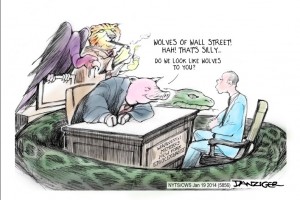
 Wolves of Wall Street?

Currents in Currencies

The Australian government is actively trying to cool the rise in AUD, while the euro appears set for a period of rebalance as the region battles economic decline and worries over the impact of geopolitical troubles, particularly in Ukraine and the Middle East.

EUR recently hit a 21-month low against the CHF and was struggling against JPY too, which some consider the most secure safe haven within G10. The threat of war and deflation at a time when other developed economies are deep into recovery does not bode well for the currency.

The key in the short-term will be interest rate decisions in the UK and, more importantly, the US. The markets are expecting the US economy to be strong enough to bear an interest rate hike in the first-half 2015.

If a rise occurs within that timeframe then emerging market debt and currency, which are already being hit by a flight from risk and search better quality yield, should continue to face headwinds.

As ever, traders will be watching central bank action in Europe, UK and US. It could be a choppy ride, but one where the odds seem to have returned in favour of traditional ‘safe havens’.

A safe haven:

  • Market size and volume
  • Stable interest rates
  • Controlled inflation
  • Robust balance sheets
  • Strong foreign investment positions
  • Liquid and robust financial markets
  • Low risk of geo-political or financial instability

 Sahe Havens for Currency