War on Women?

Heather Wilhelm writes: If you follow the antics of modern “feminism”—or even if you desperately try to ignore them—you’ve probably witnessed the following sad and wacky spectacle: Every week or so, certain clusters of cloistered, college-educated, first-world women will dredge the darker realms of the Internet for some new form of oppression to call their own.

It was refreshing, then, to see many of America’s much-touted, reproduction-obsessed, faux “War on Women” candidates—most notably Colorado’s Mark Udall and Texas’s Wendy Davis—lose handily in Tuesday’s elections. Equally refreshing was recent news out of Australia, in which the country’s foreign minister, Julie Bishop, told an audience that “feminist” is “not a term that I find particularly useful these days.”  Bishop sees herself, apparently, as a person, not a walking “lady part” grievance machine.“I’m a female politician, I’m a female foreign minister,” Bishop said. “Get over it.”

The bulk of modern feminists probably won’t approve.  Monsters, apparently, are everywhere. “Sexism is not just something that occasionally rears its ugly head,” as feminist writer Jessica Valenti recently warned in the Guardian. “It exists every day in every space.”

Yikes! As a woman who occupies various and sundry spaces on this madcap, whirling sphere, I was certainly surprised to learn this.

“What part of feminism,” asked Clementine Ford, a Melbourne-based feminist and writer, did foreign minister Bishop “find so unappealing?”  The nagging suspicion that most hard-core feminists would happily karate-kick you from behind in a dark alley if you disagree with them. It also could be the repeated public “rage spirals.”

There’s a more serious problem, however: For modern feminists, facts don’t seem to matter, and manufactured crises are all part of a day’s work. As some very real oppression of women unfolds around the globe, today’s Western feminists are busy constructing entire narratives out of false “epidemics”—widespread, sinister “street harassment” is the latest of many—that crumble upon closer examination.

I guess this makes sense, when you think about it: If the “oppression” of American women were to entirely disappear, a whole host of laptop scribblers would face the daunting task of selling “think pieces” about something else, and the only other thing they tend to know about is fusty, boring old Marxist economics. Who, aside from the people who pretended to get beyond Page 2 of Thomas Piketty’s book attacking capitalism, wants to read about that? There’s a delicate economy in the balance here, people—and, no doubt, large piles of unpaid student loans.

So the show must go on. Dilemmas must be concocted, and hackles must be raised. However, judging by the peculiar, stringent waft of its latest narratives, modern feminism might face an interesting test in the coming years—and it could fail that test by seriously misunderstanding what women really want.

Many women, in short, want husbands. A stable marriage is usually the best economic arrangement for all parties involved. The Democrats aren’t alone in getting this.  Desperate to appeal to left-leaning single ladies, the College Republican National Committee recently ran a cringe-worthy ad that compared choosing a candidate to buying a wedding dress.

While this week’s election results suggest that the left’s “War on Women” narrative is sputtering, the progressive dedication to curating the single, female demographic will continue to grow. With that comes a subtle vested interest in keeping more single ladies, well, single. Who needs a husband, after all, when you’ve got Uncle Sam?\


War on Women?

Luxembourg, a Tax Haven

Center for Public Integrity reports on the magical land of Luxembourg which has become a tax haven for large corporations.

  • Pepsi, IKEA, AIG, Coach, Deutsche Bank, Abbott Laboratories and nearly 340 other companies have secured secret deals from Luxembourg that allowed many of them to slash their global tax bills.
  • Advisors have helped multinational companies obtain at least 548 tax rulings in Luxembourg from 2002 to 2010. These legal secret deals feature complex financial structures designed to create drastic tax reductions. The rulings provide written assurance that companies’ tax-saving plans will be viewed favorably by Luxembourg authorities.
  • Companies have channeled hundreds of billions of dollars through Luxembourg and saved billions of dollars in taxes. Some firms have enjoyed effective tax rates of less than 1 percent on the profits they’ve shuffled into Luxembourg.
  • Many of the tax deals exploited international tax mismatches that allowed companies to avoid taxes both in Luxembourg and elsewhere through the use of so-called hybrid loans.
  • In many cases Luxembourg subsidiaries handling hundreds of millions of dollars in business maintain little presence and conduct little economic activity in Luxembourg. One popular address – 5, rue Guillaume Kroll – is home to more than 1,600 companies.

Magical Kingdom of Luxembourg

The “Living Will” Provision of Dodd Frank

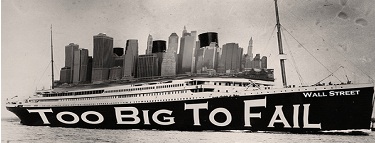
Is this a solution to ‘too big to fail?”

Jeffrey M. Lacker, had of the Federal Reserve of Richmond, spoke on ‘too big to fail’

Here are his main points:

  • “Too big to fail” results from two mutually reinforcing conditions: Investors feel protected by an implicit commitment of government support, and policymakers feel compelled to provide that support to avoid a disruptive adjustment of expectations.
  • The origins of too big to fail can be traced back to the introduction of federal deposit insurance in 1933. The problem was exacerbated by a series of rescues by the Federal Reserve and the FDIC that began in the 1970s, and by policymakers’ actions during the financial crisis of 2007–08.
  • The Orderly Liquidation Authority created by the Dodd-Frank Act retains many of the flaws of ad-hoc pre-crisis practices and does little to improve creditors’ incentives to monitor risk-taking.
  • A better strategy for ending too big to fail is the provision in the Dodd-Frank Act requiring large financial firms to prepare “living wills” detailing how they could be resolved under the Bankruptcy Code.
  • Resolution planning is difficult work, but living wills must be credible in order for policymakers to commit to using them rather than relying on government backstops.

Living Wills?

Israel Arrests 14 for Tax Evasion

Steven Scheer writes:   Israel arrested 14 people, including a senior UBS investment adviser, as part of an investigation into Israelis allegedly holding undisclosed bank accounts with UBS worth hundreds of millions of euros, the Tax Authority said on Wednesday.  All 14 had been released on bail soon after their arrests.
In addition to the unnamed senior investment adviser at UBS who was arrested in June in Tel Aviv, 12 Israelis with accounts at UBS had also been arrested, including two suspects who own a chain of health clinics abroad, said the tax authority. An accountant for the clinics was also arrested.  An Israeli court allowed publication of the arrests and allegations following a petition by an Israeli newspaper. The court is considering whether to release the names of those arrested.
Israel is starting to crack down on foreign bank accounts held by its citizens after a similar move by the United States to track accounts held by Americans abroad.  The tax authority said it had carried out a long investigation into accounts held by Israelis in Swiss banks and received information that thousands of Israelis maintain accounts in Switzerland, worth hundreds of millions of euros.

The authority said that the UBS adviser had arrived in Israel the day before he was arrested. He had met Israeli clients at a luxury hotel in Tel Aviv the following day.
“The meetings were held under secret surveillance of tax authority investigators,” it said. “At the end of the meeting …all the participants were arrested.”
Searches were subsequently made in the hotel room of the UBS adviser, UBS’s office in Israel and in other locations.  Among the adviser’s possessions, investigators found lists of hundreds of Israelis with unreported bank accounts in Switzerland, the authority said, adding that he is accused of helping clients intentionally and deliberately avoid reporting and paying taxes.
It said the adviser — directly responsible for dealing with the accounts — would visit Israel for secret meetings with clients who did not want to send instructions and documents to the bank by phone, mail or fax to avoid revealing that they held Swiss bank accounts.
Leumi, Israel’s second largest bank, last week said a settlement with U.S. authorities over possible tax evasion by the bank’s American clients could be far higher than previously estimated.
The total penalty could reach as much as $600 million, based on Leumi’s previous estimate as well as a settlement offer from New York State’s financial regulator.

Arrests

Can Germany Help Italy?

Jim O’Neill writes:  I’ve spent a good deal of my 35 years as an economic and financial analyst puzzling over Italy. Studying its economy was my first assignment in this business — as a matter of fact, Italy was the first foreign country I ever flew to. I’m just back from a vacation in Puglia and Basilicata. Over the decades, the question has never really changed: How can such a wonderful country find it such a perpetual struggle to succeed.

All the while, Italy has pitted weak government against a remarkably adaptable private sector and a particular prowess in small-scale manufacturing.

The rest of Europe had mixed feelings about this readiness to restore competitiveness through devaluation — meaning at their expense. When discussions began about locking Europe’s exchange rates and moving to a single currency, opinions divided among the other partners, notably Germany and France, on what would be in their own best interests. Many German conservatives, including some at the Bundesbank, doubted Italy’s commitment to low inflation.

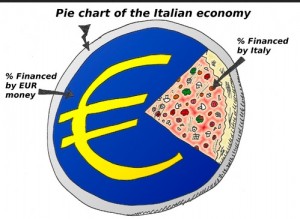
In the end, of course, the decision was made to bring Italy in. The results haven’t been good. It’s ironic that between 2007 and 2014 Italy has done better than most in keeping its cyclically adjusted budget under control.  The reason is persistent lack of growth in nominal GDP, itself partly due to an overvalued currency and tight budgetary restraint.

Italy is the euro area’s third-largest economy and its third-most populous country. Given this, the scale of its debts and everything we’ve learned about Europe’s priorities during the creation of the euro and since, I’ve always presumed that, in the end, Germany would do whatever was necessary to protect Italy from the kind of financial blow-up that hit Greece in 2010.

Italy needs growth in nominal GDP to stop its debt burden from rising any further.

This means it needs Germany’s help — not just through greater fiscal flexibility, which is essential, but also through a rise in euro-area inflation back to the European Central Bank’s target of “below, but close to, 2 percent

Perhaps German citizens should pay an extra tax each year the country experiences inflation that is below but not close to 2 percent — with the penalty increasing in proportion to the shortfall? The proceeds could be distributed to countries with a cyclically adjusted fiscal deficit of less than 3 percent and less-than-trend GDP growth.  Perhaps Italy could impose a punitive tax on German tourists?

Crazy?  I know.  Not any crazier than insisting on an arbitrary fiscal-deficit rule, unadjusted for the economic cycle — or letting demand fall so low that Europe misses its inflation target by a mile, and in a way that condemns Italy and others to endless recession?

Italian Economics?

The Kremlin’s Cleanest Hands?

Michael weiss writes;  Igor Schualov, Moscow’s first deputy prime minister, is worth 250 million dollars.   Called Mr. Clean, where di he get his money?

Shuvalov used offshore companies to purchase close to $2 million in building materials from a Belgian contractor in order to outfit a lavish greenhouse for his 18.5-acre estate just outside Moscow. The company, Glas & Metaal Engineering, which filed for bankruptcy in June 2011 and no longer exists, was based in the municipality of Menen, Belgium. It was contracted in February 2006 to sell “glass-panels and the support-structures in stainless steel, and aluminium outside cleaning-gantry” for the glazed dome and walls for the “Wintergarden” on Shuvalov’s sprawling estate in Zarechye village in the Odintsovo district of Moscow, the buildings of which were designed by Italian architect Giuliano Moretti.

The land of Zarechye-4, Shuvalov’s property, formerly belonged to members of the Soviet Politburo, including hard-line communist ideologist Mikhail Suslov, for the purpose of hosting VIPs. Shuvalov’s neighbors include billionaire oligarchs Roman Abramovich and Suleyman Kerimov, with whom Shuvalov has profited enormously in financial dealings uncovered in 2011 and 2012.

Shuvalov was meant to be different. A reputed liberal in the Kremlin, once considered Russia’s business-friendly “sherpa” to the G-8, Davos, and the World Trade Organization, Shuvalov has long been thought of as an agreeable counterpoint to the hard-line siloviki, or strongmen, a faction that now seems dominant in the Kremlin. In congratulating the formation of the new Russian government after Putin’s return to the presidency in May 2012, the influential U.S.-Russia Business Council named Shuvalov first as an “[advocate] for improving the business climate and strengthening the U.S.-Russia bilateral commercial relationship.”

Shuvalov’s role has been to put a more respectable face on international Russian commerce, a face never more urgently needed than it is now.  Corruption in Control in Russia

Shuvalov

Republicans May Make Positive Impact on Global Economy in the Legislature

The Repulicans will control both houses of Congress in the US.  This may be good news for the global economy.

Daniel Altman writes:  Both houses of Congress will fall into Republican hands for the first time since 2005. The global economy will be watching to see if the two parties can finally work together — and perhaps, in some ways, they can.

With Republicans at the helm in both houses, simply boasting of stopping President Barack Obama’s agenda probably won’t impress voters too much in 2016, either. And no one wants to go down in history as the party bigwig who merely watched while nothing got done (right, Mitch McConnell?). So Republicans may want to advance some legislation that the president would sign.

This is where the global economy comes in. The United States has been the lead horse pulling the wagon for several years now, and that doesn’t look like changing in the next two. The European Union is still hamstrung by austerity, unemployment, and weak monetary policy.   China is in the midst of a slowdown.  And Japan, though showing some hopeful signs, is operating far from capacity.

In other words, the ball is in Washington’s court. And there are three important areas where Republicans can set an agenda that might even bring Obama along, offering him a chance to strengthen his as-yet-shaky legacy, and give Congress something to crow about.

The first is taxes, and the corporate income tax is front and center. The United States has one of the highest rates in the world, which has resulted in vast pools of cash owned by American corporations sitting unused overseas.   Cutting the rate would make federal tax revenue less volatile, but it would also give Americans who pay taxes as companies a chance to shelter vast amounts of income. To preserve the reduction in volatility while maintaining the tax base, legislation might also get rid of some of the dozens of loopholes. 

If American companies took advantage of a friendlier tax rate to bring their earnings back stateside and invested them in their businesses, global growth could get an enormous boost. U.S. companies may hold on the order of $5 trillion in cash abroad; investing even $1 trillion at return of 5 percent would raise annual output in the United States by $50 billion, or about 0.3 percent per year, with likely spillovers abroad. Of course, the rest of the world might also suffer a dent in its liquidity, but the net effect of putting those dollars to work would almost certainly be positi

Another area ripe for reform is immigration. The United States has an immigration policy that’s largely motivated by politics and cultural considerations rather than economics.

Even against the backdrop of an immigration policy that lacks economic underpinnings, research suggests that migration to and from the United States responds to supply and demand.  Taking the brakes off immigration would allow more businesses to operate efficiently, bringing in workers as they would raw materials or physical capital. And when immigrants work in the United States, they frequently earn much more than they would have at home — and they send a portion of their incomes back to spur growth there as well. It’s hard to believe that Obama would reject a pro-business immigration reform that also allowed Republicans — not to mention the president — to accentuate their toughness on border security.

The last area where Republicans and the president might find common ground is trade. Obama is more in favor of free trade than the Democratic caucus, which has put a damper on his administration’s efforts to sign historic pacts with the EU and neighbors across the Pacific.  There’s a chance that immigration and trade deals could be pushed through

That’s the economics. But from a political perspective, do any of these three areas show actual potential for progress?

Establishment Republicans, as opposed to the insurgent Tea Partiers and their ilk, have always boasted of a pro-business agenda. And John Boehner, the speaker of the House of Representatives, and Mitch McConnell, the presumptive Senate majority leader-in-waiting, are about as establishment as they come. By a stroke of luck, it’s also fashionable for Democrats to be pro-business these days.  For Obama, especially as a lame duck, there’d be little benefit to vetoing economically driven proposals on any of the issues above; instead, he could use pro-business credentials to become an asset on the campaign trail again. 

No, the big question is whether the pragmatism of establishment Republicans can win over the more ideological wings of their party. Immigration, trade, and even taxes are all emotional issues, especially for Americans fed up with job searches and stagnating incomes. But as long as payrolls in the United States keep growing, there may just be room under the covers for some rather unusual bedfellows. If they can finally get it together, the global economy may be in for a blissful couple of years.

China: Should We Look at Productivity Instead of Growth?

Look at productivity in China, not growth. to see where China is really headed.

With iron ore prices already sitting at five year lows, a further slowdown in Chinese growth is not the sort of news that Australian policy-makers need. What is of greater concern is whether we are seeing the beginning of something more permanent. Will China have a similar trajectory to Japan since the early 1990s? This would impact the rise of China’s middle class.

In the long run economic growth is delivered when productivity climbs. That means finding better ways of doing things. The only other way to produce more output is to use more inputs. However, the problem is diminishing returns. Building a rail link that connects an inland city with a port brings enormous benefits but once built, there is little need for another..

Productivity struggles to attract the attention of commentators because it is hard to calculate. Professor Chris O’Donnell and James Laurenceson found evidence of rapid productivity growth across most provinces. This is good news but also no surprise – China had access to easy sources of productivity gains such as borrowing technology from overseas.

The key question is whether productivity can continue to improve as the economy matures?  The government has spent much on human capital and the results are significant. China’s universities are now second only to the US in terms of their total research output.

But for truly rich productivity gains to be unlocked, reforms are needed that shift the economy away from its dependence upon investment. For consumers to take the lead they need more income. Getting state-owned banks to pay the household sector market rates of return on their savings deposits is one example of the type of policy that is sorely needed.

Facing a downturn in economic activity, the first instinct of China’s leaders is to pull policy levers that pump up aggregate demand. But temporary measures to boost growth such as expanding the supply of credit have largely run their course and are no longer sustainable.

When pushed they have also shown themselves to be nothing if not pragmatic. President Xi Jinping’s aggressive tackling of official corruption in response to public anger is a case in point. If stalled living standards are to be avoided, committing to a productivity-enhancing reform agenda is really the only option that China has left.

Focus  on what the data says about the trajectory of productivity. Through the first half of 2014 consumption contributed 54% of GDP growth, while investment chimed in with 49% (net exports were responsible for -3%).

The overall growth rate may be disappointing but if there is a widening of the gap in favour of consumption then this is exactly the sort of news that China and Australia needs.The Conversation

Productivity in China

SEC Fines Bio-Red Laboratories for Bribery

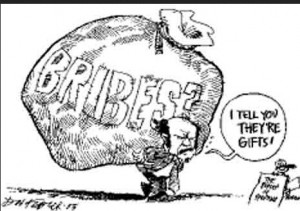
An SEC investigation found that Bio-Rad Laboratories lacked sufficient internal controls to prevent or detect approximately $7.5 million in bribes that were paid during a five-year period and improperly recorded in books and records as legitimate expenses like commissions, advertising, and training fees. The improper payments enabled Bio-Rad to earn $35 million in illicit profits.Bio-Rad, which self-reported its misconduct and extensively cooperated during the investigation, agreed to pay $55 million to settle the SEC’s charges and a parallel action announced today by the U.S. Department of Justice. Said Andrew J. Ceresney, Director of the SEC’s Division of Enforcement:

Bio-Rad Laboratories failed to detect a bribery scheme and did not properly address red flags that such a scheme was underway. This enforcement action, which reflects credit for Bio-Rad’s cooperation in our investigation, reiterates the importance of all companies ensuring they have the proper internal controls to prevent FCPA violations.

According to the SEC’s order instituting settled administrative proceedings, Bio-Rad made excessive payments disguised as commissions to foreign agents with phony Moscow addresses and off-shore bank accounts. The agents had no employees and no capacity to perform the purported services for Bio-Rad, and were retained primarily to influence Russia’s Ministry of Health and help the company win bids for government contracts. Bio-Rad managers repeatedly ignored various red flags indicating that the Russian agents were likely bribing government officials, and they condoned an atmosphere of secrecy. Country managers were allowed to communicate through at least 10 different personal e-mail addresses with aliases, and referred to the commissions with code words such as “bad debts.”

According to the SEC’s order, Bio-Rad employees used local intermediaries in Vietnam and Thailand to funnel bribes through to foreign officials in exchange for business. Bio-Rad’s Singapore subsidiary sold products at a deep discount to Vietnamese distributors, who passed through a portion of it as bribes. Bio-Rad acquired a company in Thailand and failed to uncover a pre-existing bribery scheme in which Thai agents received inflated commissions that were partially used for improper payments.

The SEC’s order finds that Bio-Rad, headquartered in Hercules, Calif., violated the anti-bribery, internal controls, and books and records provisions of the Securities Exchange Act of 1934. The company agreed to pay $40.7 million in disgorgement and prejudgment interest to the SEC, and a $14.35 million criminal fine to the Department of Justice. The company also must report its FCPA compliance efforts to the SEC for a period of two years.

The SEC’s investigation was conducted by FCPA Unit members Catherine W. Brilliant and Alka N. Patel in the Los Angeles office. The SEC appreciates the assistance of the Fraud Section of the Criminal Division at the Department of Justice as well as the Federal Bureau of Investigation, Bank of Lithuania, Financial and Capital Market Commission of Latvia, and British Virgin Islands Financial Services Commission.

When governments put their mind to it, coruption can be stopped.

Bribes


Venezuela Raises Minimum Wage…Again

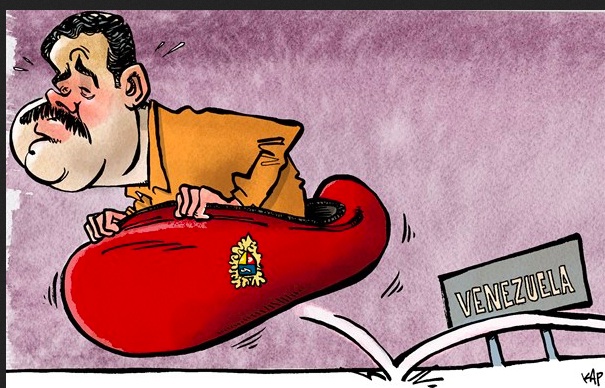
President Maduro has raised the minimum wage for the third time this year.  The raise comes amid an annual inflation rate of 63.4%.

Mr Maduro said the measure and other benefits meant workers would be better off despite the inflation, which he blamed on an “economic war” the opposition were waging against him.

The new wage will be 4,889 bolivars per month ($776; £485 at official exchange rates, $49 in the black market).

Under Venezuela’s strict currency controls, people and businesses can receive US dollars at the official rate only by applying to a government currency agency, and then only for specific purposes such as importing goods or paying for foreign travel.

The amount of dollars available at the official rate is restricted, but the demand remains high. This has caused the black market to flourish.

To applause from party members and workers gathered at an official event, President Maduro said he had “decided to accept the proposal from the workers to decree a 15% rise in the minimum salary from 1 December”.

Last week, the president announced that he would raise the salaries of the members of the Venezuelan armed forces by 45%, a move which was heavily criticised by the opposition.

Mr Maduro said the increase was “just” and “well deserved”.

Mr Maduro says Venezuela’s economic problems are created by a greedy elite which lives off the profits of smuggling and selling goods at inflated prices.  The opposition accuse the socialist government of Mr Maduro and that of his predecessor in office, Hugo Chavez, of mismanaging the economy for the past 15 years they have been in office.

Maduro