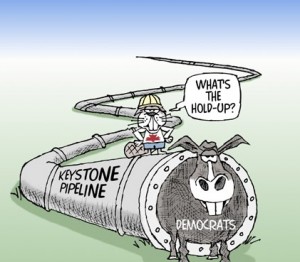
Waiting for the Keystone Pipeline

Peter Moskovitz writes;  As many people here see it, the keys to unlocking Montana’s full economic potential are just 40 miles beyond the state’s eastern border, out of the reach of even Montana’s most powerful politicians.

There, in a dirt field in Gascoyne, North Dakota, sit hundreds of segments of 36-inch-wide pipe, each painted pale green to prevent rust and stamped with the letters “KXL.’’

For many Montanans, the pipes represent a slap in the face from the federal government, which for six years has labored over whether to allow Canadian pipeline giant TransCanada to build the Keystone XL.  The pipeline would bring up to 850,000 barrels of oil from Alberta’s tar sands through Montana, South Dakota and Nebraska, to an existing pipeline system stretching from Kansas to oil refineries on the Gulf Coast.

The Keystone has run into opposition from dozens of environmental groups across the U.S., with activists arguing that the pipeline is an environmental catastrophe waiting to happen. Those concerns have shaken up politics in South Dakota and Nebraska. But in Montana, a state keenly aware of the benefits of a booming energy industry, the fight over the pipeline is virtually nonexistent. A few local environmental groups have protested it, but in political races, at school board meetings and in local bars, the debate seems to be settled.

Baker, a city a few miles from the North Dakota border, home to a little less than 2,000 residents, makes clear why: It’s bustling thanks to the ancillary effects of the oil industry, mainly drilling in eastern Montana and western North Dakota. Hotels are full, real estate prices are high, and the population is slowly growing. Two interstate pipelines already pass through the town. For many here, the idea that another pipeline would cause controversy is confounding.

Many think Montana’s support for the pipeline has to do with the state’s already robust energy industry.  Energy infrastructure can be seen even through the most desolate sections of the state. Mile-long freight trains carrying tons of coal from Montana’s Powder River Basin crawl from east to west. Oil rigs in the hills of eastern Montana tap into the same Bakken formation that made North Dakota an American energy success story.Keystone Pipeline


All in the Family

Family firms are flourishing around the world.  37% of firms with over 1 billion in assets are leading the ermerging markets.

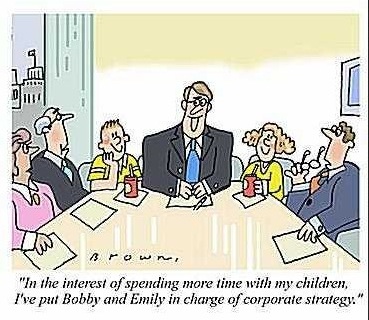
In the US, family  firms are treated favorably by legislation   Families can keep their money and reinvest it in the business with favorable consequences.  Ford weathered the economic downtrun without borrowing money from the govenrment.  Almost 40 famiily members are connected to Ford.

Walmart, Volkswagen, Glencore, and Samsung are still controlled by families.

Special classes of shares, allowing family members to run the company, liike Ana Botin and Abigail Johnson,and maybe even genetics come into play.

Family firms are less likely to lad up on debt they historicaly have had better labor relaitons, and they tend to have a superior corporate culture.

Warren Buffet likes to buy family firms. Helzberg Diamonds has been discussed on this site.  Buffett plans for succession in his firm include his son.

Family Businesses

MicroLoans from Local Chambers of Commerce?

A division of the Indianapolis Chamber is applying to become a U.S. Small Business Administration-affiliated microlender, a move aimed at boosting its available capital and expanding its territory in a wide-open frontier of finance.

The 124-year-old chamber already offers microloans through its Business Ownership Initiative, putting it in rare company among its peers across the country and giving it a leading position as a one-stop shop for small businesses. But that’s not enough. BOI is looking to beef up its role as a microlender as demand for these mostly low-five-figure loans continues to grow.

The BOI Microloan Program has a roughly $2 million fund to make these loans, but nearly half of that already has been deployed. And because of its diverse history, much of the program’s funds are restricted to Marion County, even specific neighborhoods within the county.

Becoming an SBA intermediary would pave the way for BOI to receive an initial infusion of about $750,000 from the SBA and would allow the program to expand to eight surrounding counties. The program over time could receive as much as $5 million from the SBA—money that BOI would have to repay.

Microloans are loans of less than $50,000 that some businesses struggle to obtain from traditional financial institutions. Such low amounts often aren’t worth the bank’s or credit union’s while, and sometimes collateral or credit scores pose a problem for small-business owners.

BOI was an independent microlender before it merged into the chamber in 2012. It started out with about $150,000 in capital, officials said, but got grants from the city of Indianapolis and JP Morgan Chase’s charitable arm to grow the fund.

Ian Scott of the Association of Chambers of Commerce Executives said several chambers across the country are involved in connecting small businesses with financing, but Indy Chamber’s latest venture puts it in rare company.

“This is an innovative program that is certainly on the cutting edge of what chambers are doing to support small- and medium-sized businesses,” Scott said.


As an intermediary, BOI would not be able to use SBA money for operations, officials said, and all interest income on SBA funds is returned to the SBA. Julie Grice, who oversees BOI as the chamber’s vice president of entrepreneur services, said the $1.2 million annual operating budget is supported by grants, service fees and interest income from its other microloan funds.

The loans made by BOI so far have been as small as a few thousand dollars and have allowed businesses like Kountry Kitchen at 19th Street and College Avenue to make unexpected repairs.

The smaller the loan, the more personal the collateral, Grice said. One loan has been secured by three guitars, she said. Another involved a lawnmower.

The region has a few other non-SBA microlenders, including Indianapolis-based Lynx Capital Corp., which focuses on minority businesses, and Grameen America, a Bangladesh-based lender that opened an Indianapolis office in 2012. The Boone County Economic Development Corp. and the town of Zionsville also have microlending initiatives.

Flagship is the Big Kahuna with respect to SBA microloans in the state, but that might change if BOI joins the fray. Adam Hoeksema, Flagship’s loan program manager, said he doesn’t see BOI’s entry as a bad thing, and the two organizations already send referrals to each other.

Microloans

To Frack or Not to Frack?

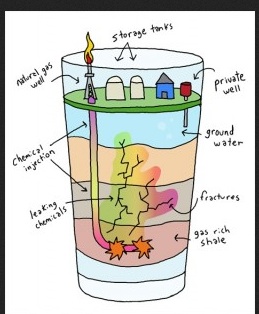
John Hickenlopper, governor of Colorado, has an even-handed and clear approach to fracking.  He supports the technology associated with hydraulic fracturing used to extract oil and natural gas.

Hickenlooper governs an energy rich state. He is up for re-election in the US this Tuesday and in a tight race.  He bravely and intelligently argues that fracking can be safe if it is done right.   He takes seriously complaints about unsafe measures.

Colorado has mandated disclosure of fracking fluid ingredients and additional groundwater testing, while designing stricter air quality regulations.  Before the regulations are passed, the govenror gets a buy-in from industry and environmentalists.

The governor sought out measures to provide an altnernative to ballot measures that might have crippled drilling.  The state has a chance to reach a compromise on local control of driling.

Hickenlooper has been a leader on a very controversial subject.

To Frack or Not to Frack?

Oil Prices and Governance

As oil prices plummet, consumers are delighted. Oil producers retrench.

OPEC is scrambling to gain control of the market again and meets at the end of November.  Countries desperate to boost prices, like Venezuela and Russia, are also the least democratic. Oil revenue is used to pay off a powerful elite or pay expensive subsidies to the poor. Neither tactic works well over time.

Norway’s example is of a society that decided to secure its own power and position vis  a vis the big oil companies.  Norway is the world’s fifth largest exporter,  They have tried to distribute money fairly and leave an economy for the future which is not oil-based.  Fighting a tendency to have personal favoritism in government is particularly important for oil rich countries.  High levels of trust and transparency are essential.  These stand out in a country like Norway when oil prices fall.

Falling Oil Prices

Abe’s Efforts at Gender Equality Faltering

Two women ministers, Industry and Justice, both women, have left Abe’s cabinet in Japan.  The two resigned amid allegations they violated political funding and election laws.

Yoko Kamikawa will move from her post as gender equality minister to Justice.  She will be replaced by a man.

The embattled former ministers were among record-equaling five women appointed to Japan’s cabinet in September.  The industry minister became embroiled in controversy surrounding the start up of several nuclear reactors after the Fukushima Daichi meltdown.

Abe’s support has fallen since September.  Many are opposed to the sales tax hike he proposes to reform the economy. A majority oppose the restart of nuclear reactors.

Japanese Cabinet

Security Issue with Erection of Cell Towers?

Mysterious interceptor phone towers are being erected in the US.  The towers do not appear to belong to the National Security Agency.

In the US today, selling information is big business.  How can Twitter, Skype, Google and Facebook offer their services free to customers?  Just try opting out of information sharing.  It’s almost impossible.

These towers tell your phone that none of your usual conections are available and trick you into using theirs.

NSA does’t need a fake tower to tap your phone.  They just go to your supplier.  The FCC announced that it was investigated the use of towers by criminals and foreign intelligence.

Cell Towers

I


Is Tesla the Next Apple?

Is Tesla the new Apple?

This is the state of the smartphone/tablet market: Investors were overjoyed when Apple delivered 4.6 revenue growth  in the spring quarter. And the hottest product of the year in the mobile device industry is going to be iPhone 6 because it finally is an iPhone with a screen size larger than 4 inches.

The car industry,is now in the same spot the phone sector was in 2007.

The original iPhone changed what a phone was. The role of the display morphed from vehicle of passive viewing to actual control mechanism, far more intuitive than a keypad could ever be. That sort of fundamental shift of how a product can be used can only happen once in a decade or two. Now Tesla is changing the car in an equally fundamental manner: this new vehicle is totally silent, free refueling stations enable you to drive from California to New York without paying a cent in fuel costs, etc. The phone sector will be playing with  thinness, display size and camera quality for at least five years.

Tesla is getting ready to gut GM and Ford with its car range that is about to expand radically. Just as with Apple, the narrow early distribution of a groundbreaking new product is giving the established players a deceptive period of grace. It will take a couple of years for the real impact to become clear.

But we clearly are now entering an interesting period as Tesla prepares to roll out an SUV called Model X in 2015 and a budget car Model 3 in 2017.

An ecstatic new Morgan Stanley research note claims that “we’d be disappointed if the Model X did not sweep every major Car of the Year award on offer by the automotive media.”  A  palpable sense of frenzy is building in the automotive press and financial media. The design of the Model X is unusually bold and exotic for an SUV and a gutsy move.

The Model X is small potatoes compared to Model 3, though. This car is expected to retail at $30,000, less than half of the price of the current Model S. It will represent a direct attack on the smaller German quality cars of BMW, Audi and Mercedes Benz. If Model X production ramps up aggressively and starts making real inroads in the luxury SUV market, the Model 3 could form the second prong of a dangerous pincer movement aimed at the most lucrative parts of the car industry: high-end SUV models and compact luxury sedans.

As Tesla’s charging station network expands and buzz around the structural innovation of the new models builds, rival car vendors seem to be wading through molasses.

Who would have thought in 2007 that all the excitement around the iPhone would migrate to car business so rapidly?

Testosterone and Greed

To keep libidos active after menopause, some women take testossterione.  It turns out that this may make them greedier.

Joe Pinsker wrires:  Results of a study done by researchers at the University of Lausanne ecently published in The Leadership Quarterly suggest that  people with high levels of testosterone were more likely to behave greedily.

There’s already a thorough body of research on how power contorts morality and reason. Power, it’s theorized, turns people selfish because it makes them feel entitled and emotionally detached. It can make them view others as less worthy, which is of course compounded by the finding that power can increase bias. Given also that power makes people feel immune to bad consequences, it makes sense that some of those in power do so many awful things.

Hormones are a less-scrutinized variable in moral decision making. High levels of testosterone have been linked to diminished generosity and empathy, but the connections between testosterone and corruption—defined by Lausanne’s researchers as ignoring social norms for personal gain at others’ expense—hadn’t been sketched until this study.

To trace this relationship, researchers designed two experiments—both variants of what’s called “the dictator game”—that culled subjects from a Swiss university. In the first setup, subjects were randomly assigned to be leaders or followers. Each leader was solely responsible for deciding how to distribute prize money given to the group. For example, leaders at one point chose between “$100 for me; $70 for you,” “$90 for me; $90 for you,” and “$150 for me; $10 for you.” These numbers were selected such that the more the leader chose the receive, the less his or her followers would get. The leaders with more power—that is, with more followers or more distribution choices—behaved more greedily.

The second experiment was more ambitious. Weeks before subjects were assigned leader/follower roles, they filled out a survey about the fairest way to distribute the money. The vast majority of people agreed that the “$100 for me; $70 for you” arrangement was fair—which allowed the researchers to declare that picking “$150 for me; $10 for you” would be violating a norm that everyone agreed on. Subjects also had their mouths swabbed to measure testosterone levels.

During the experiments, once subjects had been named either leaders or followers, they were frequently reminded of the survey results, making them aware of what their peers expected of them. When leaders’ power over a situation was relatively low, roughly half of them stayed true to the social norms they helped develop; this dropped to 19 percent when they were given more power. Also, the greediest behavior was linked to high baseline levels of testosterone.

Susan Case, a professor of organizational behavior at Case Western notes that the average age of the subjects is about 21 years—an age too collegiate to use in generalizing about the corporate world.

From the Lausanne study, it’s not clear whether testosterone levels control corrupt behavior, or whether high levels of it are linked to the presence of some other physiological feature that does.

David Mayer, a management professor at the University of Michigan, points out that this research is similar, in spirit, to fMRI studies indicating which parts of the brain light up when a certain decision is made.

Indeed, what can be done to make business executives more likely to act with the public good in mind?  Iit appears the best way to curb selfish behavior is to turn away from hormones and toward oneself. “Being self-aware … actually reduces people’s tendency to morally disengage from the tasks they are doing and act with greater integrity,” says Fordham University’s Kyle Emich. Specifically, Emich recommends installing mirrors in the offices of the powerful—”so people are forced to look at themselves,” he says.

Testosterone and Greed

Japan Not Moving on Tsunami Repairs

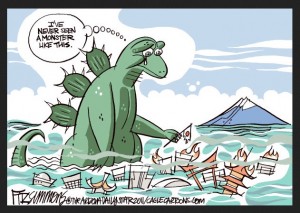
Taiga Uranaka and Antoni Stockowsky write: Japanese government funds budgeted for reconstruction and transferred to local governments are stuck in banks across the tsunami-ravaged northeast.  The central government has paid out more than $50 billion directly to local governments in Miyagi, Iwate and Fukushima prefectures, the areas hardest hit by the disaster. But about 60 percent of that money remains on deposit in the region’s banks.

Ishinomaki, where more than 3,700 people died in the tsunami – the most casualties of any city in the disaster – has been deeply affected by the funding paralysis. The port city, where 56,000 buildings were damaged, has been showered with money for reconstruction – about $4.1 billion in the three years after it was hit.

But almost 60 percent of the money, or $2.3 billion, remains in bank deposits. And fewer than five percent of the planned new homes for the city’s nearly 25,000 evacuees have been completed.

Makoto Kitamura, the deputy director general of the Reconstruction Agency, says local government spending of reconstruction money has been accelerating. “The pace of the construction projects has also been picking up,” he told Reuters, sitting in his office in Tokyo. “So it is not something you should worry about.”

For Prime Minister Shinzo Abe, the reconstruction delays are a potential time bomb. Before he became prime minister in December 2012, Abe campaigned in parliamentary elections on a pledge to speed up reconstruction – a promise he has repeated on both anniversaries of the disaster since he took office.

As prime minister, he vowed in March 2013 that “reconstruction will have made a lot of progress and our lives will be better by March 11 next year.” A year later he repeated the promise: The government would make the year ahead one in which “everyone in disaster-hit areas feels the progress of reconstruction.”

So far, about 2,700 housing units of a planned 29,000 have been completed in the tsunami-hit areas. In its housing plan issued more than a year ago, the government said it aimed to complete 15,000 homes by March next year. It has since scaled back that target to 10,000 units.

A labor shortage exacerbated by the siphoning of workers away from the disaster zone to build commercial facilities for the 2020 Tokyo Olympic Games has slowed reconstruction. So have a spike in the cost of building materials and problems in procuring land in the disaster zone.

Much of the reconstruction cash has ended up on the ledger of 77 Bank in Sendai, some 50 kilometers west of Ishinomaki. Government deposits at 77 Bank, the region’s largest lender, have jumped four-fold to almost $17 billion in the past three years as reconstruction money flooded in, the bank said.  Like 77 Bank, other regional lenders have also ploughed funds into Japanese government bonds, creating a closed loop of financing. By buying government bonds, the banks’ investments are essentially helping to fund the borrowing that the government undertook to make the disaster-related allocations in the first place. The central government issued $130 billion worth of reconstruction bonds in the three years after the disaster.

The unspent funds sitting in bank deposits also come at a cost to Tokyo. The government is under mounting pressure to cut a public debt load that is more than twice as large as annual economic output.

Separate from the money allocated directly to the prefectures, the central government has poured $140 billion into disaster-relief and reconstruction projects, including emergency loans to small- and medium-sized businesses hit by the tsunami.

The government’s five-year reconstruction plan was built on unrealistic assumptions, said Yoshikiyo Shimamine, the chief economist at Dai-ichi Life Research Institute in Tokyo. “Given bottlenecks such as labor shortages and material cost rises and difficulties in getting consensus among residents who are relocated, reconstruction budgets are not something that can be spent within five years,” he said.

Officials in Ishinomaki, home to 150,000 people, say spending the more than $4 billion in reconstruction aid has proven tough. With all of the city-owned land having been designated for temporary housing after the tsunami, the local government had to negotiate the purchase of an additional 9,000 plots to build permanent homes. That inflated the price of a plot of land in Ishinomaki by 15 percent last year, the biggest jump anywhere in Japan.

Before the city could buy land, it had to track down the legal owners. That proved tedious, said Oka. Officials discovered that in many instances, properties had been passed down without proper inheritance procedures.

After the tsunami, about a third of public works projects in Miyagi failed to attract bidders in the first round as construction companies say they held back for fear the projects would be unprofitable.

A strip of Ishinomaki’s shoreline where 6,500 homes once stood has been declared too dangerous to build on. And many local government officials, who would otherwise have played a role in reconstruction, either died in the tsunami or had their homes destroyed and are themselves living in temporary dwellings.

Tsunami Repairs