Can the New York Fed Supervise Wall Street?

Can the New York Federal Reserve supervise Wall Street?

The financial crisis could never have happened without the passivity of federal bank regulators. And no agency’s failure was more pivotal than that of the Fed, which had the authority to crack down on the abusive lending that drove the financial system and the economy over the cliff, but repeatedly failed to exercise it

The New York Fed is a key part of the Federal Reserve, acting as the on-the-ground supervisor of the major Wall Street banks. According to an internal New York Fed report, written in 2009 but revealed recently, bank supervisors in the pre-crisis years ”saw issues but did not respond,“ were not ”willing to stand up to banks and demand both information and action,“ and were excessively deferential to the banks they regulated.

Five years later, a whistleblower’s tape recordings reveal a disturbingly similar pattern of inappropriate deference to regulated banks. A still more recent official report adds fuel to the fire by criticizing the New York Fed for sloppy oversight of the JPMorgan Chase office responsible for the $6.2 billion “London Whale” disaster.

Roles of the US Federal Reserve


The Albatross of Oil?

Robert D. Kaplan writes:  Because geopolitics is based on the eternal verities of geography, relatively little in geopolitics comes to an end. The Warsaw Pact may have dissolved following the collapse of the Berlin Wall, but Russia is still big and it still lies next door to Central and Eastern Europe, so a Russian threat to Europe still exists. Japan may have been defeated and flattened by the U.S. military in World War II, but its dynamic population — the gift of a temperate zone climate — still projects power in the Pacific Basin and may do so even more in the years to come. The United States may have committed one blunder after another in Vietnam, Iraq and Afghanistan, yet through all of these misbegotten wars the United States remains by a yawning margin the greatest military power on earth — the gift, ultimately, of America being a virtual island nation of continental proportions, as well as the last resource-rich swath of the temperate zone to be settled at the time of the European Enlightenment.

So we come to the Middle East, which, despite all its changes and upheavals in the course of the decades and all the prognostications of a U.S. “pivot” to the Pacific, remains vital to the United States. Israel is a de facto strategic ally of the United States and for over six decades now has remained embattled, necessitating American protection. The Persian Gulf region is still the hydrocarbon capital of the world and thus a premier American interest. Certainly, officials in Washington would like to shift focus to the Pacific, but the Middle East simply won’t allow that to happen.

For decades the Persian Gulf represented a primary American interest: a place that was crucial to the well-being of the American economy. The American economy is the great oil and automotive economy of the modern age, with interstate highways the principal transport link for an entire continent. And Persian Gulf oil was a key to that enterprise. But increasingly the Persian Gulf represents only a secondary interest to the United States: a region important to the well-being of American allies, to be sure, and to world trade and the world economic system in general, but not specifically crucial to America itself, the war to defeat the Islamic State notwithstanding. However much oil the United States is still importing from the Persian Gulf, the fact is that America will have more energy alternatives at home and abroad in future decades.

Indeed, the United States is on the brink of being, in some sense, energy self-sufficient within Greater North America, from the tar sands of Alberta, Canada, to the oil fields of Venezuela.

Does this mean that the US can exit from the Middle East?  Rumblings that we should exit the area, rope it off and let Middle Easterners solve their own problems arupting everywhere?  Will energy indpendence free the US from the oil albatross?

US Dependence on Oil

Deutsche Bank Posts $117 Million Loss

Deutsche Bank, Germany’s largest, reported a net loss of 92 million euros, or about $117 million, compared with a profit of €51 million in the third quarter of 2013. Profit in the quarter had been expected to suffer after Deutsche Bank said last week that it had set aside an additional €894 million to cover legal costs.

The loss provides another reminder that Deutsche Bank and other large investment banks are still preoccupied with addressing the excesses associated with the financial crisis, as well as with increasing demands from regulators intent on curbing risk-taking by banks.

“It’s very clear that litigation legacy, coping with all of that, has proven to be more challenging for us and the industry than we would have thought,” Mr. Jain said on a conference call with analysts on Wednesday.

The bank is facing investigations over its role in the potential manipulation of global benchmark interest rates and inquiries into foreign exchange trading.

It is also facing lawsuits over mortgage-based securities sold in the US before the financial crisis.   Along with money set aside in previous quarters, Deutsche Bank has stockpiled a total of about €3 billion to cover potential litigation costs.

Mr. Fitschen and several former bank leaders are also facing criminal charges of colluding to give false testimony in a long-running lawsuit over the collapse of a bank client’s media empire.  In addition to legal issues, the chief executives said, headwinds include a slowing European economy and geopolitical risks, a reference to tension with Russia and fighting in the Middle East.

Deutsche Bank and its peers face increased scrutiny from regulators who are seeking to prevent future financial crises. The ECB  has already demanded more information than in the past, prompting many banks to invest in better information technology.

Deutsche Bank easily passed stress tests carried out by the ECB.  They have also actively increased equity.   But Deutsche Bank continues to face criticism that it is overly dependent on borrowed money.

 Deutsche Bank

Cash or Virtual Currency for Small Businesses?

Getting rid of cash is an alluring prospect.   First off, cash is filthy. A recent study done by New York University’s Center for Genomics and Systems Biology showed that cash is full of bacteria – including the “bacteria related to pneumonia, food poisoning, gastric ulcers and staph infections.”

Cash is expensive to make. Think of the cost of the machinery upkeep, the materials and more to create each coin and paper dollar. In addition, criminals love cash according to Mashable. And the Federal Bureau of Investigations (FBI) says that bank robberies accounted for $30 million in theft in 2011, a figure that doesn’t include insurance fees or the 100 deaths or injuries that were related to those robberies that year. It might also put a dent in tax evasion, which has costs governments across the world as much as $3.1 billion annually.

Small businesses have more trouble with virtual currrency and the apps, cards and other forms of lectronic currency.  A study by LexisNexis and Javelin Strategy & Research discovered that smaller mobile merchants — small businesses that accept at least one type of payment through either mobile browsers, mobile applications or mobile point-of-sale systems — rely on fewer fraud-prevention solutions, meaning they are often more exposed to deceptive schemes.

Cash or Virtual Money?


Turkey Is Expanding Islamic Banking

Turkey’s government has moved to expand Islamic banking by inviting public banks into the sector. Earlier this month, the largest state-run bank, Ziraat, received approval to establish an Islamic unit, a landmark move in a country where public lenders have so far stayed out of the Islamic finance realm.  In a first for Turkey, a state-run bank is poised to enter the Islamic banking sector, and other major state lenders are expected to follow.

Ziraat Bank got permission to set up a “participation bank” with $300 million in capital. Islamic banks are called “participation banks” in Turkey, a moniker for interest-free banking that refers to participation in profits from certain financial instruments.

Ziraat has nine months to establish the new bank. But a key question remains unanswered: Where will the capital come from? Ziraat is a conventional bank, whereas paying and charging interest is prohibited in Islam. How is a bank that charges and pays interest supposed to create a bank that rejects interest? If Ziraat’s interest-based earnings are considered illicit, how is it going to establish the capital of an interest-free bank?

To resolve the conundrum, the Treasury is reportedly planning to proivde the required caiptal. The Treasury, too, operates on the basis of interest — but perception is what matters. Hence, the Treasury is expected to transfer $300 million to Ziraat, a sum that will first figure in Ziraat’s assets and then become the capital of the prospective participation bank.

The government, seeming quite enthusiastic on the issue, is not expected to stop there. Another state-run lender, Vakifbank, is planning to follow in Ziraat’s steps. Things are likely to be easier for it since Vakifbank’s main shareholder, the Directorate General of Foundations, will provide the capital for the planned participation bank without stumbling over interest snags.

Simultaneously or shortly after, the third state-run bank, Halkbank, is expected to follow suit as the state descends on the sector with all its might.

The government has already submitted a bill to parliament to clear legal hurdles in Vakifbank and Halkbank’s path to Islamic banking.

Faik Oztrak, deputy chairman of the main opposition Republican People’s Party and a former Treasury undersecretary, argued that the state-run banks’ venture into Islamic banking would be a constitutional breach.

How is participation banking different from conventional? In participation banking, the interest, considered illicit in Islam, is replaced with dividends paid to depositors from profits derived through various investment instruments.

In Turkey, participation banks use mostly the “murabaha” and “sukuk” techniques. In murabaha, the bank buys a commodity from a company in the portfolio it has created, adds a margin and then sells it. Clients are informed in advance how much profit they will get and in what time, just as with interest. The earning, however, is called a “profit share” rather than interest. The collected deposits, meanwhile, serve to provide capital support for companies whose commodities are sold.

Sukuk can be described simply as an interest-free bond. Purchasers of sukuk issued by participation banks receive yields under names other than interest. The key difference is that conventional bonds are Treasury guaranteed, while a sukuk certificate is issued on the basis of a tangible material asset.

Islamic banking, based largely on temporary partnerships in company profits, is popular in the Gulf, other parts of the Middle East and Far East.  Participation banks, which debuted in 1985 in Turkey, have total assets of 81.5 billion Turkish lira ($36.9 billion) and 869 branches across the country today. The total financing they have made available to the real economy has exceeded 60 Turkish lira ($27.2 billion).

Globallly more than 700 Islamic banking institutuions, relying mostly on Gulf money, operate in 75 countries, offering 52 financial instruments. Their total assets reached $1.8 trillion as of 2013. The sector is expected to be worth $6.5 trillion in 2020. Observers note that Islamic banking has grown in popularity and expanded quickly since the 2008 global crisis.

Is the Turkish state going to move out of the interest zone completely and shift into the interest-free one? Or is it planning to grow in interest-free banking as well before privatizing entities in both realms?Cartoon of the Month Bank


Gender Gap in the Boardroom.

Beth Brooke-Marciniak writes:  As the World Economic Forum’s Gender Gap report reveals how far the world still is from achieving gender parity, I believe that one of the most important places to advocate change is right at the top: boards of directors.

The gender gap in corporate leadership isn’t just a women’s issue. It’s an issue of competitiveness. Simply put, diversity in leadership enhances corporate performance. The evidence abounds. In 2012, EY reviewed 22,000 audits our member firms were performing in four countries on three continents. We found that gender-balanced teams were much more successful than other teams. They don’t just outperform other teams in quality – they also bring back better returns.

Research shows that companies with at least one woman on the board have a higher return on equity, higher earnings and a stronger growth in stock price than companies with all-male boards. Bringing diverse voices to the table improves the solutions we see. Yet the reality is, all too often, women’s voices are not represented.

In the US, for instance, women make up 51% of the population and account for 59% of our graduate school enrollees. Yet according to our research, they represent only 15% of board members of the top S&P 1500 companies.

In our own industry, we see a similar trend. Despite the fact that women have represented about 50% of new certified public accountants (CPAs) in the accounting profession for the past 20 years, only 19% of partners in CPA firms nationwide are women. These numbers are better than at any time in the past, but they’re nowhere near good enough.

So how can companies close the gender gap in leadership roles, and consequently make themselves more competitive?

First, the public sector needs to focus attention on the issue. More than 20 countries have adopted quotas for women on corporate boards. Some have seen dramatic change after having set significant consequences. Norway is the most prominent example. Publicly traded companies there that fall short of a 40% quota can be dissolved by court order. The country went from having 9% representation of women in 2003 to more than 40% in 2012.

However, we view quotas as a “sledgehammer” of last resort. A better approach is when public officials first champion voluntary targets, and companies proactively meet them.

Second, private sector leaders need to commit. Several organizations, sometimes working with executive search firms, have compiled directories of “board-ready” women. This can help to counter suggestions there aren’t enough viable female candidates for leadership and board roles.

Twenty per cent  of the board seats at S&P 1500 companies were held by directors nearing or exceeding the common board retirement age of 72. It will take committed leadership from both genders to ensure that a significant percentage of the new board members are women.

Third, businesses need to be more transparent. In several countries, disclosure standards for listed companies now include requirements to report on gender diversity policies. This gives investors the information they need to hold companies accountable for board diversity.

In the US, investors have used shareholder proposals seeking greater gender and/or ethnic diversity on boards to prompt change in board policies and composition. Of the 26 proposals we tracked in 2013, nearly 75% of the targeted companies changed their board recruitment criteria to include diversity measures.

Finally, and importantly, greater diversity at the top sets a tone of inclusiveness that permeates the business. It can help foster a corporate culture that develops women and supports the careers of future female leaders.
Women on Boards

Child Labor in Switzerland

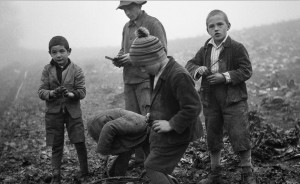
The hills were alive with the sounds of children working.  From the mid 19th century until very recently poor children were removed from Swiss homes and sent to farms to work.  Some children were sent to homes were they clearned house before and after school.

Historians estimate there were hundreds of thousands such children. For one year alone in the 1930s, records show 30,000 children were placed in foster families across Switzerland.

“It’s hard to know precisely how many contract children there were as records were kept locally, and sometimes not at all,” says Loretta Seglias. “Some children were also placed by private organisations, or their own families.”

The extent to which these children were treated as commodities is demonstrated by the fact that there are cases even in the early 20th Century where they were herded into a village square and sold at public auction.

Seglias shows me some photographs. One child looks barely two – surely she couldn’t be a contract child? “She could, she would be brushing floors bringing in the milk. Sometimes they came as babies on to the farms, and the bigger they grew the more work they would do,” Seglias says.

“Children didn’t know what was happening to them, why they were taken away, why they couldn’t go home, see their parents, why they were being abused and no-one believed them,” she says.

“The other thing is the lack of love. Being in a family where you are not part of the family, you are just there for working.” And it left a devastating mark for the rest of the children’s lives. Some have huge psychological problems, difficulties with getting involved with others and their own families. For others it was too much to bear. Some committed suicide after such a childhood.

Social workers did make visits. David Gogniat says his family had no telephone, so when a social worker called a house in the village to announce that she was coming, a white sheet was hung out of a window as a warning to the foster family. On the day of this annual visit David didn’t have to work, and was allowed to have lunch with the family at the table. “That was the only time I was treated as a member of the family… She sat at the table with us and when she asked a question I was too scared to say anything, because I knew if I did the foster family would beat me.”

Today we regard poor children as a social problem.  But the lingering idea that the poor alone are responsible for their plight plagues countries around the world to this day.

Child Labor


Internet Taxes?

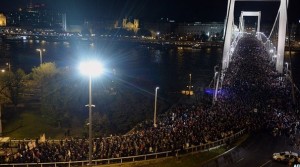
Huge crowds in Budapest marched to protest the imposition of an internet tax. The government has drafted a law which would levy a fee on each gigabyte of internet data transferred.  The EU has condemned it as a bad idea that could threaten political freedom.

Protests began in Hungary on Sunday, when demonstrators hurled old computer parts at the Budapest headquarters of Prime Minister Viktor Orban’s ruling Fidesz party.

Under the proposals, internet providers would be made to pay 150 forints (£0.40; €0.50; $0.60) per gigabyte of data traffic. The fee is one of a series of measures proposed by the government to bring down the budget deficit.  The ruling Fidesz party has tried to stem the anger by proposing a 700-forint cap on the tax for individuals and 5,000 forints for businesses.  But opponents believe the tax reflects the increasingly authoritarian style of Mr Orban.

For the first time, the ruling party’s opponents from across the whole political spectrum, from the left to the far right now have a common cause.  Despite divisions within Fidesz, Mr Orban commands broad popularity in Hungary and the party has won three elections this year.  The government criticised US charge d’affaires Andre Goodfriend after he was photographed among the protesters on Sunday.

Internet taxation is being debated around the world.

Protesting Internet Tax

Corruption in Afghanistan?

Siogahn O’Grady writes:   Billions of dollars have been wasted in Afghanistan since the U.S. launched ambitious plans to rebuild the country in 2002, and American watchdog John Sopko has spent the past two years documenting American-led reconstruction failures caused by mismanagement or outright corruption on the part of Afghan officials.

But a report from Sopko, the special inspector general for Afghanistan reconstruction, found that at least one incident of mismanagement — the failed attempt to renovate Pol-i-Charkhi prison, Afghanistan’s largest correctional facility — came at the hands of two State Department employees charged with overseeing the project. And in an unusual role reversal, it was an Afghan national who actually had to fill their shoes after both Americans were suspended from their posts for fraud and mismanagement.

Even though Al-Watan only completed 50 percent of the contracted work, the State Department still paid the company $18.5 million – over 90 percent of the initial agreement.  Though SIGAR recommended the State Department investigate whether the settlement was appropriate, State declined the possibility it was influenced by biased employees.

Al-Watan also managed to break their contract by botching necessary roof repairs. Construction workers used wood roof trusses instead of the metal ones agreed upon in the contract, then covered up the 30-year-old wood trusses with new material instead of replacing them entirely, as they were contracted to do. Sopko’s office was unable to track down any written permission for Al-Watan to replace the metal trusses with wooden ones. He also found that Al-Watan failed to properly connect six costly back-up power generators.

The watchdog laid much of the blame for Al-Watan’s failings at the feet of Kenneth Brophy, a State Department employee who oversaw the work that was completed at the prison. Sopko’s report said that Brophy’s lack of proper oversight meant the work was not always completed responsibly.”   Special Inspector General for Afghanistan Reconstruction

Pol-i-Charkhi prison,

Bears Milked for Bile in Asia

Robert Carmichael writes:  13,000 bears lived in small, cramped cages on ‘bear bile’ farms in China, Vietnam, laso and Myanmar.  They are milked for their bile, , a bitter, greenish-yelow digtive fuied produced by the gallbladder and used in tradiotional sian medicine.

The trafficking of wild-caught bears and bear parts receives less attention than the illicit trade in other exotic animals, such as elephants, rhinos, and tigers. Yet it is big business in Asia: A whole gallbladder can be worth as much as $2,000 in parts of the continent, while bear paws smuggled into China, where they are considered a delicacy, can be sold for more than 20 times what they cost to purchase in Russia. (Few estimates exist for the overall size of the bear trafficking industry in particular, but in 2012 the World Wildlife Fund placed the overall value of the global illicit trade in wildlife as high as $10 billion a year.) And unlike in the case of elephants and rhinos, which are protected by dedicated, sophisticated — and in some cases armed — task squads, bear trafficking takes place nearly unchecked across Asia, from Pakistan to Japan, from Russia to Indonesia, driven by corruption made worse by complacency and an international community that pays it little attention.    Bear Traffic

Bear Bile