Interest Rates Impacts Different Economies Differently

Daniel Gros writes: Within the eurozone, where until recently external accounts were nearly balanced, a similar creditor/debtor spectrum has emerged, with Germany and the Netherlands at one end, and much of the eurozone south at the other. This partly explains both the hostile stance toward QE adopted in the German financial press and the over-indebted periphery countries’ increasingly desperate calls for more action by the ECB.

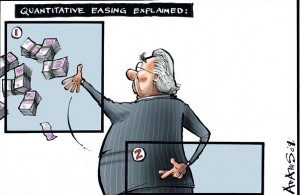
In the eurozone, however, QE is a questionable response to such calls. QE is a special instrument used when a central bank’s short- and medium-term policy rates are already at zero and it wants to lower long-term interest rates. This implies that QE can be effective only in economies in which changes in long-term (market) interest rates play an important role in the private sector.

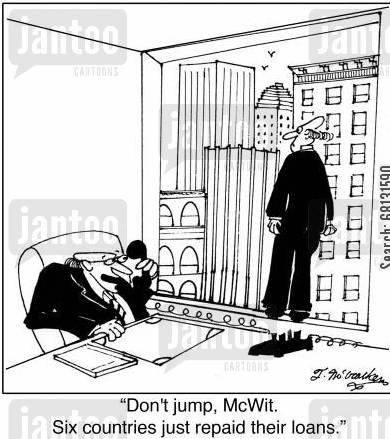
But this is not the case in Europe, where most investment is financed via bank loans that typically do not have long-term maturities – often less than five years – because banks themselves have little secure long-term financing. Moreover, the interests rates charged on these loans are not linked to market rates, but rather to the bank’s refinancing cost, which is already close to zero     Credit and Debt
Quantitative Easing

Big Impact of Tiny Qatar

Brahma Chelaney writes:  Qatar may be tiny, but it is having a major impact across the Arab world. By propping up violent jihadists in the Middle East, North Africa, and beyond, while supporting the United States in its fight against them, this gas-rich speck of a country – the world’s wealthiest in per capita terms – has transformed itself from a regional gadfly into an international rogue elephant.

Using its vast resources, and driven by unbridled ambition, Qatar has emerged as a hub for radical Islamist movements. The massive, chandeliered Grand Mosque in Doha – Qatar’s opulent capital – is a rallying point for militants heading to wage jihad in places as diverse as Yemen, Tunisia, and Syria. As a result, Qatar now rivals Saudi Arabia – another Wahhabi state with enormous resource wealth – in exporting Islamist extremism.    Qatar’s Impact

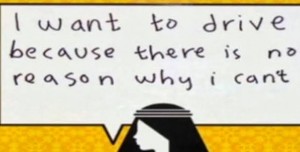
Women Drive in Qatar

Bankruptcy in Large USFinancial Institutions

The Jeffrey M. Lacker of the Federal Reserve of Richmond reports;  Here are the highlights of my speach at the National Conference of Bankruptcy Judges Annual Meeting at Chicago, Ill.

  • The bankruptcy process is an effective tool for reconciling the incentives of creditors and debtors. Yet the government has a long history of handling large complex financial institutions outside the Bankruptcy Code.
  • This has created two mutually reinforcing conditions: Investors feel protected by an implicit commitment of government support, and policymakers feel compelled to provide that support to avoid a disruptive adjustment of expectations.   Jeffrey Lacker’s Speech

Bankruptcy

Why Does the Fed Not Raise Interest Rates?

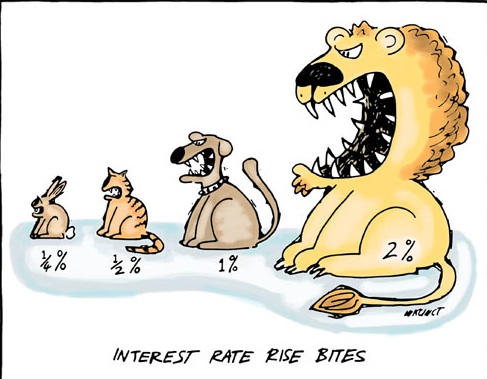
EconMaters writes:  We are not talking about raising the Fed Fund’s Rate to 4% we are just talking about raising rates more in line with basically a normal functioning economy growing at 2 plus percent on an annual basis with an unemployment rate in the fives. If the Federal Reserve cannot raise rates after 7 long years, this either says a lot about their lower rate and QE strategy in the first place, i.e., it hasn’t worked, or they need to quit making excuses and raise the freaking rate already. This has gone on long enough; I want the Federal Reserve out of financial market manipulation with absurdly idiotic interventionist policies. There is something seriously wrong if the Federal Reserve cannot raise the Fed Fund’s Rate a measly 100 basis points after 7 longs years of ZIRP! Seven years is an entire business and economic cycle, shoot the economy has been at ZIRP for so long it literally could cycle back to recession just because it has been so long, and business cycles have normal patterns of growth and contraction, we did study this in business school, this is economics 101!

Interest Rates?

Nobel Prize Gender Gap

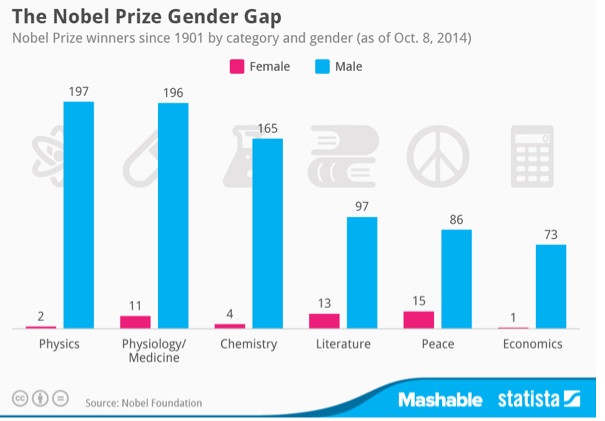
May-Britt Moser, who jointly won the Nobel Prize in Physiology or Medicine in 2014 was only the 46th female Nobel Laureate.

Since Marie Curie has been honoured twice, a total of 45 women have been awarded a Nobel Prize since 1901. The chart below shows a gender breakdown of all individual (non-institutional) Nobel Prize winners since the award’s inception.

Nobel Prize Gender Gap

Grace Hopper Panel Doesn’t Dent Sexism in High Tech

At the Grace Hopper conference, no one had much to say about the sexiam in high tech,

The panel consisted of Facebook CTO Mike Schroepfer; Google’s SVP of search Alan Eustace; Blake Irving, CEO of GoDaddy; and Tayloe Stansbury, CTO of Intuit. The assembled white men set out to tell the audience what their companies are doing to make women more welcome and how men and women (yes, that’s right—women, too) can change the boys’ club culture in tech.

Instead, they ended up reinforcing many of the stereotypes women are already all too familiar with. In essence, their advice to women was: Work harder, build great things, speak up for yourself, lean in. It got so bad that at one point, the audience started heckling the speakers.

Women in High Tech

Modi to Modernize?

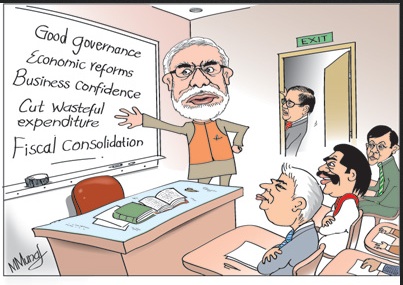
Dhiraj Nayyar:writes:   In India, Modi needs to clear away the sobwebs choking the legal and business sectors.  The real problem involves a raft of laws that lend themselves to exploitation, impeding business and government efficiency even today.

the government has now picked out 287 such measures, most of which are ludicrously outdated. One says that property in a certain part of Kolkata, one of India’s largest cities, can only be sold to the British East India Company. Another bans flying kites or balloons without police permission, because these constitute aircraft according to a 1934 law.

Such colonial-era rules may make for good comedy. But, of course, most of them are never enforced. The real problem involves a raft of laws that lend themselves to exploitation, impeding business and government efficiency even today.

Three prominent Indian think tanks — the Centre for Civil Society, National Institute of Public Finance and Policy and the Vidhi Legal Centre — recently released a report called the Repeal 100 Laws Project that identifies several such regulations. The Indian Boilers Act of 1923, for instance, requires that government inspectors certify the fitness of steam boilers in Indian factories. Originally meant as a health-and-safety measure, the law has essentially become an instrument of extortion by bribe-taking inspectors.

 Modi Reforms

Abe Needs to Encourage Innovation in Japan

Faiure to take risks, to inernalize and to value employees based on merit is crippling the Japanese economy according to co-winner of the Nobel prize in physics, Shuji Nakamura.

This has resulted in years of stagnation in sei-conductors, solar panels and smartphones.

As Diet sessions opn this month, Abe has a chance to sorrect this.  Abe has pledged to lay out the specifics of his structural reform drive, which relies heavily on corporate tax cuts and reducing red tape. But he’s been quiet on one reform that truly would encourage the risk-taking culture Japan needs so badly: making sure employees get paid for their inventions.

Abe Needs to Reform

Elon Musk Predicts Takeover by Supercomputers

At  conference in San Francisco, Musk predicted that supercomputers will replace humans.  Actually his description of the takever is more dramatic.  “I don’t think anyone realizes how quickly artificial intelligence is advancing.  Particularly if involved in recursive self-improvement…and its utility function is something that’s detrimental to humanity, then it will have a very bad effect,” Muks said.

Supercomputers could deltet human life as if it were annoying spam.

Supercomputer Takeover


UK Independence Party Candidate Wins First Seat

Once called ‘fruitcakes” by David Cameron, the UKIP wins its first eelction.Former Tory MP Douglas Carswell becomes the first UKIP candidate to be elected to the House of Commons.

The UK Independence Party has gained its first elected MP, with Douglas Carswell taking the seat of Clacton by 12,404 votes.  Mr Carswell, who defected from the Conservatives, knocked his old party – which enjoyed a 12,068 majority at the 2010 election – into second place.

UKIP leader Nigel Farage said he had “shaken up British politics”.

In the night’s other by-election, Labour held on to Heywood and Middleton but UKIP slashed its majority to 617.

Mr Farage told BBC Breakfast UKIP could hold the balance of power after next year’s general election.

He said UKIP’s second place in Heywood and Middleton was “even more significant” than its win in Clacton, saying the party was now the main opposition to Labour in northern cities.

“Something big is happening here. People want change, they have had enough of career politicians in three parties.”

Fruitcake No Longer